AKINCI and the Heavy-Class Strike Drone Programmes: How Much Does an Open Channel Speed Things Up?

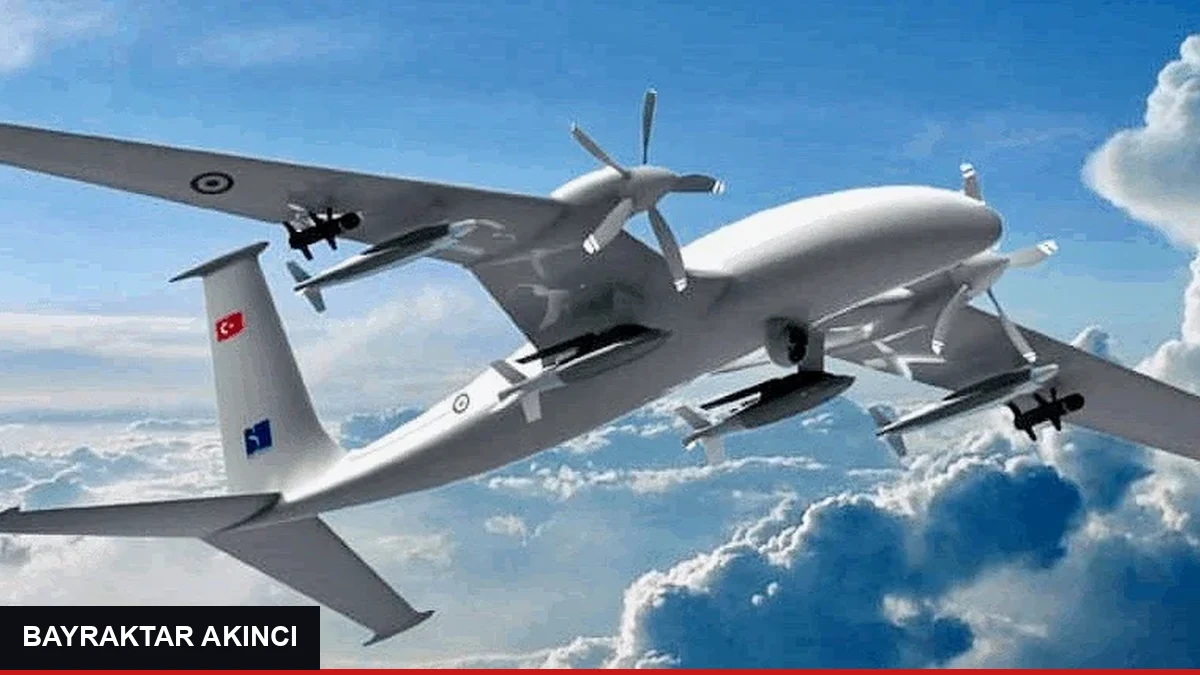
The Bayraktar TB2 took fifteen years to travel from programme start to first export. One class up, the AKINCI covered the same ground far faster: first flight in 2019, service entry in 2021, export agreements immediately after. This file separates two questions — how much does an open export channel accelerate things, and why does competition in the heavy class run by entirely different rules?
The sixth file in this series broke the transformation of a defence system into an export product into six thresholds: a home operator, weaponisation and operational use, a first export contract, an allied customer, supply-chain independence and production abroad. Here the same frame moves up a class. The class distinction set out in the first file applies unchanged.
The argument
An open channel does not remove the thresholds; it shortens them. The AKINCI passed all six again, but passed each faster, because the training infrastructure, logistic chain and customer network were already in place. Against that, the heavy class brings two new difficulties: the Missile Technology Control Regime’s Category I threshold becomes live here, and the competitors are far more mature than in the tactical class. The speed advantage and the competitive difficulty rise together.
What “heavy class” means in this file
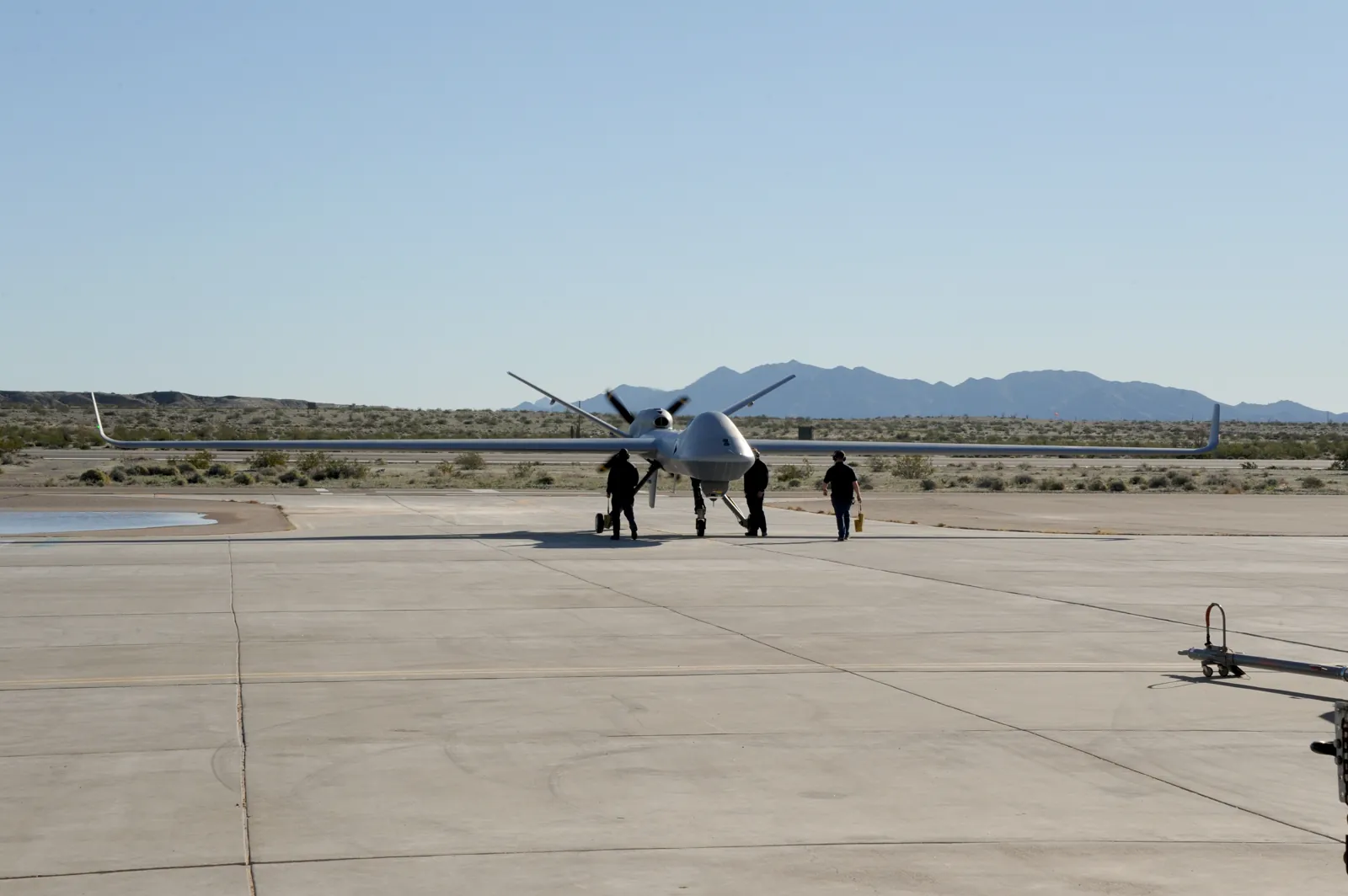
The class definition is not arbitrary; it rests on maximum take-off weight, payload and mission profile. The TB2 sits in the tactical class; the AKINCI, the MQ-9B family and platforms such as the Heron TP sit in the heavy class. ANKA and AKSUNGUR occupy the MALE band between the two and are not placed in this file’s tables.
The distinction has a practical consequence: the heavy class carries munitions and sensors the tactical class cannot — multi-mode AESA radar, signals-intelligence payloads, electronic-warfare support systems and cruise-missile-class weapons. Those capabilities bring export restrictions with them.
Excluded from this file
- Order quantities and contract values not published by the manufacturer or the buying state.
- Platforms of different classes compared in a single technical table.
- Operator lists circulating in the press with no official record.
- Loitering munitions, which are a separate category.
The AKINCI timeline
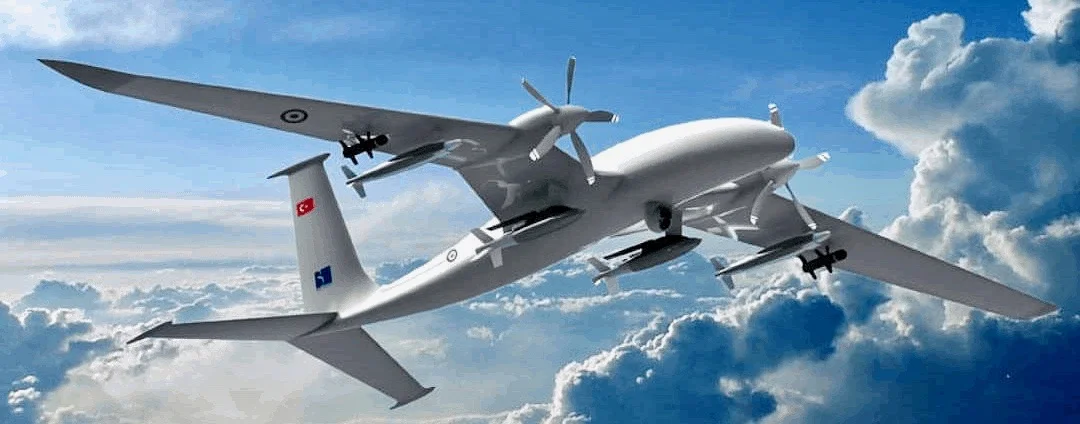
Dates are compiled from the manufacturer’s own announcements. The compression in the chart tells the file’s central finding on its own: the step from first flight to service and from service to export agreements took less than half the time equivalent steps took in the tactical class.
The same six thresholds, at a different speed
Applying the sixth file’s frame to the AKINCI shows that none of the thresholds was skipped but every one was shortened. That is how the channel effect works: a new platform inherits the training infrastructure, maintenance chain and customer relationships the previous product built.
| Threshold | TB2 | AKINCI | Difference |
|---|---|---|---|
| Programme start | 2003 | second half of the 2010s | — |
| First flight | — | 6 December 2019 | — |
| Home inventory | 2014 | 29 August 2021 | — |
| Weaponisation | 2015 | with service entry | TB2 a year later |
| Export agreements | 2018 | intensified from 2023 | — |
| Co-production | after 2024 | 2023 Saudi Arabia, 2025 Indonesia | AKINCI earlier |
The last row is the striking one. For the TB2, production abroad arrived six years after the first export; for the AKINCI, the first major export agreement itself carried a co-production dimension. The Saudi co-production arrangements are covered separately.
Heavy-class programmes that started in the same era
The series frame asks the real question: what happened to the other heavy-class programmes of the same period? The table shows the furthest stage each one has a public record of reaching. The columns compare programme stage, not capability.
| Programme | Country | First flight | Serial production / service | Export |
|---|---|---|---|---|
| Bayraktar AKINCI | Türkiye | 6 December 2019 | 29 August 2021 | 16 contracted countries (end 2025) |
| MQ-9B SkyGuardian | USA | late 2010s | in serial production | many operators |
| Heron TP | Israel | mid-2000s | in service | exported |
| Eurodrone | EU (4 states) | planned for 2027 | not reached | none |
| Orion | Russia | 2016 | delivered 2020 | none |
Two poles emerge. At one end, programmes that reached serial production and export; at the other, Eurodrone still waiting for a first flight and Orion delivered but never converted into an export. The AKINCI’s position is clear: two years from first flight to service, four more to widespread export agreements. That pace is not the norm in this class.
Part of the explanation is the channel effect, part the class itself. Heavy-class programmes usually run off a state’s long-term procurement plan; reconciling four countries’ requirements, as in Eurodrone’s case, can add years to a schedule on its own. A programme with a single manufacturer and a single principal customer has a short decision loop.
The technical band in the heavy class
The table below contains only figures published by the manufacturers themselves. Both platforms sit in the heavy class but make different design choices; this is a map of those choices, not a ranking. The AKINCI and MQ-9B SkyGuardian comparison goes into the detail separately.
| Metric | Bayraktar AKINCI | MQ-9B SkyGuardian |
|---|---|---|
| Wingspan | 20 m | 24 m |
| Length | 12.2 m | 11.6 m |
| Maximum take-off weight | 6,000 kg | 5,670 kg |
| Payload | 1,500 kg (total) | 363 kg internal + 1,814 kg external |
| Service ceiling | 40,000 ft | 40,000 ft |
| Endurance | 24+ hours | 40+ hours |
| Maximum speed | 240 KTAS | 210 KTAS |
| Range | 6,000 km (operational) | 6,000 nmi |
| Engine | 2× turboprop (450/750/850 hp) | 1× Honeywell TPE331-10 turboprop |
Two rows stand out. On payload, the AKINCI gives a higher total; but because the MQ-9B publishes internal and external figures separately, the two numbers are not directly comparable. On endurance, the MQ-9B is clearly ahead — the natural result of a single-engine design with a larger wingspan. It is the clearest illustration that there is no single answer to “better” in this class.
What a twin-engine choice means
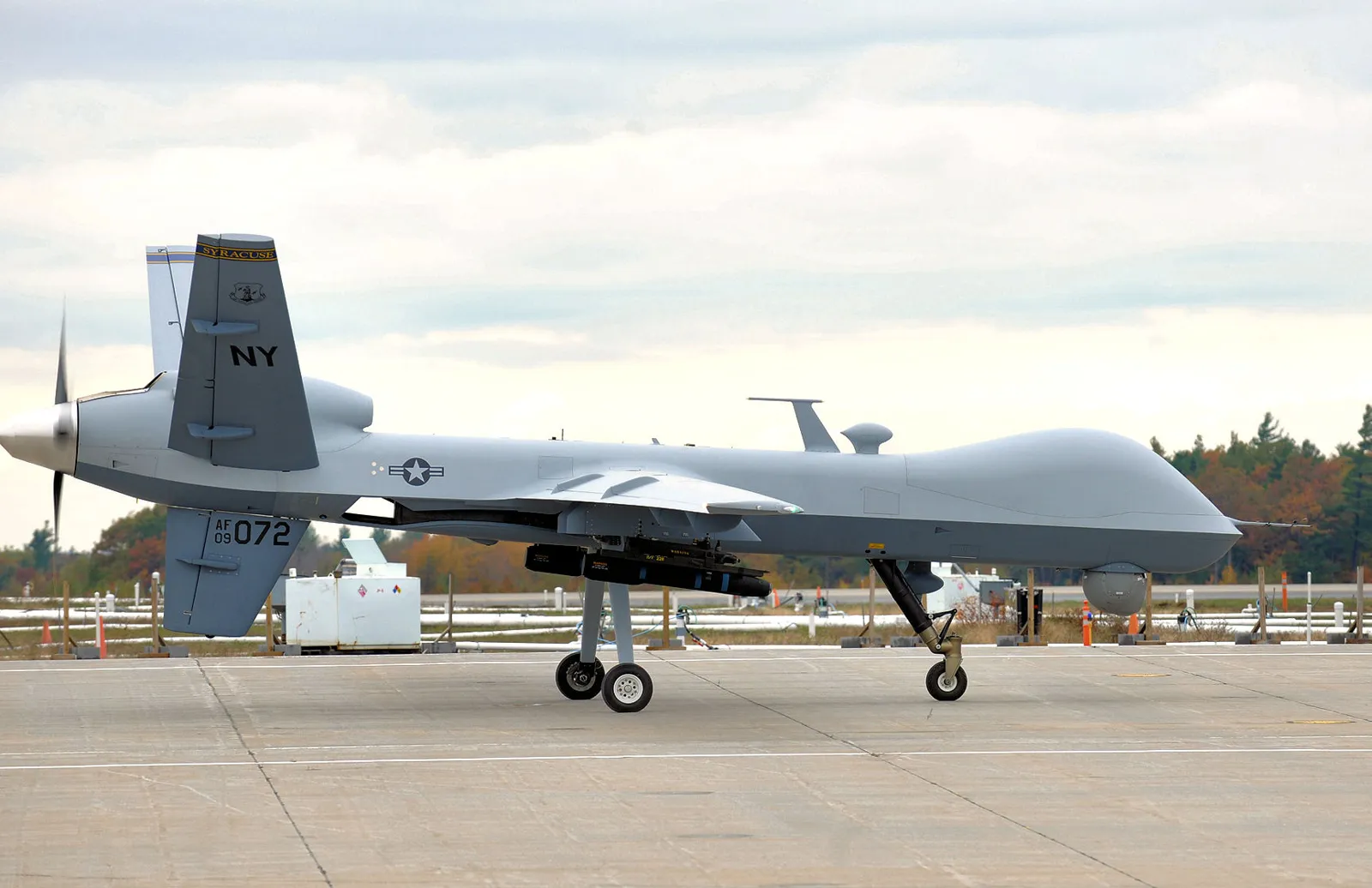
The most visible design decision separating the AKINCI from its commonest rival is engine count. The MQ-9B uses a single turboprop; the AKINCI is twin-turboprop, with published options of 2×450, 2×750 and 2×850 hp across its variants.
That choice has three consequences. First, carrying capacity: two engines allow a higher maximum take-off weight in the same airframe size — hence the 6,000 kg figure. Second, altitude: more total power makes working at high altitude easier when loaded. Third, fuel burn: two engines consume more than a single-engine design on the same mission profile, and that is largely the technical explanation for the endurance gap.
So the difference between “24+ hours” and “40+ hours” in the table is not a quality gap but the bill for a design choice. A buyer prioritising long-duration surveillance and one prioritising heavy munition carriage will pick different platforms.
What distinguishes the heavy class: munition breadth
A payload figure on its own says little; the real difference appears in what that load becomes. The manufacturer’s published integration list shows the AKINCI opening into a munition range the tactical class cannot reach.
| Category | Items |
|---|---|
| Miniature smart munition | MAM-L, MAM-T families |
| Guidance kit | TEBER-81/82, LGK-81/82, HGK-82, GÖKÇE, GÖZDE |
| Winged guidance kit | KGK-82-SİHA |
| Air-to-ground weapon | TOLUN series, LAÇIN-82 |
| Supersonic missile | İHA-230, İHA-122 |
| Cruise missile | ÇAKIR |
For export purposes this list cuts both ways. It turns the platform from a single-mission vehicle into a multi-mission system; at the same time, cruise-missile and supersonic-missile class items make transfer politically more sensitive.
The fifth threshold in the heavy class: sensor independence
The sixth file’s most decisive threshold was removing a critical component’s dependence on another state’s export licence. In the tactical class that meant, essentially, the electro-optical reconnaissance and targeting system. In the heavy class the threshold widens: the manufacturer’s published payload list includes a multi-mode AESA radar, signals intelligence and electronic-warfare support systems alongside a simultaneous EO/IR/laser designator set.
Each of those is a separate technology line. An industrial base able to build an electro-optical system at home cannot build a multi-mode airborne AESA radar with the same ease; the radar side demands different competence in materials, power management and signal processing. The real barrier to entry in the heavy class is not the airframe or the engine but this sensor line.
| Component line | Tactical class | Heavy class |
|---|---|---|
| Electro-optical / infrared | Base requirement | Simultaneous EO/IR/laser designator |
| Radar | Generally absent | Multi-mode AESA |
| Signals intelligence | Absent | Payload option |
| Electronic warfare | Absent | Support systems |
| Munition band | Miniature smart munitions | Guidance kits, supersonic and cruise missiles |
The table also shows why depth in the wider Turkish aerospace product base is not a single manufacturer’s problem. The heavy class requires not a platform but a supplier network: separate companies producing radar, electronic warfare, munitions and guidance kits, all at the same time.
The Category I threshold: why export works differently up here
One of the structural factors behind the TB2’s export volume, as the sixth file set out, was that the system falls below the MTCR’s Category I threshold. In the heavy class that advantage disappears. The regime treats unmanned systems able to deliver a 500 kg payload to 300 km as Category I and commits member states to a strong presumption of denial on transfer.
The presumption is not a ban; it makes export the exception. In practice every heavy-class export becomes a separate political assessment and the process runs longer than in the tactical class. That is why the AKINCI’s export list is shorter than the TB2’s for regulatory rather than technical reasons.
| Metric | Tactical class (TB2) | Heavy class (AKINCI) |
|---|---|---|
| MTCR position | Below the Category I threshold | May fall within Category I |
| Export process | Routine handling | Separate political assessment |
| Contracted countries (March 2025) | 34 | 11 |
| Contracted countries (end 2025) | 36 | 16 |
| Typical sale form | Direct procurement package | Co-production dimension dominant |
The two operator lists overlap substantially, so the total is not the arithmetic sum: the manufacturer gives 37 different countries for both platforms together.
The heavy class’s sale form: co-production
The Category I constraint also changes the shape of an export. Sales in this class increasingly run through co-production: the buying state wants not just the platform but a share of the manufacturing. That raises political acceptability and delivers industrial participation for the buyer.
On 18 July 2023 Baykar and Saudi Arabia’s Ministry of Defence signed a cooperation agreement covering the AKINCI’s entry into Saudi air force and naval service; the manufacturer described it as Türkiye’s largest single aviation export. On 12 February 2025 a co-production agreement was signed with Indonesia. Quantities and values for either were not itemised officially, so no figures appear in this file.
Why no numbers?
Different quantities and values for these two agreements circulate in the press. Figures that cannot be verified line by line in official sources are not written into tables in this series. The existence and the date of an agreement are verifiable; its scope is not yet. Keeping the two apart is the basic condition of this file’s reliability.

Who buys the heavy class?
The buyer profile is not the same as in the tactical class. The tactical band can be absorbed by air forces with limited budgets; the heavy class asks a far heavier commitment in infrastructure, training and munition supply. The result is fewer but better-funded buyers.
| Metric | Tactical class | Heavy class |
|---|---|---|
| Typical buyer | Mid and low-budget air forces | High-budget buyers |
| Infrastructure demand | Short runway, limited support | Long runway, broad support structure |
| Decision time | Relatively short | Long; political assessment included |
| Industrial participation demand | Limited | Often a condition of contract |
| Fleet size | High numbers | Low numbers |
The Sahel comparison and the African TB2 operator picture show the tactical pattern; Poland’s TB2 decision and the Saudi and Indonesian arrangements show how differently the heavy class behaves. The same manufacturer is selling to two distinct customer profiles across two classes.
Scale: 100,000 flight hours and the operational record
Baykar announced on 11 March 2025 that the AKINCI fleet had passed 100,000 flight hours. The same statement put contracted countries at 34 for the TB2 and 11 for the AKINCI. The hours figure is cumulative across all operators and is the most concrete plank of the export case in this class.
Two dates stand out in the operational record. On 21 June 2022 an altitude of 45,118 feet was announced — a test figure, not to be confused with the routine 30,000 ft operational altitude. On 19 May 2024 the AKINCI took part in the search and rescue effort for the Iranian presidential helicopter. The second is a directly observed international example of an armed platform used on a non-military task, and the combat-record question is a separate matter again.
EM-PDI assessment
The Envanter Medya Programme Development Index (EM-PDI) is used across the series to score programmes against common criteria. It is an editorial assessment, not an official ranking; the weightings are set out in the first file. The AKINCI’s score is high on thresholds cleared quickly, and lower than the tactical class on user diversity.
The limits of this comparison
This file examines programme calendars and export mechanics; it is not a capability ranking. The limits need stating plainly:
- Endurance. The MQ-9B SkyGuardian offers 40+ hours by its manufacturer’s figures, clearly above the AKINCI’s published 24+ hours.
- Operational depth. The MQ-9 family has been in the field since the early 2000s and holds the deepest accumulated record in the class.
- Maritime band. Derivatives such as the MQ-9B SeaGuardian represent a separate sub-family developed for maritime surveillance.
- Agreement scope. Quantities and values for the Saudi and Indonesian agreements could not be verified officially and are therefore absent here.
Conclusion: the channel accelerates, the regime slows
The AKINCI case shows two mechanisms working at once. The first is the channel effect: because the training, maintenance and customer infrastructure built by the previous product is inherited, the thresholds shorten. The second is the regime effect: because Category I assessment applies in the heavy class, every export becomes a separate political decision and the list stays narrower than in the tactical class.
Their resultant explains the heavy class’s characteristic sale form: fewer, deeper agreements carrying a co-production dimension — a pattern licensed production abroad illustrates in another segment again.
Next in the series
File 8 — KIZILELMA and the unmanned combat aircraft projects. One class up again, with KIZILELMA the first threshold returns to the front: entry into the home force’s inventory. Most unmanned combat aircraft projects of the same era stopped at the demonstrator stage — why did KIZILELMA take a different road? The full series sits on the Türkiye and World Defence Programmes page.
Frequently asked questions
When did the Bayraktar AKINCI first fly?
The maiden flight took place on 6 December 2019. The system entered Turkish Armed Forces service on 29 August 2021, one year and nine months later.
What are the AKINCI’s specifications?
By the manufacturer’s published figures: 20 m wingspan, 12.2 m length, 4.1 m height, 6,000 kg maximum take-off weight, 1,500 kg payload, 40,000 ft service ceiling, 30,000 ft operational altitude, 24+ hours endurance and 6,000 km operational range. Engine options across the A, B and C variants are twin turboprops of 2×450, 2×750 or 2×850 hp.
How many flight hours has the AKINCI logged?
Baykar announced on 11 March 2025 that the AKINCI fleet had passed 100,000 flight hours. The same statement put contracted countries at 34 for the TB2 and 11 for the AKINCI; the AKINCI figure rose to 16 by the end of 2025.
What is the AKINCI’s altitude record?
An altitude of 45,118 feet was announced on 21 June 2022. That is a test figure above the system’s 40,000 ft service ceiling and should not be confused with its routine 30,000 ft operational altitude.
What does the Saudi Arabia agreement cover?
On 18 July 2023 Baykar and Saudi Arabia’s Ministry of Defence signed a cooperation agreement covering the entry of the AKINCI into Saudi air force and naval service. The manufacturer described it as Türkiye’s largest single aviation export. Quantities and values were not itemised officially, so no figures are given in this file.
What is the main difference between the AKINCI and the MQ-9B?
Both sit in the heavy class but make different design choices. The AKINCI offers 1,500 kg of payload and 24+ hours of endurance; the MQ-9B SkyGuardian, by its manufacturer’s figures, offers 40+ hours of endurance with 363 kg internal and 1,814 kg external payload. The AKINCI leads on total load and twin-engine configuration, the MQ-9B on endurance.
Which munitions has the AKINCI been tested with?
The manufacturer’s published list includes the MAM-L and MAM-T families, the TOLUN series, TEBER-81/82, LAÇIN-82, LGK-81/82, HGK-82, the GÖKÇE and GÖZDE guidance kits, KGK-82-SİHA, the İHA-230 and İHA-122 supersonic missiles and the ÇAKIR cruise missile. That breadth is what distinguishes the heavy class: munitions the tactical class cannot carry.