Turkish vs Chinese Drones in the Sahel: A 2026 Comparison


Turkish vs Chinese Drones in the Sahel: A 2026 Comparison
Both Turkish and Chinese drone makers now sell to West Africa and the Sahel, and several militaries operate both at once. Burkina Faso and Mali fly Turkish Bayraktar TB2 and AKINCI, while Nigeria operates Chinese CH-3, CH-4 Rainbow and Wing Loong II alongside its own TB2 fleet. Neither industry has displaced the other — governments are buying whichever system arrives fastest, costs least to sustain, and comes with the fewest political conditions.
Contents
- What is a MALE drone, and why the Sahel wants them
- Turkish platforms in the Sahel: TB2 and AKINCI
- Chinese platforms in West Africa: CH-4 and Wing Loong II
- Side-by-side comparison
- The political backdrop: juntas and diversified suppliers
- Why governments buy one, the other, or both
- The Mali case: drones near a Wagner base
- FAQ
- Sources
What is a MALE drone, and why the Sahel wants them
MALE stands for medium-altitude, long-endurance — a class of unmanned aircraft that can loiter for 15–27 hours at altitudes around 5,000–8,000 metres, carrying electro-optical/infrared sensors and, on armed variants, a small number of precision-guided munitions. For Sahelian militaries fighting dispersed insurgent groups across vast, thinly policed terrain, a MALE drone offers persistent overwatch that manned aircraft and helicopters cannot sustain at comparable cost. That single capability gap — not brand loyalty — is what has pulled both Turkish and Chinese suppliers into the region over the past decade.
Turkish platforms in the Sahel: TB2 and AKINCI
Baykar’s Bayraktar TB2 is a light tactical MALE (medium-altitude, long-endurance) aircraft built primarily for reconnaissance with a secondary strike role using ROKETSAN’s MAM-L and MAM-C smart micro-munitions. The larger Bayraktar AKINCI carries a heavier payload, longer endurance and more strike-focused mission profile, and is increasingly bought as a follow-on purchase by states that already operate the TB2.
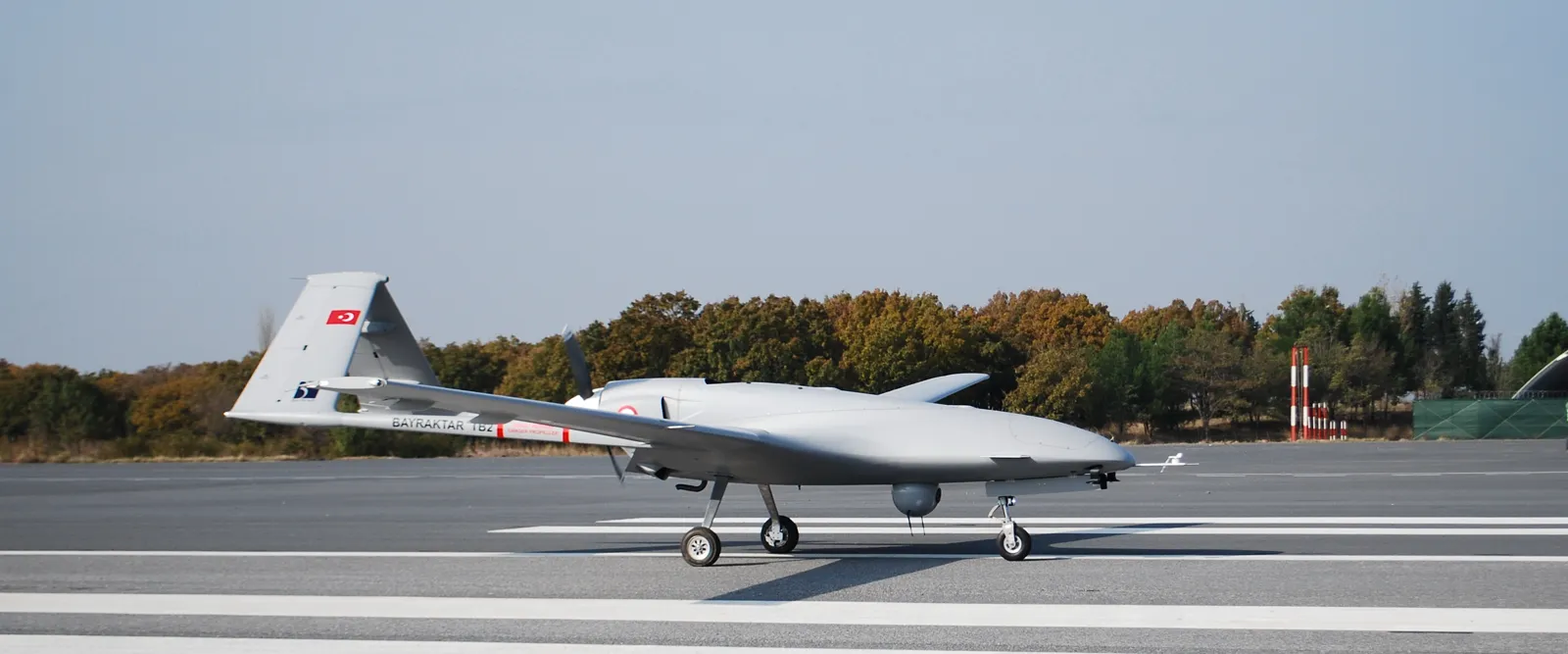
Confirmed operators in the Sahel and neighbouring West Africa include:
- Burkina Faso — took delivery of five TB2s, officially presented into service on 23 March 2023, followed by two AKINCI systems commissioned at Sapone air base in April 2024.
- Mali — one of the largest African TB2 fleets, with shipments in January and March 2023 and a further batch arriving on 4 January 2024; Mali became the fourth African AKINCI operator in December 2024, after Burkina Faso, Ethiopia and Libya.
- Nigeria — confirmed TB2 operator since 2021, used alongside its Chinese-made drone fleet (see below).
- Ethiopia — confirmed AKINCI operator, one of the earliest in Africa, and a country that also ranks among the region’s larger forces in Envanter Medya’s strongest army in Africa ranking.
Reports of interest from Niger and Chad have circulated in regional media, but neither government has published a confirmed acquisition, so they are not listed here as operators. A full country-by-country breakdown of confirmed AKINCI operators across the continent is available in our Bayraktar AKINCI in Africa report, and the wider global delivery picture is covered in our AKINCI deliveries explainer.
Chinese platforms in West Africa: CH-4 and Wing Loong II
China’s exports to the region center on two families: the CASC-built CH-3/CH-4 Rainbow series and the AVIC-built Wing Loong (CAIG “Chengdu Yi Long”) series. Both are tactical-to-medium MALE aircraft that carry Chinese-made AR-1 or Blue Arrow air-to-ground missiles and guided bombs.
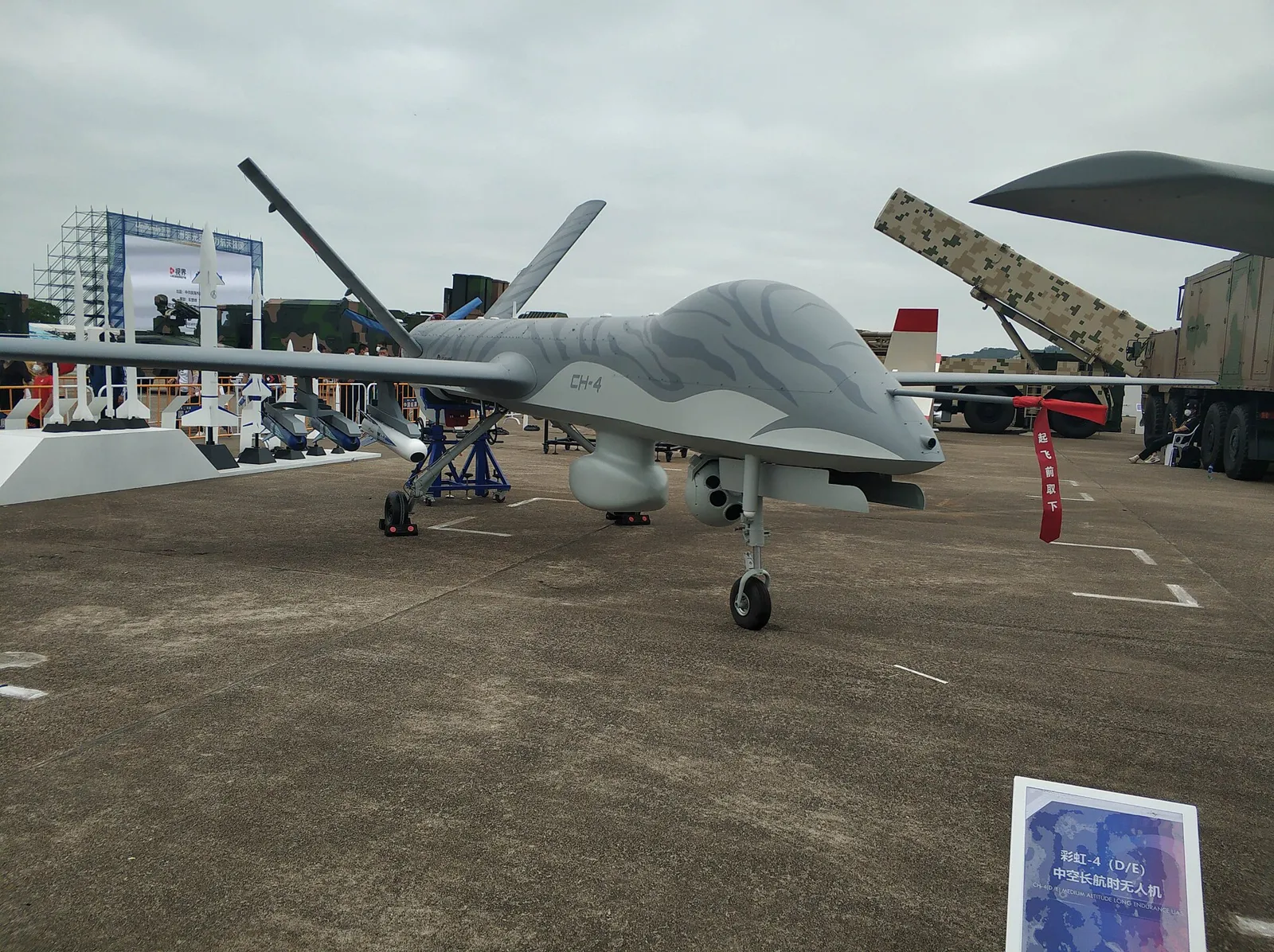
Nigeria is the clearest confirmed user in the region. The Nigerian Air Force acquired five CH-3 Rainbow drones from China before 2014, armed with AR-1 missiles, and used them in strikes against Boko Haram and ISWAP; one CH-3 was reported to have crashed in northern Nigeria in January 2015. A further order reported in 2020 added two Wing Loong II, four CH-4B and two additional CH-3A airframes to the fleet, expanding Nigeria’s own intelligence, surveillance and strike coverage. Nigeria’s broader defense-industrial relationship with Turkey — including ASELSAN’s Nigeria and South Africa expansion — runs in parallel with, rather than in place of, its Chinese drone procurement; the two supplier relationships have not been mutually exclusive.
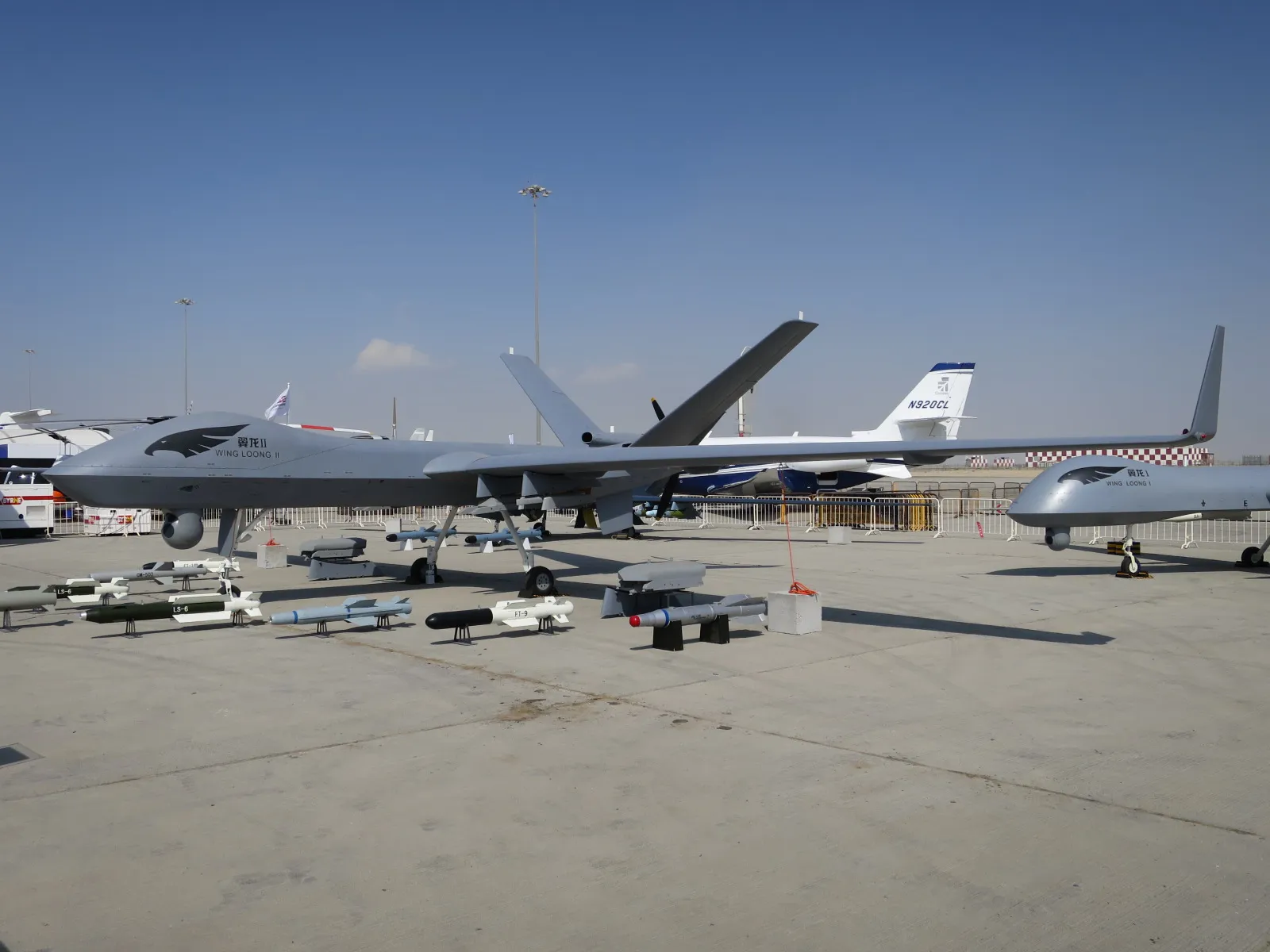
Chinese manufacturers have marketed CH-4 and Wing Loong systems more broadly across Africa and the Middle East, but for the Sahel specifically, Nigeria remains the confirmed, publicly documented case; other reported regional interest has not been confirmed by an operating government.
Side-by-side comparison
| Category | Turkey (TB2 / AKINCI) | China (CH-4 Rainbow / Wing Loong II) |
|---|---|---|
| Main role | ISR with light-to-medium strike (TB2); heavier strike-focused ISR (AKINCI) | ISR with medium strike, similar tactical MALE class |
| Production | Baykar (privately held, Istanbul) | CASC and AVIC (Chinese state-owned aerospace conglomerates) |
| Confirmed Sahel/West Africa users | Burkina Faso, Mali, Nigeria (TB2); Burkina Faso, Mali, Ethiopia (AKINCI) | Nigeria (CH-3, CH-4B, Wing Loong II) |
| Munitions used | ROKETSAN MAM-L, MAM-C | AR-1 missile, Blue Arrow-series guided munitions |
| Technology transfer | Not publicly disclosed for Sahel contracts | Not publicly disclosed for Nigerian contracts |
| Unit price | Not officially published; open-source estimates place a TB2 system in the low single-digit millions of dollars, exact contract values undisclosed | Not officially published; open-source estimates generally place CH-4 unit costs below comparable Western systems, exact contract values undisclosed |
| Delivery pattern | Phased batch deliveries with training support; Mali and Burkina Faso followed initial TB2 orders with AKINCI purchases | Phased batch deliveries; Nigeria’s fleet grew through at least two separate orders (2014, 2020) |
The political backdrop: juntas and diversified suppliers
Burkina Faso’s and Mali’s drone purchases did not happen in isolation. Both countries have been governed by military-led transitional authorities since coups in 2022 and 2020–2021 respectively, and both moved to end long-standing defense cooperation with France over 2022–2023, expelling French troops and reorienting toward alternative partners. Turkey, Russia and China all expanded their footprints in that gap, but through different channels: Turkish arms sales have run through Baykar’s direct government-to-government contracts; Russian involvement has centered on Wagner Group (later Africa Corps) personnel embedded with national armed forces; and Chinese sales in the wider region have typically followed CASC’s and AVIC’s standard state-to-state export process, as seen earlier and more extensively in Nigeria. The three tracks overlap geographically but are not the same relationship, and conflating them risks misreading who actually operates a given system.
Why governments buy one, the other, or both
Sahelian and West African governments cite similar priorities regardless of supplier: fast delivery timelines, fewer end-use restrictions than typical Western export terms, and a combat record against insurgent and asymmetric threats. Turkish systems have built a reputation from documented use in Libya, Nagorno-Karabakh, Ukraine and the Sahel itself, with a large in-region munitions ecosystem (MAM-L/MAM-C) that keeps sustainment costs predictable, and Baykar has typically paired deliveries with operator and maintainer training rather than a bare airframe handover. Chinese systems have built their share on price competitiveness and a longer export track record in Africa dating to the mid-2010s, with Nigeria as an early and repeat customer across three separate order batches.
Neither industry has a documented performance advantage in Sahel operations specifically — public reporting from the region rarely discloses strike outcomes or loss rates for either platform family, and claims of “which drone wins” beyond confirmed acquisition and deployment data are not verifiable from open sources. What is verifiable is that both supplier relationships have grown in parallel rather than at each other’s expense: none of the four confirmed Turkish-drone operators covered here dropped an existing Chinese system to acquire a Turkish one, or vice versa.
The Mali case: drones near a Wagner base
Open-source reporting has documented Bayraktar TB2 airframes present at the Sévaré military airport near Mopti, which also hosts Wagner Group personnel operating alongside Mali’s armed forces (FAMa). Malian officials present the drones as a national military-modernisation program under FAMa command, and researchers tracking the base note that Wagner personnel are unlikely to operate the TB2s directly — Malian forces are understood to fly and maintain them. Baykar has not been reported as a party to any agreement involving Wagner, and Turkish government statements on the deliveries describe them as bilateral defense-industrial cooperation with Mali’s state.
FAQ
Which African countries operate both Turkish and Chinese drones?
Nigeria is the clearest confirmed case, flying Bayraktar TB2 alongside its Chinese CH-3, CH-4B and Wing Loong II fleet.
Is the Bayraktar AKINCI used in the Sahel?
Yes. Burkina Faso and Mali are both confirmed AKINCI operators, alongside Ethiopia and Libya elsewhere in Africa.
Do Wagner forces operate Turkish drones in Mali?
No confirmed reporting shows Wagner personnel operating Malian TB2s directly. The drones are documented near a base Wagner also uses, but they are presented as being under Malian armed forces command.
Are exact prices for TB2 or CH-4 publicly known?
No. Neither Baykar nor the Chinese manufacturers publish official contract values; figures cited in media are open-source estimates, not confirmed sale prices.
Why did Burkina Faso and Mali stop buying French or Western equipment?
Both governments ended defense cooperation agreements with France in 2022–2023 following coups, and have since diversified procurement across Turkish, Russian and other suppliers rather than relying on a single partner.
Does Nigeria’s Chinese drone fleet compete with its Turkish purchases?
No confirmed reporting shows Nigeria treating the two as substitutes. Nigeria has continued to operate CH-3/CH-4/Wing Loong II alongside its TB2s and its wider Turkish defense-industrial cooperation, including with ASELSAN.
Last updated: 28 August 2026.
Related reading
- Nigerian Army Recruitment & Salary 2026
- Bayraktar TB2 Deliveries Explained
- Bayraktar AKINCI Deliveries Explained
Sources
- DefenceWeb — Burkina Faso commissions Bayraktar TB2 UAVs
- Overt Defense — Burkina Faso puts Bayraktar AKINCI into service
- Military Africa — Mali acquired AKINCI drone after Bayraktar TB2
- The North Africa Post — Mali takes delivery of new batch of TB2 drones
- Militarnyi — Bayraktar TB2 drones deployed at the Wagner PMC base in Mali
- DefenceWeb — Nigerian Air Force getting Wing Loong, CH-3 and CH-4 UAVs
- Military Africa — Nigerian military drones (UAV): a complete list