

Lentatek’s Karayel-SU and the Licence Route: Turkey’s Quieter Drone Export Model

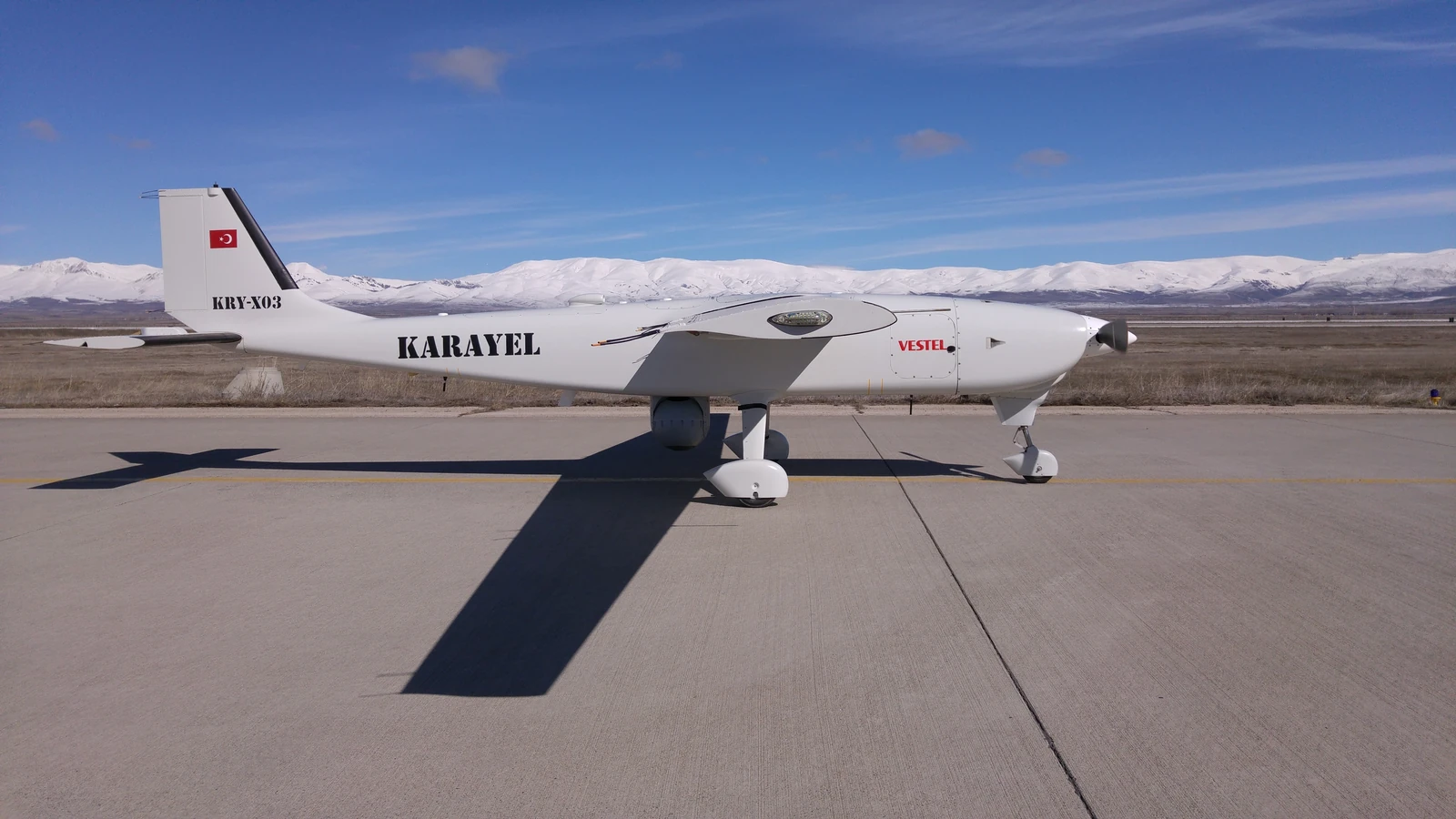
Most Western coverage of Turkish uncrewed aircraft stops at two names. The company behind a third — Lentatek, the Istanbul-based firm known until February 2022 as Vestel Savunma — has taken a different commercial route, and it is one that NATO and European capability planners have more reason to study than the headline platforms.
Lentatek does not primarily sell aircraft. It sells the ability to build them.
From Vestel Savunma to Lentatek
The company was established in 2003 inside the Vestel group of companies, part of Zorlu Holding, and rebranded as Lentatek on 14 February 2022. The name change was corporate rather than industrial: the product line, the Karayel family of tactical unmanned aerial vehicles, carried over intact. Buyers and open-source databases still encounter both names, and the Saudi programme described below was signed under the older one.
The core product is the Karayel-SU, an armed development of the baseline Karayel medium-altitude tactical UAV. In its armed configuration the aircraft carries four weapon stations rated at 30 kg each, for a total of 120 kg of ordnance. Lentatek presents the type as compliant with NATO’s STANAG 4671 airworthiness standard for uncrewed aircraft — a claim worth flagging as a manufacturer statement rather than an independently published certification record, but a commercially significant one, because STANAG 4671 is the language European air navigation authorities speak.
The Saudi line: an export that is not an export
The most consequential Karayel decision was taken in 2021. As Defense News reported on 22 March 2021, two Saudi firms — Intra Defense Technologies and the Advanced Electronics Company (AEC) — began producing the Karayel-SU under licence from what was then Vestel Savunma. AEC took the electronics workshare; the Turkish partner supplied key components. In Saudi service the aircraft is reflagged as Haboob. The reported programme covered a batch of 40 airframes across 2021–2025.
The distinction matters. A government-to-government sale of 40 airframes is a transaction. A licence that stands up a foreign assembly line, transfers an electronics workshare and leaves the original manufacturer as the component supplier is an industrial relationship with a multi-decade tail.
The follow-on effect became visible at the World Defense Show near Riyadh. On 9 February 2026, according to Army Recognition’s exhibition coverage, Intra Defense Technologies displayed the Karayel-SU alongside Shalfa, a Saudi-developed lightweight precision-guided weapon integrated onto the aircraft. That is the point at which a licence programme stops being an assembly arrangement and starts generating indigenous content on the buyer’s side — exactly the outcome Vision 2030 localisation targets are written to produce.
Turkish industry has separately continued to extend the type at home. Turkish trade press has reported loitering-munition integration work on the Karayel-SU, broadening the aircraft’s role beyond the ISR-plus-guided-munition envelope it was originally fielded in.
Why NATO planners should care
Three observations follow for allied capability staffs.
- The tactical tier is where the volume is. Karayel-SU sits below the MALE aircraft that dominate coverage. Air forces that cannot fund a MALE fleet — and that describes a great many NATO partner and Mediterranean-basin air arms — are buying in this class, and Turkish industry is competitive in it on price and delivery schedule.
- Licence production is a strategic instrument, not a sales tactic. Turkey has used co-production to convert a single sale into a durable supplier relationship, in a market where the United States and several European capitals have historically been more restrictive with transfer terms.
- Standards alignment is the entry ticket. A STANAG 4671 posture, whatever its certification status in a given country, signals that the manufacturer is building toward European and allied airspace integration rather than treating airworthiness as an afterthought.
Beyond aviation
Lentatek has also been positioning outside the airframe business. According to reporting on the company’s post-rebrand strategy, it is moving into space technologies, digital health and critical-facility security, and has committed roughly 30 million dollars to a hydrogen fuel cell line — solid-oxide cells intended for armoured vehicle power. Envanter Medya has not been able to verify the investment figure against a filed company statement; it is reported here as attributed rather than confirmed.
The wider export picture gives that diversification some context. Turkish defence and aerospace exports reached 553.4 million dollars in February 2026, bringing the January–February 2026 total to 1.107 billion dollars, according to SavunmaSanayiST’s monthly bulletin.
What is not established
Publicly verified data on Lentatek’s headcount, annual revenue and current Karayel production rate could not be located in open sources at the time of writing. Nor is there a published, independently confirmed record of STANAG 4671 certification by a named airworthiness authority. Readers should treat both as open questions.
Frequently asked questions
Is Lentatek the same company as Vestel Savunma?
Yes. Vestel Savunma, founded in 2003 within the Vestel group under Zorlu Holding, was renamed Lentatek on 14 February 2022. There was no change of ownership or product line associated with the rebrand.
What is the Haboob UAV?
Haboob is the Saudi designation for the Karayel-SU produced under licence in Saudi Arabia by Intra Defense Technologies and the Advanced Electronics Company. It is the same basic aircraft under a local name.
How much ordnance can the Karayel-SU carry?
Four weapon stations rated at 30 kg each, for 120 kg total, in the armed configuration described by the manufacturer.
Sources: Defense News (22 March 2021); Army Recognition, World Defense Show 2026 coverage (9 February 2026); SavunmaSanayiST export bulletin (February 2026); SAHA Istanbul and OSTIM Defence Cluster company records; Envanter Medya company file.