Altınay Venüs-4: 3-Axis Stabilised EO/IR Gimbal for UAVs, Explained

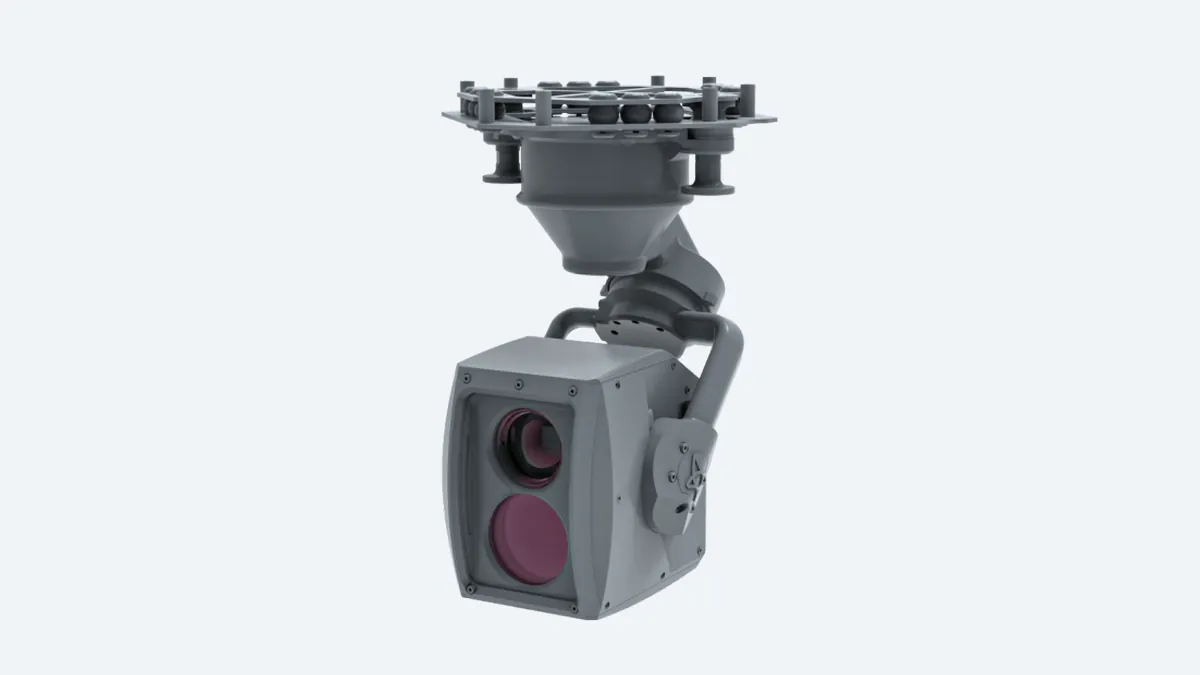
Everything a small reconnaissance drone sees passes through one rotating box under its belly: the gimbal. Altınay Savunma, the Istanbul-based motion-control company listed on Borsa Istanbul as ALTNY, builds one for mini and medium-class unmanned aircraft and calls it Venüs-4. On the official product page the company lists a 3-axis stabilised head weighing 1,350 g with a 30x day camera, a long-wave infrared (LWIR) thermal camera and a 250 microradian angular positioning error. This explainer turns those lines into plain numbers, shows where the system fits and flags what the company has not disclosed.
What a gimbal does and why Venüs-4 exists
A gimbal is a set of motorised rings that lets a camera point anywhere while the aircraft carrying it pitches, rolls and vibrates. Without one, a drone’s video shakes with every gust. Venüs-4 is Altınay’s answer for mini and medium-class unmanned aircraft: a compact head that carries a day camera and a thermal camera and holds the picture steady while the airframe moves.
It is one of five products on Altınay’s official product list, next to the telescopic mast systems, the X Motion servo drives, the weapon pedestal and the Kuşkapanı helicopter-handling system. The common thread is precise, stabilised motion, which the company has built since 2014.
Three axes: why the third one matters
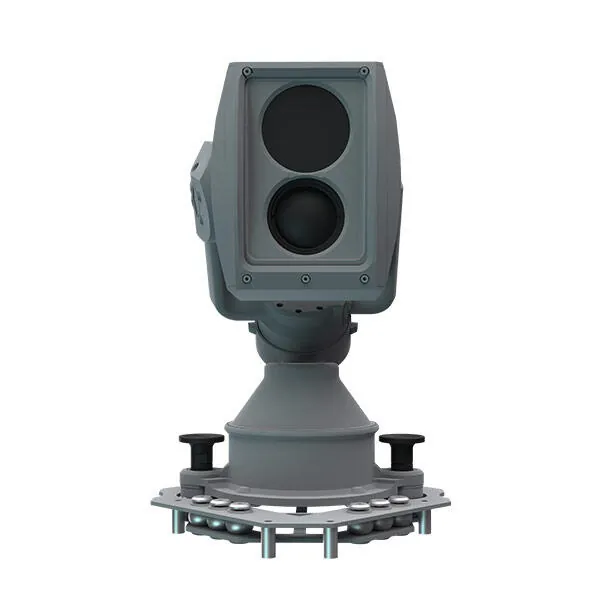
A two-axis gimbal turns left-right and up-down. The third axis, roll, compensates for the aircraft banking, so the horizon stays level even when the drone leans into a turn. Altınay’s description gives Venüs-4 a 360° continuous yaw range and a pitch range from +30° to −90°, the latter meaning the camera can look straight down. That matches an observation payload: mostly downward-looking, with the ability to sweep the full horizon.
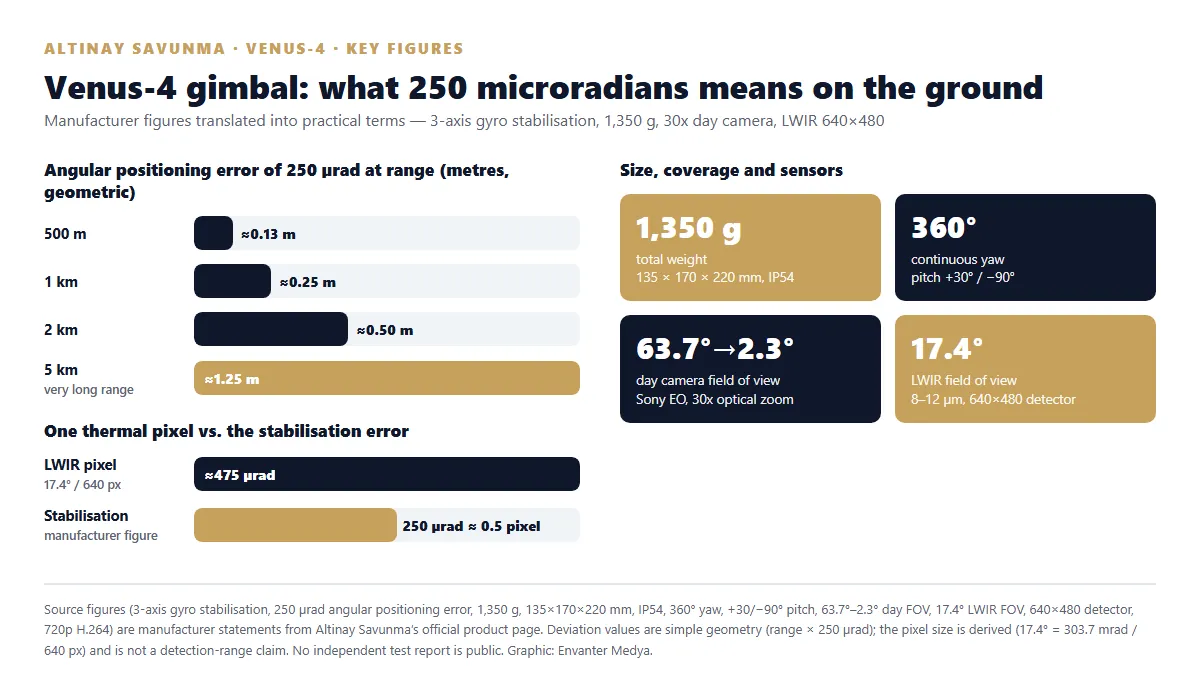
The headline figure is the 250 microradian angular positioning error. Simple geometry converts it to about 0.13 m at 500 m, 0.25 m at 1 km, 0.5 m at 2 km and 1.25 m at 5 km. A second comparison is more telling: the LWIR camera’s 17.4° field of view spread over 640 pixels gives roughly 475 microradians per pixel, so the stated error is about half a thermal pixel. The graphic below sets this out. These are arithmetic results from manufacturer data, not test measurements.
Technical specifications
All values are statements from Altınay Savunma’s official product page. No independent test report has been published.
| Parameter | Value |
|---|---|
| Mission | Reconnaissance and surveillance, day and night |
| Stabilisation | 3-axis precision gyro, 250 µrad angular positioning error |
| Dimensions | 135 × 170 × 220 mm |
| Weight | 1,350 g |
| Sealing | IP54 |
| Yaw (azimuth) | 360° continuous |
| Pitch (elevation) | +30° to −90° |
| Day camera | Sony EO, 30x optical zoom, horizontal field of view 63.7° to 2.3° |
| Thermal camera | LWIR 8–12 µm, horizontal field of view 17.4°, 640×480 detector |
| Video output | 720p, H.264 |
| Tracking modes | Coordinate tracking, inertial tracking |
Day camera, thermal camera and what they cover
The day channel is a Sony electro-optical camera with 30x optical zoom. Its horizontal field of view runs from 63.7° wide to 2.3° narrow, a ratio of about 28:1, consistent with the nominal 30x. The wide end suits area search; the narrow end suits identifying a vehicle or structure from a distance.
The thermal channel uses the LWIR band of 8–12 µm with a 640×480 detector and a fixed 17.4° horizontal field of view. Thermal imaging sees heat rather than light, so it works at night and through smoke and light haze. Output is 720p H.264 video, and two tracking modes are listed: coordinate tracking, which follows a given map point, and inertial tracking, which holds the camera on a direction using the gyros.
How it compares with similar payloads
The table is qualitative and is not a performance ranking. It shows which class of problem each payload addresses; the rival category is described generally rather than by named product.
| Payload | Platform | Sensors | Weight class | Typical role |
|---|---|---|---|---|
| Altınay Venüs-4 | Mini / medium UAV | Day + LWIR, 3-axis | 1.35 kg (stated) | Reconnaissance and surveillance |
| Sensor block in Altınay’s weapon pedestal | Medium / heavy UAV | Day + LWIR + 1 km laser rangefinder | Part of a <13 kg module | Sighting for a stabilised rifle |
| Large-UAV multi-sensor turret (category) | Large UAV / MALE class | Multi-sensor, often with laser designator | Several times heavier | Long-range surveillance and targeting |
Where it flies
Altınay defines the target as mini and medium-class UAV systems and says the flexible design allows easy integration into different platforms. It has not named a drone. Its subsidiary DASAL builds multirotors in that range (see our DASAL and TAAC profile), but neither company has stated that Venüs-4 is fitted to them, so this explainer does not link the two. No customer, contract or export has been announced for the gimbal either.
For Turkey the relevance is supply independence. Gimbals combine precision mechanics, drive electronics, stabilisation software and optics, and sensor heads of this class are commonly subject to export approvals. A domestic design reduces that dependence. An overview of the company’s wider programme involvement is in our projects file.
| Altınay Venüs-4 — Fact Box | |
|---|---|
| Product | Venüs-4 (Venüs 4-101) 3-axis stabilised electro-optical gimbal |
| Manufacturer | Altınay Savunma Teknolojileri A.Ş. (Borsa Istanbul: ALTNY) |
| Platform class | Mini and medium-class UAV systems |
| Key figures | 1,350 g, 250 µrad, IP54, 360° yaw, +30/−90° pitch |
| Sensors | Sony EO 30x day camera, LWIR 8–12 µm 640×480 thermal camera |
| Tracking | Coordinate and inertial |
| Disclosed users / platform | Not announced |
Frequently Asked Questions
What is Venüs-4?
A 3-axis stabilised electro-optical gimbal developed by Turkish company Altınay Savunma for mini and medium-class UAVs. It carries a day camera and an LWIR thermal camera for day-and-night reconnaissance and surveillance.
How accurate is the stabilisation?
The manufacturer states a 250 microradian angular positioning error, which is about 0.25 m at 1 km by simple geometry and roughly half a pixel of the thermal camera.
How heavy is it?
1,350 g, measuring 135 × 170 × 220 mm, with IP54 sealing.
What can the cameras do?
The Sony day camera zooms 30x optically (63.7° to 2.3° field of view). The LWIR camera works in the 8–12 µm band with a 640×480 detector and a 17.4° field of view. Video leaves the unit at 720p H.264.
Does it have target tracking?
Yes, two modes are listed: coordinate tracking and inertial tracking.
Can it look straight down?
Yes. Pitch runs from +30° to −90°, and yaw rotates a continuous 360°.
Which drones use it?
Altınay has not named a platform. DASAL, its subsidiary, builds drones in the right class, but an official integration has not been announced.
Is it in service or exported?
No user, contract or export has been publicly announced for Venüs-4.
Sources
- Altınay Savunma official product page — Venüs-4 (altinaysavunma.com/tr/urunler/venus-4)
- Altınay Savunma — Electro-Optical Imaging Systems category (altinaysavunma.com)
- Envanter Medya Altınay archive