Where Turkey Ranks Among the World’s Leading Defense Producers

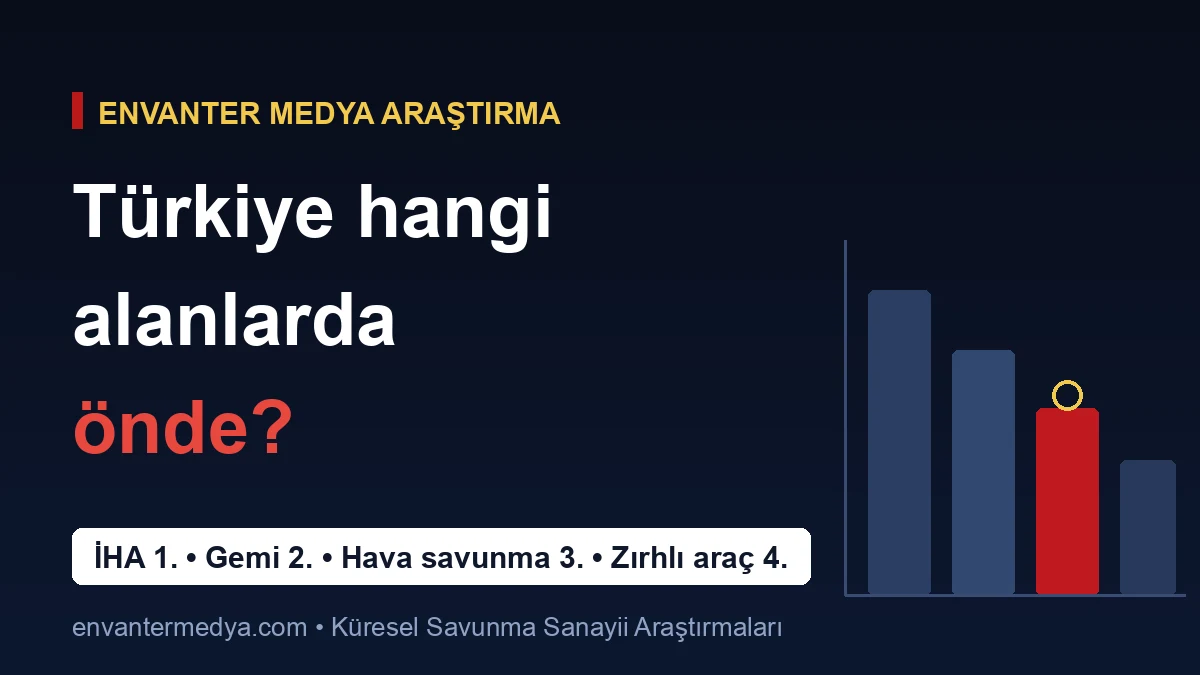
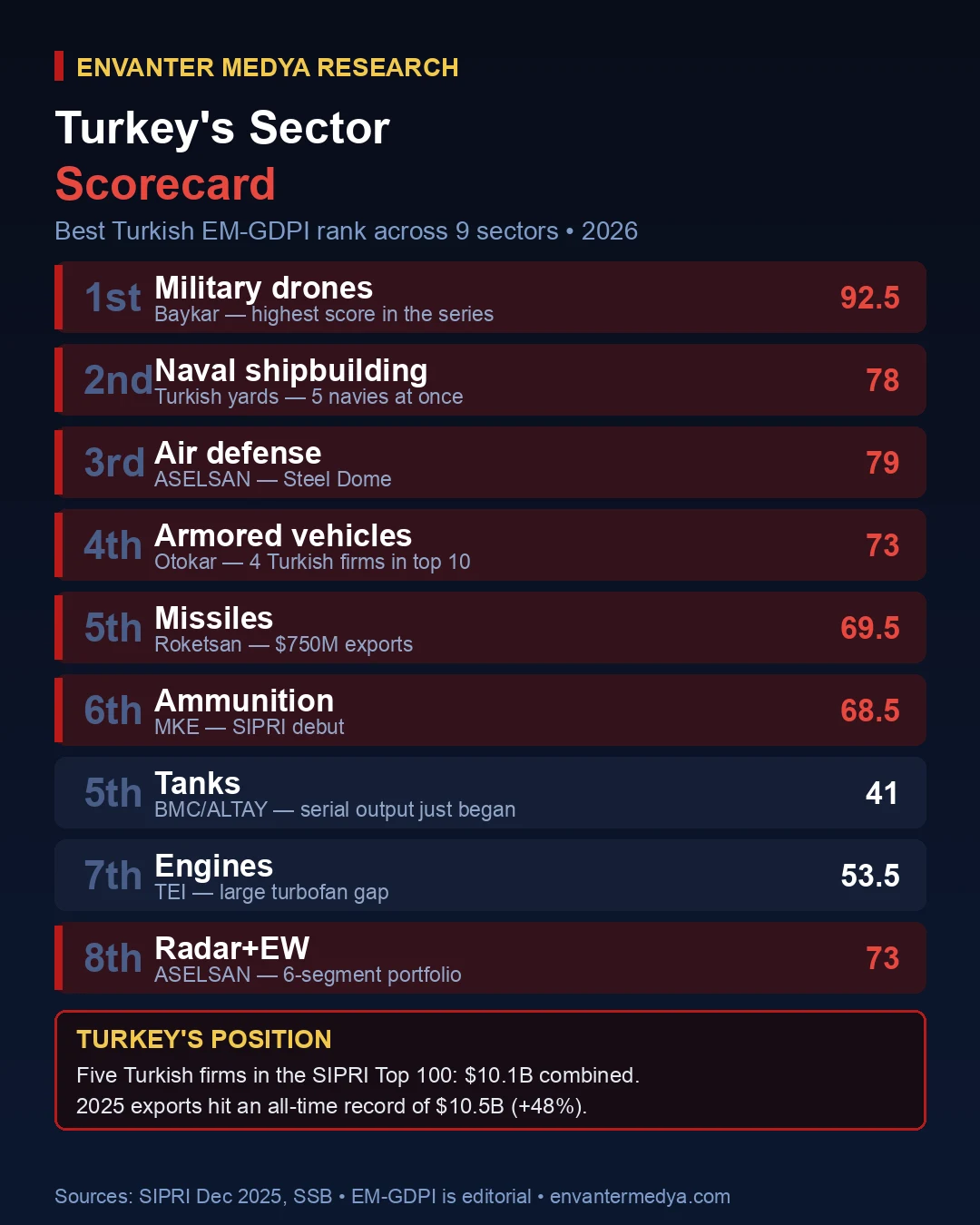
Ask where Turkey genuinely ranks among the world’s defense producers and you get nine different answers — one per sector. Having spent this research series scoring the global giants and Turkish firms side by side across nine industries, we can now give the composite picture. Turkey sits among the world’s leading producers in four fields: military drones, where Baykar posted the highest composite score measured anywhere in the series; naval shipbuilding, where Turkey’s multi-yard ecosystem ranks second while building for five foreign navies at once; air defense, where ASELSAN placed third; and armored vehicles, where four of the global top ten are Turkish. In missiles and ammunition Turkey plays in the upper league; in main battle tank output and large propulsion, the data says the story is still being written. This synthesis draws on all nine sector studies of our Global Defense Industry Research series.
Editorial note: This is an editorial study prepared by Envanter Medya using publicly available data; it is not an official ranking. Sector scores come from the EM-GDPI composite index whose methodology is published in each sector study.
The study at a glance
Nine sectors, one scoreboard
Each sector’s full index and raw data are published in its own study; values in parentheses are EM-GDPI points out of 100. Grey bars mark sectors where the rank looks high but the score trails the leaders substantially (tanks: 5th at 41 points; engines: 7th at 53.5). The index is editorial.
Strength 1: Military drones — the series’ only Turkish first place
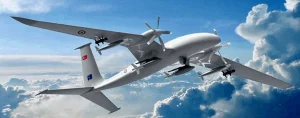
Across nine sector indices, exactly one category has a Turkish company on top. In the military drone study, Baykar scored 92.5 against General Atomics’ 80.5 and IAI’s 72. No single number explains it; the profile does. A company ranked just 73rd on SIPRI’s revenue table ($1.90 billion in 2024) outscores every category leader on delivered platforms, breadth of export geography, munitions integration and production tempo. TUSAŞ adds a second Turkish presence at seventh with the ANKA and AKSUNGUR families. In this category Turkey is not merely a producer — it sets the reference point others are measured against.
Strength 2: Naval shipbuilding — five navies at once
The most striking finding of the naval study: Turkey’s shipyard ecosystem ranks second at 78 points, just behind Fincantieri (84) and ahead of HD Hyundai (76) and TKMS (74). The reason is concrete. As of August 2026, Turkish yards are simultaneously building for five foreign navies — four Ada-class corvettes for Pakistan, two corvettes for Ukraine, three for Malaysia, two logistics ships for Portugal, plus the Romania program. This is not one company but a multi-yard ecosystem — STM, ASFAT, Dearsan, Sefine and others — able to run many programs in parallel, a flexibility few countries can match.
Strength 3: Air defense — the Steel Dome effect
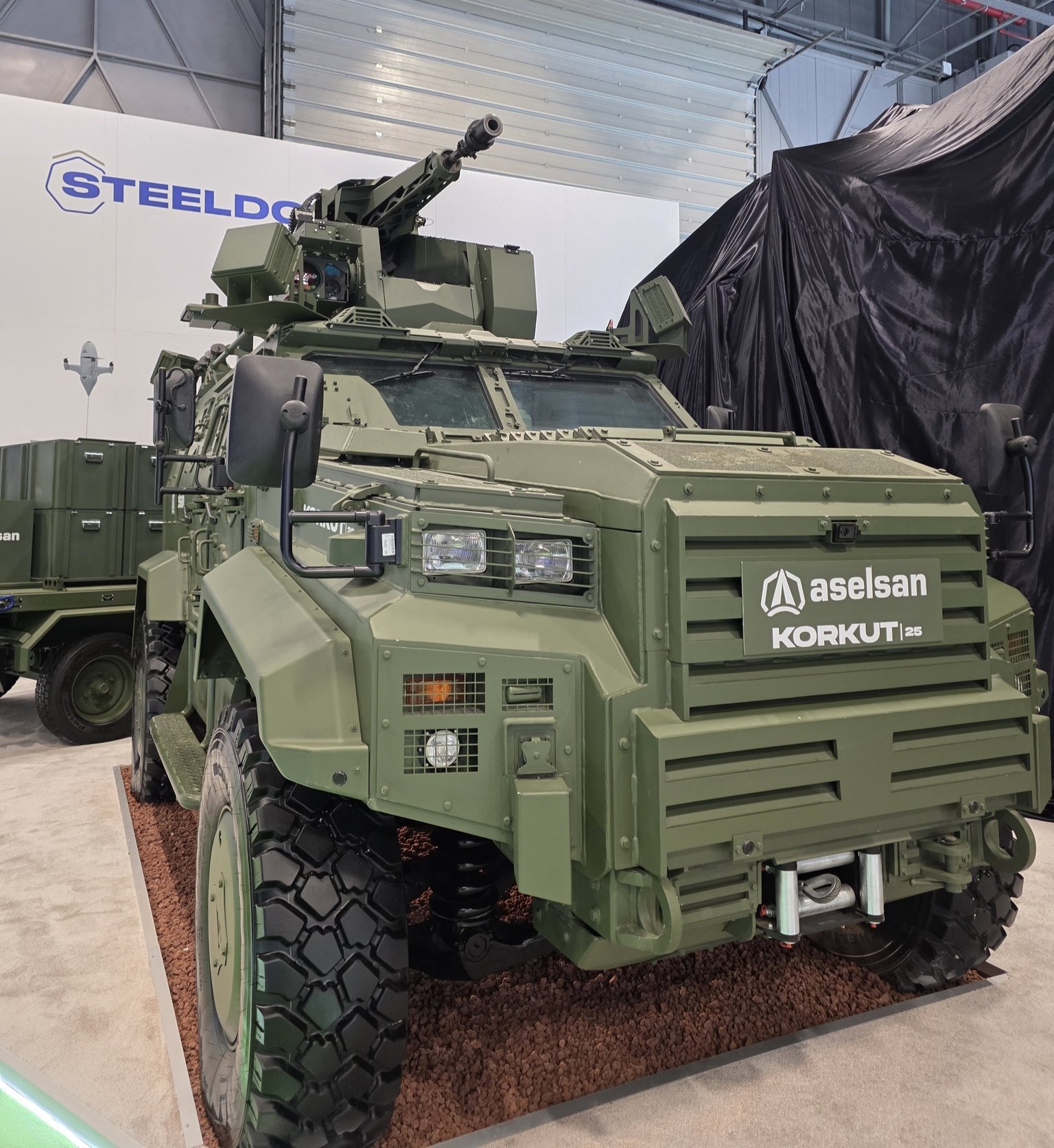
In the air defense study, ASELSAN placed third at 79 points, behind RTX (91) and Lockheed Martin (84) but ahead of Diehl, Kongsberg, MBDA and Rafael. The driver is a full-layer portfolio — from the gun-based KORKUT to the SİPER long-range system — unified under the ÇELİK KUBBE (Steel Dome) architecture, and a 47-system bulk delivery in 2026. With Roketsan’s HİSAR family and SUNGUR alongside, Turkey has joined the short list of countries able to produce every air defense layer domestically.
Strength 4: Armored vehicles — four of the top ten
In the armored vehicle index, Otokar is 4th, Nurol Makina 7th, FNSS 9th and BMC 10th — no other country places four makers in the top ten. Turkish firms hold the top two spots on the user-country criterion (Nurol 20 countries, Otokar 13), and Romania’s 1,059-vehicle COBRA II award is one of Europe’s largest current land programs. The five structural reasons behind this strength are examined in a dedicated study.

Competitive fields: Missiles and ammunition
In the missile study, Roketsan ranks fifth at 69.5 points — exports above $750 million in 2024, more than 500 ATMACA missiles on order, and a portfolio stretching from the CİRİT rocket to the TAYFUN ballistic missile put it ahead of Kongsberg and IAI. In ammunition, MKE entered the SIPRI Top 100 for the first time and ranks sixth, while Repkon has become one of the rare firms that exports the factory itself, setting up 155 mm production lines in the United States, Germany, Pakistan and Iraq. Turkey plays in the upper league in both fields; the scale gap with volume giants like Lockheed Martin, RTX and Rheinmetall remains.
Beyond revenue: the five Turks on SIPRI’s table
Source: SIPRI Top 100 (December 2025), constant 2024 dollars — a combined $10.1 billion, roughly 1.5% of the global total. ASELSAN grew 24% in real terms. Revenue alone understates production power: unit prices in the drone, armored vehicle and ammunition segments where Turkish firms concentrate are far below Western flagship platforms.
The export line is moving faster still. According to Turkey’s Defence Industry Agency (SSB), defense and aerospace exports rose from $7.1 billion in 2024 to $10.5 billion in 2025 including services — roughly 48 percent growth and an all-time record — while new contracts signed in 2025 reached $17.8 billion, pre-loading the delivery pipeline for years ahead.
Source: official statements by SSB President Haluk Görgün (January 2026, Anadolu Agency). The 2025 figure comprises $9.87B in goods and $184M in services.
Where Turkey lags — and what the data says about closing the gap
| Field | Current position (verified) | Programs aimed at the gap |
|---|---|---|
| Main battle tank serial output | ALTAY ranks 5th at 41 points; first serial deliveries only recently began, cumulative output far below KNDS/Hyundai Rotem | BMC’s Ankara plant ramping to 96 tanks/year; BATU engine in integration |
| Large propulsion | TEI 7th at 53.5 in the engine index; Turkey does not yet build GE/P&W-class large turbofans | TEI’s TF-6000/TF-10000 line and the TF-35000 targeted for the KAAN fighter |
| Tracked IFV exports | No serial export contract yet on the CV90/Lynx/Redback scale | FNSS KAPLAN family; the Indonesian KAPLAN MT line is the first case |
| Radar/EW revenue scale | ASELSAN strong on portfolio breadth (8th at 73) but far from RTX/Thales revenue scale | Export growth (+24%) and proliferation of AESA families |
The common denominator is scale and accumulated output: against rivals with decades of serial production, most Turkish programs are in their first production cycles. The trend line, however, is unambiguous — Turkish firms are growing faster than the sector average on SIPRI’s own measure.
How this study was prepared
Data base: This file synthesizes data verified across the nine sector studies of the Envanter Medya Global Defense Industry Research series; each sector’s raw tables, sources and EM-GDPI scoring are published in the respective study. Revenue: SIPRI Top 100 (December 2025, 2024 data). Exports: official SSB statements (January 2026). Limit: EM-GDPI is an editorial index; scores are relative within each sector’s peer group, so cross-sector comparisons (Baykar’s 92.5 vs ASELSAN’s 79) are not an absolute power ranking.
Frequently asked questions
In which defense fields does Turkey lead globally?
The data most strongly supports four: military drones (Baykar tops the index), naval export shipbuilding (the yard ecosystem ranks second), air defense (ASELSAN third) and armored vehicles (four Turkish firms in the top ten).
Where does Turkey rank in the global defense industry?
There is no single official ranking; it depends on the metric. Five Turkish firms in the SIPRI Top 100 generated a combined $10.1 billion (about 1.5% of the global total), and 2025 exports hit a record $10.5 billion. Sector-by-sector positions are in Chart 1.
Is Baykar the world’s largest drone maker?
By Envanter Medya’s nine-criterion index, it ranks first; by defense revenue alone it sits 73rd on SIPRI’s table, in the same league as General Atomics. Details in the drone study.
Where does ASELSAN rank globally?
47th on SIPRI’s 2024 revenue table; 3rd in our air defense index and 8th in radar-EW.
Which navies are Turkish shipyards building for?
As of August 2026, simultaneously for Pakistan (four Ada-class corvettes), Ukraine (two corvettes), Malaysia (three), Portugal (two logistics ships) and Romania.
Is Roketsan among the world’s major missile makers?
Yes — fifth in the EM-GDPI missile index at 69.5 points, ahead of Kongsberg and IAI, with 2024 exports above $750 million.
Why does Turkey trail in tanks?
ALTAY’s serial deliveries have only just begun; cumulative output and proven exports remain far behind GDLS, KNDS and Hyundai Rotem’s decades of production. BMC’s plant is ramping to 96 tanks a year; the 41-point, fifth-place score reflects a transition, not a verdict.
Can Turkey build fighter engines?
TEI has reached serial production with the TS1400 turboshaft and TJ family, but Turkey does not yet produce large turbofans in the GE F110 / P&W F135 class. The TF-6000/TF-10000 line and the TF-35000 targeted for KAAN aim at that gap.
How big are Turkey’s defense exports?
$10.5 billion in 2025 including services per SSB — up about 48% from $7.1 billion in 2024, an all-time record, with $17.8 billion in new contracts signed.
Which Turkish firms are in the SIPRI Top 100?
ASELSAN (47th), TUSAŞ (65th), Baykar (73rd), Roketsan (87th) and MKE (93rd) — five companies, $10.1 billion combined.
What is this assessment based on?
On production, export, user-country and revenue data verified across nine sector studies; all raw tables are published in the respective files, starting with the drone study.
Will these rankings change?
Likely — this is a living study updated in annual report seasons; the fastest-moving lines are Turkish export growth, ALTAY’s production ramp and TEI’s turbofan programs.
Sources and methodology notes
This is an editorial study prepared by Envanter Medya by cross-checking publicly available official company data, institutional reports, contract and delivery records, and industry sources. Principal sources:
- SIPRI Top 100 Fact Sheet (December 2025) — 2024 revenues, ranks, growth
- SSB / Anadolu Agency (January 2026) — 2025 export and contract figures
- The nine sector studies of the Envanter Medya Global Defense Industry Research series: drones, armored vehicles, tanks, ammunition, missiles, air defense, radar-EW, naval shipbuilding, engines
Last updated: August 16, 2026. This is a living study and will be updated in annual report seasons.