Why Turkey Became One of the World’s Armored Vehicle Powerhouses

When Romania picked the winner of one of Europe’s largest current land vehicle tenders in December 2024 — 1,059 vehicles, roughly 972 million dollars — the contract did not go to a German, American or French prime. It went to Otokar, one of five Turkish armored vehicle makers competing for export orders at the same time. That plurality is the headline fact of this story: no other country fields five simultaneously exporting armored vehicle manufacturers. Otokar, Nurol Makina, FNSS, BMC and Katmerciler have put Turkish vehicles into service on four continents, from Estonian frost to Omani heat and Malaysian monsoon. This follow-up to our ranking of the world’s largest armored vehicle manufacturers asks a single question: where does that strength come from? We found five answers in the data.
Editorial note: This is an editorial study prepared by Envanter Medya using publicly available data; it is not an official ranking. Sources and method are explained in the “How this study was prepared” section at the end.
The study at a glance
Five manufacturers, one ecosystem
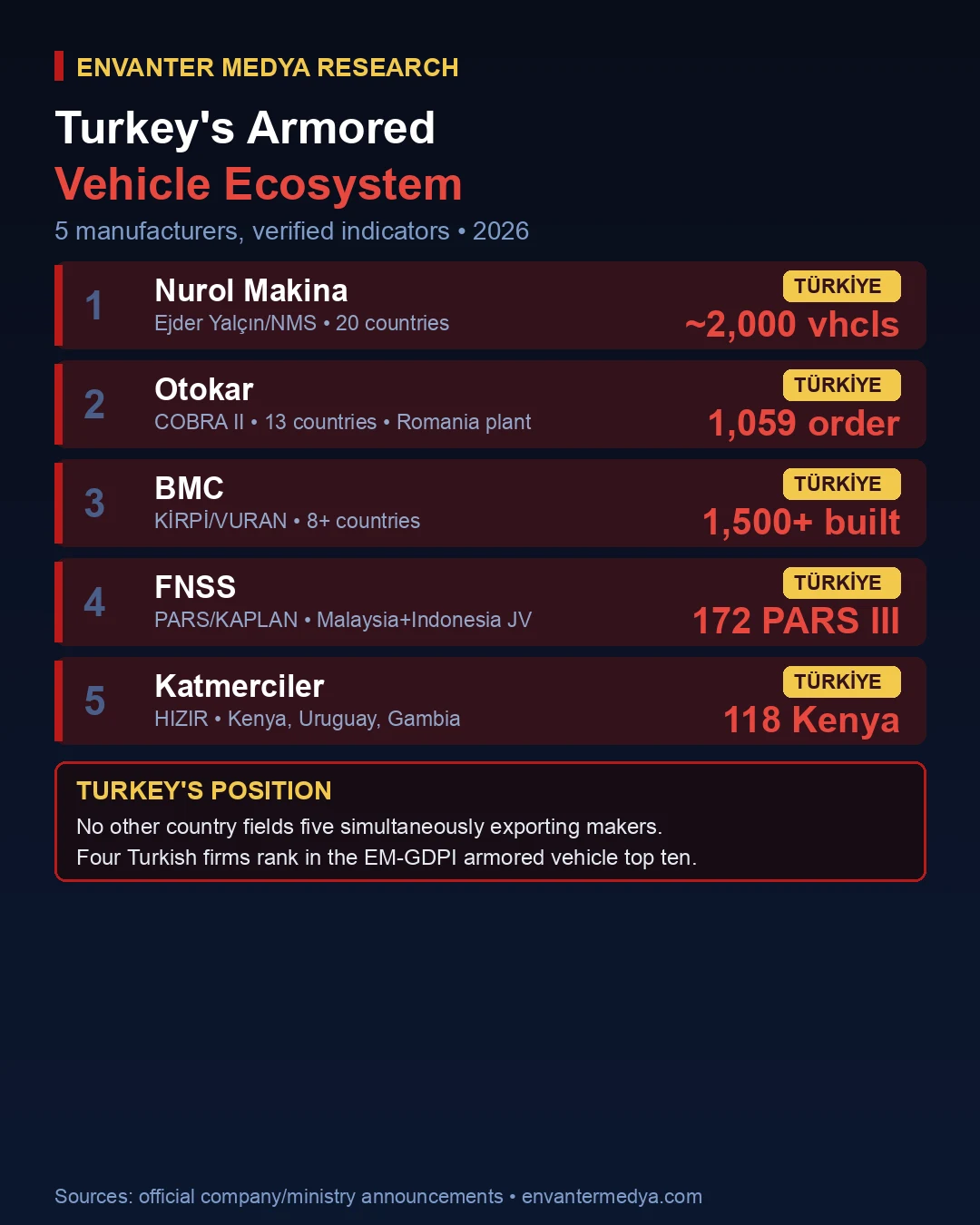
Most armored vehicle powers rest on a single national champion — Patria in Finland, Hanwha in South Korea. Turkey’s distinction is an ecosystem in which five exporters coexist and compete, widening the product range and removing dependence on any single company’s capacity.
| Company | Main products | Verified indicator | Flagship markets | Data |
|---|---|---|---|---|
| Otokar 🇹🇷 | COBRA II, ARMA 6×6/8×8, AKREP, TULPAR | COBRA II with 20+ users in 13 countries; 1,059-vehicle, ~$972M Romania contract | Romania, Gulf states | R |
| Nurol Makina 🇹🇷 | Ejder Yalçın, NMS, Ejder TOMA | ~2,000 vehicles to 20 countries in 6-7 years; Hungary program past 400 vehicles | Hungary, Qatar, Senegal | R |
| FNSS 🇹🇷 | PARS, KAPLAN, ACV, ZAHA, SAMUR | 172 PARS III to Oman; 257-vehicle joint production in Malaysia; KAPLAN MT with Indonesia | Oman, Malaysia, Indonesia | R |
| BMC 🇹🇷 | KİRPİ, VURAN, AMAZON, ALTUĞ | 1,500+ KİRPİ family sales, 200+ exported; 46 VURAN delivered to Georgia | Qatar, Turkmenistan, Kosovo | R / T |
| Katmerciler 🇹🇷 | HIZIR, HIZIR TTZA | 118-vehicle, ~$91M package for Kenya; deliveries to Uruguay and The Gambia | Kenya, Uruguay | R |
Data labels: R = official/company statement, T = reliable industry reporting.
Reason 1: Designs forged in the field
Turkey’s armored vehicle profile grew out of necessity before it became industrial policy. From the 1990s onward, mines and improvised explosive devices became the defining threat of Turkey’s counter-terrorism campaign, pushing the armed forces and police toward mine-protected platforms. BMC’s KİRPİ, Otokar’s COBRA family and Nurol Makina’s Ejder Yalçın are products of that requirement — and all three matured under real operational conditions rather than on proving grounds alone. For export customers facing similar threats, that is a reference no brochure can match.

Reason 2: A user map few producers can match
The customer list for Turkish armored vehicles stretches from Estonian winters to Gulf summers, from the Sahel to Southeast Asian monsoon belts. Proven performance across climates is as decisive in armored vehicle tenders as any technical specification.
Sources: company statements and defense press records. For context: Oshkosh’s JLTV serves 11+ countries, BAE’s CV90 ten, Patria’s AMV nine.
Verified example users per region; several contracts do not disclose customers, so figures are lower bounds. Sources: company and ministry announcements.

Reason 3: Signed programs, not brochures
Turkish armored vehicle exports have shifted from one-off sales to multi-year, high-volume programs. The chart below shows only announced, verified contracts:
Sources: official contract and delivery announcements. BMC’s 200+ exported KİRPİ are spread across multiple countries and not shown as a single program. For scale, Europe’s other current landmark orders are Germany-Patria at 876 vehicles and Italy’s Lynx program at 1,050.
Put plainly: Romania’s 1,059-vehicle COBRA II award is larger than Germany’s 876-vehicle Patria order and Italy’s 1,050-vehicle Lynx program — meaning a Turkish manufacturer is prime contractor on one of Europe’s three biggest current land vehicle programs. The first 14 vehicles were handed over in June 2025; by August 2026 deliveries approached 278. Otokar accepted penalty payments over a schedule slip and publicly confirmed the program would continue — a transparency as notable as the contract’s size.

Reason 4: Selling production, not just vehicles
The second structural advantage is flexibility about where the vehicle gets built. For buyers this means industrial participation and jobs; for Turkish makers it is an offer that goes beyond price:
| Program | Country | Model | Status |
|---|---|---|---|
| COBRA II | Romania | Local production facility | Facility being established; deliveries ongoing |
| Gidrán (Ejder Yalçın) | Hungary | Local outfitting/production partnership | 400+ vehicles; program expanding |
| AV-8 GEMPITA (PARS) | Malaysia | Licensed joint production with DefTech + technology transfer | 257 vehicles completed |
| KAPLAN MT / Harimau | Indonesia | Joint development with PT Pindad | In serial production phase |
The strategic reading: Malaysia’s GEMPITA line and the jointly developed KAPLAN MT show that Turkish industry can export production capability, not just hulls. The Romanian facility carries the same model onto NATO’s eastern flank.
Reason 5: A product range from 4x4s to amphibians
Across five makers, the combined portfolio covers nearly every segment from light tactical vehicles to tracked combat platforms and amphibious carriers — not under one roof, but within one country:
Main families in active production/marketing; derivatives (ambulance, riot control, CBRN) not counted. Source: official company catalogues.
Turkish manufacturers with an active product per segment (Envanter Medya compilation, 2026). FNSS’s ZAHA covers the amphibious niche; FNSS KAPLAN and Otokar TULPAR the tracked segment.
Price-performance and delivery tempo
Unit prices in the 4×4 and MRAP segments where Turkish makers concentrate sit well below Western Europe’s heavily protected tracked platforms. That equation keeps Turkish firms invisible in revenue tables — none clears the SIPRI Top 100 threshold — but formidable at the tender table: more vehicles for the same budget, usually on shorter schedules. Nurol Makina’s 2,000 vehicles to 20 countries in six to seven years is the clearest expression of that tempo. Why revenue rankings mislead in this segment is explained in detail in our main armored vehicle ranking.
Where Turkey still lags
Data honesty is this series’ rule, and the picture is not one-sided. Turkish makers have yet to sign a tracked infantry fighting vehicle export on the scale of the CV90, Lynx or Redback; the KAPLAN MT program with Indonesia is the most concrete step in that direction. Turkish platforms have so far not reached the finals of Western Europe’s heavy 8×8 tenders in the Boxer and Piranha class — Romania’s COBRA II award is the first major breach in that wall. Dependence on foreign engines and drivetrains persists, though BMC Power and TÜMOSAN powerplants entering serial production are narrowing the gap. Turkey’s main battle tank story, including ALTAY’s honest scoring, is covered in our tank manufacturers study.
How this study was prepared
Data window: Contract, delivery and user-country data were compiled from official company and ministry announcements between January 2025 and August 2026; revenue comparisons rest on SIPRI’s December 2025 release of 2024 figures. Scope: The five actively exporting Turkish manufacturers (Otokar, Nurol Makina, FNSS, BMC, Katmerciler); the ALTAY main battle tank is covered separately in the series’ tank study. Missing data: Where contracts do not disclose customers or quantities, user counts are given as lower bounds; company revenue breakdowns are not public and were not estimated. Method: Only figures verified by official announcements or multiple reliable industry sources were used.
| Company | Data reliability | Note |
|---|---|---|
| Otokar, Nurol Makina, FNSS | A | Official contract/delivery announcements, current and detailed |
| BMC, Katmerciler | A / B | Official announcements available; some totals are company statements |
Frequently asked questions
Why is Turkey strong in armored vehicle production?
Five reasons: five simultaneously exporting manufacturers; designs proven in real counter-terrorism operations; a user base spanning four continents; a local-production and technology-transfer business model; and a product range running from 4x4s to amphibious platforms.
Which Turkish companies build armored vehicles?
Otokar, Nurol Makina, FNSS, BMC and Katmerciler are the five active exporters; firms such as Anadolu Savunma and Koluman also operate in the ecosystem.
How many countries use Turkish armored vehicles?
By platform family: Nurol Makina 20 countries, Otokar’s COBRA II 13, BMC more than 8, FNSS more than 7, Katmerciler more than 4. Because customer lists overlap and some are undisclosed, a single national total is not published; verified users span four continents.
What makes Otokar’s Romania contract significant?
At 1,059 vehicles and roughly $972 million, it is one of Europe’s largest current land vehicle programs and includes a production facility in Romania — the first time a Turkish maker has won a NATO/EU member’s principal vehicle program.
Is Hungary’s Gidrán a Turkish vehicle?
Yes. Gidrán is the locally outfitted Hungarian version of Nurol Makina’s Ejder Yalçın; the program has grown past 400 vehicles.
How many KİRPİ vehicles has BMC built?
KİRPİ family sales exceed 1,500 vehicles, with more than 200 exported to customers including Qatar, Tunisia, Turkmenistan, Kosovo and Libya.
What are FNSS’s technology transfer programs?
The 257-vehicle AV-8 GEMPITA licensed production with Malaysia’s DefTech and the KAPLAN MT / Harimau medium tank jointly developed with Indonesia’s PT Pindad are among Turkish industry’s most comprehensive technology-transfer projects.
Where has Katmerciler exported the HIZIR?
Verified customers include Kenya (a 118-vehicle, ~$91 million package), Uruguay (armored personnel carriers and ambulances for its UN mission battalion) and The Gambia.
Where does Turkey stand in 8×8 vehicles?
FNSS’s PARS and Otokar’s ARMA families are in production and BMC’s ALTUĞ 8×8 is being readied for the Turkish Armed Forces, but Turkish platforms have not yet reached the finals of Western Europe’s Boxer/Piranha-class tenders — a gap this study states openly.
How do Turkish makers rank globally?
In Envanter Medya’s nine-criterion EM-GDPI armored vehicle index, four of the top ten manufacturers are Turkish: Otokar 4th, Nurol Makina 7th, FNSS 9th, BMC 10th. The full index is in the main ranking.
Are Turkish vehicles proven outside Turkey?
Yes — verified users operate them in climates from Baltic winter (Estonia) to Gulf heat (Qatar, Oman), the Sahel (Senegal, Kenya) and Southeast Asian monsoon conditions (Malaysia, Indonesia).
Which Turkish armored vehicle programs come next?
BMC’s ALTUĞ 8×8, FNSS’s KAPLAN family exports and the serial production ramp-up of domestic BMC Power and TÜMOSAN engines are the programs most likely to reshape the next edition of this study.
Sources and methodology notes
This is an editorial study prepared by Envanter Medya by cross-checking publicly available official company data, institutional reports, contract and delivery records, and industry sources. Principal sources:
- Otokar official statements — Romania contract, delivery counts, follow-on orders
- Nurol Makina statements — 20 countries / ~2,000 vehicles, Hungary’s Gidrán program
- FNSS official site — PARS, KAPLAN, ZAHA programs; Oman, Malaysia, Indonesia
- Katmerciler official statements — HIZIR exports including the Kenya package
- DefenceTurk — Uruguay HIZIR deliveries
- SIPRI Top 100 Fact Sheet (December 2025) — 2024 defense revenues and threshold comparison
- Patria / CAVS and Defense News — European program scale comparisons
Last updated: August 16, 2026. This is a living study and will be updated as major contracts are announced. All sector studies in the Envanter Medya Global Defense Industry Research series are linked from the main armored vehicle ranking.