STM’s ALKAN FPV Kamikaze Drone Enters Service, Built on KARGU’s Warhead and Fibre-Optic Link

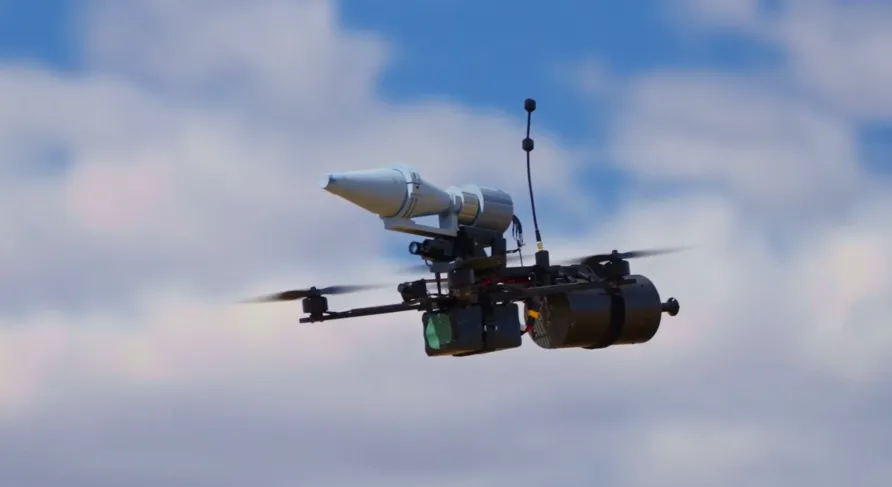
Turkish defence engineering firm STM says its ALKAN FPV kamikaze drone has completed acceptance testing and that an initial batch of systems has already been delivered to Turkish security forces. Previously known under the designation KARGUFPV, the platform inherits much of its warhead and fuze design from STM’s existing KARGU loitering munition, which appears to have helped it move quickly from testing to limited operational use.
STM confirmed the delivery on November 23, with more units expected to follow. The company has not disclosed the exact size of the initial batch.
From KARGUFPV to ALKAN FPV
ALKAN FPV sits in STM’s growing lineup of unmanned strike systems built for asymmetric warfare and fast-changing battlefield conditions. It combines first-person-view control, high maneuverability, autonomous terminal engagement once an operator designates a target, and precision-strike capability against both stationary and moving targets.
Its entry into service marks the shift from development and testing to initial operational availability — the kind of transition STM has repeated across several of its drone programs.
Specs and warhead flexibility
The drone has a mission range of 10 kilometers and a top speed of 140 km/h. Its stated mission altitude is 500 meters, with a maximum altitude of 5,500 meters above mean sea level. Endurance runs over 20 minutes in the armed, kamikaze configuration, and up to 44 minutes when flown unarmed for observation.
It can carry either an anti-personnel or an armour-piercing warhead, built around a MIL-STD-331-compliant safety fuze with adjustable distance fuzing. STM says ALKAN FPV shares its warhead and fuze architecture with the KARGU loitering munition, meaning KARGU-compatible munitions can be used on the new platform without modification — a logistics shortcut that simplifies supply chains for units already fielding KARGU.
No GPS, no RF needed: the fibre-optic link
On the guidance side, the system pairs FPV control with autonomous terminal diving after target designation, plus dual communications — radio frequency and fibre-optic cable. STM says the fibre-optic link can function without GPS or RF signals at all, giving it a degree of resistance to jamming that pure-RF FPV drones lack.
Low radar cross-section and day-and-night operation round out the feature set. The fibre-optic option in particular tracks a trend seen since the war in Ukraine, where cheap commercial FPV drones proved vulnerable to electronic warfare, pushing manufacturers toward tethered or jam-resistant alternatives for the final approach.
STM’s strike-drone family and the export picture
STM General Manager Özgür Güleryüz said ALKAN FPV builds on the company’s experience with KARGU, BOYGA, TOGAN and ALPAGU, and noted that STM now exports to more than 15 countries. The company is clearly positioning the new platform as the next step in that lineup rather than a standalone product.
Army Recognition reported that STM signed an agreement covering KARGU and ALPAGU with an unnamed NATO and EU member state back in January 2026, but no export deal for ALKAN FPV has been announced so far — unsurprising, given the system has only just entered domestic service. How quickly deliveries scale up, and whether an export customer follows, will say a lot about how STM’s strike-drone portfolio performs against the increasingly crowded FPV-drone market.
Sources:
– Army Recognition, “STM Delivers ALKAN FPV Kamikaze Drones to Turkish Forces with Autonomous Precision-Strike Capability,” November 23, 2026 — used for system specifications, delivery details and STM’s statement.
– STM’s official announcement of November 23, 2026 (as relayed by Army Recognition) — used for acceptance-test status, delivery status and General Manager Özgür Güleryüz’s remarks.