World’s Largest Armored Vehicle Manufacturers: Production, Exports and Operators Compared (2026)

Europe is rearming, and nowhere is the industrial scramble more visible than in armored vehicles. Ask who the world’s largest armored vehicle manufacturers are and the answer again depends on the ruler: by group defense revenue it is BAE Systems and General Dynamics; by single-model output it is America’s Oshkosh Defense, which has built more than 23,000 JLTV tactical trucks in a decade; by Europe’s capacity race it is Germany’s Rheinmetall, now producing around 400 combat vehicles a year and aiming past 1,000. And one country appears in this table like no other: Türkiye fields four separate exporting armored vehicle makers — Otokar, FNSS, Nurol Makina and BMC — a depth of suppliers no other nation matches. Otokar’s roughly $972 million contract for 1,059 COBRA II vehicles for Romania is one of Europe’s largest 4×4 deals in years. This is the second file of Envanter Medya’s Global Defense Industry Research, following our study of the world’s largest military drone manufacturers; main battle tanks are excluded here and get their own file next.
Editorial note: This ranking is an editorial research piece prepared by Envanter Medya using publicly available data; it is not an official international ranking. Sources, reference years and methodology are explained at the end.
The research at a glance
“Largest” by which measure?
The armored vehicle market does not fit on one list. Tracked infantry fighting vehicles (CV90, Lynx, Redback), wheeled 8×8 carriers (Boxer, Stryker, PARS), mine-resistant MRAPs (KİRPİ, COBRA II) and light tactical 4x4s (JLTV, Ejder Yalçın) play in different leagues for both unit price and production tempo — one CV90 costs as much as several tactical 4x4s, so pooling their unit counts would mislead. Envanter Medya therefore assesses each maker’s verified indicator within its own class, and weighs nine criteria together only in the composite EM-GDPI index.
By defense revenue: the giants’ league — and where Turkish makers really sit
In SIPRI’s December 2025 data for 2024, the revenue table of groups that build armored vehicles is topped by conglomerates for which land systems are only one slice: BAE Systems at $33.79 billion and General Dynamics at $33.63 billion. China’s land-systems giant NORINCO follows at $13.97 billion. The fastest riser is Rheinmetall, whose defense revenue jumped 36 percent in constant prices to $8.2 billion, lifting it to 20th place; Leopard 2 and Boxer co-maker KNDS sits 42nd, and South Korea’s Hanwha group grew a remarkable 42 percent.
Source: SIPRI Top 100 (December 2025), total 2024 defense revenues — only part of each comes from armored vehicles. NORINCO is a SIPRI estimate flagged with high uncertainty. Otokar, FNSS, Nurol Makina and BMC fall below the Top 100 revenue threshold and so do not appear here; their strength shows in the production and operator tables below, not in dollars.
Do not confuse revenue with production muscle: high-priced tracked vehicles and multi-domain portfolios automatically tilt the revenue table toward Western giants. A maker shipping hundreds of 4x4s a year to dozens of countries may not register in dollar rankings at all. That is exactly why the production, operator and export sections below must be read separately.
By production and deliveries: the verified numbers
| Company | Country | Main products | Verified production/delivery indicator | Data type |
|---|---|---|---|---|
| Oshkosh Defense | USA | JLTV, M-ATV, FMTV | 23,000+ JLTVs since 2015; 1,600+ fielded with NATO and allies beyond the US | O |
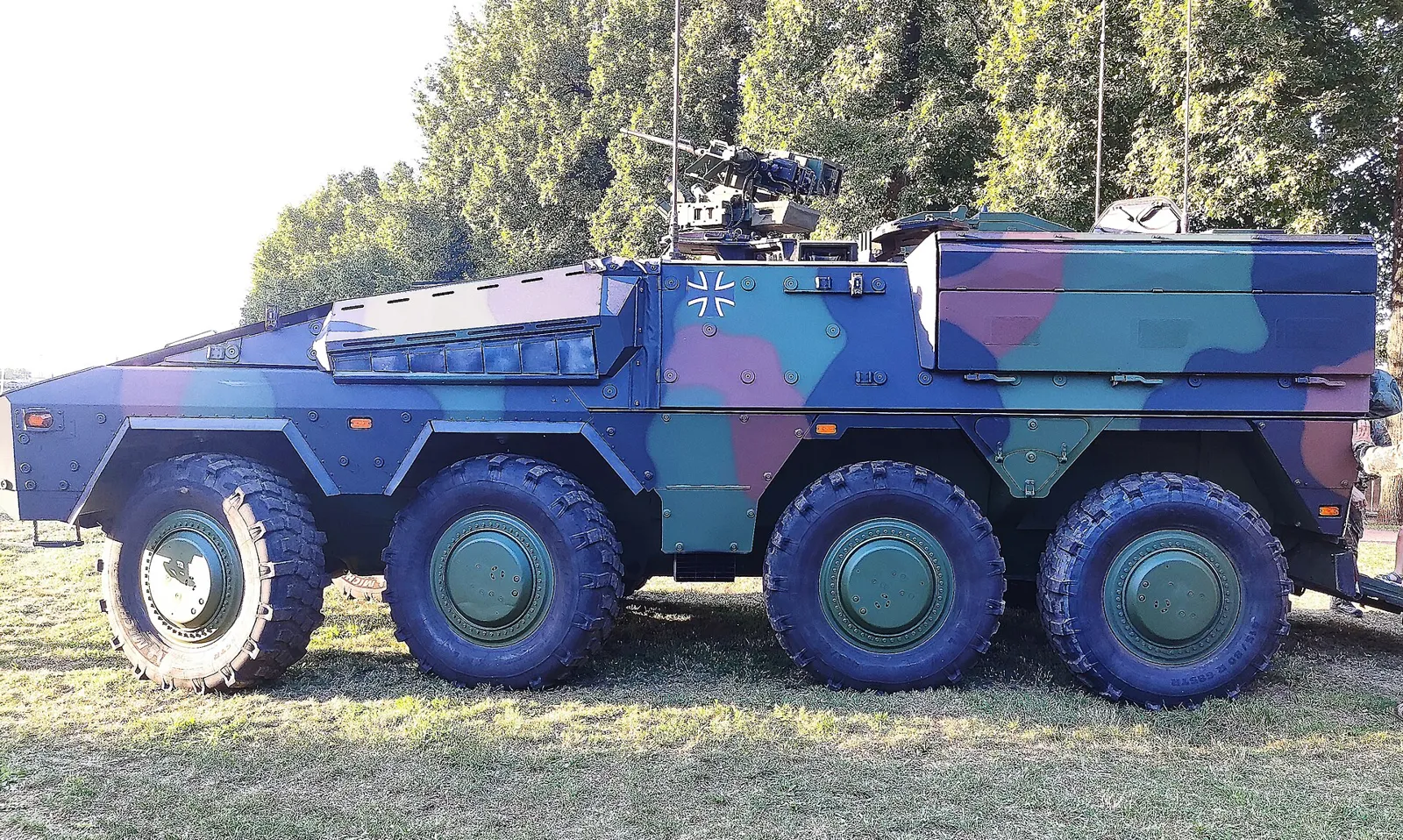
| Rheinmetall | Germany | Boxer, Lynx, Puma, Fuchs | Combat vehicle capacity ~600/year, ~400 in production; Boxer alone targeted at 500+/year; 1,050-vehicle Lynx program with Italy | O |
| BAE Systems | UK/Sweden | CV90, AMPV, BvS10 | CV90: 1,300 delivered, ~1,900 on order; output rising to 250/year in 2026 | O |
| GD Land Systems | USA | Stryker, Piranha, AJAX, LAV | Stryker line rated at 150/year; Piranha family (GDELS) above 11,000 cumulative | O / E |
| Otokar 🇹🇷 | Türkiye | COBRA II, ARMA, AKREP, TULPAR | 1,059-vehicle, ~$972m Romania contract; ~278 COBRA IIs delivered by August 2026, local plant being established; COBRA II with 20+ users in 13 countries | O |
| Nurol Makina 🇹🇷 | Türkiye | Ejder Yalçın, NMS | ~2,000 vehicles to 20 countries in 6-7 years; 400+ vehicle program with Hungary; Estonia is NMS’s first NATO customer | O |
| BMC 🇹🇷 | Türkiye | KİRPİ, VURAN, ALTUĞ | KİRPİ family sales above 1,500, 200+ exported; VURAN delivered to Georgia (46) and Kosovo | O / E |
| FNSS 🇹🇷 | Türkiye | PARS, KAPLAN, ACV, ZAHA | 172 PARS IIIs to Oman; 257-vehicle AV-8 GEMPITA co-production in Malaysia; KAPLAN MT program with Indonesia | O |
| Patria | Finland | AMV, 6×6 (CAVS) | 876-vehicle German 6×6 order (Dec 2025); licensed AMV XP production started in Japan; investing to double capacity | O |
| Hanwha | S. Korea | Redback, K21 | 129 Redbacks for Australia (deliveries 2027-28); group defense revenue up 42% in 2024 | O |
| NORINCO | China | VN series, ZBL-08 | Production and export volumes undisclosed | U |
Data type: O = official/company statement, E = credible industry estimate, U = unknown. Mixing classes (a tactical 4×4 with a tracked IFV) in one count would mislead, so each maker’s own verified indicator stands on its own row.
By operator countries: a Turkish company leads the dataset
How many armies drive a vehicle is the most concrete proof of its reliability across climates and combat environments. On this ruler, the first place in our dataset belongs to a Turkish firm: Nurol Makina has put the Ejder Yalçın and NMS family into service in 20 countries, from Qatar and Senegal to Hungary and Estonia. Otokar’s COBRA II serves more than 20 users in 13 countries; BAE’s CV90 flies the flags of 10 nations, Ukraine included.
Turkish companies highlighted. Figures count active operator/contracted countries per platform family; total company export geographies can be wider. Sources: company statements and defense-press records.

The capacity race: Europe’s rearmament resets the table
2024-2026 is producing the largest capacity expansion the sector has seen in thirty years. Rheinmetall plans to push past 1,000 vehicles a year by 2030; BAE has raised CV90 output 400 percent over pre-war levels toward 250 a year; Patria announced a €40 million investment to double capacity. On the Turkish side, Otokar is building a plant in Romania under its contract, and Nurol Makina runs a 400-vehicle joint program with Hungary. SIPRI’s growth numbers confirm the trend: Hanwha group +42 percent, Rheinmetall +36, KNDS +14 in 2024 alone.
The Envanter Medya composite index: EM-GDPI
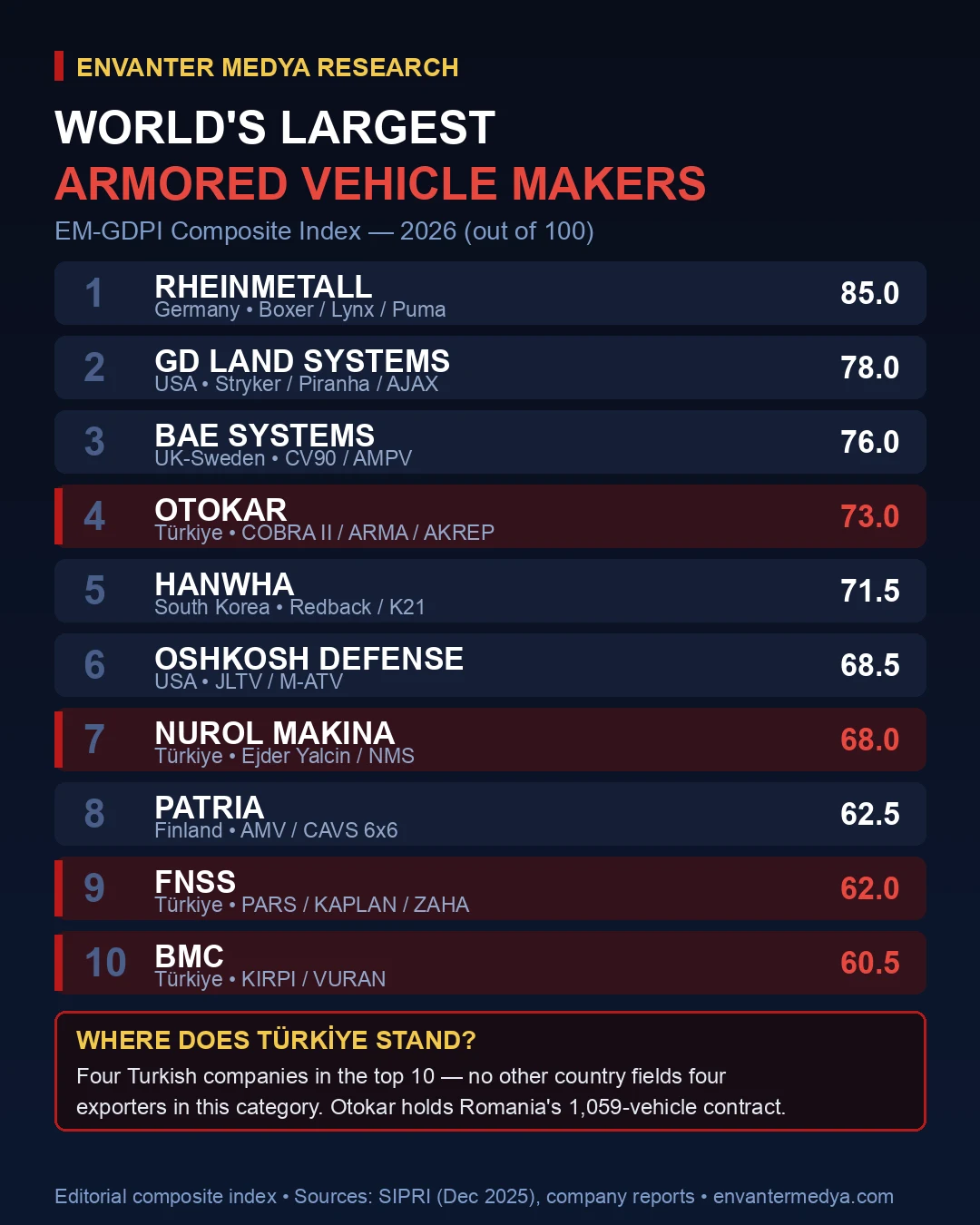
Nine weighted criteria — verified production volume (25), land-systems-attributable revenue (15), exports (15), operator countries (10), product breadth (10), capacity (10), backlog (5), technology (5), growth (5) — produce a 100-point editorial composite:
Editorial composite index; not an official ranking. NORINCO and Russian makers were not scored due to insufficient data. Turkish companies highlighted.
In short: Rheinmetall’s near-perfect scores on capacity, backlog and growth put it first; General Dynamics and BAE follow on revenue and technological depth. What lifts Otokar to fourth is winning one of Europe’s biggest 4×4 tenders, high unit output and a broad product family. Four Turkish companies in a top ten is a producer density no other country shows in this category.
Where does Türkiye stand?
Türkiye fields one of the world’s most crowded armored vehicle ecosystems: Otokar, FNSS, Nurol Makina, BMC and Katmerciler all build for the Turkish Armed Forces and for export at once. The specialization is no accident — years of counter-insurgency operations created hard, field-tested requirements for mine protection, pushing Turkish industry into early expertise in MRAPs and protected tactical vehicles.
Otokar: inside Europe through Romania
Beyond COBRA II’s 13-country user base, the turning point is the Romania deal signed in December 2024: 1,059 vehicles, about $972 million, five years of deliveries and a production facility on Romanian soil. The first 14 vehicles arrived in June 2025; by August 2026 deliveries approached 278. Otokar has also acknowledged schedule delays and agreed to pay compensation while continuing the project — a transparency worth noting alongside the contract’s size. The portfolio spans the ARMA 6×6/8×8, the light AKREP II and the tracked TULPAR, and a further $83.6 million COBRA II order landed in December 2025.
Nurol Makina: the widest geography in the dataset
Nurol Makina has delivered roughly 2,000 vehicles to 20 countries in six to seven years. The Ejder Yalçın serves from Qatar to Senegal; Hungary’s program has grown past 400 vehicles built locally as the Gidrán, and Estonia became the NMS’s first NATO customer.

FNSS: the broadest product range
FNSS carries the deepest tracked-vehicle tradition among Turkish makers: 172 PARS IIIs delivered to Oman, 257 AV-8 GEMPITA vehicles co-produced with Malaysia’s DefTech, the KAPLAN MT medium tank program with Indonesia, plus the amphibious ZAHA marine assault vehicle — a portfolio built on technology transfer as much as export.

BMC: volume leader in MRAPs
BMC’s KİRPİ family has passed 1,500 vehicles sold, more than 200 of them exported to customers including Qatar, Tunisia, Turkmenistan, Kosovo and Libya. The VURAN 4×4 completed its 46-vehicle delivery to Georgia in 2024, and the ALTUĞ 8×8 moves the company into the wheeled combat vehicle segment. Katmerciler’s HIZIR rounds out a five-maker ecosystem.

Why don’t Turkish makers appear in the revenue table?
None of the four passes SIPRI’s Top 100 revenue threshold — not for lack of production, but because of product mix. Unit prices in the 4×4 and MRAP segments sit far below CV90-class tracked vehicles and the multi-domain portfolios of the giants, so equal unit counts produce very unequal dollars. On the rulers of volume, operator countries and proven performance across climates, Turkish firms sit near the top: the first two places in our operator-country criterion belong to Nurol Makina (20) and Otokar (13). The next step is the higher-value tracked league — FNSS’s KAPLAN family and BMC’s ALTUĞ are the vehicles of that transition. Honest accounting also requires the reverse view: no Turkish maker has yet landed a CV90-scale tracked IFV export contract, and Western Europe’s heavy 8×8 tenders have so far gone elsewhere — Romania’s COBRA II award is the first major breach in that wall.
How this research was prepared
Data year: revenues are SIPRI’s 2024 defense revenues (December 2025 release, constant 2024 dollars); production, delivery and contract data come from official company and ministry announcements of January 2025 – August 2026. Scope: eleven groups building tracked IFVs, wheeled 8x8s, MRAPs and tactical 4x4s; main battle tanks excluded. Currency: US dollars, no additional conversion. Missing data: NORINCO’s and Russian makers’ volumes, and Turkish makers’ revenue breakdowns, are not public — marked “unknown”, not estimated. EM-GDPI: nine criteria (production 25, revenue 15, exports 15, operators 10, breadth 10, capacity 10, backlog 5, technology 5, growth 5) scored 0-10, weighted; relative within the group, and editorial.
| Company | Data reliability | Note |
|---|---|---|
| Otokar, Nurol Makina, FNSS, BMC | A | Current, detailed official company/contract announcements |
| Rheinmetall, BAE, Patria, Oshkosh, Hanwha | A | Public reports + official program announcements |
| GD Land Systems | B | Strong segment data; land vehicle breakdown limited |
| NORINCO, Russian makers | D | No reliable current data; excluded from rankings |
Frequently asked questions
Who is the world’s largest armored vehicle manufacturer?
By group defense revenue, BAE Systems and General Dynamics; by single-model volume, Oshkosh with 23,000+ JLTVs; by European capacity, Rheinmetall — which also tops Envanter Medya’s composite index.
Where does Türkiye rank in armored vehicles?
Türkiye is one of the only countries with five active exporters in the category. Four Turkish companies make the EM-GDPI top ten, and the top two places for operator countries belong to Nurol Makina (20) and Otokar (13).
How big is Otokar’s Romania contract?
About $972 million for 1,059 COBRA II vehicles over five years, with a production facility in Romania; roughly 278 vehicles had been delivered by August 2026.
How many JLTVs has Oshkosh built?
More than 23,000 since 2015, with over 1,600 fielded by NATO members and allies beyond the US armed forces.
How many countries operate the CV90?
Ten, including Ukraine — 1,300 vehicles delivered against an order book of about 1,900, with production rising to 250 a year in 2026.
How many vehicles can Rheinmetall build per year?
Current combat vehicle capacity is about 600 a year across Boxer, Lynx and Puma, with a target above 1,000 by 2030 and Boxer alone planned at 500+ annually.
What are Europe’s biggest current armored vehicle orders?
Germany’s 876-vehicle 6×6 order to Patria, Italy’s 1,050-vehicle Lynx program and Romania’s 1,059-vehicle COBRA II tender — the last won by a Turkish maker.
How many KİRPİ MRAPs has BMC produced?
Over 1,500 sold, with 200+ exported to Qatar, Tunisia, Turkmenistan, Kosovo, Libya and others.
What is the difference between an MRAP and an APC?
An MRAP is designed around V-hull protection against mines and IEDs; an armored personnel carrier prioritizes troop transport. Their capabilities increasingly overlap in modern designs.
Which Turkish armored vehicles compete with Western models?
The Ejder Yalçın is regularly compared with the JLTV, the PARS III with the Boxer, and FNSS’s KAPLAN-20 with the CV90; you can browse their technical profiles in the Envanter Medya Defense Atlas.
Sources and methodology notes
This study is an editorial research piece prepared by Envanter Medya by cross-checking publicly available official company data, institutional reports, contract and delivery records and industry sources. Principal sources:
- SIPRI Top 100 Fact Sheet (December 2025) — 2024 defense revenues and growth rates
- Otokar official statements — Romania contract, delivery counts, new orders
- Nurol Makina statements — 20 countries / ~2,000 vehicles, Hungary program
- FNSS official site — PARS, KAPLAN, ZAHA programs; Oman and Malaysia deliveries
- BAE Systems / Shephard (DSEI 2025) — CV90 1,300 delivered / 1,900 ordered / 250-a-year target
- Rheinmetall capacity statements — 600/year current, 1,000+ target
- Oshkosh Defense / Shephard — 23,000+ JLTVs built
- Patria / CAVS program — Germany’s 876-vehicle order
- Hanwha / Shephard (Avalon 2025) — 129 Redback delivery schedule
- Defense News — Italy’s 1,050-vehicle Lynx program
Last updated: 15 August 2026. This page is living research, updated in annual reporting seasons and after major contract announcements. File three of this series examines the world’s largest tank manufacturers.