World’s Largest Military Drone Manufacturers: Production, Exports and Revenue Compared (2026)

Ask who builds the world’s largest military drone fleet and you will get a different answer depending on which ruler you use. By defense revenue, the giant is America’s Northrop Grumman. By cumulative deliveries, it is General Atomics, maker of the MQ-9 Reaper, with more than 1,000 aircraft over three decades. But by export reach and annual production capacity, the leader is a company that barely existed in this market fifteen years ago: Türkiye’s Baykar. In December 2025, SIPRI’s ranking of the world’s 100 biggest arms producers recorded a quiet milestone — Baykar, at $1.90 billion, edged past General Atomics ($1.89 billion) for the first time. Envanter Medya’s research compares the industry’s heavyweights not by a single number, but across production, revenue, exports, operator countries and product range.
Editorial note: This ranking is an editorial research piece prepared by Envanter Medya using publicly available data; it is not an official international ranking. Sources, reference years and methodology are explained in the “How this research was prepared” section at the end.
The research at a glance
“Largest” by which measure?
Before crowning any company “the world’s biggest drone maker,” it is worth saying which yardstick is being used — because revenue, unit production, exports and operator count tell four very different stories. A handful of extremely expensive aircraft can lift a company to the top of the revenue table, while a firm churning out hundreds of affordable drones can look small in dollar terms and enormous on the flight line. A manufacturer selling to one giant home market and one selling to forty countries may post similar revenues yet occupy completely different positions in the global market.
That is why this study measures the sector with five separate rulers: defense revenue, verified production and deliveries, exports and operator countries, growth, and a weighted composite of all of them — the Envanter Medya Global Defense Production Index (EM-GDPI). The comparison focuses on makers of medium-altitude long-endurance (MALE, i.e. Reaper/TB2-class) and heavy strike drones; hand-launched small drones and loitering munitions (one-way “kamikaze” drones) are a separate league, covered in their own section below.
By defense revenue: Northrop on top — and Baykar past General Atomics for the first time
According to the Stockholm International Peace Research Institute (SIPRI), the world’s 100 largest arms companies earned a combined $679 billion in 2024. Among groups that build drones, the biggest defense revenue belongs to Northrop Grumman — $37.85 billion — though unmanned aircraft are only a small slice of a portfolio dominated by bombers, missiles and space systems. China’s aviation conglomerate AVIC ($20.32 billion) and CASC ($10.23 billion), the state group behind the CH “Rainbow” drone series, follow.
Source: SIPRI Top 100 (December 2025), 2024 defense revenues. Turkish companies highlighted. For Northrop Grumman, AVIC, CASC, Elbit, IAI and Turkish Aerospace only part of this revenue comes from drones; Baykar’s revenue is almost entirely drone sales. AVIC, CASC and General Atomics figures are SIPRI estimates flagged with high uncertainty.
The real story hides in the lower rows. Baykar — which earns roughly 95 percent of its revenue from exports — landed at 73rd with $1.90 billion, one step above General Atomics at 74th with SIPRI’s $1.89 billion estimate. In other words, the makers of the world’s two most recognizable armed drones now sit in the same revenue league, and the Turkish company is a nose ahead.
Do not confuse revenue with production muscle: a revenue table is not a production table. Most of Northrop Grumman’s income comes from bomber, space and missile programs; its actual drone output is tiny next to that figure. A single high-altitude Global Hawk costs many times more than a tactical drone, so a company can rank high in dollars while building very few aircraft. Read the production, export and operator tables below as separate rankings.
By production and deliveries: a 30-year archive versus a 10-year sprint
Unit production is the hardest number to verify in this market. Western manufacturers occasionally publish cumulative deliveries; Chinese and Russian producers almost never do. Here is what can be verified:
| Company | Country | Main products | Verified production/delivery indicator | Data type |
|---|---|---|---|---|
| General Atomics | USA | MQ-9A, MQ-9B, MQ-1C Gray Eagle, YFQ-42A | More than 1,000 drones delivered in over 30 years (company statement) | O |
| Baykar 🇹🇷 | Türkiye | TB2, AKINCI, TB3, KIZILELMA | TB2 fleet has flown over 1 million hours; annual capacity of 250 TB2 + 50 AKINCI (company); cumulative TB2 output put at ~600 by industry sources | O / I |
| Turkish Aerospace 🇹🇷 | Türkiye | ANKA, AKSUNGUR, ANKA-3 | ANKA delivered to Tunisia (5), Kazakhstan (3), Chad (2); AKSUNGUR to Kyrgyzstan (2); AKSUNGUR output moving from one per quarter to one per month | O |
| AVIC + CASC | China | Wing Loong I/II, CH-3/4/5 | SIPRI records 200+ armed drones exported to 17 countries in 2013-2023; domestic inventory undisclosed | O (exports) / U (domestic) |
| IAI | Israel | Heron, Heron TP, Heron MK II | Heron family operational with 20+ users; cumulative total undisclosed | E |
| Elbit Systems | Israel | Hermes 450, Hermes 900 | 20+ customers for Hermes 900; 65% of a $22.6bn backlog is international | O |
| Northrop Grumman | USA | Global Hawk, MQ-4C Triton | Low-volume, very high unit value; RQ-4/MQ-4C total counted in dozens | E |
| Kronstadt | Russia | Orion | No reliable production data since sanctions | U |
Data type: O = official/company statement, E = credible industry estimate, I = industry estimate, U = unknown/insufficient data. Because mixing different drone classes into one unit count would be misleading, the table gives each maker’s own verified indicator on its own row.
The story the table tells: General Atomics built its 1,000-aircraft archive over thirty years, and its tempo is slowing now that the US Air Force has stopped buying MQ-9s. Baykar reached more than half that volume in a single decade and today runs the highest-tempo military drone lines in the world — up to 300 aircraft a year from its Istanbul plants alone. That figure does not yet include the new factory completed in Ukraine in 2025 (around 120 aircraft a year) or LBA Systems, the joint production venture with Leonardo in Italy.
By exports and operators: Baykar leads the dataset
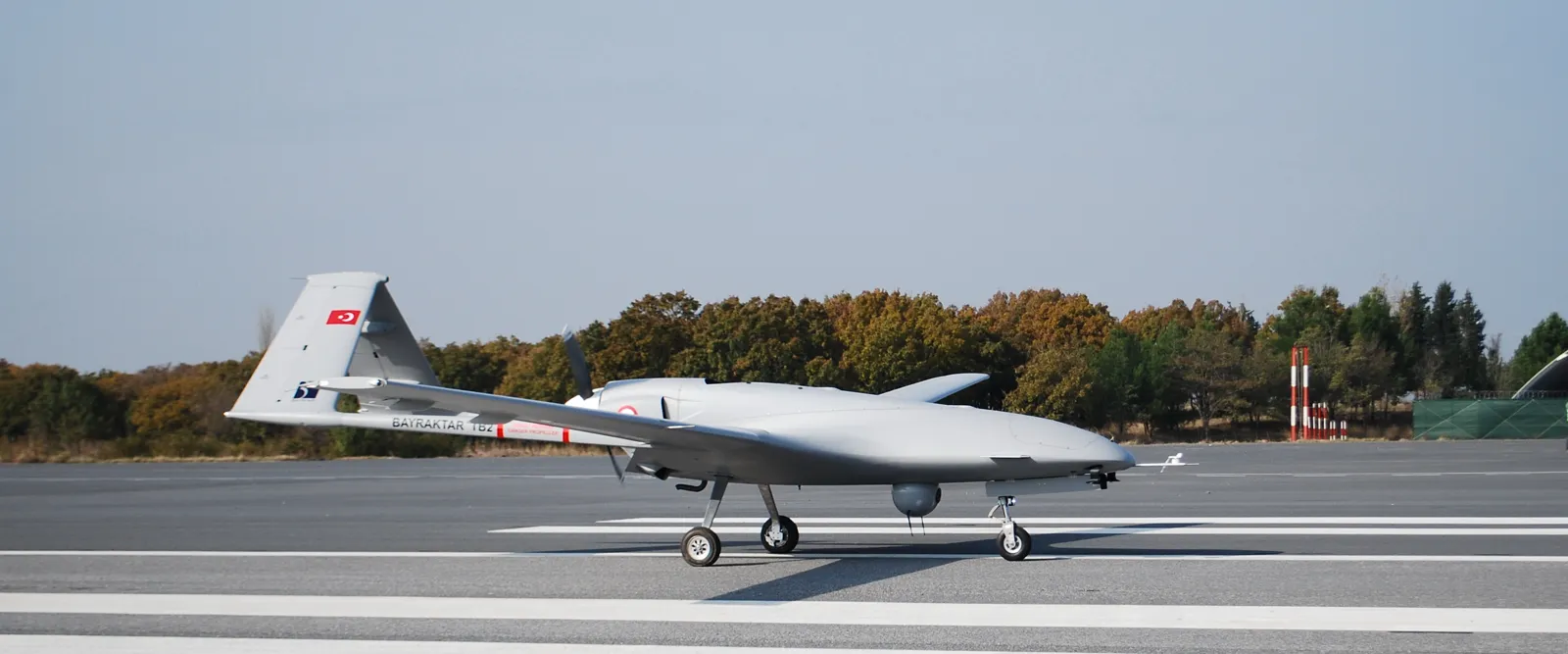
How many countries fly a drone is one of the most concrete measures of trust in it. Here the picture sharpens: the Bayraktar TB2 serves in 34 national inventories, with export agreements signed with 36 countries for the TB2 and 16 for the heavier AKINCI — 37 countries in total across the portfolio. AKINCI has already been delivered to 10 of them. Baykar closed 2025 with a record $2.2 billion in exports, and 97.5 percent of its contract book is international.
Turkish companies highlighted. IAI says it has reached 49 drone customers historically with 80% of output exported; the chart counts active Heron operators. China’s figure is based on SIPRI’s 2013-2023 delivery records.
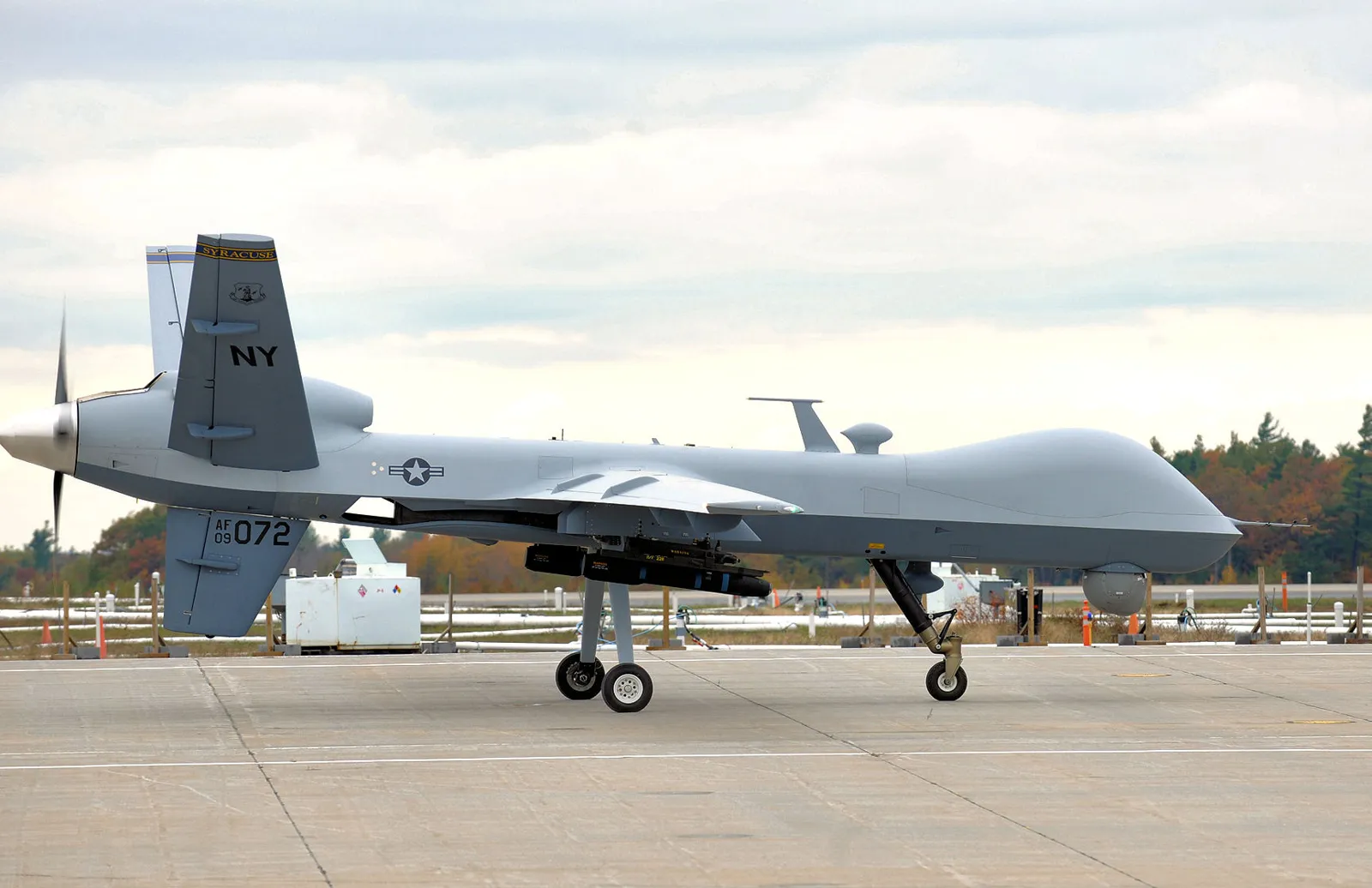
Geographic reach is not a Turkish monopoly. China filled the space left by Western export restrictions across the Middle East and Africa with its Wing Loong and CH series — more than 200 armed drones to 17 countries in a decade, led by the UAE, Saudi Arabia, Egypt and Pakistan. Israel’s IAI and Elbit kept armed exports restrained and went deep in surveillance instead. General Atomics sells only to NATO members and close allies: the United Kingdom, Belgium, Canada, Denmark, Germany, Poland, India, Japan and Taiwan are among the countries under contract for the MQ-9B SkyGuardian/SeaGuardian.
Growth: who rose and who slipped in 2024
SIPRI’s constant-price year-on-year change shows where the market is heading. The champions of 2024 were electronics and missile houses investing in drones; among pure drone makers, the extraordinary demand of the early Ukraine-war years was normalizing.
Green bars show growth, grey bars decline; bar lengths are scaled within each group. Source: SIPRI (December 2025).
Baykar’s 12 percent dip should not be read in isolation: SIPRI attributes it to the normalization of Ukraine’s exceptional early-war TB2 demand, and the company answered with a record $2.2 billion export year in 2025, keeping its position as the world’s top armed-drone exporter for the fifth consecutive year. General Atomics’ decline tracks the US Air Force ending MQ-9 procurement; the company has pivoted to its jet-powered YFQ-42A fighter drone and NATO orders for the MQ-9B.
Every Turkish company on the list climbed the SIPRI ladder in 2024: ASELSAN from 52nd to 47th, Turkish Aerospace from 75th to 65th, Roketsan from 92nd to 87th, and MKE entering at 93rd for the first time. The five firms’ combined revenue rose 11 percent to $10.1 billion — the strongest Turkish representation in the ranking’s history.
The Envanter Medya composite index: EM-GDPI
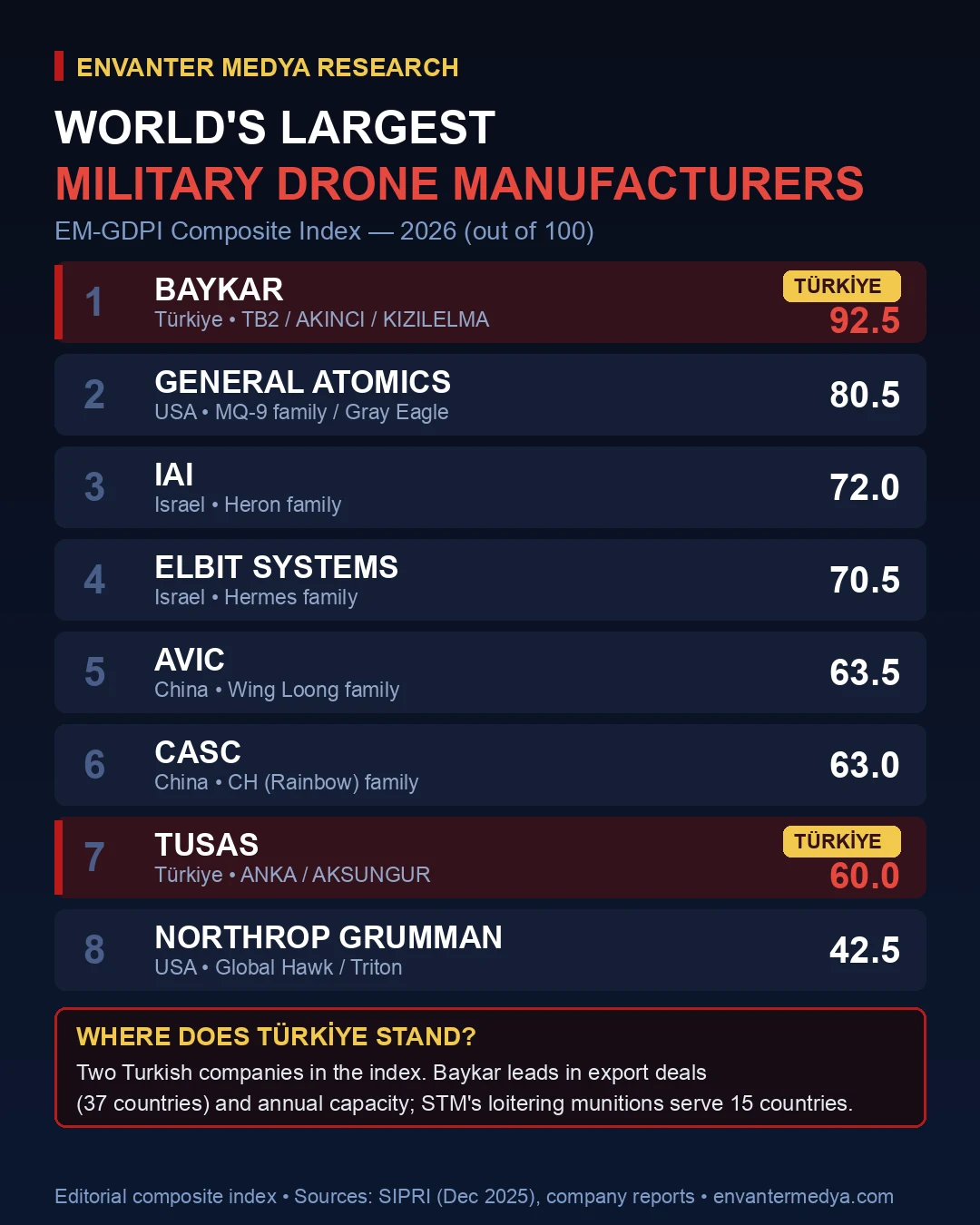
To get past the tyranny of any single metric, we weighted nine criteria into a 100-point composite: verified production/delivery volume (25), drone-attributable revenue (15), export performance (15), operator countries (10), product family breadth (10), annual production capacity (10), order backlog (5), technological depth (5) and recent growth (5). The index is an editorial assessment; scoring rationale is in the methodology section.
Editorial composite index; not an official ranking. Kronstadt (Russia) was not scored due to insufficient data. Turkish companies highlighted.
| Company | Production (25) | Revenue (15) | Exports (15) | Operators (10) | Other 5 criteria (35) | TOTAL |
|---|---|---|---|---|---|---|
| Baykar 🇹🇷 | 22.5 | 13.5 | 15.0 | 10.0 | 31.5 | 92.5 |
| General Atomics | 25.0 | 13.5 | 9.0 | 6.0 | 27.0 | 80.5 |
| IAI | 17.5 | 7.5 | 12.0 | 9.0 | 26.0 | 72.0 |
| Elbit Systems | 17.5 | 7.5 | 12.0 | 8.0 | 25.5 | 70.5 |
| AVIC | 17.5 | 6.0 | 10.5 | 6.0 | 23.5 | 63.5 |
| CASC | 17.5 | 6.0 | 10.5 | 6.0 | 23.0 | 63.0 |
| Turkish Aerospace 🇹🇷 | 15.0 | 6.0 | 9.0 | 6.0 | 24.0 | 60.0 |
| Northrop Grumman | 10.0 | 4.5 | 6.0 | 4.0 | 18.0 | 42.5 |
In short: General Atomics is near-perfect on cumulative production and technological depth, but Baykar tops every export, operator, capacity and growth criterion, which carries it to first place in the composite. Israel’s two firms share the middle with balanced but lower-volume profiles; China’s producers hold on to the top five through export volume despite the transparency gap.
Where does Türkiye stand?
Türkiye enters this table with two large airframers, a loitering-munition specialist and a deepening ecosystem of subsystem suppliers. Its position rests on three verifiable facts: the widest armed-drone export geography in the world, the highest active series-production capacity, and fully domestic munition integration.
Baykar: the world’s top armed-drone exporter
Baykar has now led global armed-drone exports for five consecutive years. Its 2025 exports hit an all-time record of $2.2 billion; the TB2 flies in 34 countries and the heavy-strike AKINCI has been delivered to 10. On the production side the numbers are starker still: Istanbul lines capable of 250 TB2s and 50 AKINCIs a year were joined in 2025 by a factory in Ukraine (roughly 120 aircraft annually) and by LBA Systems, a joint venture with Italy’s Leonardo that brings Baykar production inside NATO’s European industrial base. The jet-powered KIZILELMA (“Golden Apple”) fighter drone is due for first delivery in the first quarter of 2026, and the ship-borne TB3 has proven short-deck operations from the amphibious carrier TCG Anadolu. No other large producer in SIPRI’s list earns 95 percent of its revenue abroad.
Turkish Aerospace: the twin-engine challenger
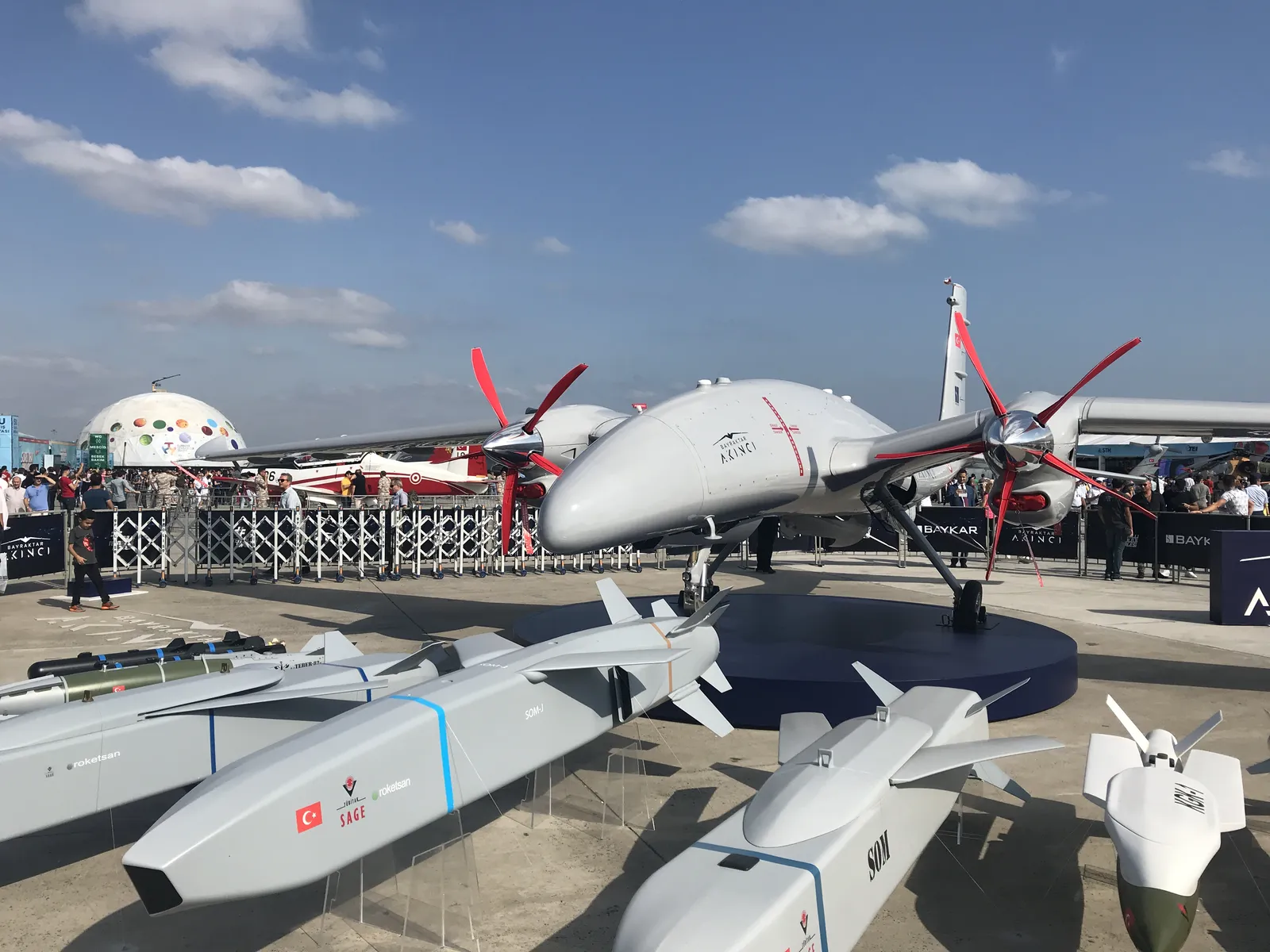
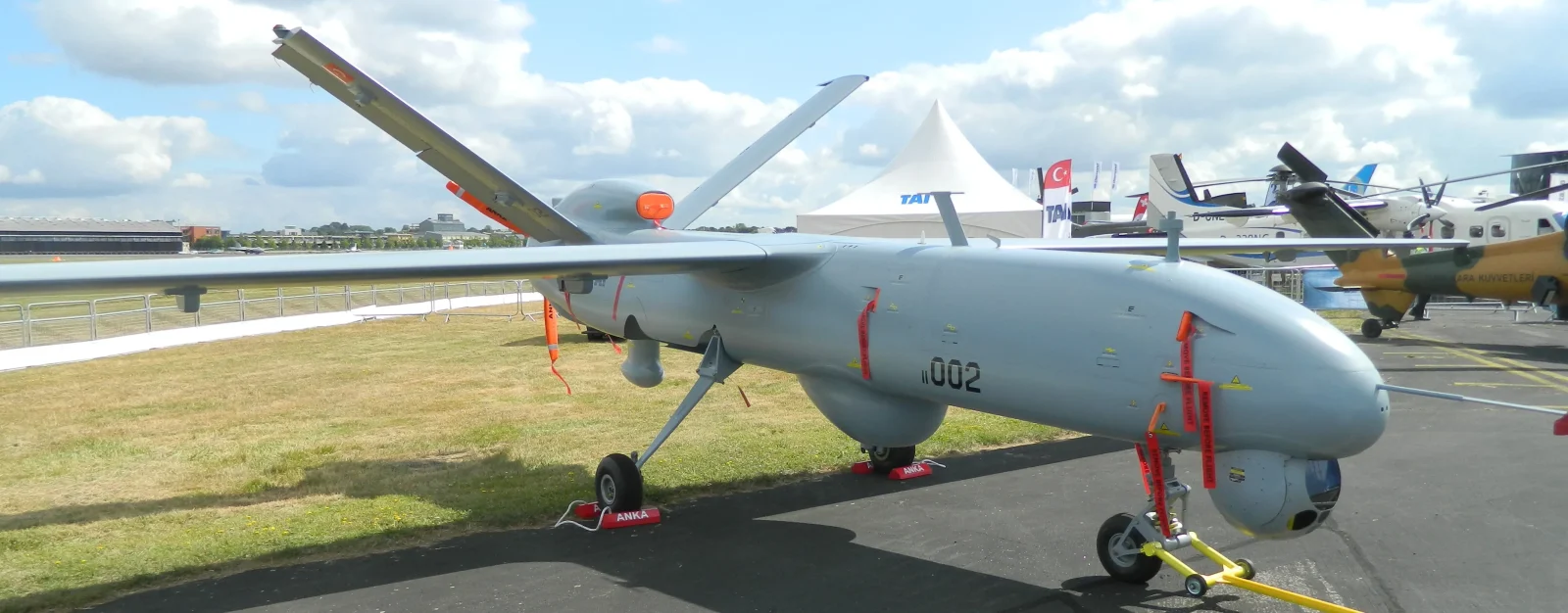
Turkish Aerospace (TUSAŞ) fields the ANKA reconnaissance drone, the twin-engine AKSUNGUR and the flying-wing ANKA-3. ANKA has been delivered to Tunisia, Kazakhstan and Chad, with Algeria, Indonesia and Malaysia among ordering countries; AKSUNGUR’s first export deliveries went to Kyrgyzstan, with Angola next in line. The company says it has signed $3.3 billion in contracts with 13 countries over five years and is lifting AKSUNGUR output from one aircraft a quarter to one a month. Most of its $2.16 billion SIPRI revenue comes from the KAAN fighter, HÜRJET trainer and helicopter programs — drones are the fast-growing slice.
STM: the quiet exporter of loitering munitions
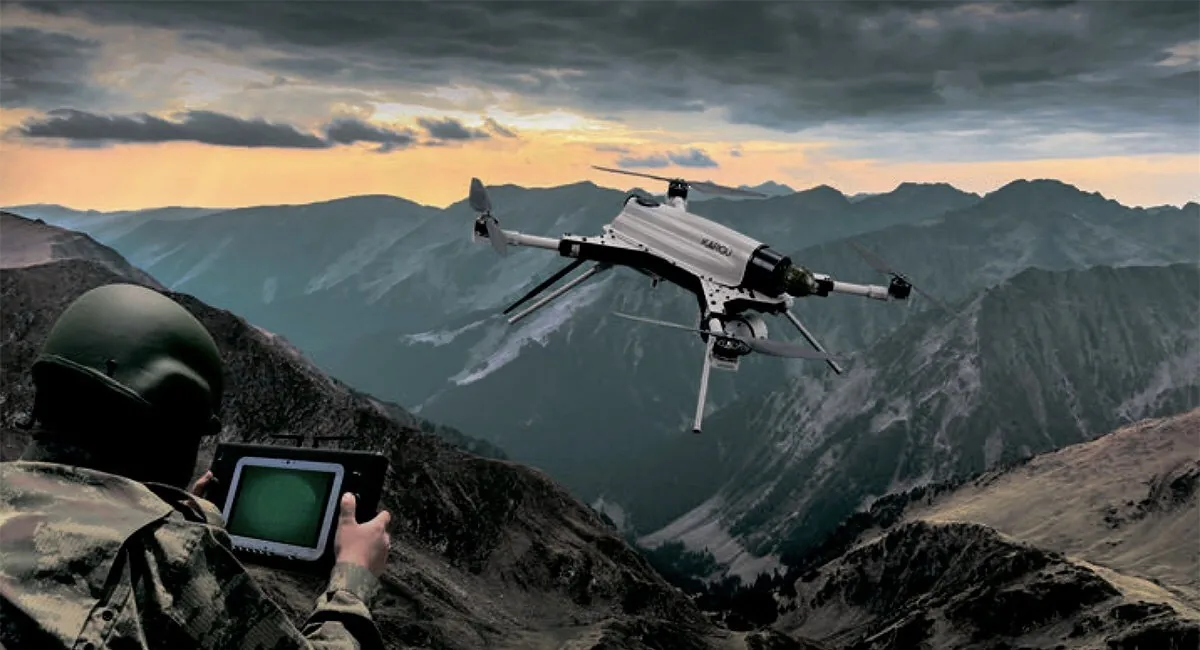
STM, maker of the KARGU rotary-wing loitering munition, has placed its drone systems in 15 countries across four continents. In January 2026 the company announced that KARGU and the fixed-wing ALPAGU had entered the inventory of a European country that belongs to both NATO and the EU — the first Turkish loitering munition inside Western Europe. A new KARGU variant with a penetrating warhead is already under export contract.
Why do Turkish firms rank lower on revenue?
The gap between Northrop Grumman’s $37.85 billion and Baykar’s $1.90 billion reflects product mix, not production muscle. Unit prices in the segments where Turkish industry concentrates — drones, armored vehicles, munitions — are far below those of bomber, space or nuclear-submarine programs, so equal platform counts translate into very unequal dollars. Strip the table down to pure-play drone makers and it inverts: Baykar is the largest pure drone company in SIPRI’s list. Price-performance is part of the same story — the TB2 and AKINCI deliver comparable mission profiles at a fraction of Western unit costs, which is precisely why they sell across Africa, Central Asia and the Gulf.
Small drones and loitering munitions: a different league
Hand-launched reconnaissance drones and one-way attack drones dwarf the Reaper class in unit numbers but cost thousands of times less, so they cannot share a ranking. The revenue leader of this league is America’s AeroVironment, maker of the Switchblade loitering munition and Puma/Raven reconnaissance drones, whose fiscal-2025 revenue rose 14 percent to $820.6 million before its merger with BlueHalo turned it into a broader defense-tech group. Ukraine out-produces the entire world in FPV drones, with output counted in millions a year; Türkiye’s STM (KARGU/ALPAGU) and Baykar’s mini-drone family are the exporting players of the segment. A dedicated ranking of FPV and loitering-munition makers is planned later in this series.
Rising players and data limits
Three developments will reshape the next edition of this table. First, Silicon Valley-backed Anduril more than doubled its revenue to $2.2 billion in 2025 and is racing General Atomics head-to-head in the US Air Force’s collaborative combat aircraft program with its YFQ-44A. Second, the birth of the jet-powered fighter-drone segment — KIZILELMA, YFQ-42A, YFQ-44A — creates a market with far higher unit values than the Reaper class. Third, the transparency problem: Russian producers, Kronstadt included, publish no reliable production data, and Chinese firms do not disclose domestic inventories. Where data does not exist, this research says “unknown” — inventing numbers is what it refuses to do.
Could the ranking change in five years?
Easily. General Atomics’ MQ-9B order book is growing across Europe, and the US CCA program opens a new revenue line for both it and Anduril. On Baykar’s side, KIZILELMA series production, the ship-borne TB3’s export potential and the Italian and Ukrainian lines mean access to the NATO market from within. Chinese producers retain a price advantage across Africa and Asia if they weather their procurement purges, and European demand for long-range surveillance drones is already visible in Elbit’s $22.6 billion backlog. You can compare the technical profiles of these platforms in the Envanter Medya Defense Atlas.
How this research was prepared
Data year: revenue figures are SIPRI’s 2024 defense revenues published in December 2025 (constant 2024 dollars). Export, delivery and capacity data come from official company statements made between January 2025 and August 2026, each dated in the text. Companies examined: nine groups producing MALE and heavy strike drones, plus three producers from the small-drone/loitering-munition segment. Ranking criteria: defense revenue, verified production/deliveries, exports, operator countries and the nine-criterion EM-GDPI composite. Currency: all figures in US dollars; SIPRI data uses the institute’s own constant-price conversion, company statements are quoted at announced dollar values; no additional conversion applied. Missing data: domestic production totals of Chinese and Russian makers, and the drone-segment revenues of IAI and Elbit, are not public; these fields are marked “unknown” rather than estimated. EM-GDPI: nine criteria (production 25, revenue 15, exports 15, operators 10, product breadth 10, capacity 10, backlog 5, technology 5, growth 5) scored 0-10 and weighted; scores are relative within the group and the index is editorial. Where data was missing, the relevant criterion was scored conservatively and noted.
| Company | Data reliability | Note |
|---|---|---|
| Baykar, Turkish Aerospace, STM | A | Official, current company/institution statements + SIPRI |
| Elbit, IAI, AeroVironment | A-B | Public financial reports; drone-segment breakdown limited |
| General Atomics, Northrop Grumman | B | Strong company statements; private-company/segment revenue is SIPRI estimate |
| AVIC, CASC | C | Export records reliable (SIPRI); domestic output and revenue split opaque |
| Kronstadt | D | No reliable current data; excluded from rankings |
Frequently asked questions
Who is the world’s largest military drone manufacturer?
It depends on the measure: Northrop Grumman by defense revenue, General Atomics by cumulative deliveries (1,000+ aircraft), and Baykar by export agreements (37 countries) and annual production capacity. Baykar ranks first in Envanter Medya’s composite index.
Where does Baykar rank globally?
73rd in SIPRI’s 2024 defense revenue ranking — one step above General Atomics — and first in armed-drone exports for the fifth consecutive year, with $2.2 billion in 2025 exports.
How many countries operate the Bayraktar TB2?
34 countries have the TB2 in inventory, with 36 export agreements signed. The fleet has flown more than one million hours.
How many countries have bought the AKINCI?
Agreements cover 16 countries and deliveries have reached 10; cumulative deliveries are expected to reach 120 aircraft by the end of 2026.
Which countries fly Turkish Aerospace drones?
ANKA serves Tunisia (5), Kazakhstan (3) and Chad (2), with Algeria, Indonesia and Malaysia on order; AKSUNGUR’s first exports went to Kyrgyzstan, with Angola awaiting delivery.
How many drones has General Atomics built?
The company says it has delivered more than 1,000 unmanned aircraft in over 30 years — the largest cumulative total any manufacturer discloses.
Which country produces the most military drones?
By segment: Türkiye leads Reaper-class exports, the United States leads cumulative Western production, China holds an undisclosed but large domestic inventory — and in small FPV drones Ukraine is the undisputed volume leader with millions per year.
Where does China rank in drone exports?
SIPRI records 200+ armed drones exported to 17 countries in 2013-2023, which made China the long-time volume leader; in recent years Türkiye has overtaken it in both customer countries and export revenue.
When will KIZILELMA enter service?
First delivery of the jet-powered KIZILELMA is planned for the first quarter of 2026; five prototypes and two series-production aircraft have been completed.
Which countries use the KARGU?
STM has exported KARGU to more than 10 countries, and its drone systems reach 15 countries on four continents. In January 2026 KARGU and ALPAGU entered the inventory of a NATO and EU member state.
Who is Israel’s biggest drone maker?
Elbit Systems by revenue ($6.28 billion defense revenue); IAI by export history (49 customers, 80% of output exported). Both count 20+ active users in the Reaper class.
What is the world’s largest defense company overall?
Lockheed Martin, with $64.65 billion in 2024 defense revenue per SIPRI — though its drone portfolio is limited.
How strong is Türkiye’s defense industry globally?
2024 marked its strongest showing ever in SIPRI’s Top 100: five companies (ASELSAN 47th, Turkish Aerospace 65th, Baykar 73rd, Roketsan 87th, MKE 93rd) with a combined $10.1 billion in revenue.
What is the difference between a drone and a UCAV?
A drone (UAV) is any unmanned aircraft; a UCAV — unmanned combat aerial vehicle — is one designed to carry and release weapons. The TB2, AKINCI, MQ-9 and Wing Loong are UCAVs; you can browse their technical profiles in the Defense Atlas.
Sources and methodology notes
This study is an editorial research piece prepared by Envanter Medya by cross-checking publicly available official company data, institutional reports, contract and delivery records and industry sources. Principal sources:
- SIPRI Top 100 Fact Sheet (December 2025) — 2024 defense revenues, ranks, annual changes, China/Russia data caveats
- Baykar official statements — export totals (2024: $1.8bn; 2025: $2.2bn), country counts, production capacity, one million flight hours
- General Atomics Aeronautical Systems — 1,000+ delivery statement, MQ-9B customer list
- Elbit Systems FY2024 results — $6.83bn revenue, $22.6bn backlog
- IAI FY2024 financial results — record $6.1bn revenue, ~$25bn backlog
- STM press releases — KARGU/ALPAGU exports, 15 countries / 4 continents
- Turkish Aerospace statements and defense-press records — ANKA/AKSUNGUR deliveries, $3.3bn contracts with 13 countries
- AeroVironment FY2025 results (SEC) — $820.6m revenue
- CSIS ChinaPower and SIPRI arms-transfer database — China’s 200+ armed drones to 17 countries
- Anduril 2025 revenue — industry analyses ($2.2bn)
Last updated: 15 August 2026. This page is living research and will be updated in annual reporting seasons and after major contract announcements. The second file of Envanter Medya’s Global Defense Industry Research examines the world’s largest armored vehicle manufacturers.