Gulf Surface-Fleet Recapitalisation: The Corvette and OPV Decision


Executive Summary
Gulf navies are recapitalising their surface fleets around the corvette and offshore-patrol-vessel (OPV) tier, the workhorse class for littoral security, maritime-infrastructure protection and presence in a confined, contested sea space. The competition is mature and crowded: Naval Group’s Gowind, Navantia’s Avante family, the German MEKO lineage, Italian offerings and Turkey’s Ada and İstif-class designs all target the same requirement. This analysis compares them on the criteria that govern Gulf naval procurement — combat-system openness, air-defence depth, local build participation and sustainment — and argues that platform steel is now the least differentiated part of the decision.
Operational Context
The Gulf maritime environment imposes a specific set of demands: shallow and congested waters, short engagement timelines, a dense civilian and commercial traffic picture, and a threat set dominated by fast inshore attack craft, anti-ship cruise missiles and, increasingly, uncrewed surface and air systems. The 2019–2024 period demonstrated that maritime infrastructure — terminals, platforms and the tankers that service them — is a primary target, and that air and surface threats arrive with little warning in cluttered conditions.
This favours a vessel optimised for layered self-defence and persistent presence over blue-water reach. The corvette/OPV tier fits: large enough to carry a meaningful sensor and air-defence fit, small enough to field in numbers and to operate in shallow approaches. The procurement question is not displacement or top speed but whether the combat system can fuse a crowded picture and prosecute multiple simultaneous threats, and whether the buyer can sustain and adapt that system over a thirty-year hull life without depending on a single foreign gatekeeper.
| Design | Origin | Displacement (approx.) | Air-defence fit | Local-build track record |
|---|---|---|---|---|
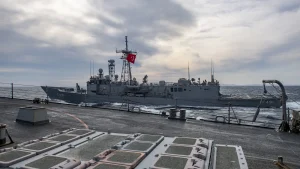
| Ada / İstif-class | Turkey | ~2,400–3,000 t | Point/local-area, national CMS | Export builds offered with ToT |
| Gowind 2500 | France | ~2,500 t | Local-area (VL MICA) | Multiple export local builds |
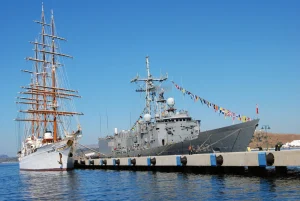
| Avante 2200 / Al Jubail | Spain | ~2,500–3,000 t | Local-area, in Gulf service | Delivered to Gulf operator |
| MEKO A-200 | Germany | ~3,700 t | Local-area, modular | Extensive export licensing |
Figures are indicative and configuration-dependent; air-defence fit varies by buyer specification.
Comparative Analysis
Combat system and openness. The decisive differentiator at this tier is the combat-management system (CMS) and how open it is to the buyer’s preferred sensors and weapons. European designs typically pair the hull with a national CMS and a defined weapons set; integrating a buyer’s existing or non-origin systems is possible but adds cost and time. The Turkish offering’s selling point is a national CMS marketed as open to integration, including non-Turkish effectors — attractive to a buyer wanting to standardise across a mixed fleet, though the integration claims warrant trials rather than acceptance at face value.
Air-defence depth. All four can be fitted for local-area air defence, but the realistic ceiling varies. For Gulf operators facing saturating anti-ship and air threats, the relevant questions are vertical-launch cell count, the missile family integrated, and whether the radar and CMS can manage simultaneous engagements. A larger hull such as the MEKO A-200 offers more growth margin; the smaller corvettes trade that for numbers and shallow-water access.
Local build and industrial participation. Gulf naval programmes increasingly require local construction, assembly or sustainment as a condition, not a bonus. Navantia, Naval Group and the German yards have established export-build models; Turkey has competed aggressively on technology transfer and local-yard participation. The substance behind these offers — how much real work and IP transfers, versus assembly of imported modules — is where buyers should concentrate diligence.
Sustainment and lifecycle. A thirty-year hull is a thirty-year sustainment relationship. The mature European suppliers offer deep, proven support networks; the Turkish offer competes on cost and willingness to localise. For a Gulf buyer, the trade is between an established support tail and a more sovereign, lower-cost arrangement whose wartime resilience is less proven.
Procurement Considerations
Four tests should structure a Gulf corvette/OPV decision. First, CMS openness, contractually defined: the right to integrate chosen sensors and weapons without per-change vendor veto. Second, air-defence growth margin: cell count and power/cooling headroom for the threat as it evolves, not only as it is today. Third, real industrial transfer: a specified work-share and IP package, audited against the build plan. Fourth, sustainment guarantees: spares and upgrade access defined for surge conditions. On these, hull form and displacement are secondary.
Outlook
The Gulf corvette/OPV competition will not be decided by naval architecture, where the contenders are closely matched and all adequate to the environment. It will be decided by combat-system openness, air-defence growth, the substance of industrial participation and the credibility of long-term sustainment. European yards bring proven support and integration pedigree; the Turkish offering competes on cost, transfer willingness and an open-CMS proposition that, if it holds up under trials, addresses a real Gulf requirement to standardise across mixed fleets. For procurement officers, the disciplined approach is to specify combat-system and sustainment terms first and let hull selection follow from them — the reverse of how these competitions are often marketed.