The Kerch Bridge span that fell: is the bigger loss the road or the strait?

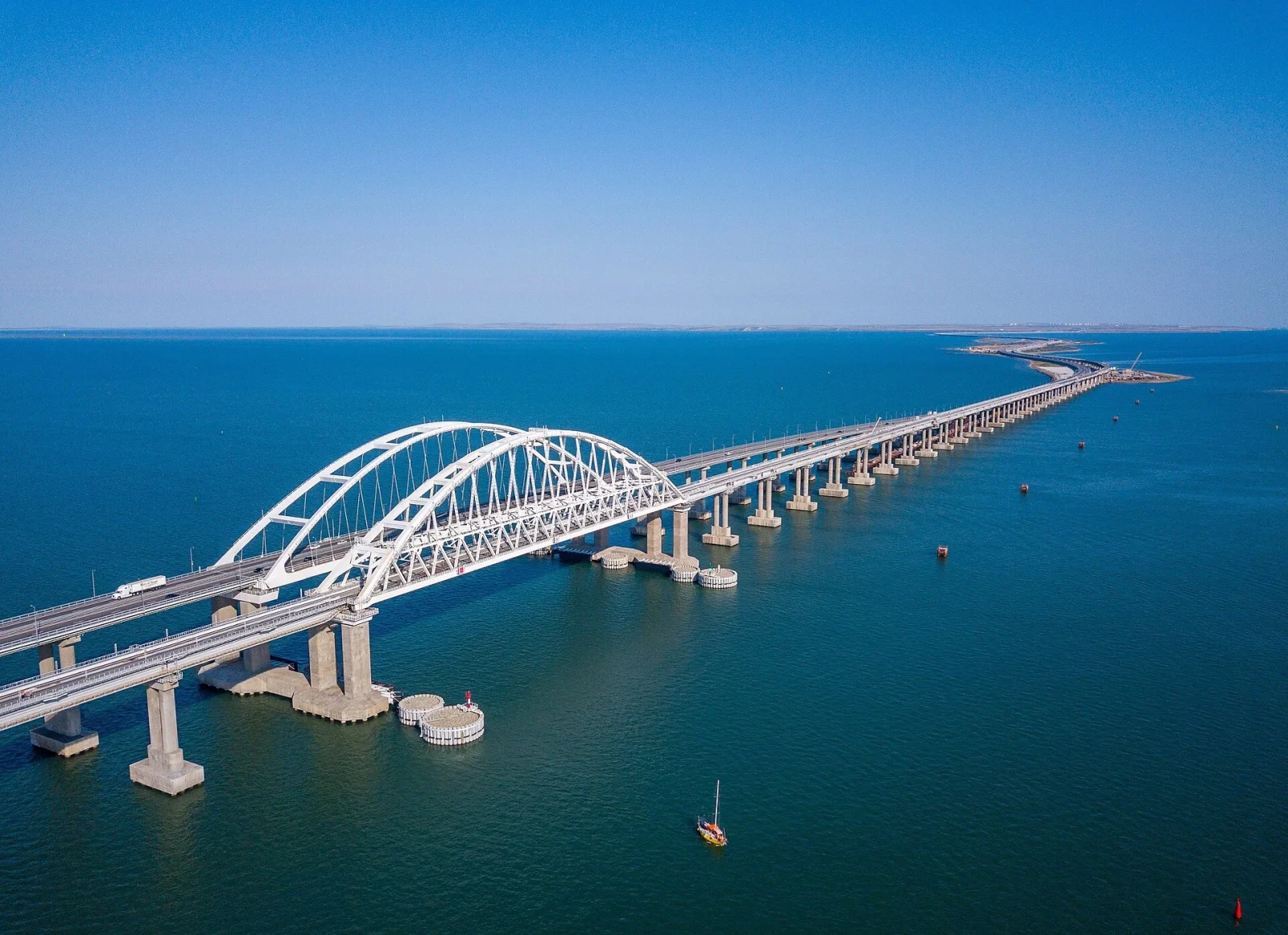
Ukraine struck the Kerch (Crimean) Bridge, which links Russia to Crimea, annexed by Russia in 2014, on two consecutive nights, 16 and 17 November. In the second attack, the steel arch of the road bridge and the span beneath it fell into the sea.
The collapse is reported by Ukraine’s General Staff and the Security Service of Ukraine (SBU) and is supported by published video and satellite imagery. Russia has not detailed the extent of the damage. Kremlin spokesman Dmitry Peskov said the bridge would be restored and would be “even better than before”, but gave no timeline. That road traffic is halted is confirmed by both sides. That the railway section is standing with a damaged arch is a claim by Ukraine’s General Staff; Russian officials have announced that train services have resumed.
For the bridge’s structure and earlier attacks, see our timeline piece. This analysis asks a different question: why is the fallen section not just another span?
Why it matters: the navigation arch is down
The Kerch Bridge consists of two parallel structures: a four-lane road bridge and a double-track rail bridge. Its longest span is the roughly 227-metre arched navigation span, which sits over the main shipping channel between the Sea of Azov and the Black Sea. The October 2022 truck bomb also brought down sections of the road bridge, but those were standard girder spans away from the channel. This time, the arch over the channel has fallen.
Data → function → limit → meaning: The arch provides, in a single span, the width and clearance ships need to pass underneath. Its limit is that the whole span depends on one load-bearing system; if the arch goes, the deck goes with it. The meaning shows in the repair time: fabricating a long steel arch, moving it and seating it over open water is a longer job than replacing a standard girder span. This is an engineering inference; Russia has not yet given a timeline.
The second effect is at sea. The debris fell directly into the shipping channel, blocking the passage of large vessels through the strait, at least temporarily. Until the channel is cleared, traffic to and from Sea of Azov ports will be affected. This is a separate consequence of the damage, independent of overland supply.
How it was done: Ukraine’s account
Ukrainian President Volodymyr Zelensky described the strike as the seventh stage of an operation that had been under way for weeks. According to the SBU, the operation lasted about a month: air defence, radar and electronic warfare assets around the bridge were targeted first, and then the bridge itself.
The systems Zelensky listed include Ukrainian-developed missiles and drones such as the Neptune cruise missile, the FP-5 Flamingo, the Ruta and the Palianytsia. Netherlands-based Destinus, which makes the Ruta, said seven Ruta missiles hit the bridge on the second night and that one span collapsed. All of these are claims by a party to the war or by a manufacturer and have not been independently verified. Accounts also differ on which weapon struck which part of the bridge.
Russia’s Defence Ministry said it shot down 1,336 and 1,441 Ukrainian drones over the same two nights. These figures cannot be independently verified either.
What came before, what is new
The three previous major attacks on the bridge used close-range or sabotage methods: an explosive-laden truck in October 2022, Sea Baby uncrewed surface vessels in July 2023, and underwater charges placed on the piers in June 2025. After 2023, Russia surrounded the bridge with floating barriers, barges and additional air defence systems.
What is new is the method. Ukraine claims a phased campaign with stand-off missiles and drones that first wore down the defences and then struck the target. If accurate, it shows that at one of Russia’s most heavily defended points, the defence itself became the first target.
Why the common framing falls short: Crimea is not “cut off”
Crimea’s link to the mainland has not been severed. The railway is running, there is a ferry line, and there is a land route around the Sea of Azov. Russian officials say the bridge carried little freight and that supplies to Crimea and Sevastopol will not be affected. Ukrainian Navy spokesman Dmytro Pletenchuk had also said earlier that the bridge’s logistical importance for Russia was declining.
The real effect is better read as a shift of load to other channels. The weight of military supply now falls on the railway, the ferry and the long land route, and each has its own weakness. Ferries have been attacked before and did not run on 17 November because of the weather. The land route lies within Ukraine’s reach; Ukraine’s General Staff says the Chonhar and Henichesk bridges were put out of action this autumn.
Possible consequences and counter-moves
- The rail arch (possibility): The railway is standing and operating. Ukraine may turn the same phased method against the rail arch. Russia’s counter-move could be to pull air defence systems from other fronts, where they are already known to be scarce.
- Retaliation (reported): Russia reportedly struck the Northern and Southern bridges over the Dnipro in Kyiv.
- Political timing (possibility): The strikes came just before a planned meeting of Putin, Xi Jinping and Trump in Shenzhen on 19 November. Peskov did not rule out a link between the two.
- A show of rapid repair (speculation): Given the symbolic weight Moscow attaches to the bridge, an attempt to partially reopen traffic quickly with temporary solutions can be expected. Whether that is technically possible depends on the state of the arch.
Strategic and industrial impact
Strategically, the bridge is for Russia both a supply line and a symbol of its post-2014 Crimea policy. Industrially, the notable point is Ukraine’s claim that it carried out the operation with weapons it developed or produces itself. If confirmed, it could mean less dependence on outside approval for long-range strikes. For Black Sea littoral states, the blockage in the Kerch Strait is a new item to watch for maritime trade and freedom of navigation.
What we know / what we don’t
Known: The bridge was struck on the nights of 16 and 17 November. Road traffic has stopped. The collapse of the arched road span is supported by imagery. Rail services have resumed. Russia has said it will repair the bridge.
Unknown: How long repairs will take, when the shipping channel will reopen, how badly the rail arch is damaged, how many missiles and drones were used and which hit where. Russia says it has completed its damage assessment but has not published the results.
What to watch
The first indicator will be Moscow’s repair timeline and the date the shipping channel reopens. The bigger question: if one of Russia’s most heavily defended targets can be brought down by a month-long phased campaign, which front will lose air defences to protect the rail arch that is still standing?
Asaf Türk