MİĞFER: ASELSAN’s AI Bodyguard That Shoots Kamikaze Drones Out of the Sky

Small, cheap drones have inverted the economics of ground warfare: a multi-million-dollar tank can be destroyed by a kamikaze drone costing a few thousand, diving from an angle no camouflage or armour can guard. ASELSAN’s MİĞFER — “helmet” in Turkish — is Türkiye’s response to that inversion: an integrated, AI-driven shield that detects micro-drones and shoots them down with direct fire from the very platform it protects.
MİĞFER is a hard-kill counter-UAV system — it physically destroys the target with gunfire rather than merely jamming it. It is designed to neutralise mini and micro unmanned aerial vehicles at close range, and crucially, those resistant to jamming. That is the crux of the problem: modern drones guided by fibre-optic cable or onboard autonomy ignore electronic jammers entirely, and the only way to stop them is to knock them out of the air.
Four senses for one hunter
MİĞFER watches its surroundings with a multi-layered sensor suite that combines an acoustic sensor picking up the buzz of rotors, LIDAR (a laser sensor that maps its surroundings in 3-D), radar, and electro-optical subsystems — round the clock and in all weather. The senses cross-check one another to drive the false-alarm rate to a minimum, so the system does not burn through ammunition chasing birds and shadows.
Key specifications
| Type | Self-defence hard-kill counter-UAV system |
| Targets | Mini and micro UAVs, including jamming-resistant types |
| Sensors | Acoustic, LIDAR, radar and electro-optical |
| AI | Automatic detection and classification, threat prioritisation, fire assistance |
| Design | Minimal, compact, cost-effective turret |
| Standards | Compliant with MIL-STD-810 and MIL-STD-461 |
An artificial brain runs the fight
Artificial intelligence is the backbone of MİĞFER. Image-processing algorithms handle automatic threat detection, tracking and classification, while supporting algorithms prioritise engagements when several drones attack at once — the swarm tactic designed to overwhelm human defenders. The system assists the gunner with AI-supported fire control, up to fully automated target engagement, compressing those critical seconds of reaction time into fractions.
A helmet on the head, not a fortress in the rear
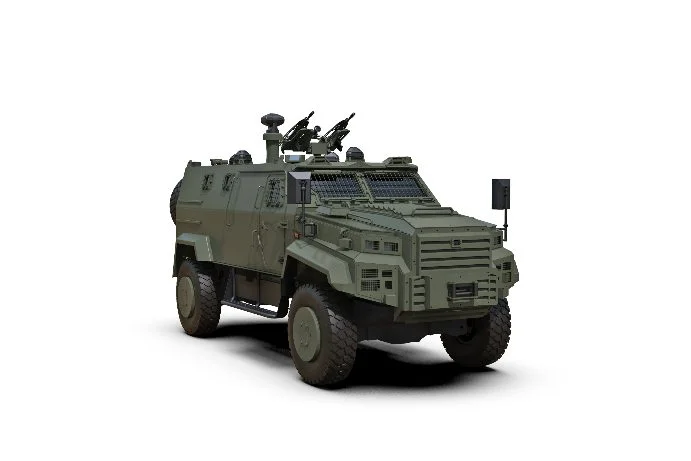
ASELSAN chose a name that captures the philosophy: like a helmet stays with the soldier’s head, MİĞFER stays with its platform. Its minimal, compact turret mounts on armoured vehicles and various platforms to defend themselves without waiting for a distant air-defence umbrella. The system integrates smoothly with higher command-and-control via wired and wireless links, so each turret becomes a node in a defensive network that shares warnings and targets rather than a lone gun.
Why it matters
The front lines in Ukraine are a daily demonstration that the cheapest weapons of war now destroy the most expensive, and that the era of armour confident in its own thickness is over. With MİĞFER, ASELSAN offers a cost-effective, practical answer to a question that haunts every army on earth: how do you protect your striking power from a relentless swarm of hornets? Türkiye’s answer is a smart helmet over every head — one that sees, classifies, decides and fires before the hornet completes its dive.