World’s Largest Tank Manufacturers: Production, Orders and Operators Compared (2026)

For thirty years the tank business was a museum with a production line attached. The war in Ukraine changed that: order books for the world’s largest tank manufacturers are now at their highest levels since the Cold War. Who is biggest depends, as ever, on the ruler. By group defense revenue it is General Dynamics, maker of the M1 Abrams. By active orders it is KNDS, whose new Leopard 2A8 has racked up 350 orders from five NATO countries. By delivery tempo it is South Korea’s Hyundai Rotem, which shipped 180 K2 Black Panthers to Poland in record time and signed a $6.5 billion follow-on. And the newest entrant is Türkiye: serial production of the ALTAY began in October 2025, and BMC’s new Ankara plant — rated at up to 96 tanks a year — opened as one of Europe’s largest tank factories. This is file three of Envanter Medya’s Global Defense Industry Research, following the world’s largest armored vehicle manufacturers.
Editorial note: This ranking is an editorial research piece prepared by Envanter Medya using publicly available data; it is not an official international ranking. Sources and methodology are explained at the end.
The research at a glance
“Largest” by which measure?
Unlike the crowded armored vehicle market, tank production is a club with few members and long-lived products — the count of active Western tank lines fits on one hand. Europe’s rearmament has nonetheless pushed order books to a thirty-year high, and the answer to “who is biggest” shifts with the question: revenue, active orders, delivery tempo or historical user base? This study measures all of them separately.
By defense revenue: General Dynamics leads clearly
In SIPRI’s December 2025 data for 2024, the largest tank-building group is General Dynamics at $33.63 billion — a portfolio spanning nuclear submarines to Strykers, of which the Abrams is one slice. China’s NORINCO follows at $13.97 billion; Rheinmetall, Challenger 3 builder and Leopard partner, grew 36 percent to $8.2 billion. KNDS, the Leopard 2 and Leclerc house, ranks 42nd with revenue up 14 percent and a backlog that reached €23.5 billion by December 2025.
Source: SIPRI Top 100 (December 2025). Only part of each group’s revenue comes from tanks. Full breakdowns for KNDS (42nd) and Hyundai Rotem were not charted; no comparable public data exists for BMC or Russia’s UVZ — marked “unknown” rather than estimated.
Do not confuse revenue with production muscle: the tank is the lowest-volume, highest-unit-value land platform in the defense industry. A group’s revenue rank says little about its tank line’s tempo — most of General Dynamics’ income comes from submarines and aerospace. Read the order and delivery tables separately.
By production, orders and deliveries: the verified numbers
| Company | Country | Tank | Verified production/order indicator | Data type |
|---|---|---|---|---|
| GD Land Systems | USA | M1 Abrams, M1E3 | Poland: 116 M1A1s complete + 117 of 250 SEPv3s delivered (finishing 2026); Romania 54 and Australia 75 ordered; M1E3 prototype delivered December 2025 | O |
| KNDS | Germany-France | Leopard 2A8, Leclerc | 350 Leopard 2A8s on order (Germany 123 + 75 planned, Netherlands 46, Czechia 44, Lithuania 44, Sweden 44); output ~58 tanks/year; 41-tank assembly plant being built in Kaunas; first 2A8s hand over from April 2026 | O |
| Hyundai Rotem | S. Korea | K2, K2PL | 180 K2GFs delivered to Poland — complete; August 2025 second contract worth $6.5bn: 116 K2GF (2026-27) + 64 K2PL (2028-30, 61 built in Poland); framework up to 1,000 tanks | O |
| Rheinmetall | Germany | Challenger 3 (RBSL), KF51 | 148 Challenger 3 conversions for the UK (via RBSL with BAE); KF51 production base in Hungary; major Leopard supplier | O |
| BMC 🇹🇷 | Türkiye | ALTAY T1/T2 | Serial production began October 2025, first tanks handed to the Turkish Land Forces. Schedule: 3 in 2025, 11 in 2026, 41 in 2027, 30 in 2028 (85 T1s); Ankara plant rated at 8/month, 96 tanks/year; T2 with domestic BATU engine from 2028 | O |
| Mitsubishi HI | Japan | Type 10 | Low-rate domestic production (~10/year); no exports | E |
| UVZ | Russia | T-90M | No reliable production data published since sanctions; new-build and depot modernization mixed | U |
| NORINCO | China | Type 99A, VT-4 | Domestic output undisclosed; VT-4 exported to Thailand, Pakistan and Nigeria | U / E |
Data type: O = official/company statement, E = credible industry estimate, U = unknown. Modernization of existing hulls and new-build production are different processes; the table relies on new-build and firm orders wherever possible.

By active orders: the Abrams wave races the K2
Different program types shown together: Abrams and K2 are export orders, Leopard 2A8 a multinational procurement, ALTAY the announced total of a domestic program (85 by 2028), Challenger 3 a hull conversion. Poland’s K2 framework can grow to 1,000. Turkish program highlighted.
By operator countries: the Leopard still rules
Leopard 2 and Abrams counts reflect historical user bases (estimate label); K2 and ALTAY reflect current status. Turkish program highlighted.
The Envanter Medya composite index: EM-GDPI
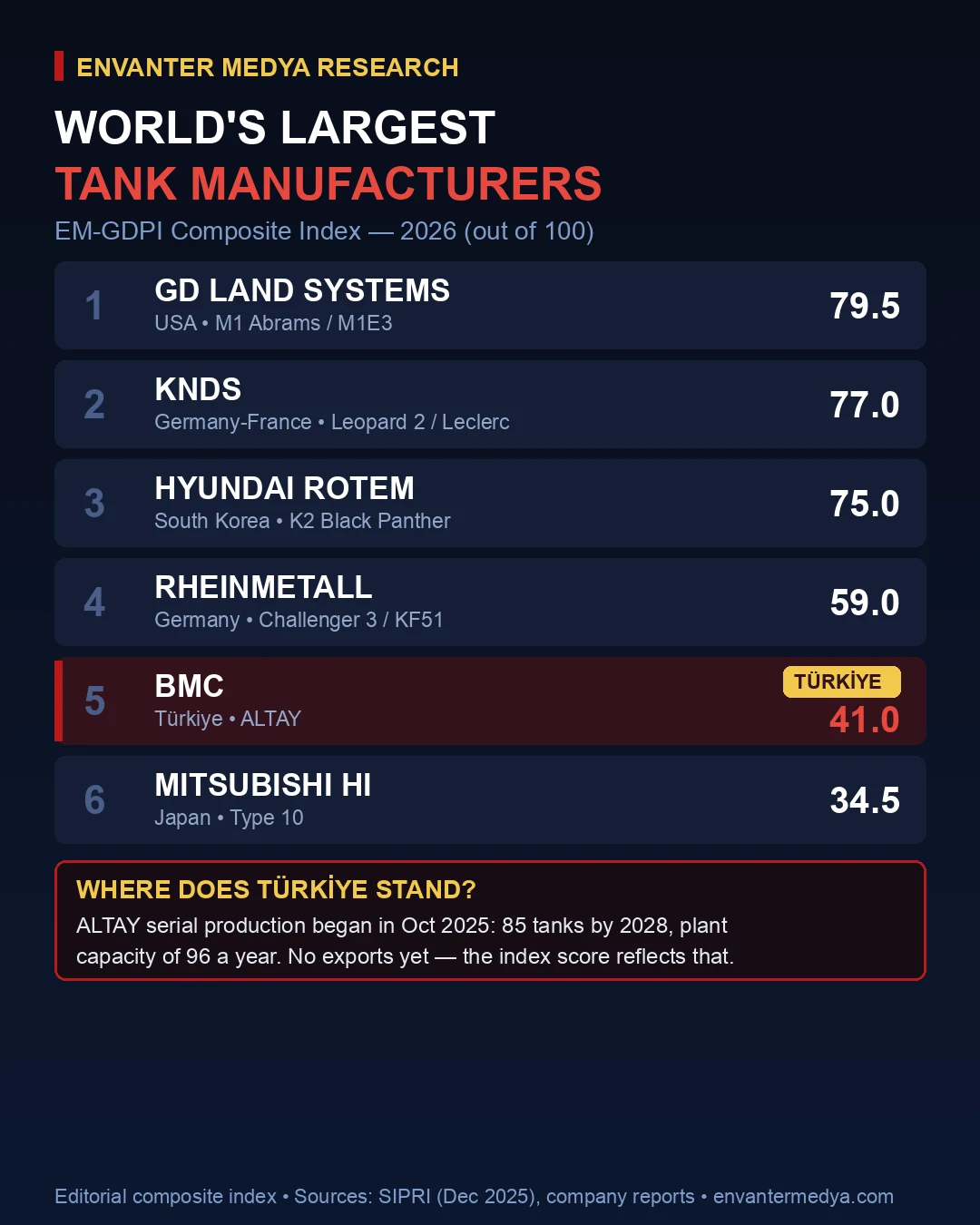
Nine weighted criteria (production 25, revenue 15, exports 15, operators 10, breadth 10, capacity 10, backlog 5, technology 5, growth 5) produce a 100-point editorial composite. UVZ and NORINCO were not scored because their domestic output is opaque — that does not mean Russia and China build no tanks; it means no data, no score.
Editorial composite index; not an official ranking. UVZ and NORINCO unscored for lack of data. Turkish company highlighted.
What lifts General Dynamics to first is the sheer size of the active Abrams wave (495 tanks) plus revenue power; KNDS follows on its 19-country user base and record backlog, Hyundai Rotem on the world’s fastest active delivery tempo. BMC’s 41 points are a snapshot of a program ten months into serial production: production and export scores are low because the tanks are only now leaving the line — while the capacity criterion already puts the Ankara plant’s 96-a-year ceiling near the top of the field. If the delivery schedule holds, next year’s update moves BMC up.
Where does Türkiye stand?
Türkiye is the newest member of the tank-makers’ club, and honesty requires saying so plainly: the ALTAY has not yet reached high production totals. Serial production started in October 2025, with the first tanks handed to the Turkish Land Forces at the opening of BMC’s Ankara facility. The announced schedule runs 3 tanks in 2025, 11 in 2026, 41 in 2027 and 30 in 2028 — 85 T1s ahead of the domestically powered T2. The total program is 250 tanks; plant capacity is eight a month.

The real depth of the Turkish program is the ecosystem around the tank: MKE series-produces the 120 mm gun and its ammunition; Roketsan developed the composite armor package and AKKOR, one of the few combat-proven active protection systems in serial integration anywhere; ASELSAN supplies the VOLKAN fire control system and SARP remote weapon station; BMC Power’s BATU engine is in testing. And Türkiye’s tracked export muscle is not zero: the KAPLAN MT medium tank, co-developed by FNSS with Indonesia, already serves in the Indonesian army as the Harimau — a Turkish-designed tank that has, in fact, been exported. The honest reverse view: ALTAY’s operator count is one, its exports are none, and the first 85 tanks run on an imported powerpack — gaps the BATU engine and the delivery schedule are meant to close.
How this research was prepared
Data year: revenues from SIPRI’s December 2025 release (2024, constant dollars); order and delivery data from official announcements of January 2025 – August 2026. Scope: eight groups building main battle tanks; medium tanks (KAPLAN MT) noted in the Türkiye section. Currency: US dollars; KNDS backlog quoted in euros as announced. Missing data: UVZ’s and NORINCO’s domestic outputs and the full revenue breakdowns of Hyundai Rotem and KNDS are not public — marked “unknown”, not estimated. EM-GDPI: nine criteria scored 0-10, weighted; relative within the group and editorial; data-deficient companies unscored.
| Company | Data reliability | Note |
|---|---|---|
| GDLS, KNDS, Hyundai Rotem, Rheinmetall, BMC | A | Current official contract and delivery announcements |
| Mitsubishi HI | B | Traceable through budget documents; low transparency |
| UVZ, NORINCO | D | No reliable current data; excluded from the index |
Frequently asked questions
Who is the world’s largest tank manufacturer?
By group revenue, General Dynamics; by active Leopard 2A8 orders, KNDS (350 tanks); by delivery tempo, Hyundai Rotem. General Dynamics Land Systems tops Envanter Medya’s composite index.
Where does Türkiye rank in tank production?
Türkiye joined the small club of active tank producers when ALTAY serial production began in October 2025. Its plant capacity (96/year) is top-tier; total output and exports are still at the starting line. BMC ranks fifth in the EM-GDPI with 41 points.
How many ALTAY tanks will be built?
The announced schedule delivers 85 T1s by 2028 (3+11+41+30); the total program is 250 tanks, with the domestically powered T2 entering production in 2028.
How many countries operate the Leopard 2?
Nineteen. The new 2A8 variant has 350 orders from Germany, the Netherlands, Czechia, Lithuania and Sweden.
How many K2 tanks will Poland get?
The first 180 K2GFs are delivered; the August 2025 second contract adds 116 K2GF and 64 K2PL, with a framework of up to 1,000 tanks.
Who is buying the Abrams now?
Poland (116 M1A1 + 250 SEPv3), Romania (54) and Australia (75) lead the current wave; the historical user base is ten countries.
How many tanks does Russia build a year?
No reliable public figure exists. UVZ mixes new production with depot modernization; this research declines to publish unverifiable numbers.
What is the world’s fastest tank production line?
Among lines with published ceilings, BMC’s Ankara plant (96/year) ranks first; in active delivery tempo Hyundai Rotem’s Changwon line leads, while KNDS’s Leopard line runs near 58 a year.
Is the Challenger 3 a new tank?
No — 148 British Challenger 2 hulls are being converted to Challenger 3 standard by RBSL, the Rheinmetall-BAE joint venture.
Has Türkiye ever exported a tank?
Yes, in the medium class: the FNSS-designed KAPLAN MT serves in Indonesia as the Harimau. The main battle tank ALTAY has no export customers yet. Platform profiles are in the Envanter Medya Defense Atlas.
Sources and methodology notes
This study is an editorial research piece prepared by Envanter Medya by cross-checking publicly available official company data, institutional reports, contract and delivery records and industry sources. Principal sources:
- SIPRI Top 100 Fact Sheet (December 2025) — 2024 defense revenues and growth
- KNDS press releases — Leopard 2A8 orders, Kaunas plant, backlog
- The Defense Post — 350 Leopard 2A8 orders from five NATO countries
- Defence Industry Europe — Poland’s $6.5bn second K2 contract; 180 K2GFs completed
- European Security & Defence — ALTAY serial production start
- Defense News — BMC Ankara plant capacity and delivery schedule
- Defence Industry Europe / Defence24 — Poland’s Abrams deliveries
- ESD — “What next for Abrams?” — M1E3 program, Romania and Australia orders
- Defense Express — Leopard 2A8 output (~58/year)
Last updated: 15 August 2026. This page is living research, updated with delivery and contract announcements. File four of this series examines the world’s largest ammunition manufacturers.