World’s Largest Air Defense Manufacturers: Layers, Orders and Operators Compared (2026)

As drones and ballistic missiles keep driving down the price of attack, the price — and value — of defense keeps climbing: air defense is now one of the defense industry’s fastest-growing markets. Atop the table of the world’s largest air defense manufacturers sit RTX, architect of the Patriot, and Lockheed Martin, maker of the PAC-3 and THAAD. The name in third place is one of this series’ most striking findings: Türkiye’s ASELSAN. The Steel Dome (Çelik Kubbe) layered architecture entered Turkish service on 27 August 2025 with a first delivery of 47 systems; the long-range SİPER-1 is on duty; and ASELSAN now builds every layer from gun systems to long-range interceptors under one roof — something few companies anywhere can claim. This is file six of Envanter Medya’s Global Defense Industry Research, following the world’s largest missile manufacturers.
Editorial note: This ranking is an editorial research piece prepared by Envanter Medya using publicly available data; it is not an official international ranking. Sources and methodology are explained at the end.
The research at a glance
“Largest” by which measure?
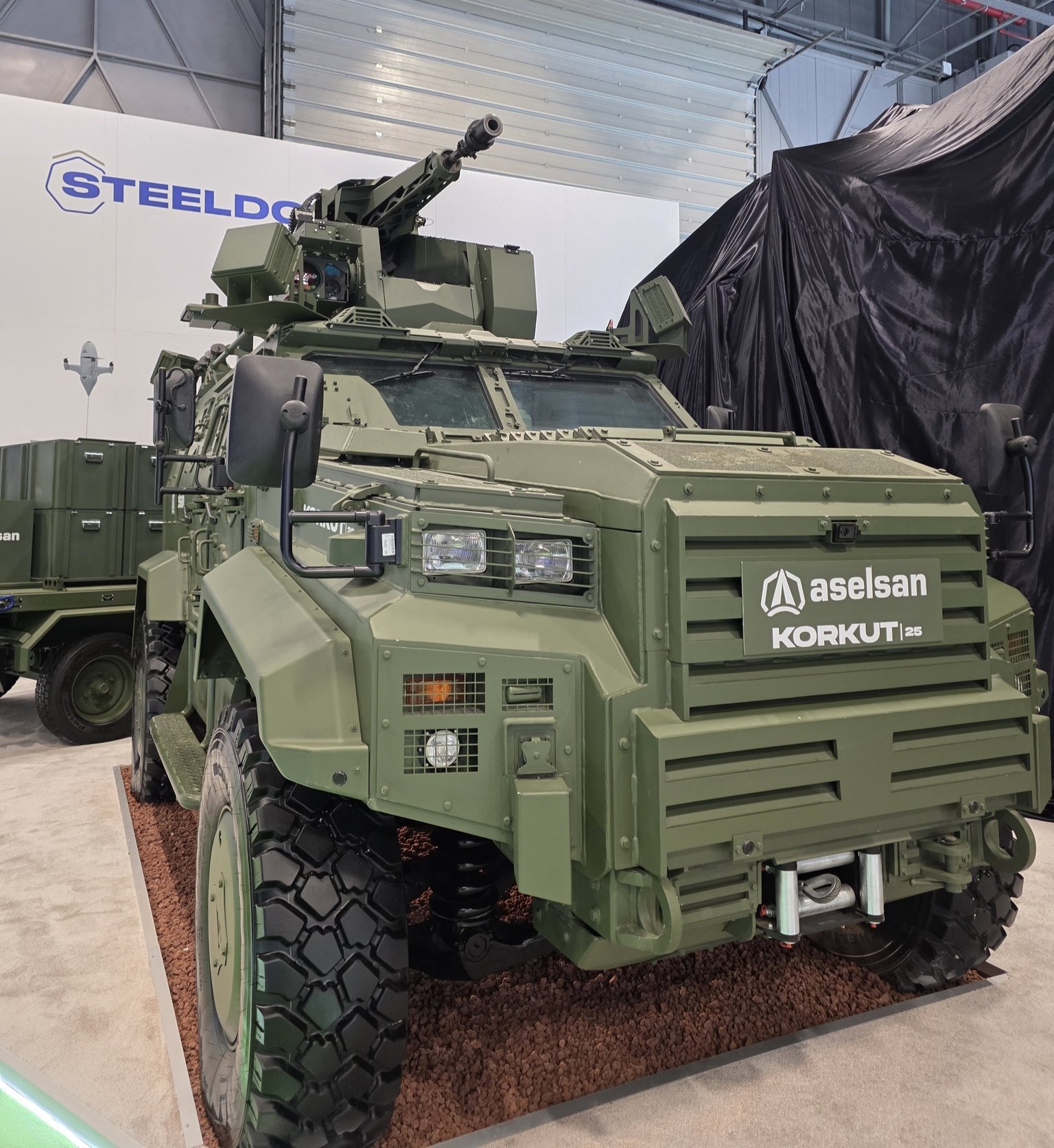
Air defense is not a product but a layered architecture: gun-based point defense (KORKUT, Gepard), very short range (SUNGUR, Stinger), short-to-medium range (HİSAR, IRIS-T, NASAMS), long range (Patriot, SİPER, SAMP/T) and ballistic missile defense (THAAD, Arrow, SM-3) are separate technologies and separate markets. What makes a producer “biggest” changes by layer; this study assesses each company within its layers and merges the picture only in the composite index.
By defense revenue: the giants — and fast-rising ASELSAN
Source: SIPRI Top 100 (December 2025). Only part of each group’s revenue comes from air defense. ASELSAN ranks 47th and, at 24 percent, is among the list’s fastest growers. Russia’s Almaz-Antey publishes no comparable data and is excluded.
Do not confuse revenue with production muscle: the binding constraint in air defense is battery and interceptor output. Ukraine’s expenditure rates showed annual effector production, not stockpiles, is the bottleneck — read the tempo table separately.
Layer by layer: the verified numbers
| Company | Country | Systems | Verified indicator | Data type |
|---|---|---|---|---|
| RTX (Raytheon) | USA | Patriot, NASAMS (partner), ESSM | Patriot in 19 countries; additional European GEM-T line (COMLOG); record multiyear contracts | O |
| Lockheed Martin | USA | PAC-3 MSE, THAAD | PAC-3 MSE at a record 600+ missiles in 2025, with a tripling plan announced; THAAD with the US plus export customers | O |
| ASELSAN 🇹🇷 | Türkiye | Steel Dome, SİPER, HİSAR, KORKUT, GÜRZ, GÖKDENİZ | First Steel Dome delivery of 47 systems worth $460M on 27 Aug 2025; SİPER-1 in service; $1.9bn follow-on (2028-32) plus a $900M add-on; effectors co-produced with Roketsan | O |
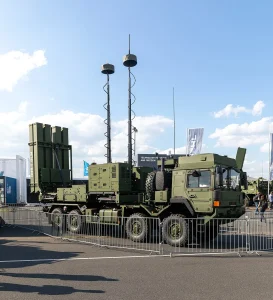
| Diehl Defence | Germany | IRIS-T SLM/SLS/SLX | Orders from 10 countries (8 European Sky Shield states plus Ukraine and Egypt); Ukraine alone signed a €2.2bn expansion; missile output rising from 800-1,000 to 2,000+ a year; 16 batteries/year targeted | O |
| Kongsberg | Norway | NASAMS | NASAMS in 13+ countries, combat-proven in Ukraine; Norway ordered 4 more batteries (NOK 4.8bn) | O |
| MBDA + Thales | Europe | SAMP/T NG, Aster, VL MICA | SAMP/T NG under French-Italian orders; Aster line expanding; new customers including Denmark | O / E |
| Rafael | Israel | Iron Dome, David’s Sling, SPYDER | Iron Dome combat-proven with 5,000+ intercepts; David’s Sling sold to Finland; SPYDER with numerous Asian users | O / E |
| LIG Nex1 + Hanwha | S. Korea | Cheongung II (KM-SAM) | Exports to the UAE ($3.5bn), Saudi Arabia and Iraq | O / E |
| Almaz-Antey | Russia | S-400, S-350 | Production and delivery data undisclosed | U |
Data type: O = official/company statement, E = credible industry estimate, U = unknown. System counts across different layers are never pooled.
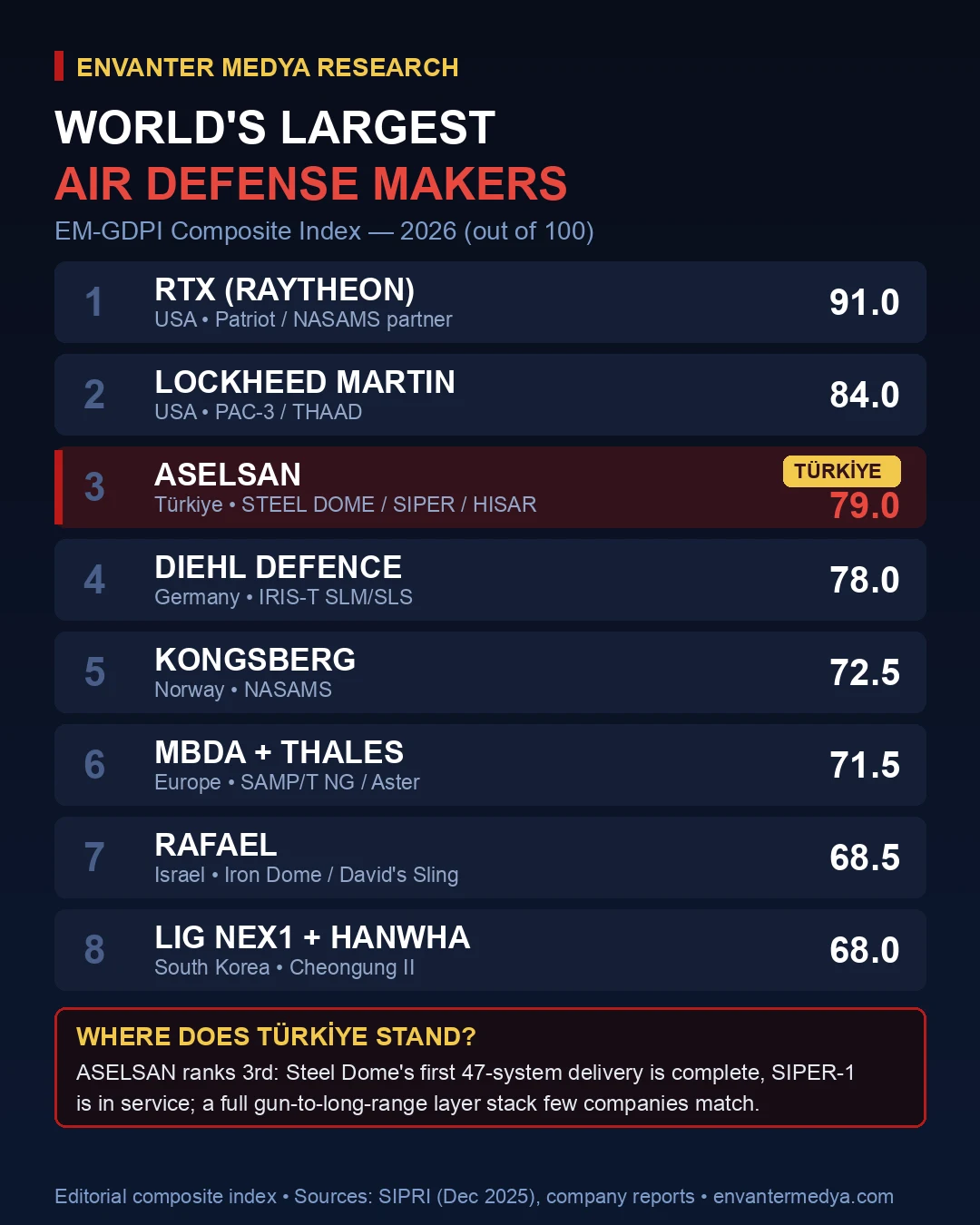
The Envanter Medya composite index: EM-GDPI
Editorial composite of nine weighted criteria (production 25, revenue 15, exports 15, operators 10, breadth 10, capacity 10, backlog 5, technology 5, growth 5); not an official ranking. Almaz-Antey and Chinese makers unscored; IAI (Barak/Arrow) ranks ninth at 62.5. Turkish company highlighted.
Patriot’s unmatched 19-country base and record backlog carry RTX to first; Lockheed follows on the PAC-3 tempo record and THAAD. Three criteria lift ASELSAN a hair above Diehl into third: layer breadth (a complete gun-to-long-range portfolio matched in this list only by RTX), a $2.8 billion order pipeline and the group’s highest growth at 24 percent. Diehl’s strength is depth in one product — IRIS-T SLM, Europe’s fastest-spreading medium layer.
Where does Türkiye stand? The rise of the Steel Dome
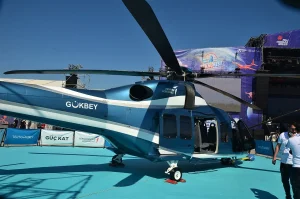
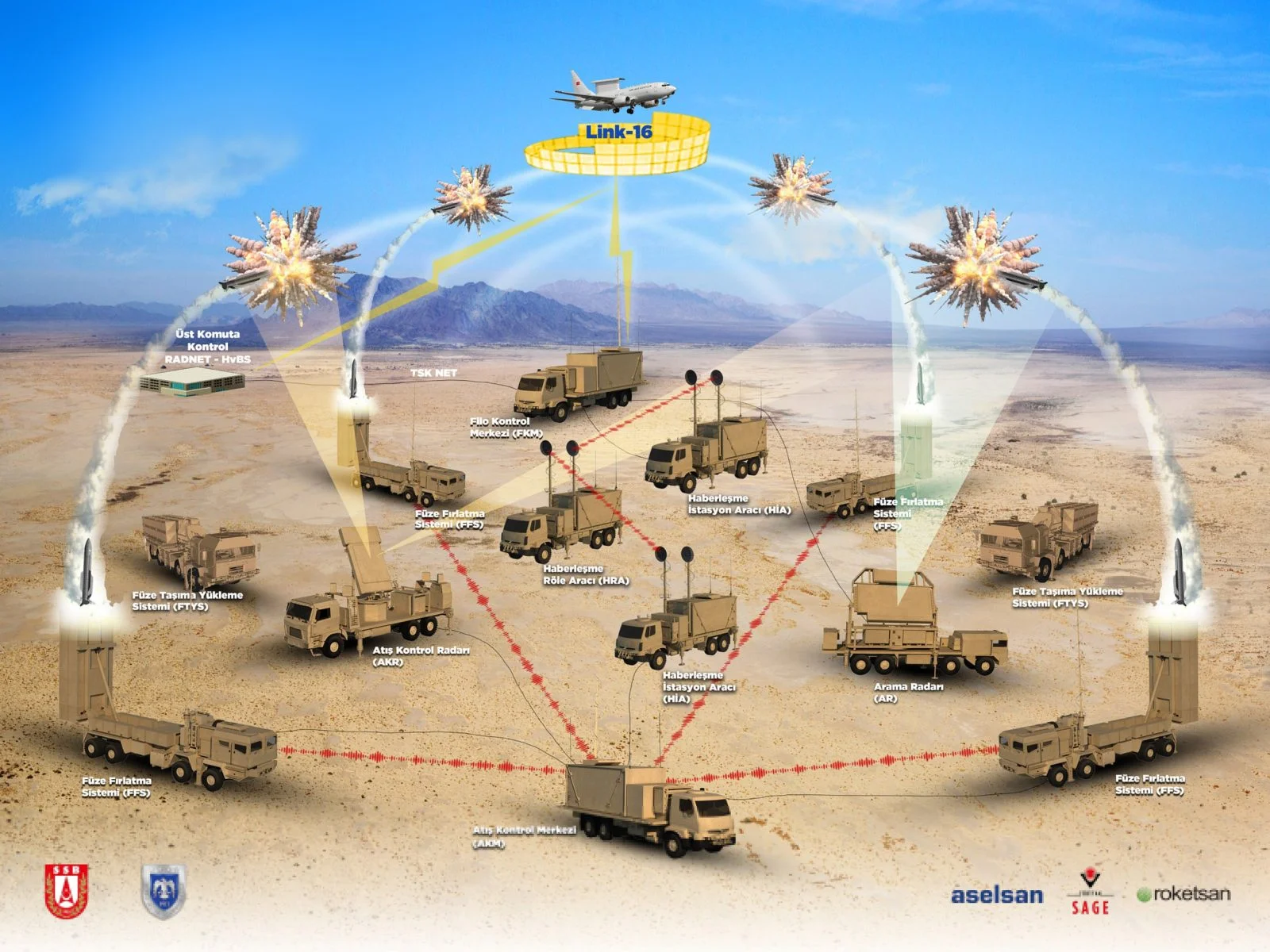
Türkiye’s air defense story is a ladder, not a single system: the gun-based KORKUT, the shoulder-fired SUNGUR, the short-to-medium HİSAR family and the long-range SİPER, all tied together by the network-centric Steel Dome. On 27 August 2025, a first $460 million package of 47 systems — SİPER, HİSAR, KORKUT, ALP and PUHU radars included — was handed to the Turkish Armed Forces. A $1.9 billion contract signed with the SSB procurement agency in September 2025 covers 2028-2032 deliveries; a further $900 million deal followed in June 2026. Roketsan builds the interceptors; ASELSAN the radars, guns and command network — with the naval GÖKDENİZ and MİDLAS vertical launcher part of the same ecosystem.
The honest reverse view: the Steel Dome has no export customers yet — the system itself is new. Beyond limited HİSAR and KORKUT export steps, Turkish air defense currently produces for the home market, well short of Patriot’s 19, NASAMS’s 13 and IRIS-T’s 10-country bases. In upper-tier ballistic missile defense (THAAD/Arrow/SM-3 class) Türkiye has no product; SİPER’s Block-2/3 developments aim at that tier. What supports optimism: the full-layer portfolio, the $2.8 billion pipeline and a cost-effective architecture built for the drone-swarm threat that now dominates the battlefield.

How this research was prepared
Data year: revenues from SIPRI’s December 2025 release (2024); deliveries and contracts from official announcements of January 2025 – August 2026. Scope: nine groups building land-based air defense; naval systems are covered in the naval file. Currency: US dollars; Diehl in euros, Kongsberg in NOK as announced. Missing data: all Almaz-Antey/Chinese data and part of the interceptor output figures are not public — marked “unknown”, not estimated. EM-GDPI: nine criteria scored 0-10, weighted; relative and editorial.
| Company | Data reliability | Note |
|---|---|---|
| RTX, Lockheed, ASELSAN, Diehl, Kongsberg | A | Current official delivery/contract announcements |
| MBDA+Thales, Rafael, LIG+Hanwha | B | Strong program announcements; volumes partial |
| Almaz-Antey, Chinese makers | D | No reliable data; excluded from the index |
Frequently asked questions
Who is the world’s largest air defense manufacturer?
RTX, on the Patriot’s 19-country base and record orders; Lockheed Martin and ASELSAN follow in Envanter Medya’s composite index.
Where does ASELSAN rank globally?
47th overall in SIPRI’s 2024 table — and 3rd in the EM-GDPI air defense index on layer breadth, order pipeline and growth.
What is Türkiye’s Steel Dome, and is it operational?
A network-centric layered air defense architecture. The first 47-system package was delivered on 27 August 2025; a $1.9 billion contract covers 2028-2032 deliveries.
Is SİPER in service?
Yes — SİPER-1, the first fully indigenous long-range system, is integrated into the Steel Dome network. Block-2/3 versions will extend range and ballistic capability.
How many countries operate the Patriot?
Nineteen. On the effector side, Lockheed’s PAC-3 MSE hit a record 600+ missiles in 2025, with a tripling plan announced.
Which countries have ordered IRIS-T?
Ten: eight European Sky Shield states plus Ukraine and Egypt. Diehl is raising missile output beyond 2,000 a year.
How many countries use NASAMS?
More than thirteen, with combat proof in Ukraine; Norway has ordered four more batteries.
Who builds the Iron Dome?
Rafael, with RTX as US partner; the system counts more than 5,000 combat intercepts.
Why is the S-400 not ranked?
Almaz-Antey discloses no production or delivery data; this research does not rank what cannot be verified.
Where is Turkish air defense still behind?
Exports and upper-tier ballistic missile defense. All lower layers — gun, very short, short-medium and long range — are in domestic serial production. Browse systems in the Defense Atlas.
Sources and methodology notes
Principal sources:
- SIPRI Top 100 Fact Sheet (December 2025) — revenues, ASELSAN’s 47th place and 24% growth
- SSB/ASELSAN announcements — Türkiye Today — 47-system, $460M delivery; SİPER handovers
- Breaking Defense — Steel Dome architecture and the $1.9bn contract
- Breaking Defense (June 2026) — the $900M add-on
- Army Recognition — SİPER-1 entering service
- Defense Express — Diehl’s 16-battery/year target and missile capacity
- Norsk Luftvern — IRIS-T SLM’s ten-country order base
- Lockheed Martin — PAC-3 MSE record tempo
- Kongsberg official announcements — NASAMS user base and Norway’s four-battery order
Last updated: 15 August 2026. File seven of this series examines the world’s largest radar and electronic warfare manufacturers.