World’s Largest Military Engine Manufacturers: Turbofans, Turboshafts and Localization Compared (2026)

The hardest discipline in the defense industry is neither drones nor tanks: it is engines. The number of countries that can series-produce a fighter-class turbofan barely exceeds the fingers of one hand, and the table of the world’s largest military engine manufacturers reflects that scarcity: GE Aerospace, home of the F110 and F404; Pratt & Whitney, maker of the F-35’s F135 heart; Rolls-Royce, keeper of British and AUKUS nuclear submarine propulsion; and Safran, builder of the Rafale’s M88 and much of the world’s helicopter engine fleet. Türkiye is the league’s youngest player: TEI’s TS1400 turboshaft has entered serial production with the GÖKBEY helicopter, its PD170 diesel powers the ANKA fleet, and the TF35000 is in development for the KAAN fighter. Kale’s KTJ-3200 quietly closed a critical gap as the serial engine of the ATMACA and SOM missiles. This is the ninth and final sector file of Envanter Medya’s Global Defense Industry Research, following the world’s largest naval shipbuilders.
Editorial note: This ranking is an editorial research piece prepared by Envanter Medya using publicly available data; it is not an official international ranking. Sources and methodology are explained at the end.
The research at a glance
“Largest” by which measure?
The engine market splits into fighter turbofans, helicopter turboshafts, drone turbodiesels, missile turbojets, tank powerpacks and naval turbines — each demanding different metallurgy, test infrastructure and certification. A country’s “engine independence” is measured by how many of those segments it can serve with its own serial product. This study assesses makers segment by segment and merges the picture in the composite index; supplier-chain parts production — one of Türkiye’s biggest aviation export lines — is noted separately.
By defense revenue: the engine giants
Sources: SIPRI Top 100 (December 2025) and company reports; the RTX figure covers the whole group. TEI’s and Kale’s revenues fall below the SIPRI threshold; much of TEI’s turnover comes from GE supply-chain parts production. “Unknown” fields are not estimated.
Do not confuse revenue with independence: the critical question in engines is not “how many dollars” but “which classes can you build yourself.” In sanction and embargo periods, the one item that cannot be procured is usually the engine — the shared cause of Türkiye’s ALTAY and drone program delays.
Segment by segment: the verified indicators
| Company | Country | Key engines | Verified indicator | Data type |
|---|---|---|---|---|
| GE Aerospace | USA | F110, F404/F414, T700 | The F110 powers F-16 fleets and KAAN’s prototypes; the T700 is the world’s most widely used military turboshaft | O |
| Pratt & Whitney | USA | F135, F119 | Sole engine supplier of the F-35 — history’s biggest-budget military engine program, powering 1,200+ delivered aircraft | O |
| Rolls-Royce | UK | MT30, AE family, nuclear propulsion | Sole builder of British and AUKUS submarine reactors; the MT30 naval turbine serves many navies, Türkiye’s MILGEM frigates included | O |
| Safran | France | M88, Arrano, Makila | The Rafale’s M88; the world’s broadest civil-military helicopter engine base (GÖKBEY first flew on a Safran engine) | O |
| Honeywell | USA | AGT1500, TFE731 | Maker of the Abrams tank’s AGT1500 gas turbine | O |
| MTU | Germany | EJ200 (partner), MB873/MT883 | Eurofighter engine partner; diesel powerpacks of the Leopard 2 and many other tanks — ALTAY’s first prototypes ran on MTU too | O |
| TEI 🇹🇷 | Türkiye | TS1400, PD170, TJ300, TF6000/TF10000, TF35000 | TS1400 turboshaft in serial production for GÖKBEY; PD170 diesel flying ANKA/AKSUNGUR; TF6000 in maturation tests for ANKA-3; afterburning TF10000 first-ignition target late 2027; TF35000 is KAAN’s target engine; also a global GE parts supplier and F110 assembly-MRO center | O |
| Kale Jet 🇹🇷 | Türkiye | KTJ-3200, KTJ-1750 | KTJ-3200 is the serial engine of the ATMACA (A) and SOM (S) missiles — the program that freed Türkiye from missile-turbojet dependence; deliveries since 2022 | O |
| UEC/Klimov, Motor Sich | Russia / Ukraine | AL-41, TV3-117; MS series | UEC data opaque; Motor Sich continues production under war conditions | U / E |
Data type: O = official/company statement, E = credible industry estimate, U = unknown. Counts of different engine classes are never pooled.
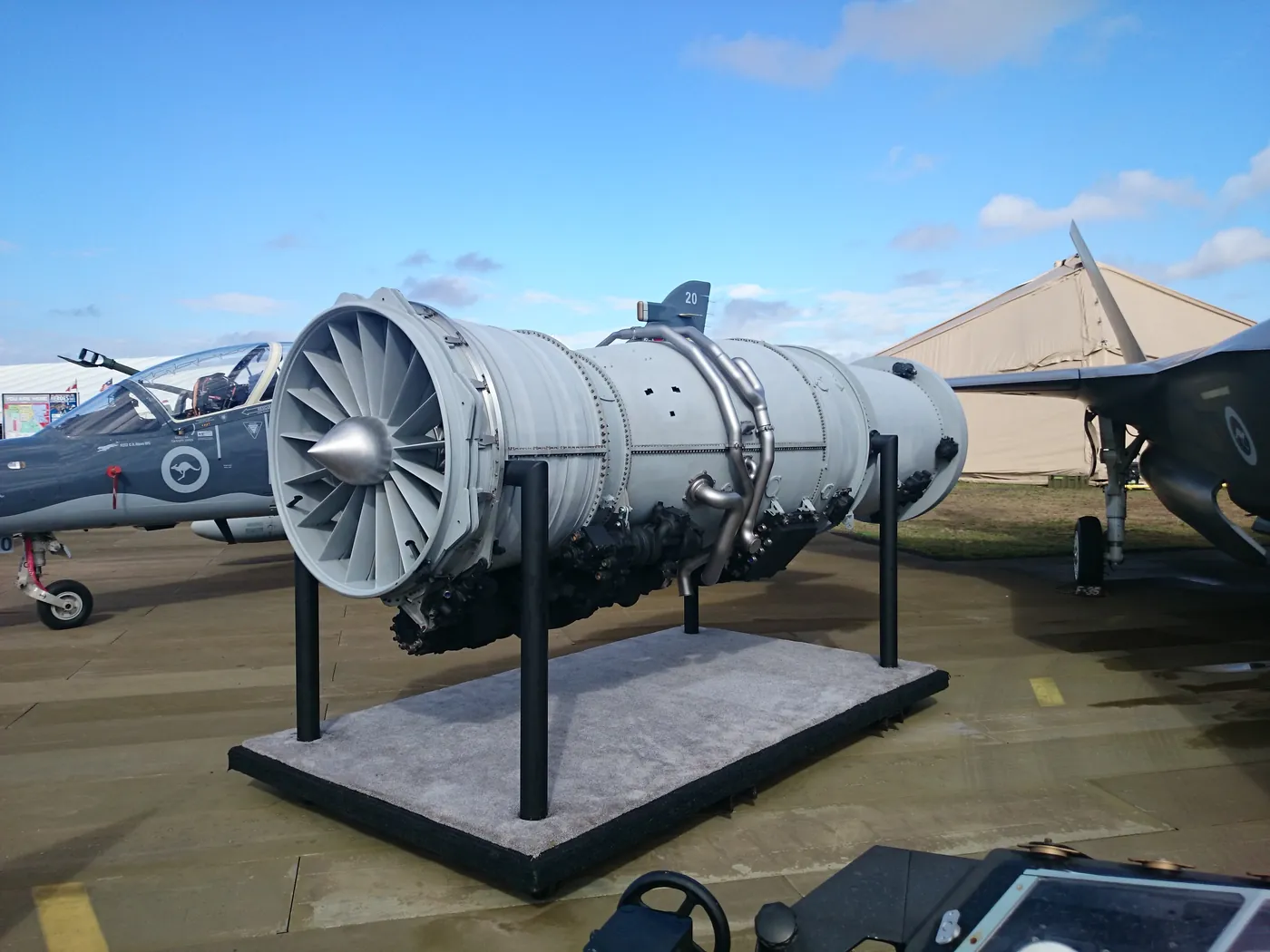
The Envanter Medya composite index: EM-GDPI
Editorial composite of nine weighted criteria; not an official ranking. UEC and China’s AECC unscored for lack of data. Turkish companies highlighted.
The gap between GE and P&W is within statistical error; platform breadth and export base tip it to GE. Rolls-Royce holds the nuclear-propulsion monopoly, Safran the helicopter-engine crown. TEI’s 53.5 must be said plainly, as our editorial rule requires: Turkish engine industry remains far from the giants in revenue and cumulative volume. But the criterion that tells the real story is growth — five years ago Türkiye had no serial indigenous engine in any segment; today it has three.
Where does Türkiye stand? The industry of the critical threshold
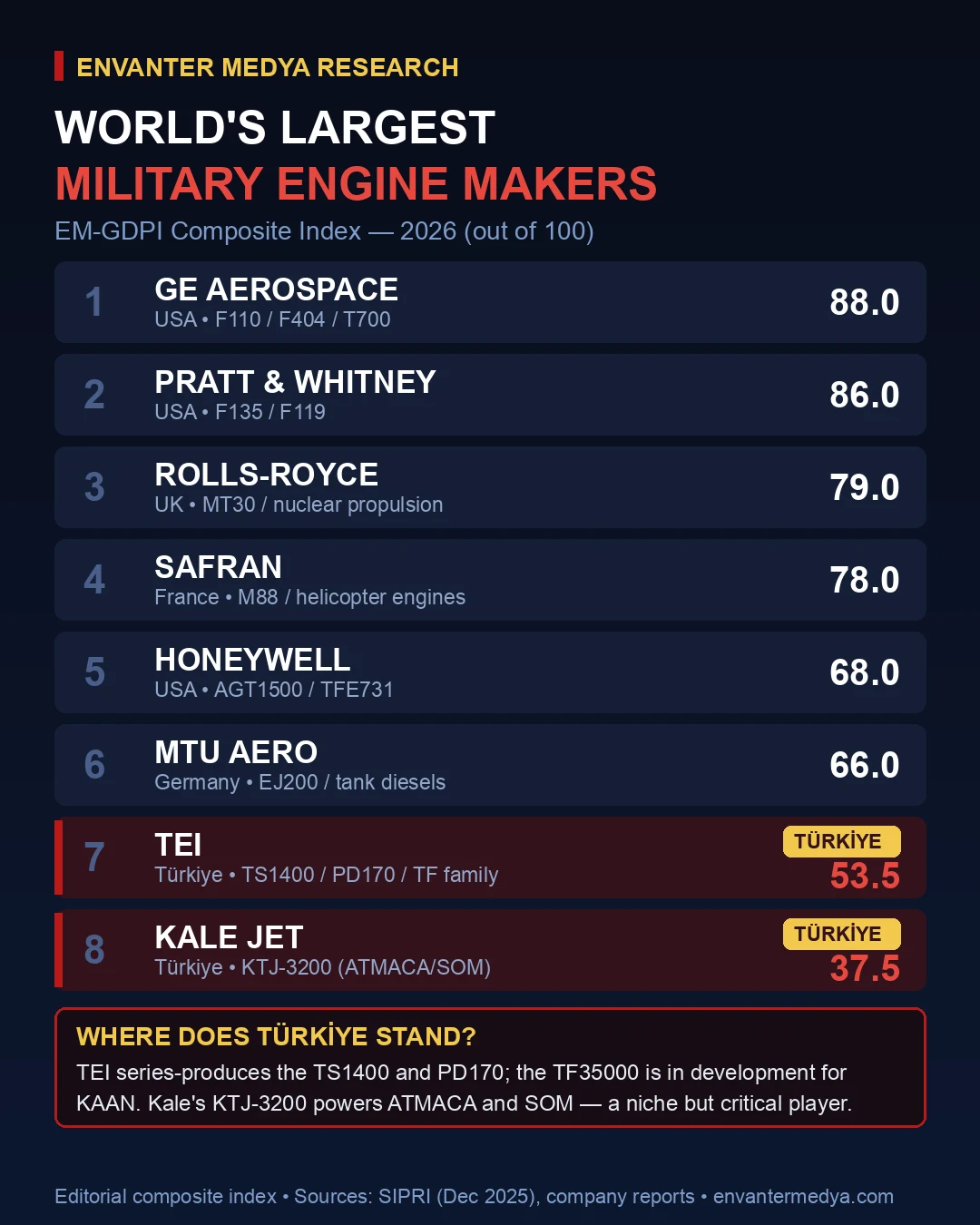
Engines were the Turkish defense industry’s longest-standing dependency — and the fastest-closing gap of the past five years, readable in three layers. In serial production: TEI’s TS1400 turboshaft reached serial production with the GÖKBEY helicopter, admitting Türkiye to the small club of countries building their own helicopter engines; the PD170 turbodiesel has flown ANKA and AKSUNGUR for years; and Kale’s KTJ-3200 has been delivered serially for the ATMACA and SOM since 2022 — the antidote to missile-engine embargoes.
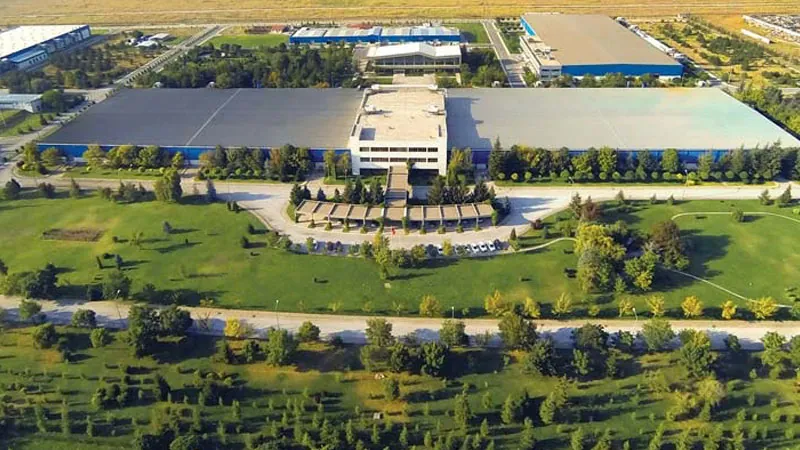
In development: the TF6000 turbofan is in maturation testing for ANKA-3-class platforms; the afterburning TF10000 targets first ignition in late 2027; and at the summit sits the TF35000, KAAN’s indigenous engine. On the ground, BMC Power’s BATU is in testing for the ALTAY T2. KAAN’s prototypes fly on the GE F110 for now — the engine schedule is the critical path of the fighter’s production timeline. The honest reverse view: Türkiye cannot yet series-produce a fighter-class turbofan — a capability held only by the US, Russia, the UK-European consortia, France and China; there is no domestic product in large naval gas turbines or high-bypass transport engines; and much of TEI’s revenue still comes from GE supply-chain parts — proof of entry into aviation’s most tightly audited chain, but independent engine revenue remains small.
How this research was prepared
Data year: revenues from SIPRI’s December 2025 release (2024) and company reports; program data from official announcements of January 2025 – August 2026. Scope: nine military engine groups; AECC and UEC excluded for lack of data. Currency: US dollars. Missing data: military engine segment revenues are mostly not reported separately; TEI’s and Kale’s volumes are undisclosed — not estimated. EM-GDPI: nine criteria scored 0-10, weighted; relative and editorial.
| Company | Data reliability | Note |
|---|---|---|
| GE, P&W, Rolls-Royce, Safran, Honeywell, MTU | A | Public reports + official program data |
| TEI, Kale Jet | B | Strong program announcements; volumes and revenue splits limited |
| UEC, AECC, Motor Sich | D | No reliable current data; excluded |
Frequently asked questions
Who is the world’s largest military engine manufacturer?
GE Aerospace and Pratt & Whitney run neck and neck; GE tops Envanter Medya’s composite index on platform breadth and export base.
How many countries can build fighter engines?
Fighter-class turbofans are series-produced only by the US, Russia, the UK-European consortia, France and China. Türkiye’s TF35000 is its bid to join.
Is the TS1400 in serial production?
Yes — the GÖKBEY helicopter’s indigenous turboshaft has reached serial production, Türkiye’s first serial domestic helicopter engine.
What engine powers KAAN?
Prototypes fly on the GE F110; the target engine is TEI’s TF35000, with the afterburning TF10000’s first ignition planned for late 2027 as the stepping stone.
Who builds the ATMACA and SOM engines?
Kale Jet Engines’ KTJ-3200 (A and S variants), delivered serially since 2022.
Why does the F135 matter so much?
As the F-35’s sole engine it powers 1,200+ delivered aircraft; the program is history’s biggest-budget military engine effort.
Is the ALTAY tank’s engine domestic?
The first 85 tanks use a South Korean powerpack; BMC Power’s BATU enters service with the T2 in 2028.
What does TEI build for GE?
TEI is a global parts supplier in GE Aerospace’s chain and an F110 assembly-MRO center — among Türkiye’s largest aviation export lines.
Why are Russian and Chinese engine makers absent?
UEC and AECC publish no production data; this research does not rank what cannot be verified. Browse systems in the Defense Atlas.
Sources and methodology notes
Principal sources:
- SIPRI Top 100 Fact Sheet (December 2025)
- TEI statements / Türkiye Today — TF6000 tests, TF10000 timeline, TS1400 serial production
- EDR Magazine (IDEF 2025) — Turkish engine program status
- EDR Magazine / Kale Arge — KTJ-3200 in ATMACA and SOM
- Defense News — Kale’s missile turbojet deliveries
- GE Aerospace, Pratt & Whitney, Rolls-Royce, Safran and MTU official program pages
Last updated: 15 August 2026. The nine sector files of this series are complete; all research will be consolidated in the annual Envanter Medya Global Defense Industry Report.