World’s Largest Ammunition Manufacturers: The 155 mm Race, Capacity and Exports Compared (2026)

The war in Ukraine turned the defense industry’s least glamorous business into its most strategic one overnight: ammunition. Atop the list of the world’s largest ammunition manufacturers today sits Germany’s Rheinmetall, racing toward roughly 1.5 million 155 mm artillery shells a year by 2027 across factories in six countries. Czechia’s CSG group plans 850,000 large-caliber rounds in 2026; South Korea’s Hanwha, Israel’s Elbit (IMI) and America’s General Dynamics OTS fill out the top tier. Türkiye plays two distinct roles in this table: MKE, spanning small-arms cartridges to 155 mm shells, entered SIPRI’s Top 100 for the first time — while Repkon, an Istanbul machinery maker, is literally building the world’s new shell factories, from Texas to Germany, Pakistan and Iraq. This is file four of Envanter Medya’s Global Defense Industry Research, following the world’s largest tank manufacturers.
Editorial note: This ranking is an editorial research piece prepared by Envanter Medya using publicly available data; it is not an official international ranking. Sources and methodology are explained at the end.
The research at a glance
Why “biggest bullet maker” is a misleading question
In everyday speech “bullets” covers everything from pistol cartridges to 155 mm artillery shells — products separated by thousandfold price gaps and entirely different manufacturing technologies. A plant turning out a billion 5.56 mm rounds a year and one producing 100,000 heavy shells are, in effect, different industries. This study therefore never pools unit counts across calibers: large-caliber (artillery, tank, mortar), medium-caliber (20-40 mm), small arms and guided/air-delivered munitions are treated in separate sections, and every “X rounds per year” claim is labeled with its caliber.
By defense revenue: the rising ammunition powers
SIPRI’s December 2025 data shows the ammunition-heavy groups surging: Rheinmetall grew 36 percent to $8.2 billion, driven by shells as much as vehicles; Elbit Systems carries Israel’s munitions base at $6.28 billion; Hanwha’s group revenue jumped 42 percent. And Türkiye’s MKE entered the Top 100 for the first time, at 93rd with $1.21 billion and 17 percent growth.
Source: SIPRI Top 100 (December 2025). Only part of each group’s revenue is ammunition. GD-OTS (group total $33.63bn) and Hanwha’s munitions breakdowns are not disclosed separately and were not charted. NORINCO’s and Russian makers’ data are opaque — marked “unknown”.
Do not confuse capacity with deliveries: ammunition makers usually announce annual capacity targets, which are not the units delivered that year. Target years and data types are labeled throughout, and calibers are never pooled in one chart.
Large caliber: the verified numbers of the 155 mm race
The sector’s heart now beats in 155 mm NATO artillery ammunition. Combined output across the EU, UK and Ukraine is projected to reach 2.8-3 million shells a year in 2026 — near ten times the pre-war level:
| Producer | Country | Verified 155 mm / large-caliber indicator | Data type |
|---|---|---|---|
| Rheinmetall | Germany | Target: ~1.5 million 155 mm/year by 2027; plant network in Germany, Spain, Hungary, South Africa, Ukraine and Bulgaria | O (target) |
| CSG | Czechia | ~630K large-caliber rounds produced in 2025; 850K planned for 2026, 1.1M targeted for 2027; €100M+ components deal with Poland’s Dezamet (PGZ) | O |
| GD-OTS | USA | Prime of the US Army’s 155 mm ramp-up, which reached ~40,000 shells a month by late 2025 (including the new Texas plant) | O / E |
| MKE 🇹🇷 | Türkiye | 155 mm lines being expanded; strategic agreement with Germany to supply Europe; modular charges and tank ammunition in production; annual volume undisclosed | O (program) / U (volume) |
| Repkon 🇹🇷 | Türkiye | Machinery maker of shell production lines: equipped the US Army’s Mesquite, Texas plant (30K/month initial → 100K/month target), a filling facility deal in Germany, turnkey factories for Pakistan and Iraq | O |
| Nammo | Norway-Finland | Raising 155 mm capacity stepwise; licensed production cooperation with Ukraine; volumes undisclosed | E |
| Hanwha | S. Korea | 155 mm supplier of the K9 howitzer ecosystem, exporting shells and modular charges; group revenue +42% | O / E |
| Elbit (IMI) | Israel | Artillery, tank and mortar rounds plus precision guidance; munitions are a major share of a $22.6bn backlog | O / E |
| Ukrainian industry | Ukraine | Domestic 155 mm production started at 100K/year; Rheinmetall and Nammo joint plants under way | O |
| NORINCO / Russian makers | China / Russia | Volumes undisclosed | U |
Data type: O = official/company statement, E = credible industry estimate, U = unknown. Non-155 mm calibers are excluded from this table; capacity targets and actual output are distinct concepts, and target years are stated.

The 155 mm capacity race
Figures mix targets, plans and tempos from different years and sit side by side only for order-of-magnitude comparison. The Repkon row is the annualized final target of the US-operated Mesquite plant whose machinery is Turkish. MKE’s annual volume is undisclosed and therefore absent — writing “unknown” beats inventing a number.
Medium and small calibers: a different world
In medium caliber (20-40 mm), Rheinmetall, Nammo and GD-OTS lead in the West, while Türkiye’s ASELSAN-MKE pair produces 35 mm airburst ammunition for the KORKUT gun systems. Small arms ammunition is counted in billions and shaped by the civilian market: Olin Winchester and Vista Outdoor in the US, the CBC group (including Sellier & Bellot and Magtech) and Fiocchi in Europe are the volume leaders, with Türkiye’s MKE and Sarsılmaz exporting alongside. On principle, this study does not rank those unit counts against 155 mm shells.
The Envanter Medya composite index: EM-GDPI
Nine weighted criteria (production 25, revenue 15, exports 15, operators 10, breadth 10, capacity 10, backlog 5, technology 5, growth 5) produce a 100-point editorial composite focused on military large-caliber output. NORINCO and Russian makers were unscored for lack of data; Repkon, as a machinery maker, is assessed outside the index.
Editorial composite index; not an official ranking. Turkish company highlighted.
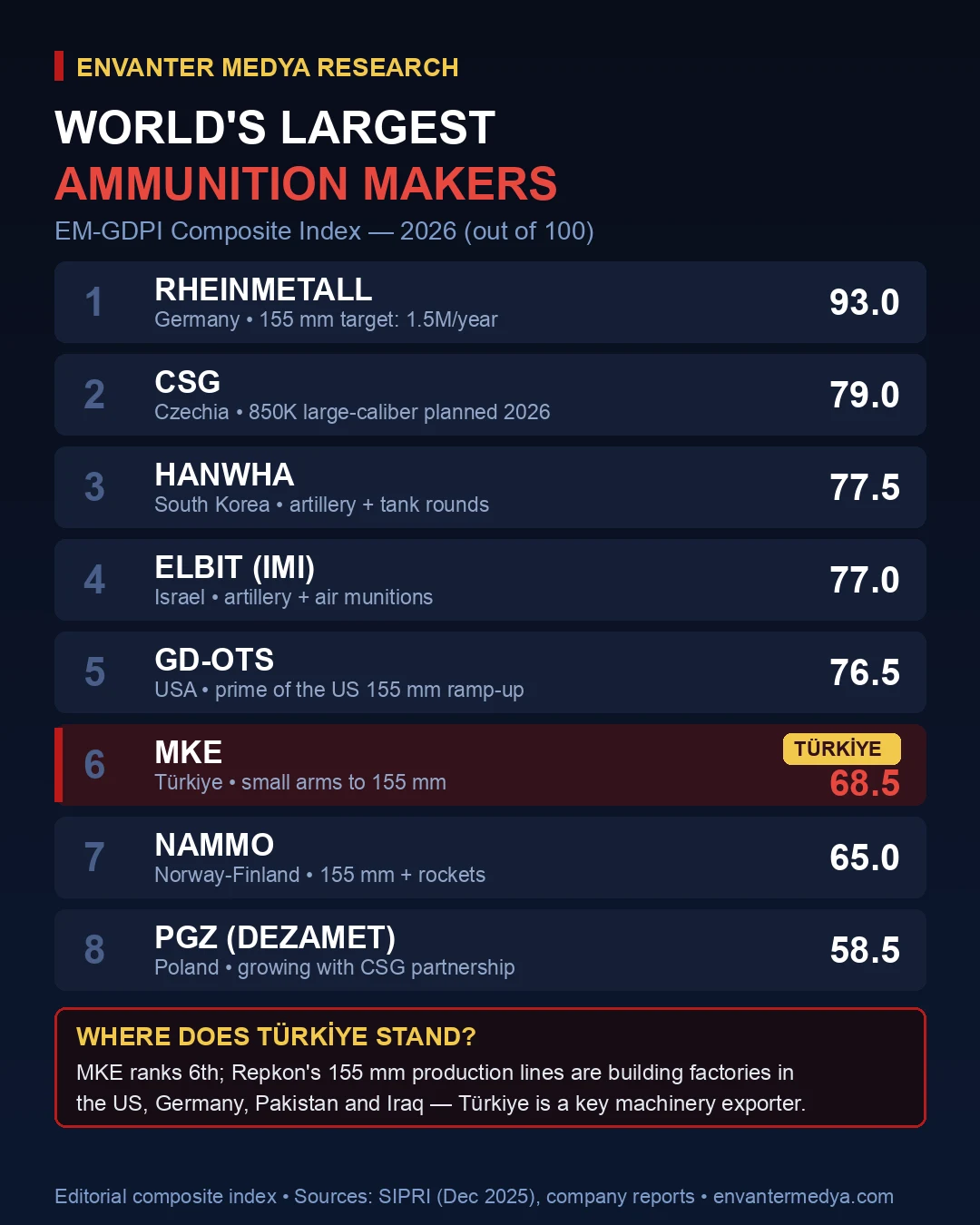
Where does Türkiye stand?
MKE: a 200-year-old institution’s Top 100 debut
MKE, the republic’s oldest defense manufacturer, entered SIPRI’s Top 100 for the first time on 2024 revenue of $1.21 billion, up 17 percent. Its range runs from small-arms cartridges to 155 mm shells, mortar and tank ammunition, and the barrels of the T-155 howitzer. Its 155 mm lines are expanding, a strategic agreement with Germany plugs MKE into Europe’s shell supply chain, and a precision-guided artillery program with Roketsan and TÜBİTAK SAGE is moving up the value chain.

Repkon: the Turkish company building the world’s shell factories
The lesser-known story is Repkon’s. The Istanbul-based firm is one of the few makers anywhere of flow-forming production lines for 155 mm shell bodies. The US Army’s new plant in Mesquite, Texas runs on Repkon machinery — 30,000 shells a month initially, targeting 100,000. The company has signed for an explosive-filling facility in Germany and turnkey factories in Pakistan and Iraq covering shells, propellant charges and mortar rounds. In NATO’s race to close its shell gap, a good share of the machines come from Türkiye. With private producers like ARCA entering 155 mm M107 production, the Turkish ecosystem has grown beyond a single state maker. The honest caveats: MKE’s annual volume is unpublished and assessed below the million-class targets of the Rheinmetall-CSG league, Turkish precision-guided artillery rounds are not yet in serial export, and the global propellant bottleneck — nitrocellulose above all — affects Türkiye too.
How this research was prepared
Data year: revenues from SIPRI’s December 2025 release (2024); capacity and contract data from official announcements of January 2025 – August 2026. Scope: ten large-caliber-focused groups plus medium/small-caliber sections; calibers never pooled. Currency: US dollars; the CSG-Dezamet deal quoted in euros. Missing data: MKE’s volumes, Nammo’s capacity figures and all NORINCO/Russian data are not public — marked “unknown”, not estimated. EM-GDPI: nine criteria scored 0-10, weighted; relative within the group and editorial.
| Company | Data reliability | Note |
|---|---|---|
| Rheinmetall, CSG, GD-OTS, Elbit, Hanwha | A-B | Official targets and contracts; actual volumes partial |
| MKE, Repkon, Nammo, PGZ | B | Strong program announcements; annual volumes undisclosed |
| NORINCO, Russian makers | D | No reliable data; excluded from the index |
Frequently asked questions
Who is the world’s largest ammunition company?
In large caliber, Rheinmetall leads clearly on capacity targets and plant network: ~1.5 million 155 mm shells a year by 2027 across six countries. It also tops Envanter Medya’s composite index.
Where does MKE rank globally?
MKE entered SIPRI’s Top 100 for the first time at 93rd with $1.21 billion in 2024 revenue, and ranks 6th in the EM-GDPI ammunition index.
Who makes the most bullets in the world?
Split by caliber: Rheinmetall and CSG lead 155 mm artillery shells, while small-arms volume leaders include Olin Winchester and the CBC group. Ranking different calibers in one list is misleading.
How many shells does Rheinmetall produce a year?
Its 155 mm target is about 1.5 million a year by 2027, across plants in Germany, Spain, Hungary, South Africa, Ukraine and Bulgaria.
How many 155 mm shells does Europe produce?
Combined EU, UK and Ukrainian output is projected at 2.8-3 million a year in 2026 — roughly ten times the pre-war level.
How many 155 mm shells does the US make monthly?
The US Army program reached about 40,000 a month by late 2025; the new Texas plant’s machinery was installed by Türkiye’s Repkon.
Where is Repkon building factories?
The US (Texas), Germany (filling facility), Pakistan and Iraq — covering 155 mm shells, propellant charges and mortar ammunition.
How many rounds does CSG produce?
About 630,000 large-caliber rounds in 2025, with 850,000 planned for 2026 and 1.1 million targeted for 2027.
Does Türkiye produce 155 mm shells?
Yes: MKE is expanding its lines, private maker ARCA produces M107 shells, and a supply agreement with Germany connects Turkish output to Europe; annual volumes are undisclosed.
Why did ammunition become strategic?
Daily consumption of tens of thousands of shells in Ukraine showed NATO stocks could vanish in months; production capacity became a measure of deterrence. See our Rheinmetall company profile and the Defense Atlas for the wider picture.
Sources and methodology notes
This study is an editorial research piece prepared by Envanter Medya by cross-checking publicly available official company data, institutional reports, contract records and industry sources. Principal sources:
- SIPRI Top 100 Fact Sheet (December 2025) — 2024 revenues, MKE’s debut
- Rheinmetall official statements — 155 mm capacity target and plant network
- CSG statements / Militarnyi — 630K (2025), 850K (2026 plan), 1.1M (2027 target)
- CSG-Dezamet agreement (GlobeNewswire)
- Breaking Defense — US 155 mm tempo
- Defense Express — Repkon’s US, Pakistan and Iraq lines
- Army Recognition — Türkiye-Germany 155 mm supply agreement
- Defense Express — Ukraine’s 100K/year domestic start
- Defence Finance Monitor — Europe’s 2.8-3M projection
Last updated: 15 August 2026. File five of this series examines the world’s largest missile manufacturers.