Türkiye Tightens R&D-to-Production Pipeline as Defence Procurement Chief Görgün Meets Industry Minister Kacır

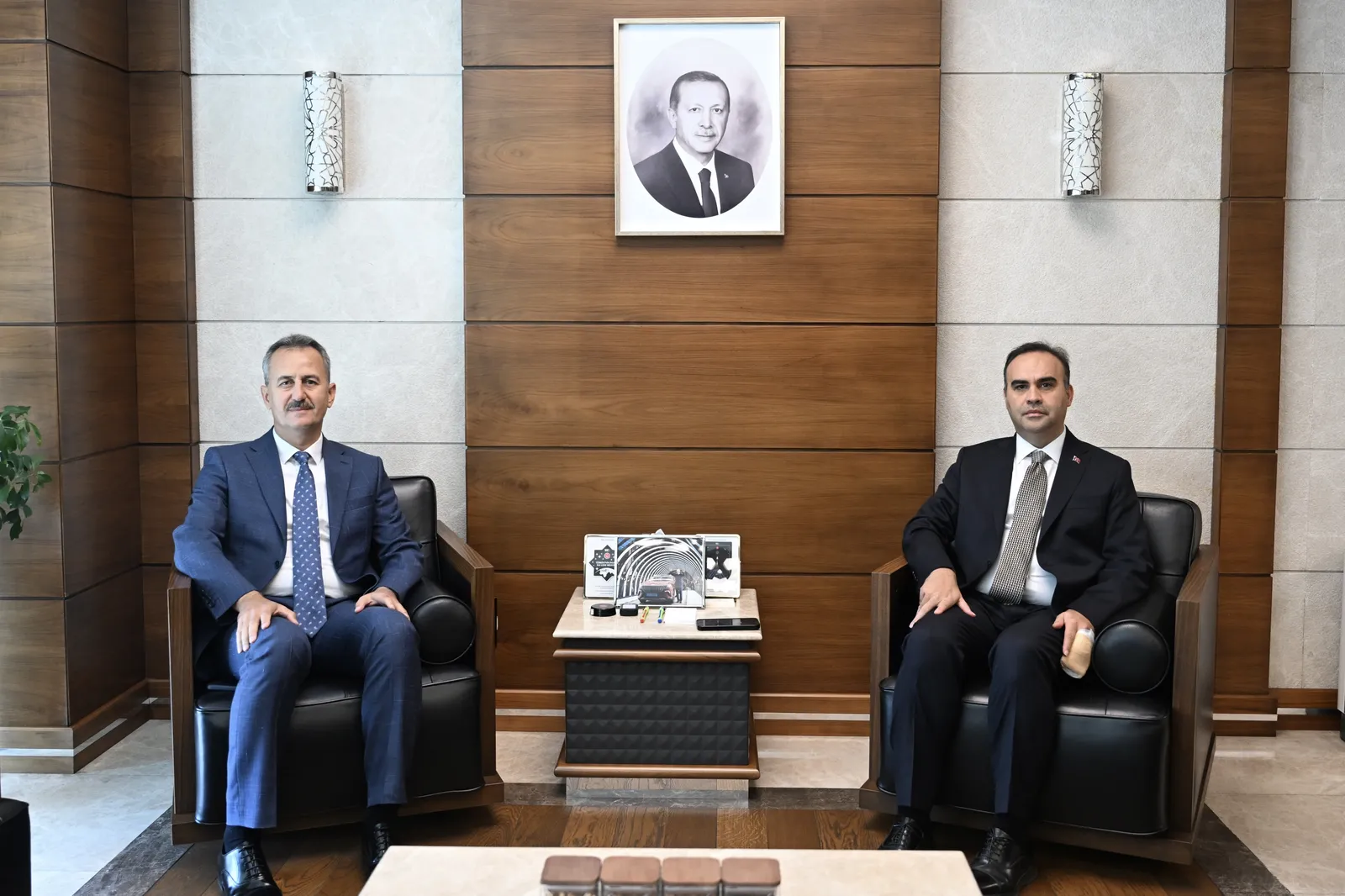
The meeting in Ankara underscores how Türkiye is trying to close the gap between prototype and mass production — a challenge most NATO defence industries are now grappling with.
ANKARA (Envanter Medya) — Prof. Haluk Görgün, head of Türkiye’s Presidency of Defence Industries (SSB), visited Industry and Technology Minister Mehmet Fatih Kacır in Ankara to review ongoing cooperation between the two institutions and to explore new areas of joint work.
In a statement published on social media after the meeting, Görgün said that moving a defence technology from the laboratory to the field requires more than a strong R&D base: it depends on the right investment instruments and sustainable production capacity operating together. “We are working in close cooperation with our Ministry of Industry and Technology throughout this process,” he said.
From SİPER and GÖKTUĞ to Atomic Clocks
Görgün pointed to concrete programmes where the cooperation is already visible. SSB works with TÜBİTAK SAGE — the national research council’s defence R&D institute — on the SİPER long-range surface-to-air missile system and the GÖKTUĞ family of air-to-air missiles. SİPER is being developed jointly by TÜBİTAK SAGE, ASELSAN and ROKETSAN to meet Türkiye’s long-range air and missile defence requirements, while GÖKTUĞ follows a similar multi-stakeholder model.
Beyond missiles, joint work with TÜBİTAK BİLGEM, the Marmara Research Center (MAM) and the National Metrology Institute (UME) covers navigation, radar, communications, advanced materials and atomic clock technologies. The indigenous atomic clock developed at TÜBİTAK UME is being positioned for use in satellite systems, communications infrastructure and navigation applications — a sovereignty-sensitive capability that very few countries produce domestically.
Investment Incentives Target Serial Production
A central theme of the meeting was the mechanism for carrying developed systems into serial production. Görgün noted that the ministry’s project-based investment incentives offer significant opportunities at this stage, and that support provided for new investments by ASELSAN, ROKETSAN, HAVELSAN and Makine ve Kimya Endüstrisi (MKE) is expanding the ecosystem’s production capacity while advancing its technological competence.
“As SSB, we structure critical technologies into programmes, and we bring together the resources our ministry provides through its R&D, investment and industrial policies around shared objectives,” Görgün said.
Why It Matters
Scaling serial production — particularly for air defence systems — has become one of SSB’s stated priorities, alongside co-production arrangements, secure supply chains and technology partnerships. The emphasis mirrors a broader trend across Europe and the United States, where procurement agencies are pushing industry to convert development successes into sustained output. For Türkiye, the coordination between the procurement authority and the industry ministry is intended to run as a single continuum: from design and development, through the localisation of critical sub-technologies, to investment incentives and volume manufacturing.
Görgün closed his statement by reaffirming what Ankara calls the “Century of Türkiye” vision — a country producing high technology, independent in critical technologies and globally competitive — and thanked Minister Kacır for the meeting.