Pakistan–Türkiye Defence Industry Relations: Anatomy of a Two-Way Partnership (2009–2026)

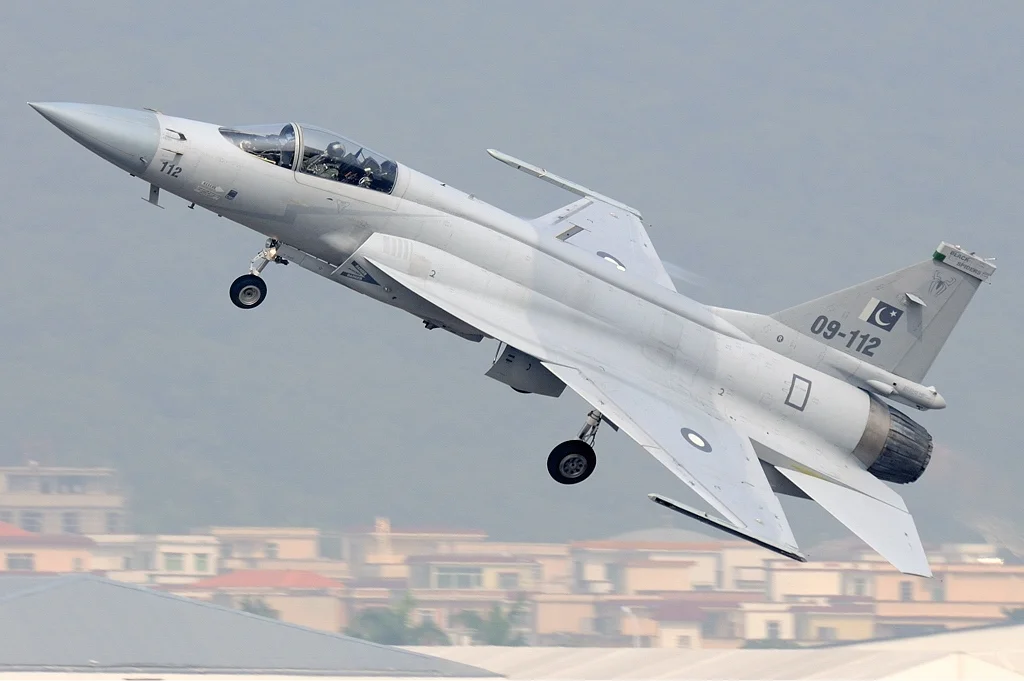
Türkiye’s largest arms customer is also the only Asian country that sells aircraft to Türkiye. That is why this series reads the Pakistan–Türkiye defence relationship not as an export story but as a two-way industrial partnership. This file gathers seventeen years, three services and one cancelled contract into a single table.
This is the series’ first bilateral file. Pakistan’s MILGEM decision was examined as a single procurement in the third file (Turkish); that data is not repeated. What is added is the rest of the relationship: submarine upgrades, a fleet tanker, F-16 upgrades, a targeting pod, two drone classes, low-level air defence, a munitions contract, joint R&D and the 2026 alliance layer. Every item carries its status — ordered, in service, cancelled, report. The Turkish original is here; the full list of Turkish weapons used by Pakistan is kept on a separate page.
Short answer: a relationship that flows both ways
By SIPRI’s March 2026 data, 16 per cent of Turkish arms exports in 2021–2025 went to Pakistan, the largest single buyer. In the other direction, Pakistan Aeronautical Complex delivered 52 Super Mushshak basic trainers to the Turkish Air Force under a contract completed in December 2025, the company’s largest export order. The two-way flow seen in the Ukraine and UAE files exists here at aircraft level: Türkiye bought aircraft from an export customer.
| Domain | System | Turkish company | Contract | Status |
|---|---|---|---|---|
| Navy | 4 Babur-class corvettes (MILGEM) | ASFAT, STM, HAVELSAN, Aselsan | 5 Jul 2018 · ~$1.5bn | 2 in service, 2 building/trials |
| Navy | 3 Agosta 90B upgrades | STM | Jun 2016 · ~$350m | 2 complete, 1 ongoing |
| Navy | PNS Moawin fleet tanker | STM (design) | 2013 | In service (16 Oct 2018) |
| Air | 41 F-16 upgrades | TUSAŞ | Jun 2009 | Complete (2 Sep 2014) |
| Air | 24 ASELPOD targeting pods | Aselsan | Jun 2016 + May 2017 · $25m + $24.9m | In service |
| Air | Bayraktar TB2 + Akinci | Baykar | Numbers and value undisclosed | In service (ISPR, 2 Jan 2024) |
| Air | 30 T129 ATAK | TUSAŞ | Jul 2018 · ~$1.5bn | Cancelled (US engine licence) |
| Air defence | KORKUT + ŞAHİN | Aselsan | Undisclosed | In service (PAF, 6 Sep 2026) |
| Munitions | Aerospace munitions | MKE → GIDS | 24 Jul 2025 · quantity undisclosed | Ordered |
| R&D | NASTP joint R&D, KaGeM V3 | Baykar | 7 Aug 2023 | In development |
| Reverse | 52 Super Mushshak → Turkish Air Force | PAC (Pakistan) | May 2017 | Complete (Dec 2025) |
Three things the table says. The relationship spans Pakistan’s three services, with the navy carrying the largest contracts. Of eleven rows only one is cancelled, and the cause is not the product but a third-country licence. And the last row is unique in the series: a buyer selling aircraft to the seller.
What did Pakistan need?
Pakistan’s procurement rests on China: 78 per cent of imports by SIPRI, against 3.6 per cent from Türkiye. The Turkish line is therefore a niche supplier, not a main one, and the niche opened in three places. The navy needed to renew Soviet- and Western-origin platforms; the Chinese line covered part of that (Hangor-class submarines, Tughril-class frigates) and the corvette and upgrade work went to Türkiye. The air force‘s F-16 upgrade depended on US approval and TUSAŞ won it with that approval; for the JF-17‘s targeting pod, Aselsan was chosen over Western sources. In unmanned systems the Chinese CH-4 and Wing Loong II were already in inventory; TB2 and Akinci were added alongside.
Navy: the largest contracts
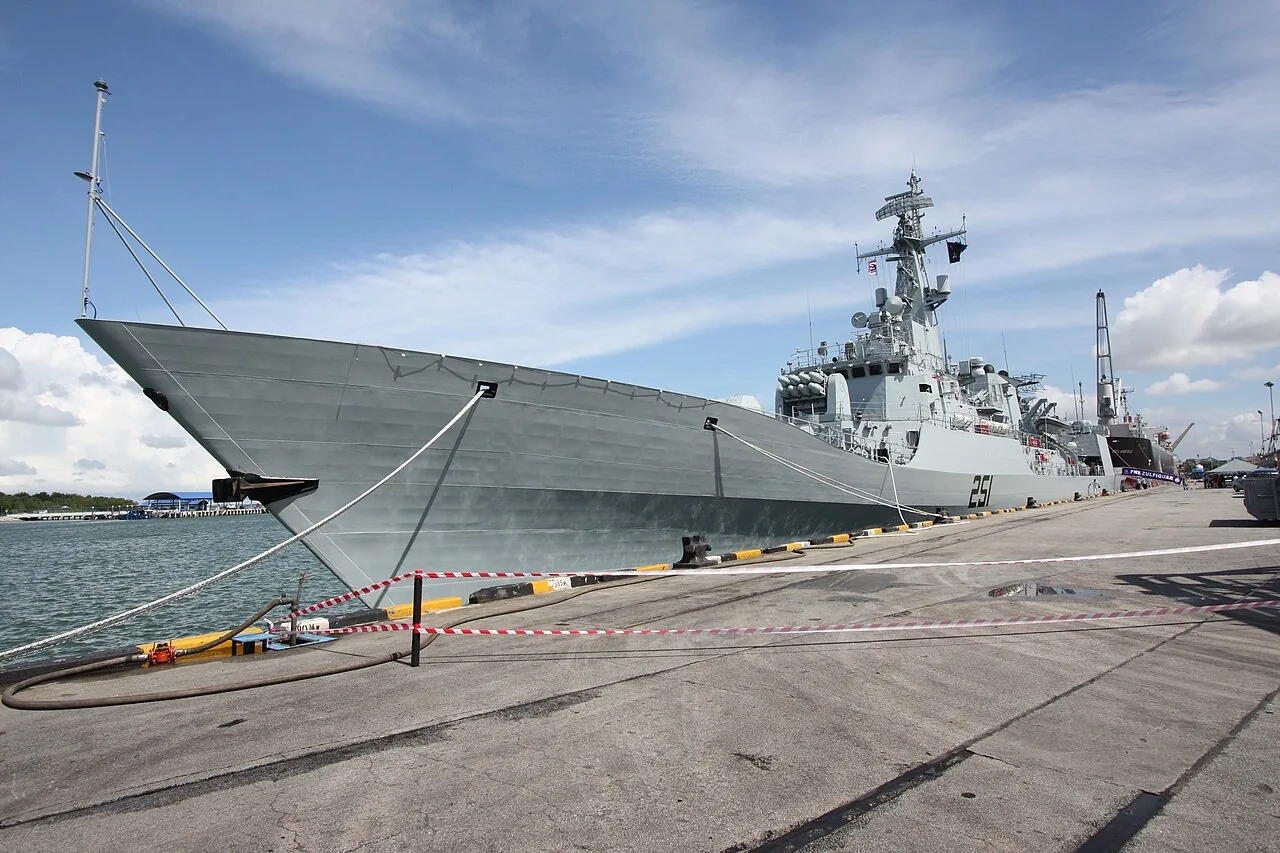
The naval leg was built on three contracts through the same chain of companies. The 17,000-tonne PNS Moawin, designed by STM under a 2013 contract, was built at Karachi Shipyard and commissioned on 16 October 2018 as the largest warship ever built in Pakistan. That project’s success was decisive in awarding STM the Agosta 90B upgrade in June 2016, covering sonar, periscopes, command-and-control and electronic support; PNS Hamza was delivered in 2021, PNS Khalid in December 2022, PNS Saad continues. The MILGEM contract of 5 July 2018 covered four corvettes — two built in Istanbul, two in Karachi — with design transfer; PNS Babur and PNS Khaibar are in service, PNS Badr and PNS Tariq in Karachi. GÖKDENİZ, ADVENT and SMART-S Mk2 form the ships’ Turkish backbone; the missile is the Pakistani Harbah. The SSB naval programme list and Asia’s submarine fleets give the wider picture.
Air: upgrade, pod, drones
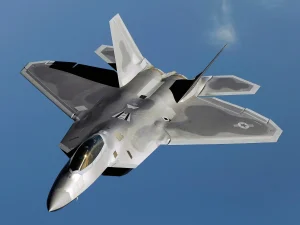
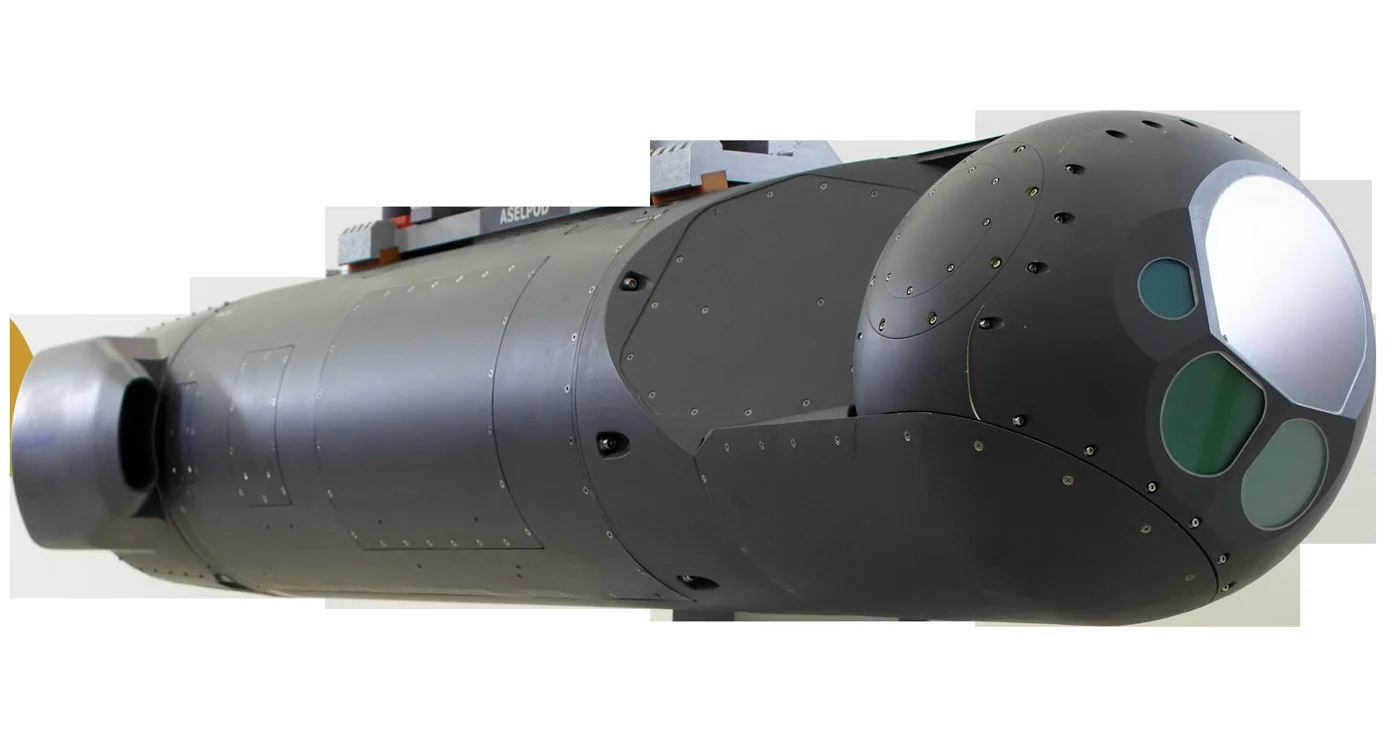
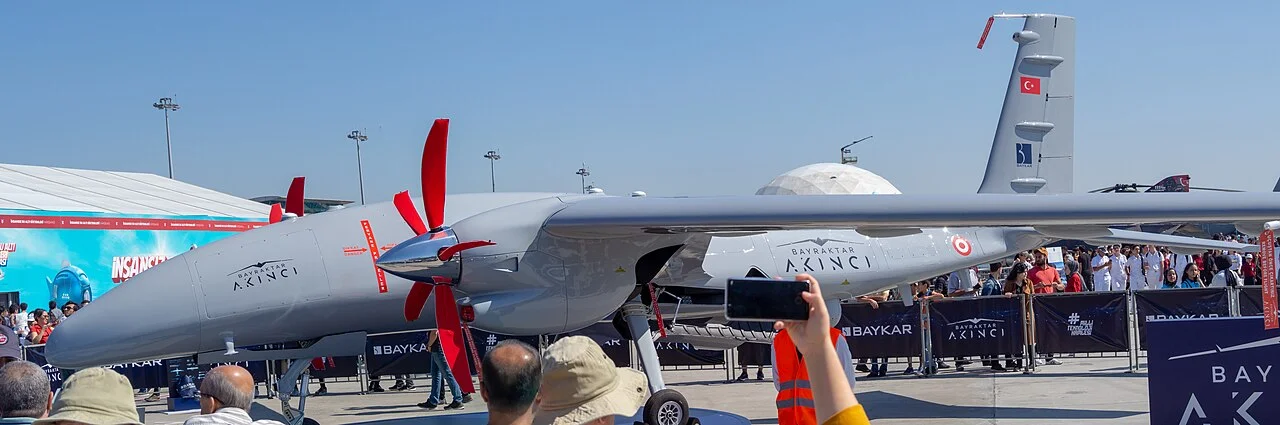
The air leg began in 2009 when TUSAŞ took on the upgrade of 41 F-16A/Bs; the first aircraft was handed over on 8 February 2012, the last four on 2 September 2014. In June 2016 Aselsan sold eight ASELPODs for the JF-17 ($25 million), with 16 more in May 2017; Pakistan became the pod’s launch export customer and ASELPOD became the JF-17’s standard pod. In unmanned systems the TB2 was flown to Pakistan in March 2022 on an Il-78 from Çorlu and confirmed by satellite imagery at Murid in April 2022; 44 Pakistani personnel trained on the Akinci in October 2022 and the first batch arrived in April 2023. Both types were formally inducted on 2 January 2024. Numbers and prices were never disclosed; the TB2 delivery record shows Pakistan among the undisclosed operators.
Land and air defence: the new layer
On Defence Day, 6 September 2026, the Pakistan Air Force showed Aselsan’s KORKUT 35 mm and ŞAHİN 40 mm low-level air defence systems for the first time. Contract date and numbers were not disclosed; the systems were presented in a base-defence role. This is the first verified case of the Turkish line entering a third layer in Pakistan after sea and air.
Alternatives and the cancelled contract
| Item | Turkish offer | Alternative | Outcome |
|---|---|---|---|
| Corvette | MILGEM (Ada/Babur) | Chinese Tughril class (bought in the same period) | Both: 4 Turkish + 4 Chinese |
| Submarine | STM upgrade | Chinese Hangor class (new build) | Upgrade Turkish, new boats Chinese |
| Targeting pod | ASELPOD | Western pods (export approval) | ASELPOD, JF-17 standard |
| Armed drone | TB2, Akinci | Chinese CH-4, Wing Loong II | Side by side; Turkish line added |
| Attack helicopter | T129 ATAK | Chinese Z-10ME | Z-10ME — US engine licence not granted |
| Trainer | — | Pakistani Super Mushshak | Türkiye became the buyer |
T129: a licence, not a product
The T129 contract signed in July 2018 — 30 helicopters, about $1.5 billion — was the largest agreement between the two countries to that date. The helicopter’s LHTEC T800 engine is a US–British product and the US export licence was not granted; after several deadline extensions Pakistan said in 2022 that it had “moved on” to the Chinese Z-10ME. Nothing was delivered. The row’s value for this file is that it shows the series’ recurring finding most clearly: the critical-component constraint also seen in the Azerbaijan and Ukraine files. Türkiye developed the TEI-TS1400 indigenous turboshaft afterwards; whether Pakistan will return to the T129 with that engine is unknown, and this file does not write it even as a forecast.
Cost: known and unknown
The relationship’s cost can be read at two ends. The known end is naval and pod contracts: MILGEM about $1.5 billion, the Agosta upgrade about $350 million, ASELPOD about $50 million across two contracts, the F-16 upgrade $64.5 million by press reports. The unknown end is unmanned systems and air defence: neither numbers nor prices were disclosed for TB2, Akinci, KORKUT or ŞAHİN. Official trade data misleads too: recorded Türkiye–Pakistan arms trade for 2024 shows only $5.16 million, because large items enter the record in different years and codes. The file therefore computes no total.
The Pakistan version of the Turkish package
In the Gulf, Balkan and Central Asian files we counted the components of the Turkish package. Pakistan adds two on top: construction in the buyer’s yard and reverse flow.
Built in the buyer’s yard
Two of the four corvettes and the fleet tanker were built at Karachi Shipyard — the most developed example in the series of the naval file’s pattern B. For the buyer that means yard capability, not only ships: PNS Moawin was the largest warship built in Karachi, and MILGEM’s Karachi leg carried the same yard into corvette construction. Among Turkish naval exports, the Pakistan line is the one that touches the buyer’s industry most.
Reverse flow: Super Mushshak
The Turkish Air Force issued a requirement in 2013 for 52 basic trainers to replace its SF-260s; Pakistan Aeronautical Complex bid with the Super Mushshak. The pre-agreement was signed at IDEAS in Karachi on 23 November 2016 and the contract at IDEF in Istanbul in May 2017. Deliveries were to start in 2020 and slipped with the pandemic; the first three aircraft reached Yalova in October 2022 and the 52nd was delivered in December 2025. The row shows the relationship cannot be read as “Türkiye sells, Pakistan buys”.
Training and logistics
Training was arranged differently in each contract: 44 Pakistani personnel trained in Türkiye on the Akinci in October 2022; MILGEM’s Karachi leg required yard staff training in Istanbul; STM teams worked in Karachi on the Agosta upgrade. The logistics line is sea and air; unlike Central Asia, ship and submarine maintenance can be done in the buyer’s own yard, which keeps the logistics score above the regional files.
The institutional mechanism
The High-Level Strategic Cooperation Council founded in 2009 is the ground between contracts: seven sessions, the latest in Islamabad on 12–13 February 2025 with 24 documents. Joint exercises (Ataturk-XIII, February 2025; Jinnah-XIII, April 2026), Türkiye’s status as the largest foreign exhibitor at IDEAS 2024 with about 75 companies, and Defence Minister Asif‘s Istanbul contacts belong to the same frame; the Pakistan–Kuwait protocol shows how Islamabad runs parallel frameworks.
Seventeen years of change
The timeline shows three waves: 2009–2014 F-16 upgrades (service), 2016–2018 naval and pod contracts (product and design), 2022–2026 drones, air defence and joint R&D (ecosystem). In 2018 the two largest contracts — MILGEM and T129 — were signed in the same summer; one entered service, the other was cancelled.
Official versus reported
News density on the Pakistan line is high and official confirmation is often mixed with press reports. The table separates them; report rows are not written as contracts.
| Item | Source | Status | Note |
|---|---|---|---|
| Baykar–NASTP R&D agreement | Baykar statement, 7 Aug 2023 | Official | KaGeM V3 mini cruise missile in development |
| Baykar assembly plant | Press, Dec 2025 | Report | No official confirmation |
| KAAN participation | Minister Güler, 20 Jan 2025 | Talks | No contract as of May 2026 |
| KIZILELMA | Press, 22 May 2026 (air chief at Baykar) | Report | ‘Close to finalising’ — unconfirmed |
| GAZAP on F-16 | Press, 9 Jun 2026 | Report | No official confirmation |
| Kamikaze drones | Press, 9 Sep 2026 | Report | No ISPR or Baykar confirmation |
| KORKUT and ŞAHİN | PAF Defence Day, 6 Sep 2026 | Official display | Contract date and numbers undisclosed |
| MKE–GIDS munitions | Contract, IDEF 24 Jul 2025 | Official | Quantity undisclosed |
The table shows where the next wave lies: if the three big talks — KAAN, KIZILELMA, the assembly plant — turn into contracts, the Pakistan line rises to the same step as Indonesia, joint development. Today all three are reports, and this file leaves them there.
The alliance layer: the Mecca Agreement
The Joint Defence Agreement signed in Mecca on 7 August 2026 by the Saudi Crown Prince, President Erdoğan and Prime Minister Shehbaz Sharif added Türkiye to the Saudi–Pakistani agreement of 17 September 2025. The text is unpublished; official statements say an attack on one is to be treated as an attack on all. Turkish mechanisms were set out on 13 August, the first committee met in Istanbul on 31 August and a secretariat in Riyadh was announced. The activation debate and the industrial reading are covered separately.
For this file the question is whether the alliance layer changes the industrial relationship. No item has turned into a contract, and Saudi Arabia’s Akinci production share predates the agreement. The layer is therefore not scored in the EM-PFI and is marked as an assessment. If it changes anything, the place is clear: joint munitions and drone production are the topics discussed — but a topic discussed is not a contract in this series.
EM-PFI assessment
Because the file covers the whole relationship, the score assesses the relationship as a whole, not one contract. The MILGEM decision scored 80 in the third file; the whole relationship sits two points higher on NASTP joint R&D and the reverse flow.
| Criterion | Weight | Score | Rationale |
|---|---|---|---|
| Operational need | 20 | 18 | Naval renewal, air ISR-strike, base defence; three services |
| Technical fit | 15 | 13 | Subsystems integrated on JF-17 and F-16; corvette design |
| Geography and climate | 10 | 9 | Arabian Sea and hot climate; no issues reported |
| Inventory compatibility | 10 | 7 | Chinese-heavy inventory; Turkish systems a niche layer with separate logistics |
| Logistics | 10 | 7 | Sea route; ship and submarine work possible in Karachi |
| Cost-effectiveness | 10 | 8 | MILGEM package scaled; drone and air-defence prices undisclosed |
| Delivery and production | 10 | 7 | MILGEM schedule slipped; T129 never delivered; Super Mushshak late |
| Technology transfer | 5 | 5 | MILGEM design transfer; NASTP joint R&D |
| Local production | 5 | 4 | Two corvettes and tanker in Karachi; none for drones |
| Modernisation path | 5 | 4 | KAAN and KIZILELMA in talks; no contract |
| Total | 100 | 82 | Strong choice |
Risks and limits
This section exists to make the file usable, not to weaken the product.
| Item | Status | What it means |
|---|---|---|
| Third-country licence | US licence for the T129 engine not granted | Every product with imported components carries the risk; different after the indigenous engine |
| Quantity transparency | TB2, Akinci, KORKUT numbers undisclosed | Fleet size unknown; the file makes no estimate |
| MILGEM schedule | 2 corvettes in service, 2 in Karachi | Karachi leg behind schedule; delivery forecast 2026–2027 |
| Report density | KAAN, KIZILELMA, plant, GAZAP, kamikaze drones | Five big topics unconfirmed; not to be read as contracts |
| Roketsan | No confirmed export | Babur class carries Harbah; the munitions line is not open |
| Mecca Agreement | Text unpublished | Industrial effect unmeasurable; not scored |
| Chinese weight | 78 per cent of imports from China | Turkish line is a niche; complementary, not a rival on main platforms |
The view from Washington
For a Western reader the Pakistan line is the series’ clearest case study in export-control policy, because the same capital both opened and closed doors. Washington approved the F-16 upgrade that TUSAŞ carried out in 2009–2014 — the relationship’s first contract — and a decade later did not grant the engine licence that would have delivered 30 T129s. Both decisions followed US policy towards Pakistan and Türkiye at the time, not the products. The lesson Türkiye drew was industrial: an indigenous turboshaft, and a drone family — TB2, Akinci — whose licence comes from Ankara alone. The Akinci–MQ-9B comparison shows the class where that licence difference matters most.
The second implication concerns the Mecca Agreement. A NATO member has entered a collective defence commitment with two non-NATO states; the text is unpublished and no joint command exists. What Washington will watch is not the treaty language but whether Turkish production lines — the Saudi Akinci share, the Pakistani NASTP work — are joined into one industrial chain. Today they are not, and this file scores only what exists.
Pakistan took from Turkish industry the niches China did not fill — corvettes, submarine upgrades, a targeting pod, mid-class drones, low-level air defence — and in return enlarged its yard, set up joint R&D and sold aircraft to Türkiye. It is the second-deepest relationship in the series after Indonesia and the only one in which buyer and seller change places. Its next step depends on three talks: KAAN, KIZILELMA and Baykar’s Pakistani facility. If all three become contracts, the line reaches joint development; if none does, it stays where it is — niche product, buyer’s yard, joint R&D — which is already a high step. IDEAS in November 2026 is the first place to look; the Poland file shows what an alliance-standard relationship looks like from the other side. The full series sits on the Turkish defence exports hub.
Frequently asked questions
What has Pakistan bought from Türkiye?
Navy: four Babur-class (MILGEM) corvettes (2018, ~$1.5bn), three Agosta 90B submarine upgrades (2016, ~$350m), the PNS Moawin fleet tanker (contract 2013, commissioned 2018). Air: 41 F-16 upgrades (2009), 24 ASELPOD targeting pods (2016–2017), Bayraktar TB2 and Akinci (2022–2023). Air defence: Aselsan KORKUT and ŞAHİN (revealed 6 September 2026). Munitions: MKE–GIDS contract (July 2025, quantity undisclosed).
What has Türkiye bought from Pakistan?
Fifty-two MFI-395 Super Mushshak basic trainers. Pre-agreement at IDEAS on 23 November 2016, contract at IDEF in May 2017; the first three reached Yalova in October 2022 and deliveries were completed in December 2025. It is Pakistan Aeronautical Complex’s largest export order and the only case in this series of Türkiye buying aircraft from a customer.
Is Pakistan Türkiye’s largest arms customer?
According to SIPRI, 16 per cent of Turkish arms exports in 2021–2025 went to Pakistan, making it the largest single buyer; the share was 10 per cent for 2020–2024. From Pakistan’s side, Türkiye is the second supplier (3.6 per cent) after China (78 per cent).
What is the status of the MILGEM corvettes?
All four are under contract: PNS Babur (commissioned in Istanbul 23 September 2023, inducted in Karachi 6 September 2024) and PNS Khaibar (handed over 20 December 2025, inducted 4 April 2026) are in service; Karachi-built PNS Badr (launched 20 May 2022) is on sea trials and PNS Tariq (2 August 2023) under construction. Details in the third file.
What happened to the T129 ATAK contract?
A contract for 30 helicopters worth about $1.5 billion was signed in July 2018. The US export licence for the LHTEC T800 engine was not granted; after several deadline extensions Pakistan turned to the Chinese Z-10ME in 2022. Nothing was delivered. Türkiye subsequently developed the TEI-TS1400 indigenous turboshaft.
How many TB2s and Akincis does Pakistan operate?
Official numbers were not disclosed. The TB2 was first confirmed by satellite imagery at Murid base in April 2022; the first Akinci batch (six to seven aircraft according to press) arrived in April 2023. The Pakistan Air Force formally inducted both types on 2 January 2024 (ISPR 6712). This file makes no estimate.
When was ASELPOD sold to Pakistan?
A $25 million contract for eight pods in June 2016 and a second for 16 pods in May 2017. Pakistan is ASELPOD’s launch export customer; the pods were integrated on the JF-17 and Aselsan confirmed the integration in November 2016.
Is the Agosta 90B upgrade complete?
Two of three boats: PNS Hamza was delivered in 2021 and PNS Khalid in December 2022; work on PNS Saad continues. STM’s programme covers sonar, periscopes, command-and-control and electronic support; Hamza sank a target ship with a single torpedo in the 2022 exercise.
Does the Mecca Agreement change the industrial relationship?
The Mecca Joint Defence Agreement of 7 August 2026 between Saudi Arabia, Türkiye and Pakistan added Türkiye to the Saudi–Pakistani agreement of 17 September 2025. The text is unpublished; official statements describe a collective defence commitment and the first committee meeting in Istanbul on 31 August. Its industrial effect is marked as an assessment; no item has turned into a contract.
Will Pakistan join the KAAN programme?
In talks. On 20 January 2025 at the 8th Joint Working Group at NASTP, Defence Minister Güler said an agreement was nearing finalisation; as of May 2026 no formal contract has been announced. This file keeps KAAN, KIZILELMA and the Baykar assembly plant at report status.
Is there Turkish joint R&D in Pakistan?
Yes. A Baykar subsidiary signed an R&D agreement with Pakistan’s National Aerospace Science and Technology Park on 7 August 2023; the KaGeM V3 mini cruise missile is being developed under it. Reports of an assembly plant (December 2025) have no official confirmation.
Has Roketsan exported to Pakistan?
No confirmed Roketsan export. The Babur-class corvettes carry the Pakistani Harbah anti-ship missile, not ATMACA. The munition packages for TB2 and Akinci were not disclosed.
What is the institutional framework?
The High-Level Strategic Cooperation Council founded in 2009. Its seventh session was held in Islamabad on 12–13 February 2025 with 24 documents signed. Joint exercises (Ataturk-XIII, February 2025; Jinnah-XIII, April 2026) and Türkiye’s status as the largest foreign exhibitor at IDEAS 2024 (about 75 companies) are further pillars.
What does the EM-PFI score mean?
The Pakistan × Turkish defence industry relationship scores 82/100, ‘strong choice’. The score assesses the whole relationship, not one contract: full marks on technology transfer (MILGEM design transfer, NASTP), low on delivery and logistics (MILGEM slippage, T129). It is Envanter Medya’s editorial assessment.
What comes next?
On the verified calendar: PNS Badr and PNS Tariq deliveries, the PNS Saad upgrade and MKE–GIDS deliveries. KAAN, KIZILELMA and the Baykar plant are in talks; IDEAS in November 2026 is the first place to look. This file recorded only what was signed and delivered.
Sources and method
- ISPR press release 6712 (2 January 2024) — TB2 and Akinci induction; PAF Defence Day (6 September 2026)
- STM project pages and press releases — Agosta 90B upgrade, PNS Moawin, ASFAT propulsion integration
- Pakistan Navy and Naval News — Babur-class commissioning (23 September 2023; 6 September 2024; 20 December 2025; 4 April 2026)
- TUSAŞ — Pakistan F-16 upgrade project page; Aselsan — ASELPOD integration statement (November 2016)
- Baykar — NASTP R&D agreement statement (7 August 2023)
- Pakistan Ministry of Foreign Affairs — HLSCC-7 joint declaration (13 February 2025); Mecca Summit statement (7 August 2026); SPA
- Turkish Ministry of Foreign Affairs — HLSCC sessions; Turkish Ministry of National Defence (13 August 2026)
- Scramble / PAC — Super Mushshak deliveries (October 2022 – December 2025); SIPRI March 2026 — share data
- International defence press — report-status items marked in the table
Method note. Every item is written with its status — ordered, in production, in service, cancelled, report; report items are not presented as contracts. No estimate was entered for contracts without disclosed numbers or values. The T129 row rests on the licence fact only. The Mecca Agreement’s industrial effect is unscored because the text is unpublished. The Indian context is outside this file’s scope. EM-PFI is Envanter Medya’s editorial assessment, not an official index.