Thales Subsidiary AAC Lands US Navy Contract for Remote Mine Hunting Modules Worth Up to $196 Million

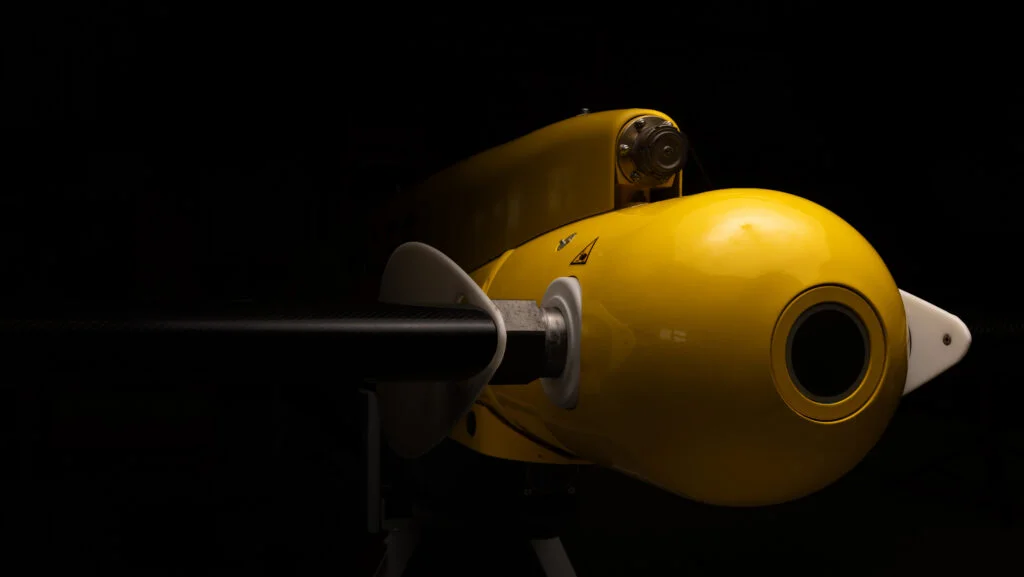
Advanced Acoustic Concepts (AAC), Thales’s US defense subsidiary, has won a $53.9 million contract from the US Navy for remote mine-hunting modules. Breaking Defense reported the award on November 3; with follow-on orders, the deal could grow to as much as $196.2 million.
The contract covers production of at least two Remote Mine Hunting (RMH) modules built around Thales’s SAMDIS 600 sonar and AI-assisted software for rapid mine classification. It also includes engineering support for the modules. The first two modules are due for delivery by October 2029, while potential follow-on modules could be delivered as late as 2039.
Thales North America CEO Rob Geckle called the ability to counter undersea mine threats fundamental to maritime security and naval mission success. Tony Lengerich, vice president of naval programs at Thales Defense & Security, said SAMDIS 600’s three-beam sonar architecture improves detection accuracy: “You get three looks at an object instead of just one look.”
The contract’s strategic backdrop overlaps with this year’s developments in the Strait of Hormuz. US Central Command (CENTCOM) launched a mine-clearing operation in the strait in April, and President Trump said in August that the mines had been cleared. That operational experience is seen as one factor accelerating US Navy investment in uncrewed mine-hunting capacity.
HII’s Nicholas Green emphasized that the program’s core benefit is keeping human crews away from the minefield itself. That approach aligns with earlier joint work between Thales and HII, which integrated and tested the SAMDIS 600 sonar on HII’s REMUS 620 uncrewed underwater vehicle, destroying detected mines with Thales’s ANGLER neutralization system.
The RMH program is part of the US Navy’s gradual shift from crewed platforms to autonomous systems in its mine-countermeasure strategy. Thales positioning itself in this field through its AAC subsidiary fits the company’s broader strategy of strengthening its US market presence since taking full ownership of AAC from Leonardo DRS in 2022.
The contract’s long delivery horizon — first deliveries by 2029, potential follow-ons out to 2039 — shows the US Navy treating this technology as a long-term program rather than a one-off purchase, suggesting RMH modules are planned as a lasting component of the Navy’s future mine-warfare architecture.
SAMDIS 600’s three-beam architecture offers a marked accuracy advantage over traditional single-beam sonar systems in mine detection. Viewing an object from three different angles helps AI-assisted classification software lower its false-positive rate and helps operators distinguish real threats faster, a technical approach aimed at closing the reliability gap between autonomous mine-hunting systems and human-supervised operations.
The contract’s potential growth to $196.2 million indicates the US Navy is treating the initial order as a pilot phase. How the first two modules perform will be the key benchmark determining whether follow-on orders proceed — a phased procurement model frequently used to manage risk as new autonomous systems enter naval inventories.
Pairing Thales’s ANGLER neutralization system with the SAMDIS 600 sonar within a single integrated architecture points to a shift where mine detection and neutralization are handled by one module rather than separate platforms. That integration shortens operation time while further reducing the need for human intervention; a detected mine can be classified and neutralized through the same platform.
For Türkiye, this investment in autonomous mine-hunting systems confirms a technology trend the Turkish Navy is also tracking through systems like the MALAMAN bottom mine and NATO mine-warfare cooperation in the Black Sea. The US Navy’s investment in AI-assisted sonar classification provides a global reference point shaping Turkish defense industry R&D priorities in unmanned naval systems.
Sources
- Breaking Defense, “Thales subsidiary lands US Navy contract for remote mine hunting modules”, November 3, 2026 (https://breakingdefense.com/2026/11/thales-subsidiary-lands-us-navy-contract-for-remote-mine-hunting-modules/) — primary source for contract value, delivery schedule and official statements.
- Thales Group press release, “DSEI 2025: Thales and HII partners to develop advanced autonomous undersea mine countermeasure capabilities” (https://www.thalesgroup.com/en/news-centre/press-releases/dsei-2025-thales-and-hii-partners-develop-advanced-autonomous-undersea) — secondary source verifying the SAMDIS 600/REMUS 620 joint work.