Pakistan Military Power 2026: Army, Air Force, Navy, Weapons and Defence Industry

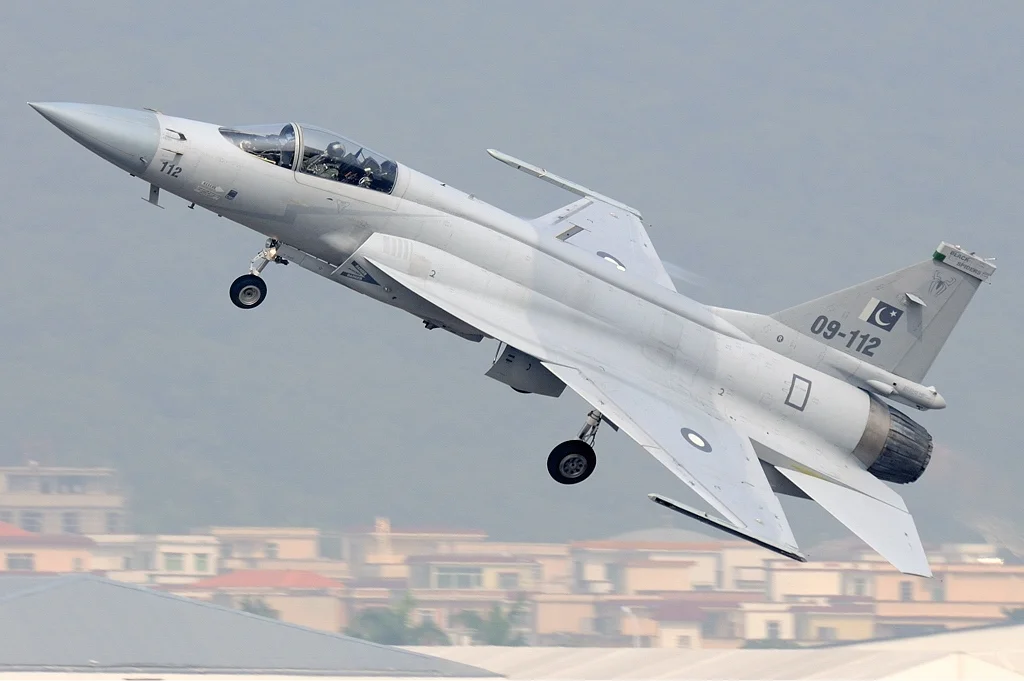
Short answer: Pakistan has the world’s seventh-largest active force (660,000, IISS Military Balance 2025/26), about 175 JF-17 and 75 F-16 fighters, roughly 2,500 tanks, four Type 054A/P frigates and its first Hangor-class submarine. The FY2026-27 defence allocation is PKR 3.01 trillion, about USD 10.8 billion (Ministry of Finance, June 2026). SIPRI Yearbook 2026 estimates around 170 nuclear warheads. Global Firepower ranks Pakistan 14th of 145 in 2026, a composite score rather than an official inventory.
Last updated: 17 September 2026
Pakistan Defence Hub: Pakistan Military Power → Army → Air Force → Navy → Defence Industry → Türkiye–Pakistan
This is the reference page of Envanter Medya’s Pakistan Defence series: what the Pakistan Army, Pakistan Air Force (PAF) and Pakistan Navy operate in 2026, what the budget looks like, what is on order, and where the defence industry and the partnership with Türkiye fit. Official order-of-battle data is not published; ISPR confirms inductions and tests and the Ministry of Finance publishes the budget, but fleet totals come from the IISS Military Balance, usually via secondary sources. Every figure below carries its year and source, and press reports are labelled as such.
Pakistan Armed Forces at a glance: Army, Air Force and Navy
The Pakistan Armed Forces are an all-volunteer force under the Joint Staff Headquarters in Rawalpindi. The Army is the largest service and sets procurement priorities; the PAF has modernised most visibly since 2020 with JF-17 Block III, J-10CE, Erieye and Turkish drones; the Navy is absorbing Chinese frigates and submarines, Turkish-designed corvettes and Dutch-built patrol vessels in the same decade. Three facts shape the inventory: China supplied 81% of major-arms imports in 2020-24 (SIPRI, March 2025); the US channel has been frozen since the late 2010s (12 AH-1Z helicopters built in 2017-18 were never delivered, and the 30 Turkish T129 helicopters ordered in 2018 were cancelled in 2022 over US engine licences); and Türkiye has become the second pillar, with Pakistan taking 16% of Turkish arms exports in 2021-25 (SIPRI, March 2026). The Pakistan Defence hub collects the full series.
Pakistan defence budget 2026-27 in PKR and USD
Pakistan’s fiscal year runs from 1 July to 30 June, so FY2026-27 is not calendar-year 2026. The Ministry of Finance allocated PKR 3.01 trillion to Defence Affairs and Services, 17.65% above the original FY2025-26 figure of PKR 2.55 trillion and about 16% above the revised PKR 2.59 trillion (Janes). At roughly 279 PKR/USD in mid-June 2026 that is about USD 10.8 billion, 2.08% of projected GDP and 15.9% of the federal outlay. Military pensions, PKR 822 billion, are a separate head. SIPRI’s broader estimate of 2025 military expenditure is USD 11.9 billion.
| Item | FY2025-26 | FY2026-27 | Year + source |
|---|---|---|---|
| Defence Affairs & Services (original) | PKR 2.55 tn | PKR 3.01 tn | MoF Budget in Brief 2025-26 / 2026-27 |
| Change on previous original allocation | +20% | +17.65% | Reuters Jun 2025; Dawn 13 Jun 2026 |
| USD equivalent at announcement | ~USD 9.0 bn @ 282 PKR | ~USD 10.8 bn @ ~279 PKR | Reuters 2025; Janes Jun 2026 |
| Share of GDP / federal outlay | n/a | 2.08% / 15.9% of PKR 18.77 tn | Dawn; Business Recorder 2026 |
| Military pensions (separate head) | PKR 742 bn | PKR 822 bn (+10.8%) | Janes; Dawn Jun 2026 |
| Physical assets / procurement line | n/a | PKR 925.8 bn (+39.6%) | Dawn / Janes Jun 2026 |
| SIPRI military expenditure (calendar 2025) | USD 11.9 bn (+11% real) | — | SIPRI Apr 2026 |
The line that matters for the inventory is procurement, up 39.6% to PKR 925.8 billion, spent under a 37-month USD 7 billion IMF programme approved in September 2024 that caps further growth. See the defence budget 2026-27 guide and the world’s ten largest defence budgets.
Personnel: how many soldiers does Pakistan have?
IISS Military Balance 2025/26 counts 660,000 active personnel, the seventh-largest active force in the world, and 550,000 reservists. Paramilitary strength is large: Civil Armed Forces above 291,000, National Guard 185,000 and the Strategic Plans Division force above 25,000. Since February 2026 the Army has run sustained Afghan-border operations while keeping eastern formations at high readiness after the May 2025 clashes with India, a two-front load compared in India vs Pakistan military strength 2026.
| Category | IISS Military Balance 2025/26 | Global Firepower 2026 |
|---|---|---|
| Active personnel | 660,000 (7th largest) | ~650,000 |
| Reserve | 550,000 | ~550,000 |
| Paramilitary | Civil Armed Forces 291,000+; National Guard 185,000; SPD Force 25,000+ | >300,000 |
| Recruitment model | All-volunteer | All-volunteer |
| World ranking | Not ranked by IISS | 14 of 145 (composite index) |
Pakistan Army ground vehicles: IFVs, APCs and artillery
Mechanised infantry rides mainly in the M113 family, plus more than 400 Talha armoured personnel carriers and the Hamza 6×6 infantry fighting vehicle from Heavy Industries Taxila (HIT). Artillery is the growth area: 236 Chinese SH-15 155 mm truck-mounted howitzers ordered in batches (53 km with rocket-assisted rounds), more than 400 M109 self-propelled guns and A-100 300 mm rocket launchers. The Army Rocket Force Command, raised in August 2025, fields the 140 km Fatah-1, the 400 km Fatah-2 (training launch April 2026) and the 750 km Fatah-4 cruise missile first tested on 30 September 2025 (ISPR via Janes).
Pakistan Army tanks 2026: Al-Khalid, Haider, VT-4, T-80UD
The tank fleet sits in the 2,470-2,630 range depending on whether older Type 69-II hulls are counted. Figures are IISS-derived via secondary sources. The core is HIT’s Al-Khalid (about 300) and Al-Khalid I (about 80, inducted August 2020). The VT-4 buy was confirmed in February 2020 with more than 300 expected; HIT’s licence-built Haider entered service in 2024 and rolled out its first locally assembled tank on 6 March 2025 with 39% indigenous content (HIT, November 2024).
| Tank | Origin / builder | Number | Status | Year + source |
|---|---|---|---|---|
| Al-Khalid (MBT-2000) | HIT / Norinco | ~300 | In service | IISS via secondary |
| Al-Khalid I | HIT | ~80 | In service (Aug 2020) | IISS via secondary; HIT |
| VT-4 / Haider | Norinco / HIT licence | “over 300” planned | Deliveries and local production continuing since 2024 | Quwa; HIT Mar 2025 |
| T-80UD | Ukraine (1997-2002) | ~315-320 | In service | IISS via secondary |
| Al-Zarrar (upgraded Type 59) | HIT | ~500 | In service | IISS via secondary |
| Type 85-IIAP | Norinco | ~268 | In service | IISS via secondary |
| Type 69-II | Norinco | ~400 | Legacy, partly in reserve | IISS via secondary |
| Total | — | ~2,467-2,627 | GFP 2026 lists 2,627 | GFP (composite, not official) |
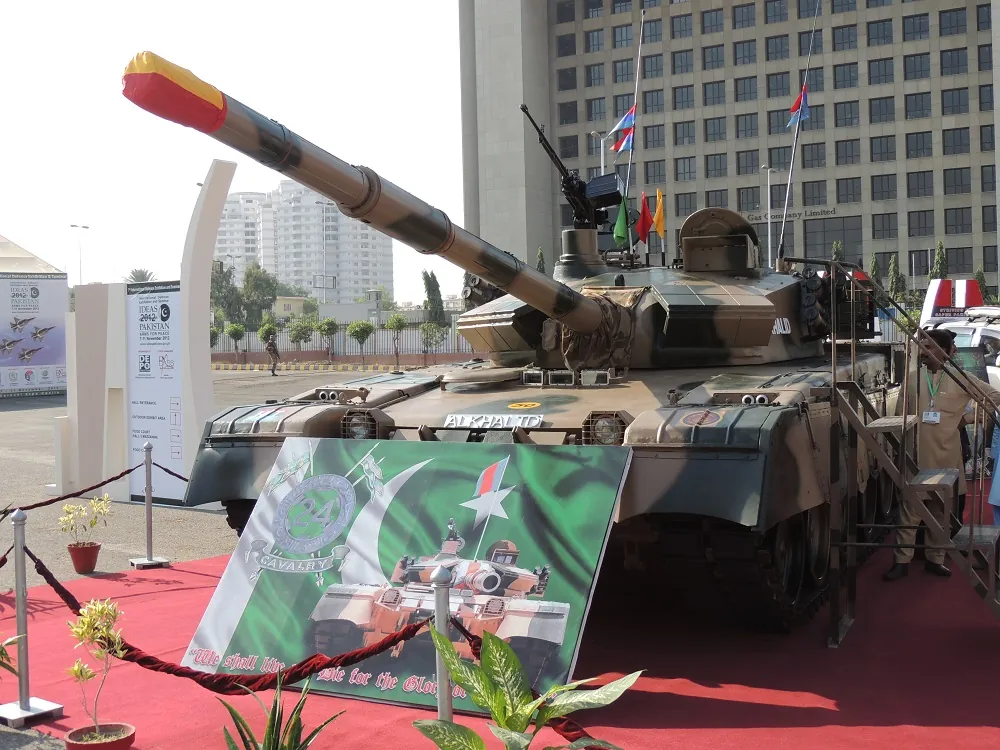
Type-by-type detail is in Pakistan Army tanks 2026; the Norinco-Pakistan VT-4 deal entry records the original contract.
Pakistan Air Force fighter jets: JF-17, F-16, J-10CE
The JF-17 Thunder, co-developed by Chengdu and Pakistan Aeronautical Complex (PAC) Kamra, is the numerical core: IISS Military Balance 2025 lists 50 Block I, 62 Block II, 26 two-seat JF-17B and 42 Block III, about 175, although the PAF itself says “more than 150”, so the honest range is 150-175 by source and year. Block III, with the KLJ-7A AESA (active electronically scanned array) radar and PL-15E missile, was inducted in November 2023. The F-16 fleet is 75 aircraft, 41 of them upgraded by Türkiye’s TUSAŞ in 2012-14. J-10CE stood at 20 in IISS 2025; reports of about 36 by early 2026 are unconfirmed. The 49 Mirage III, 37 Mirage 5 and 53 F-7PG are the obsolescence problem.
| Aircraft | Role | Number | Year + source |
|---|---|---|---|
| JF-17 Thunder (Blk I/II/B/III) | Multirole fighter | 50 / 62 / 26 / 42 = ~175 | IISS 2025 (PAF says 150+) |
| F-16A/B MLU, ADF; F-16C/D Blk 52 | Multirole fighter | 54 + 13 + 18 = 75 | IISS 2025 |
| J-10CE | Multirole fighter | 20 (reports of ~36, unconfirmed) | IISS 2025; press 2026 |
| Mirage III / Mirage 5 / F-7PG | Strike / cruise-missile carrier / interceptor | 49 / 37 / 53 | IISS 2025 |
| Saab 2000 Erieye | AEW&C | 9 (last delivered 2 Jul 2024) | Saab 2024 |
| ZDK-03 | AEW&C | 4 listed; reported retired 2023-24 | IISS 2025; press |
| Il-78MP | Tanker | 4 | IISS 2025 |
| K-8 / T-37 / Super Mushshak | Trainers | 58 / 69 / not published | IISS 2025; PAC |
| J-35A / KJ-500 / HQ-19 | Stealth fighter / AEW / BMD | Reported only; no contract confirmed | Government confirmed offer Jun 2025 |
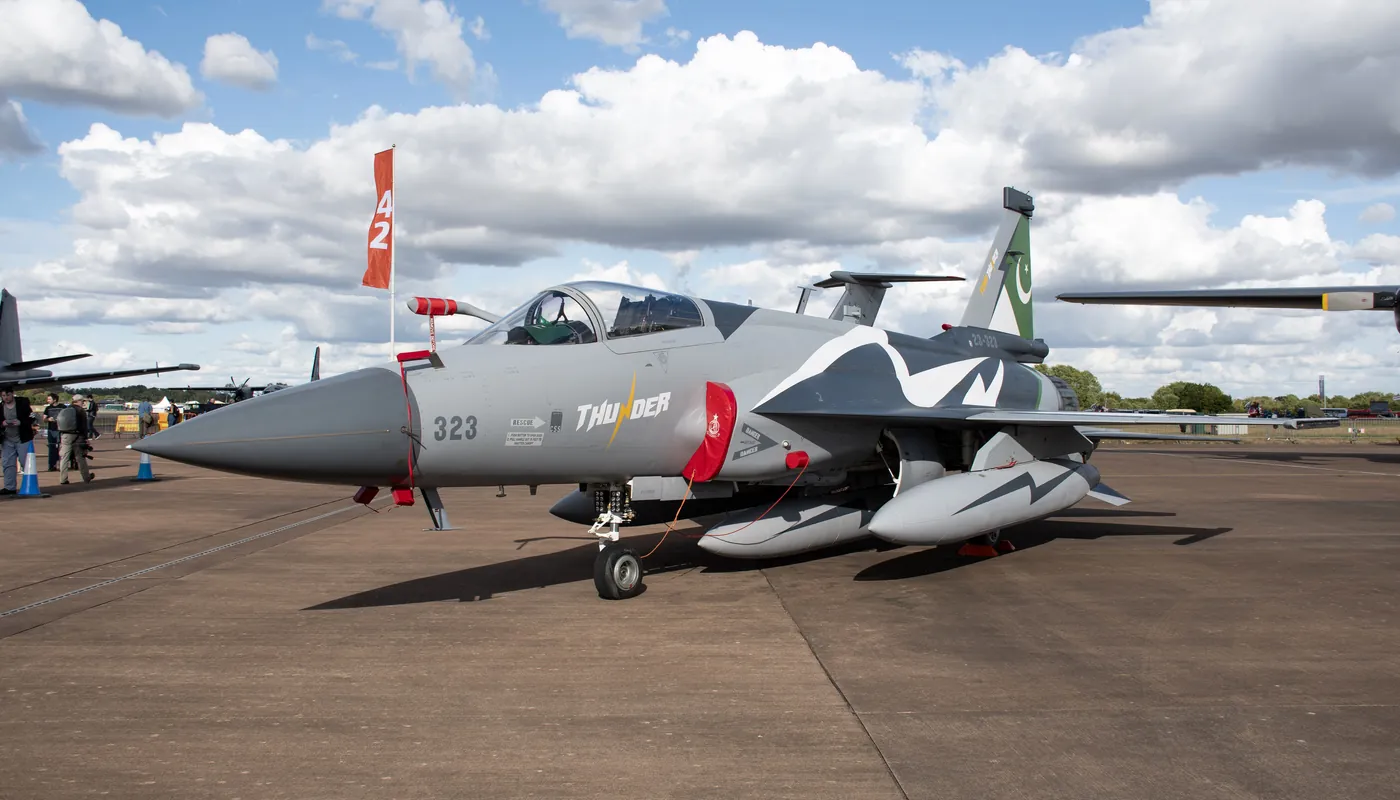
The full fleet table is in the Pakistan Air Force aircraft inventory 2026; the JF-17 Block III explainer covers radar, missiles, price estimates and exports; the AVIC-Pakistan J-10C contract records the 2022 order.
Trainer aircraft and pilot pipeline
Training runs through the PAC-built Super Mushshak, 69 T-37s and 58 K-8 Karakorum jets co-developed with Hongdu, more than 60 of which were assembled at Kamra. The Super Mushshak is Pakistan’s most exported aircraft: 52 went to the Turkish Air Force between October 2022 and December 2025. The PAF has no supersonic advanced jet trainer; HÜRJET, Türkiye’s new trainer and light-attack aircraft, is a different class from the JF-17 and no Pakistani order has been announced.
Drones and UCAVs: Bayraktar TB2, AKINCI, Wing Loong II, Shahpar
The PAF formally inducted the Bayraktar TB2 and AKINCI on 2 January 2024 (ISPR press release 6712); IISS lists 24 TB2 and 7 AKINCI, but neither Baykar nor the PAF has disclosed totals. Chinese types include the Wing Loong II (IISS counts 3 of a reported 48) and 12-24 CH-4 with the Army and Navy. The indigenous line marketed by GIDS includes the Shahpar-II (Block II shown February 2024), the Burraq strike drone and the Shahpar-III unveiled at IDEAS 2024, which had not flown by September 2026. Baykar and NASTP have co-developed the KaGeM V3 mini cruise missile since August 2023; reports of a Baykar plant, KIZILELMA or K2 purchases are unconfirmed. See TB2 vs Wing Loong II and AKINCI vs MQ-9B.
Helicopters: Z-10ME arrives, Cobra and ATAK gaps remain
The Army still flies legacy AH-1F Cobras. Twelve AH-1Z Vipers built in 2017-18 remain undelivered in US storage, and the July 2018 order for 30 T129 ATAK helicopters (about USD 1.5 billion) was effectively cancelled in 2022 when Washington refused an engine export licence. Four Mi-35M were bought in 2018. The replacement is China’s Z-10ME, first inducted at Multan on 2 August 2025 (ISPR via Janes).
Air defence: HQ-9P, HQ-16FE and the new SHORADS layer
The Army commissioned the HQ-9/P (about 125 km) in October 2021 under a CASIC contract and operates LY-80/HQ-16A (about 40 km, used in May 2025) and FM-90. The PAF has shown the HQ-16FE (about 160 km) and, in August 2025, the HQ-9BE with a reported 260 km reach. On 6 September 2026 the PAF revealed four short-range systems: China’s HQ-17AE (15 km) and LD-76, and ASELSAN’s KORKUT 35 mm and ŞAHİN 40 mm guns, the first confirmed ASELSAN air defence in Pakistani service. HQ-19 ballistic-missile defence is reported, not confirmed. Other KORKUT users are in KORKUT operators.
Pakistan missiles: ballistic and cruise missile ranges
The missile force is almost entirely indigenous, developed by NESCOM’s National Development Complex and Khan Research Laboratories. Ranges are as stated by ISPR at test time; the Pakistan missiles list gives platforms and test history.
| Missile | Type | Stated range | Year + source |
|---|---|---|---|
| Nasr / Abdali | Tactical / short-range ballistic | 60-70 km / 450 km | ISPR; May 2025 |
| Shaheen-I / IA / II / III | Short- and medium-range ballistic | 650-750 / 900 / ~1,500-2,000 / 2,750 km | ISPR (statements vary); test 9 Apr 2022 |
| Ghauri | Liquid-fuel ballistic | 1,300 km | ISPR readiness test Oct 2023 |
| Ababeel | MIRV-capable ballistic | 2,200 km | ISPR test 18 Oct 2023 (IISS analysis) |
| Babur-1B / Babur-2 / Babur-3 | Cruise (land / land / submarine-launched) | 900 / 700 / 450 km | ISPR Dec 2021; Jan 2017 |
| Ra’ad / Ra’ad-II / Taimoor | Air-launched cruise | 350 / 600 / 290 km export (~600 km domestic reported) | ISPR Feb 2020; Janes Apr 2026 |
| Fatah-1 / Fatah-2 / Fatah-4 | Guided rocket / quasi-ballistic / GLCM | 140 / 400 / 750 km | ISPR 2021; Apr 2026; 30 Sep 2025 |
| SMASH (P282) | Ship-launched anti-ship ballistic | ~350 km | Pakistan Navy test 25 Nov 2025 |
Pakistan Navy ships 2026: frigates, corvettes and patrol vessels
Four Chinese Type 054A/P Tughril-class frigates arrived between January 2022 and May 2023, joining four F-22P Zulfiquar-class frigates (2009-13). The Babur class, Pakistan’s version of Türkiye’s MILGEM corvette, was ordered from ASFAT in July 2018 for about USD 1.5 billion: PNS Babur (F280) was commissioned in Istanbul on 23 September 2023, PNS Khaibar (F282), the first Karachi-built hull, was handed over on 20 December 2025 and inducted on 4 April 2026, while PNS Badr and PNS Tariq were on sea trials as of April 2026 and are not yet commissioned. Four Damen-built Yarmook-class patrol vessels arrived in 2020-25. SEASPARK-2026 began off Karachi on 2 September 2026.
| Class | Type | Number | Status | Year + source |
|---|---|---|---|---|
| Tughril class (Type 054A/P) | Frigate | 4 | In service (2022-23) | Pakistan Navy / Naval News |
| Zulfiquar class (F-22P) | Frigate | 4 | In service (2009-13) | Pakistan Navy |
| Babur class (PN MILGEM) | Corvette | 4 ordered: 2 in service, 2 on trials | Babur 2023; Khaibar Apr 2026; Badr, Tariq trials | Naval News Apr 2026; ASFAT |
| Yarmook class (Damen OPV 2600) | Offshore patrol vessel | 4 | In service (2020-25) | Damen |
| Jinnah class | Frigate (indigenous design) | Lead ship contracted 3 Nov 2025 | Under construction, first ship ~2028 | KSEW / Quwa |
| PNS Moawin (A39) | Fleet tanker (STM design) | 1 | In service (Oct 2018) | STM; ISPR |
| Agosta 90B / Agosta 70 | Submarine (AIP) / submarine | 3 / 2 | In service; 2 of 3 STM-upgraded / end of life | STM; IISS |
| Hangor class (Type 039B export) | Submarine (AIP) | 8 ordered: 1 commissioned | PNS/M Hangor 30 Apr 2026; Shushuk launched Mar 2025 | Naval News Apr 2026 |
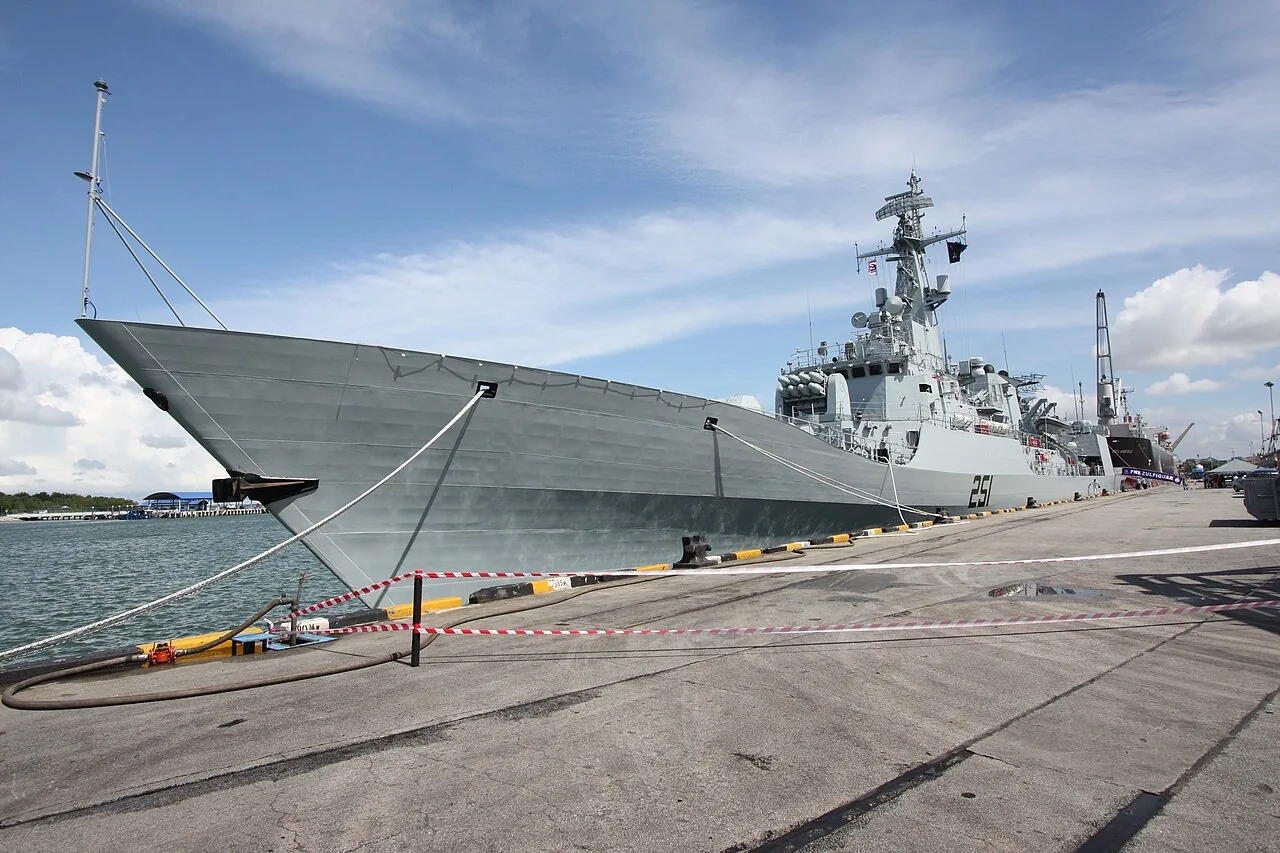
The hull-by-hull list is in Pakistan Navy ships and submarines 2026; why Pakistan bought MILGEM explains the shipyard logic and MILGEM deliveries and inventory tracks the class.
Submarines: Agosta 90B and the Hangor programme
Three Agosta 90B boats (Khalid, Saad, Hamza) are the backbone. Türkiye’s STM won their mid-life upgrade in June 2016 (about USD 350 million): Hamza was redelivered on 29 April 2021, Khalid in December 2022, and Saad’s upgrade is ongoing. The two Agosta 70s are at end of life. The Hangor class, an export Type 039B, was ordered in 2015: eight boats, four built in Wuhan and four at Karachi Shipyard. PNS/M Hangor (S131) was commissioned at Sanya on 30 April 2026 and reached Karachi on 11 June; Shushuk (S132) was launched in March 2025; no Karachi-built hull had been commissioned by September 2026, and the programme is targeted for 2028. The 450 km Babur-3 gives the force a submarine-launched cruise missile.
Pakistan defence industry: PAC, HIT, POF, KSEW, NESCOM and GIDS
The industry is state-owned under the Ministry of Defence Production in Rawalpindi: Pakistan Ordnance Factories (POF Wah, founded 1951, ammunition from 5.56 mm to 155 mm), Heavy Industries Taxila (founded 1971, tanks and armoured vehicles), Karachi Shipyard (corvettes, submarines, the Jinnah-class frigate) and NRTC Haripur (radios, jammers, counter-drone). PAC Kamra reports to the PAF and builds 58% of the JF-17 airframe with about 20 aircraft a year of capacity; NESCOM develops missiles and drones; GIDS markets them abroad. DEPO put realised exports at USD 1.3 billion over 2022-24, against a historical USD 300-500 million a year; reports of more than USD 10 billion in FY2024-25 contracts rest mainly on Azerbaijan’s 40-aircraft JF-17 order (USD 4.6 billion), and no FY2025-26 figure has been published. Turkish firms are embedded: Repkon is building a 120,000-shell-a-year 155 mm line at Wah, Sarsılmaz co-produces pistols with POF, and the ASELPOD pod (24 bought in 2016-17) flies on PAF JF-17s.
Nuclear weapons: an estimated 170 warheads
Pakistan became a declared nuclear power with the Chagai tests of 28 and 30 May 1998. The arsenal is undisclosed; SIPRI Yearbook 2026 estimates about 170 warheads as of January 2026 and the Federation of American Scientists’ 2025 assessment gives the same figure, with growth toward roughly 200 by the late 2020s. Both are estimates, not counts. Doctrine, reaffirmed by the National Command Authority in December 2017, is “full spectrum deterrence” within “credible minimum deterrence”. The Pakistan nuclear weapons explainer covers history and doctrine; this site publishes no technical or operational detail.
Türkiye-Pakistan defence cooperation: what is in service and what is not
Status matters here because several headline projects never reached service. In service: TUSAŞ’s upgrade of 41 F-16A/B (2012-14); 24 ASELPOD pods; Bayraktar TB2 and AKINCI (January 2024); STM’s upgrade of two Agosta 90B; the STM-designed tanker PNS Moawin (2018); two of four Babur-class corvettes with HAVELSAN ADVENT combat management, ASELSAN sensors and GÖKDENİZ 35 mm; and, since September 2026, KORKUT and ŞAHİN. In production: Badr and Tariq, the third Agosta upgrade, the Repkon line and KaGeM V3. Cancelled: 30 T129 ATAK. Reported only: GAZAP bombs on F-16s, KIZILELMA, Baykar K2, a Baykar plant and KAAN participation. The High-Level Strategic Cooperation Council has met seven times since 2009, and on 7 August 2026 Türkiye, Pakistan and Saudi Arabia signed the Makkah joint defence agreement, whose first committee met in Istanbul on 31 August. See the full list of Turkish weapons used by Pakistan, the Türkiye-Pakistan cooperation timeline 2009-2026 and the Mecca pact report.
Modernisation programmes 2026-2030
At sea: seven more Hangor-class submarines, two more Babur-class corvettes, the Jinnah-class frigate (first ship about 2028) and SMASH. In the air: continued JF-17 Block III production, more J-10CE, the reported J-35A package, the PFX next-generation fighter announced at IDEAS 2024 and the Z-10ME. On land: 236 SH-15 howitzers, VT-4 and Haider tanks toward a planned 679, Fatah-2 and Fatah-4, a layered counter-drone architecture and HIT’s unmanned-systems factory opened on 7 September 2026 (R-020 and R-040 drones, loitering munitions, P-905 interceptor). The 39.6% rise in the FY2026-27 procurement line is the budgetary expression of this list.
Sourcing note: fleet totals are IISS Military Balance figures relayed through secondary sources, cross-checked against FlightGlobal’s World Air Forces 2026 where possible. Global Firepower is a composite index cited for orientation, not as an inventory. Items marked “reported” (J-35A, HQ-19, KIZILELMA, K2, Baykar plant, KAAN) had no ISPR, Ministry of Defence Production or manufacturer confirmation as of 17 September 2026.
Strengths and limitations of Pakistan’s military
Strengths: a deep Chinese pipeline that delivers on schedule; an indigenous missile industry covering every range band from 70 km to 2,750 km; combat experience from May 2025; a growing second source in Türkiye; and, since August 2026, a formal alliance with Saudi Arabia and Türkiye. Limitations: fiscal space constrained by the IMF programme; 81% dependence on one supplier; a frozen US channel that cost the AH-1Z and T129; ageing Mirage, F-7PG, Agosta 70 and Type 69-II fleets due for replacement in the same decade the Navy pays for submarines; the two-front load since February 2026; and a nuclear programme that absorbs resources outside the conventional inventory.
Pakistan army rank in the world 2026
Global Firepower’s 2026 index places Pakistan 14th of 145 countries. The index blends more than 60 factors and is useful for broad tiers, but it is not an official inventory and does not measure combat effectiveness. By verifiable metrics Pakistan has the seventh-largest active force (IISS), one of the ten largest tank fleets, an arsenal estimated at around 170 warheads and a defence budget of about USD 10.8 billion, well outside the global top 20.
Frequently Asked Questions
How strong is Pakistan’s military in 2026?
About 660,000 active troops (IISS Military Balance 2025/26), roughly 175 JF-17 and 75 F-16 fighters, some 2,500 tanks and a navy taking delivery of Hangor-class submarines. Global Firepower ranks Pakistan 14th of 145 in 2026, a composite score rather than an official inventory.
How many fighter jets does Pakistan have in 2026?
IISS Military Balance 2025 lists about 175 JF-17 (all blocks), 75 F-16, 20 J-10CE, 49 Mirage III, 37 Mirage 5 and 53 F-7PG, roughly 400 combat aircraft. Reports of about 36 J-10CE by early 2026 are unconfirmed.
How many tanks does Pakistan have in 2026?
Roughly 2,470-2,630 (IISS-derived figures via secondary sources; Global Firepower 2026 lists 2,627): about 300 Al-Khalid, 80 Al-Khalid I, 315-320 T-80UD, 500 Al-Zarrar, 268 Type 85-IIAP and 400 Type 69-II, plus VT-4 and Haider tanks entering service since 2024.
How many submarines does Pakistan have?
Six in commission as of mid-2026: three Agosta 90B, two elderly Agosta 70 and PNS/M Hangor, commissioned on 30 April 2026. Seven more Hangor-class boats are on order, with the eight-boat programme targeted for 2028 (Naval News, April 2026).
Is Pakistan a nuclear power, and how many warheads does it have?
Yes; it tested at Chagai on 28 and 30 May 1998. SIPRI Yearbook 2026 estimates about 170 warheads as of January 2026, and the Federation of American Scientists gives a similar figure. These are independent estimates, not official disclosures.
What is Pakistan’s defence budget for 2026-27?
PKR 3.01 trillion for Defence Affairs and Services in FY2026-27 (1 July 2026 to 30 June 2027), about USD 10.8 billion at the roughly 279 PKR/USD rate of mid-June 2026 and 2.08% of projected GDP (Ministry of Finance; Dawn). Military pensions of PKR 822 billion are budgeted separately.
Related Envanter Medya guides
- Pakistan Air Force Aircraft Inventory 2026
- JF-17 Block III Explained: Specifications, Radar, Missiles, Price
- Which Turkish Weapons Does Pakistan Use? Full List With Status
- Pakistan Navy Ships and Submarines 2026
- Is Pakistan a Nuclear Power? History, Arsenal and Doctrine
- Pakistan Army Tanks 2026: Full List
- Pakistan Missiles List 2026: Every Ballistic and Cruise Missile
- Pakistan Defence Budget 2026-27 Explained
- Türkiye-Pakistan Defence Cooperation Timeline 2009-2026
- India vs Pakistan Military Strength Comparison 2026
- Pakistan Deploys Troops, JF-17s and HQ-9 to Saudi Arabia
Sources
- Ministry of Finance, Budget in Brief 2026-27
- Dawn, defence allocation FY2026-27 (13 Jun 2026)
- Janes, Pakistan raises defence budget for 2026-27
- SIPRI, Trends in World Military Expenditure 2025
- SIPRI Yearbook 2026 press release (nuclear estimates)
- SIPRI arms transfers 2020-24 (China 81% share), via SCMP
- FlightGlobal, World Air Forces 2026 directory
- ISPR press release 6712, PAF induction of AKINCI and TB2
- Janes, Pakistan inducts first Z-10ME helicopter
- Naval News, first Hangor-class submarine commissioned
- STM, Agosta 90B modernisation project
- Global Firepower 2026, Pakistan (composite index)