GÖZDE: How ASELSAN Turns Dumb Bombs Into Laser-Guided Precision Weapons

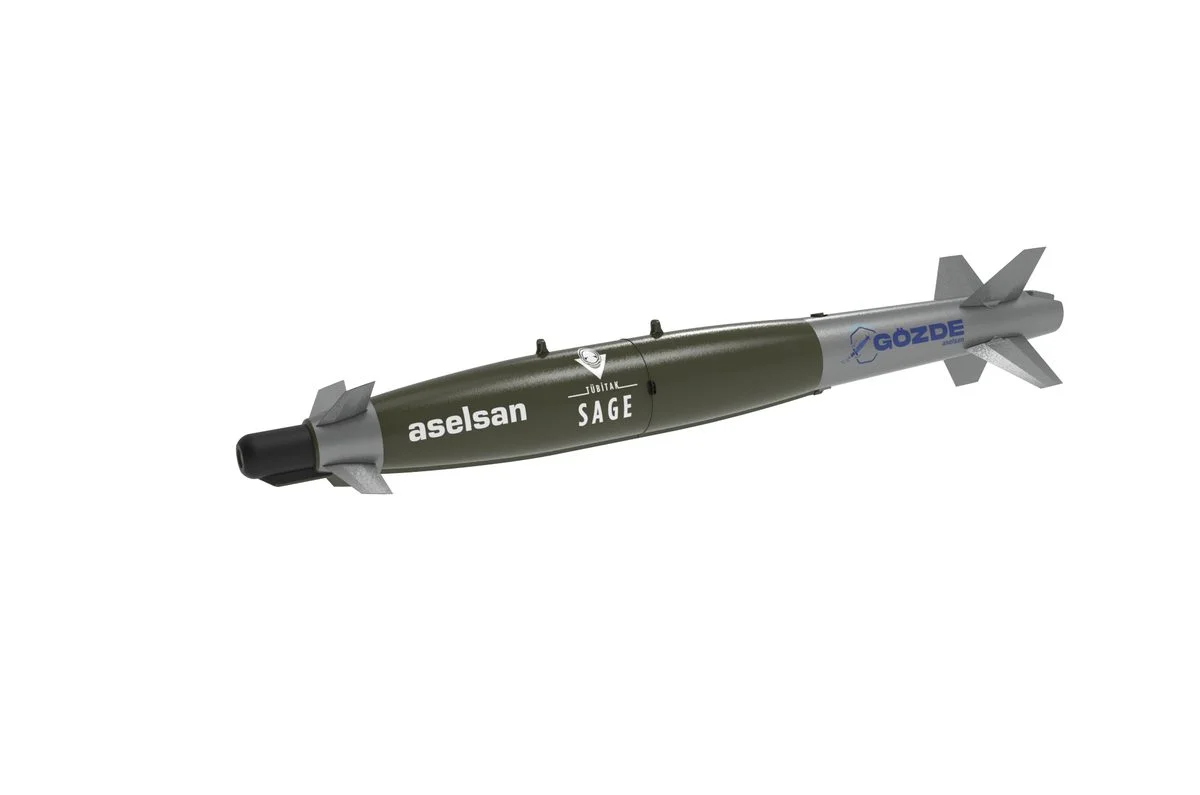
The cheapest smart weapon in any air force’s arsenal is the dumb bomb it already owns — plus a guidance kit. That is the logic behind ASELSAN’s GÖZDE, a laser-seeker guidance kit that bolts onto a standard 500 lb MK-82 free-fall bomb and turns it into a manoeuvring, re-targetable precision weapon capable of hitting moving vehicles.
Guidance kits are one of the quiet success stories of modern air power. Rather than buying purpose-built missiles at hundreds of thousands of dollars apiece, an air force converts its existing stockpile of unguided bombs — and the MK-82 exists in the millions worldwide — into precision-guided munitions at a fraction of the cost. The American Paveway family defined the category; GÖZDE is Türkiye’s sovereign answer, free of foreign export licences and open to customers that Western suppliers turn away.
Triple-redundant guidance
GÖZDE combines three navigation methods in a single kit: a semi-active laser (SAL) seeker that homes in on laser energy reflected off the target, an inertial navigation system (INS) that dead-reckons the bomb’s position with no external signals, and GPS satellite navigation. The layering is the point. If GPS is jammed — increasingly the default condition over modern battlefields — the INS carries the weapon; if the laser spot is lost, satellite and inertial guidance still deliver it to the coordinates. Each channel covers the others’ failure modes.
Key specifications
| Base munition | 500 lb MK-82 unguided free-fall bomb |
| Guidance | Semi-active laser seeker + INS + GPS, fully integrated |
| Targets | Stationary and moving, including high-speed movers under laser designation |
| Re-targeting | Possible during captive flight, before release |
| Impact angle | Selectable in advance to match target type |
| Interface | MIL-STD-1760 aircraft compatibility |
Agility against moving targets
The kit’s distinguishing feature is manoeuvrability. A new guidance algorithm and additional fins give GÖZDE more aerodynamic authority than classic laser-guided bombs, which ASELSAN says improves performance against high-speed moving targets whenever laser designation is available. Pilots can pre-select the impact angle — steep for bunkers, shallow for area targets — and re-target the weapon during captive flight as battlefield priorities shift, a flexibility that matters in dynamic close-air-support scenarios.
The economics of precision
Precision is usually framed as a moral argument — fewer stray bombs, less collateral damage — but it is equally an economic one. A guided bomb that hits on the first pass replaces the three or four sorties that unguided bombing of the same target would demand: less fuel, less airframe fatigue, less exposure of pilots to air defences. For air forces with deep MK-82 stockpiles and shallow budgets, a kit like GÖZDE is the highest-leverage purchase available.
Why it matters
GÖZDE completes a pattern visible across the Turkish defence industry: identify every imported component in the kill chain and replace it with a domestic equivalent. Türkiye already builds the aircraft, the targeting pods and the lasers that designate targets; with GÖZDE, the weapon that rides the beam is Turkish too. For Ankara that means sovereignty. For the export market, it means a Paveway-class capability from a supplier without Washington’s paperwork.