Europe’s Sovereignty in the Skies: The Eurodrone MALE RPAS and the ITAR Independence Imperative

Europe’s dependence on American and Israeli unmanned aerial systems for persistent intelligence, surveillance, and reconnaissance has been a source of strategic discomfort for over a decade. The friction became visible during the 2011 Libya campaign, when European nations discovered that using their leased Predator and Reaper drones for strike missions required explicit U.S. authorization regardless of the urgency or political context of the situation. Repeated demands for weapons release approval from Washington underscored what European defense planners had long acknowledged privately: the continent’s ISR-to-strike pipeline had a fundamental sovereignty gap at its most critical node.
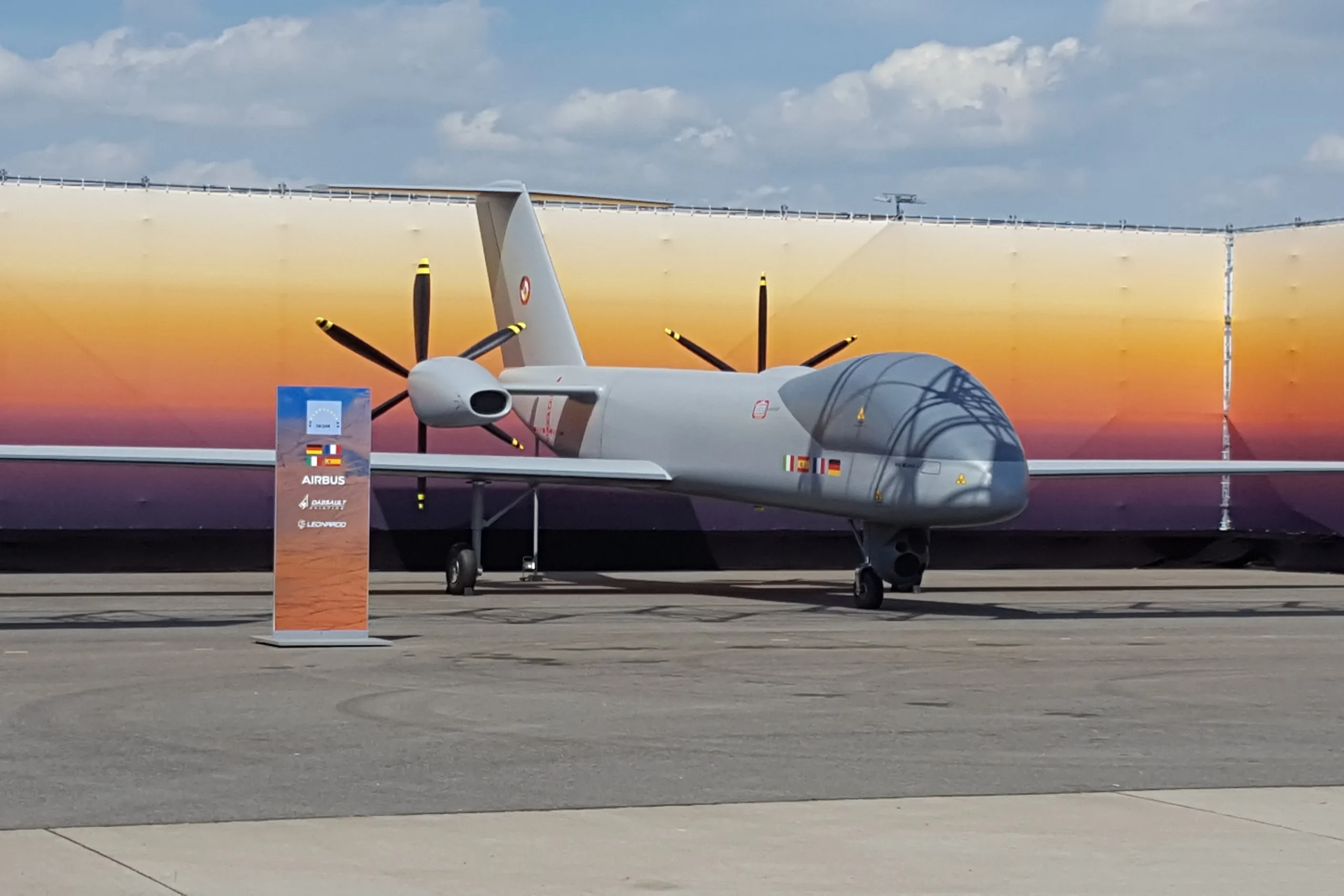
The Eurodrone MALE RPAS — Medium Altitude Long Endurance Remotely Piloted Aircraft System — is Europe’s formal answer to this deficit. Led by Airbus Defence & Space in partnership with Leonardo, Dassault Aviation, and Indra Sistemas, and contracted through OCCAR in June 2020 for approximately €2.5 billion, the program represents the most significant European unmanned aircraft initiative since the canceled EADS/BAE Mantis concept. But its significance extends far beyond the technical specifications of the platform itself.
Why Eurodrone Matters: The Sovereignty Argument
The core case for Eurodrone rests not on performance specifications — where existing platforms like the MQ-9 Reaper, the IAI Heron TP, and increasingly the Turkish Baykar Akıncı are already proven — but on the strategic autonomy argument. When European militaries operate U.S.-manufactured RPAS platforms, they are legally constrained by the U.S. International Traffic in Arms Regulations (ITAR). Arming those platforms for strike missions requires explicit U.S. government approval, a requirement that has created operational friction in multiple real-world scenarios.
A European-manufactured, ITAR-free RPAS removes that constraint. France, Germany, Italy, and Spain would be free to configure and deploy Eurodrone for armed missions according to their own national legal frameworks, without requiring Washington’s concurrence. In an era of transatlantic strategic uncertainty, that freedom has tangible operational value.
Program Status and Technical Parameters
| Parameter | Value (design target) |
|---|---|
| OCCAR Development Contract | June 2020; ~€2.5 billion |
| Wingspan | ~26 m |
| MTOW | ~11,000 kg |
| Endurance | 40 hours |
| Operational Altitude | 40,000+ ft (12,200+ m) |
| Payload | ~600 kg (sensors); 1,800 kg total |
| Propulsion | Twin turboprop (redundant) |
| Civil Airspace Compliance | STANAG 4586, EASA-compatible design |
| Target First Flight | 2025–2026 |
| Target IOC | 2029–2030 |
The twin-engine configuration — unusual in the MALE class where most competitors use a single turboprop — reflects the program’s design philosophy: a platform sufficiently reliable and technologically sophisticated to operate in contested European airspace, including cross-border STANAG-compliant flight operations. This is not an expeditionary system designed primarily for permissive environments; it is built for the complex airspace of a continent where civilian and military traffic coexist at high density.
The Budget Challenge
Program finances have been turbulent. Germany’s 2023 budget crisis — which saw Berlin scramble to reallocate defense funds within constitutional constraints following the Federal Constitutional Court’s ruling on budget transfers — created temporary uncertainty about Eurodrone funding commitments. France has continued operating leased MQ-9 Reapers as a bridge capability, a situation that underlines both the urgency of the need and the cost of delay.
Italy and Spain have maintained their financial commitments, but the program’s extended development timeline means that several of its founding nations will be operating late-generation MQ-9s or equivalent platforms for most of the coming decade before Eurodrone reaches initial operational capability. The opportunity cost of that delay — in lease fees, in operational constraints, in the continuing sovereignty compromise — is substantial but rarely discussed explicitly in public program assessments.
The Turkish Benchmark
No honest analysis of the Eurodrone program can ignore the uncomfortable benchmark established by Turkish defense industry. Baykar’s Akıncı — which achieved initial operational capability in 2021 — already delivers comparable or superior performance on several key parameters:
| Platform | Endurance | Weapons Payload | Combat Record | Status |
|---|---|---|---|---|
| Eurodrone | 40 hr (planned) | TBD (armed variant) | None (not operational) | Development |
| Baykar Akıncı | 24 hr | 1,350 kg | Ukraine, Somalia | Operational since 2021 |
| GA MQ-9 Reaper | 27 hr | 1,700 kg | Afghanistan, Iraq, Syria | Operational since 2007 |
The comparison is uncomfortable for Eurodrone’s advocates because it demonstrates that the sovereignty argument — valid as it is — cannot substitute indefinitely for operational availability. Eurodrone’s superiority in endurance (40 hours versus Akıncı’s 24) and its civil airspace compliance provide genuine differentiation, but these advantages only materialize if the program delivers on schedule — a proposition that the program’s history gives limited grounds for confidence.
Planned Procurement
| Nation | Projected Procurement | Notes |
|---|---|---|
| Germany | 20+ | Budget uncertainty persists; bridging with MQ-9 lease |
| France | 8 | Continuing MQ-9 operation as interim measure |
| Italy | 10+ | Both Navy and Air Force requirements |
| Spain | TBD | Joined 2016; procurement numbers unconfirmed |
What Eurodrone Must Prove
The program enters its critical phase — ground systems integration, airframe testing, and eventual first flight — carrying the burden of representing European technological credibility in the unmanned arena. Three specific questions will define its legacy:
First, whether it can deliver on its 40-hour endurance claim in operational conditions, not just in controlled test environments. Second, whether the ITAR-free architecture enables genuinely unconstrained weapons integration that fulfills the sovereignty promise. Third, whether the four founding nations’ procurement commitments survive the budget pressures and competing priorities of the late 2020s.
Europe’s ISR sovereignty gap is real, significant, and strategically consequential. Eurodrone is the right answer to the right problem. The question is not whether the program should exist, but whether it will deliver — and on what timeline.
FAQ
Will Eurodrone carry weapons?
The baseline program focuses on ISR. An armed variant has been discussed but not contractually committed. The founding nations’ ability to arm Eurodrone without ITAR restrictions is a core sovereignty argument for the program, but actual weapons integration will depend on national decisions made closer to IOC.
Why does Eurodrone use twin engines when competitors use single engines?
Twin engines provide redundancy and reliability essential for certified flight in European civil airspace, where single-point failures are not acceptable. The added cost and complexity are justified by the requirement to operate legally and safely in the same airspace as commercial aviation — a necessity for European operations that most expeditionary MALE platforms do not face.