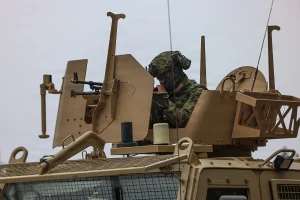
Greek Parliament clears over €1 billion in procurement: VICTA diver-delivery craft and V-BAT drones on the list

A committee of the Greek Parliament has approved eight defence programmes worth a combined total of more than €1 billion. Two headline items are 10 VICTA diver-delivery units from Britain’s SubSea Craft and 10 V-BAT vertical take-off and landing drone systems from US-based Shield AI. Part of the production is slated for the Skaramangas Shipyards near Athens.
Lead
According to Naval News, dated 12 June 2026, the Greek Parliament’s Special Standing Committee on Armaments Programmes and Contracts approved on 11 June a set of defence programmes worth more than €1 billion in total. Among the most prominent items are the VICTA platforms, capable of covertly delivering operators and equipment underwater, and the V-BAT systems designed for wide-area maritime surveillance. The acquisitions form part of Athens’ broader modernisation plan running through 2036, referenced in open sources at a scale of roughly €28 billion.
Details
As reported by Naval News, the eight programmes carry a combined value in the €1 billion to €1.2 billion range. A final sign-off is still pending from KYSEA, Greece’s top decision-making body on foreign affairs and defence, a step open sources describe as largely a formality.
On the VICTA item, 10 diver-delivery units are to be procured from Portsmouth-based SubSea Craft for approximately €145 million; six would go to the Special Warfare Command and four to the Navy, with more than 25 percent of the value returning to Greek industry and construction taking place at the Skaramangas Shipyards. A further 10 units possibly built later for another NATO navy should be treated as single-sourced.
On the V-BAT side, 10 systems (20 aircraft) are to be acquired from Shield AI for roughly €71 million; six systems would go to the Army and four to the Navy, procured over four years through the NATO Support and Procurement Agency (NSPA). The move follows a 2 June agreement the Hellenic Army signed with Shield AI to expand its fleet for Maritime Domain Awareness across the Aegean.
What is the system
Developed by SubSea Craft, VICTA is a diver-delivery platform that transits at high speed on the surface before rapidly switching to a submerged mode. Open sources put it at up to 40 knots and a 250-nautical-mile surface range, carrying two crew plus six divers roughly 25 nautical miles underwater, with a modular design.
Shield AI’s V-BAT is a single-engine, ducted-fan VTOL drone in the NATO Class I category, notable for runway-independent operation. Open-source figures put it at about 2.9 m tall with a 3.8 m wingspan, near 18 kg payload, a top speed around 157 km/h and 12-13 hours endurance with an EO/IR payload. Shield AI states it has been used in combat in Ukraine, including GPS- and comms-denied environments.
Technical and operational significance
The two systems point to complementary capability layers. VICTA gives special forces added range and concealment for covert shore infiltration, reconnaissance, sabotage and underwater attack; running fast on the surface before submerging reduces detection risk versus conventional rigid-hull craft and extends reach in island-fragmented waters.
V-BAT is positioned as a persistent surveillance asset operable from ships or constrained sites thanks to runway-independent take-off and landing. Distributing it across both the Army and Navy suggests Greece is building unmanned surveillance as a shared ISR layer rather than tying it to a single service.
Background
The VICTA-Skaramangas link is not new: SubSea Craft and the shipyard signed an MoU in early 2025 to produce the platform in Greece and establish a maritime innovation centre, within Defence Minister Nikos Dendias’ push to strengthen domestic innovation.
On V-BAT the process advanced in stages; the Army already operated the system and the 2 June agreement set the expansion in motion, with Shield AI planning an Athens office and bringing its Hivemind autonomy software. In the wider frame, the package belongs to Athens’ Agenda 2030 track, whose contemporaneous items include three Embraer C-390 transports, Israeli Heron drones and MEKO-200 frigate upgrades. Some Greek press reporting has questioned the V-BAT procurement on pricing and process grounds, an objection logged as public debate rather than an established finding.
Relevance for Turkiye, NATO and the region
These acquisitions are worth tracking in the context of the military balance in the Aegean and the Eastern Mediterranean. Both speak directly to the geography: VICTA addresses covert movement across short inter-island distances and V-BAT uninterrupted surveillance of broad sea areas; the dense island fabric and narrow lanes heighten their operational value.
From Turkiye’s vantage point, a neighbouring state combining NATO procurement with domestic-production partnerships underlines that regional capacity should be measured by industrial footprint, not only platform counts. Given Turkiye’s own unmanned-aircraft ecosystem and indigenous naval capability, reading the competition through reciprocal investment and industrial depth is the sounder framework. This is a capability observation grounded in open-source data, not a claim of superiority by either side.
Open-source verification
- Approval and the €1-1.2 billion value are corroborated by Naval News, Devdiscourse and Athens Times; a final KYSEA sign-off is described as pending.
- VICTA core figures (10 units, SubSea Craft, ~€145M, Skaramangas) appear across multiple sources; the 6/4 split and the second batch are primarily Naval News.
- V-BAT core figures (10 systems/20 aircraft, ~€71M, via NSPA) are confirmed; the 6/4 split is Naval News-sourced.
- Technical figures align across Janes, Shield AI and GreekReporter; V-BAT operators include the US, Netherlands, Romania, Japan and Ukraine in combat.
Assessment
The approved package reflects a tendency to pair platform purchases with a domestic-industry footprint. VICTA at Skaramangas, plus Shield AI’s Athens office and autonomy-software commitment, frames the acquisition as longer-term capability and industrial-base building rather than mere hardware. At the same time, the final KYSEA approval for some items is pending, several breakdowns are single-sourced, and public objections to the V-BAT deal exist. The process will read more clearly once signatures, schedules and realised local-production shares are in hand.
| Item | VICTA | V-BAT (MQ-35A) |
|---|---|---|
| Manufacturer | SubSea Craft (UK) | Shield AI (US) |
| Quantity | 10 craft | 10 systems / 20 aircraft |
| Approx. value | ~€145 million | ~€71 million |
| Allocation | Special Warfare Cmd (6) / Navy (4) | Army (6) / Navy (4) |
| Production / procurement | Skaramangas Shipyards (Greece) | Via NSPA, 4 years |
| Headline figures | 40 knots, 250 nm, 6 divers | 18 kg, 157 km/h, 12-13 h |
| Role | Covert underwater insertion | Maritime surveillance / ISR |