

Why Do Gulf States Choose Turkish Drones? Access, the Package and Two Empty Rows

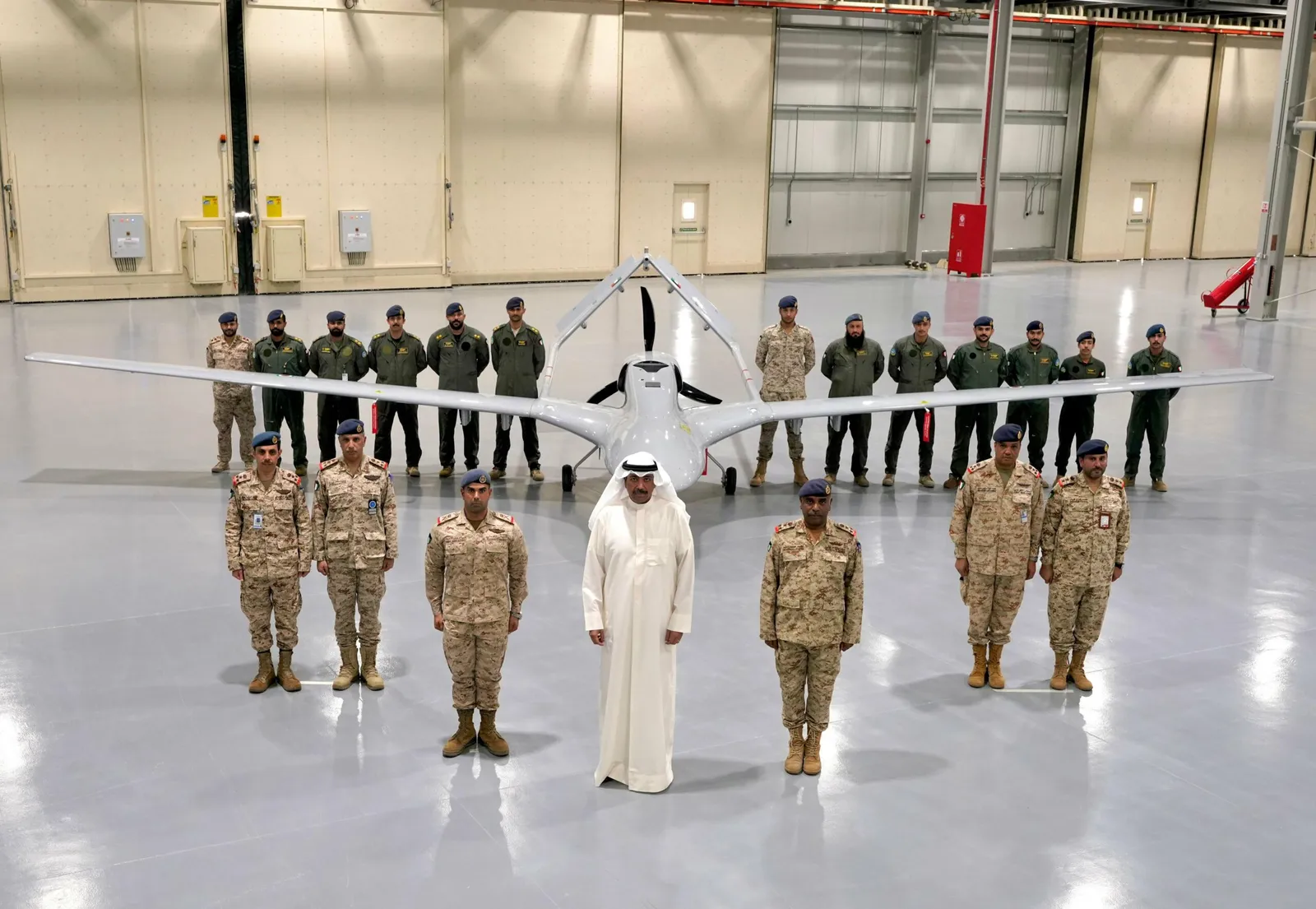
The six Gulf monarchies have the highest per-capita defence spending in the world. For a buyer with that budget, price cannot be the answer to “why a Turkish drone?” The answer sits elsewhere: in a door that closed in 2021, and in what could be put in place of the system behind it.
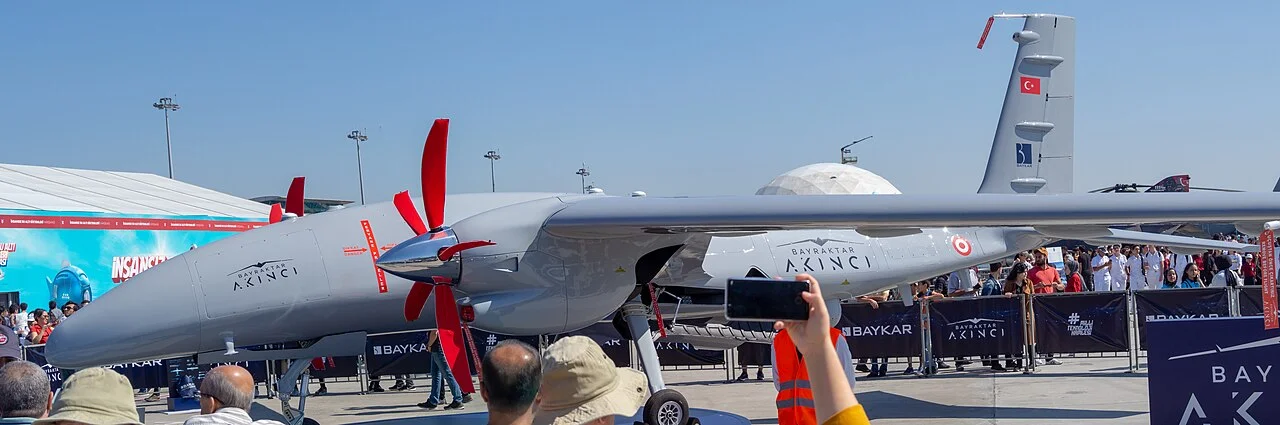
This file lines up the armed-drone choices of all six Gulf Cooperation Council states in a single table. Four have Turkish systems; two do not, and the two blanks are as instructive as the four entries. The Saudi Akinci decision, the Qatari portfolio and the Emirati industrial partnership were examined in earlier files of this series (in Turkish); here the data is not repeated. What is sought is what the region has in common. The Turkish original of this file is here.
Who bought, who did not
The table below contains only contracts and deliveries verifiable from public sources. Two rows are deliberately empty: Bahrain and Oman have no Turkish UAV, and that absence gets its own section at the end.
| Country | System | Quantity | Contract | Status |
|---|---|---|---|---|
| Qatar | Bayraktar TB2 | 6 + 3 GCS + simulator | March 2018 (DIMDEX) | Delivered; TB2’s first foreign customer |
| UAE | TB2 + Akinci | No official figure | 2022– | First 20 TB2 Sept 2022 (press); at least 2 Akinci 2024 (Baykar) |
| Kuwait | Bayraktar TB2 | 18 + 3 GCS | June 2023 · ~$367m | First batch delivered 17 July 2025 |
| Saudi Arabia | Bayraktar Akinci | Undisclosed | July 2023 | Local production share; operators graduated Oct 2025 |
| Bahrain | — | — | — | No verified Turkish UAV |
| Oman | — | — | — | No verified Turkish UAV |
The first thing the table says: Turkish drones entered the Gulf with one small order in 2018, and the real growth came in 2022–2023. The second is less visible: none of the four buyers took the same package. Qatar bought a six-aircraft starter set, Kuwait a standard fleet, Saudi Arabia a production line, and the UAE two classes at once. One region, four contract logics.
The real question is access, not product
Gulf states have operated armed drones since the mid-2010s; Türkiye was not first into this market. Saudi Arabia bought Chinese CH-4s in 2014; the UAE became the launch export customer for the Wing Loong II in 2017. So the claim that “there would be no armed drones in the Gulf without Turkish ones” is false. The right question is: why did countries that already had armed drones add another supplier?
The closed door: the MQ-9B decision
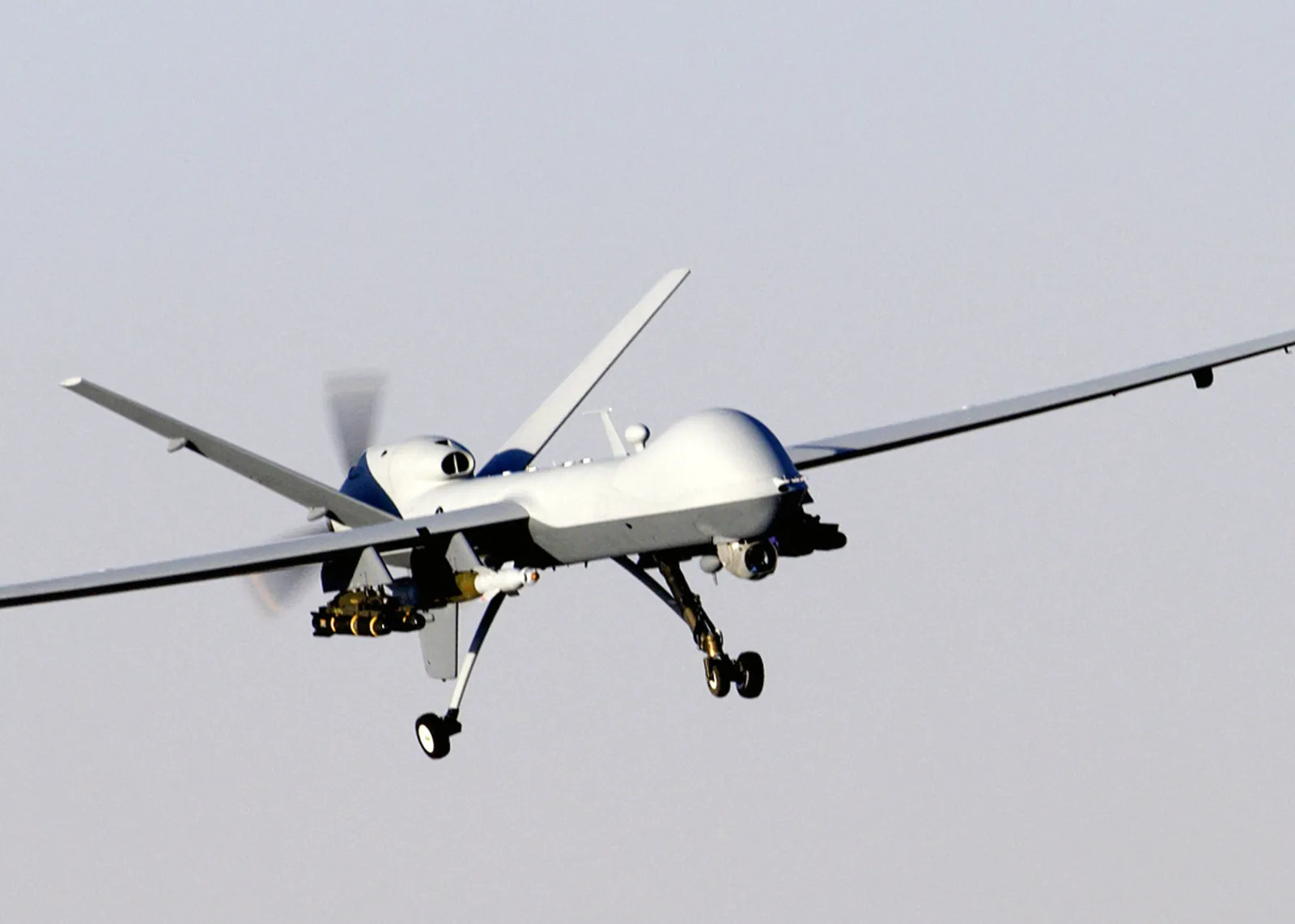
Half the answer is in Washington. The Gulf’s preferred system was long the MQ-9 family; but US armed-drone exports fall under missile-technology export controls and congressional review. In 2021 the UAE’s request for 18 MQ-9B, worth about $3 billion, was suspended. The decision concerned one country, but the whole region heard the same message: this door can open, and it can close.
The limits of the Chinese line
The other half is in China. The CH-4 and Wing Loong families solved the access problem but opened another question. Defence analyses have reported that some buyers’ expectations of these systems were not fully met; that is an assessment, not an official statement, and it is flagged as such here. What is certain: Gulf states with Chinese systems did not retire them. They added Turkish ones. The issue is not “which is better” but not depending on a single supplier. A side-by-side of the TB2 and the Wing Loong II is available separately.
| Line | Example | Access | Munitions | Constraint |
|---|---|---|---|---|
| United States | MQ-9B | Congress + export controls | US approval required | Decision time and uncertainty |
| China | CH-4, Wing Loong II | Open | Chinese-sourced | Performance expectations (assessment) |
| Türkiye | TB2, Akinci | Single capital | Same contract | Inventory fit, support network |
Four components of the Turkish package
An access problem opens a door; walking through it still requires a coherent package. Four components recur across the Gulf contracts.
1. A combat record
Gulf buyers purchased a test report in 2018 and a field record in 2022. Between the Qatari and Kuwaiti contracts the TB2 was used in more than one theatre; for the buyer that is a reference, not a brochure. The same element led Poland’s 2021 decision. The TB2’s combat record is treated in a separate file.
2. Munitions under the same contract
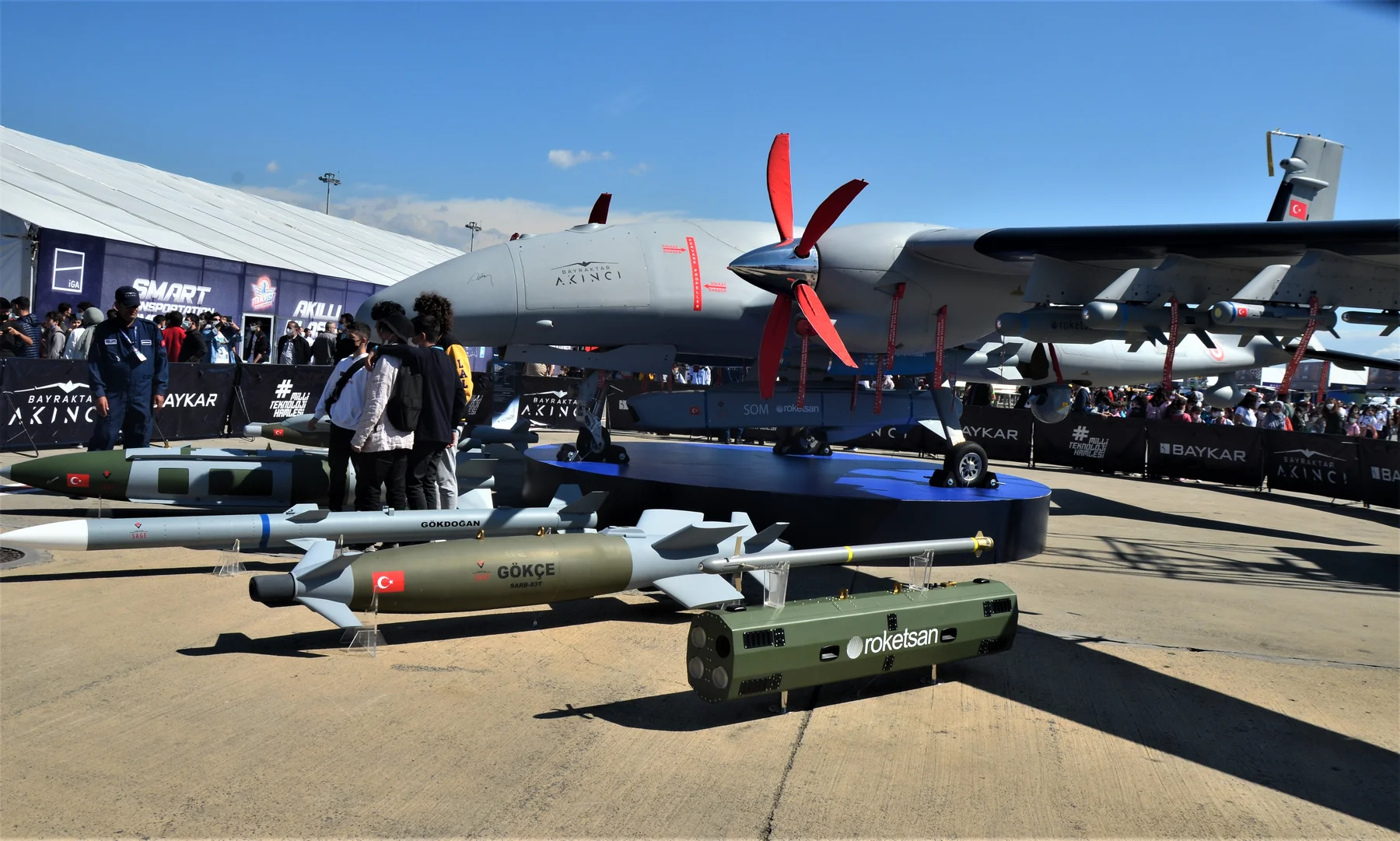
Kuwait’s package includes Roketsan munitions alongside the aircraft. Weapons such as MAM-L arriving from the same supplier means the buyer does not wait for a separate approval. On the US line, aircraft and munitions are often approved separately; on the Turkish line, one contract.
3. One capital, one licence
Export approval for Turkish UCAVs comes from Ankara alone. For the buyer, that means planning delivery without reading a third country’s politics. Still, this should not be overstated: Turkish systems contain imported subcomponents, and their supply chains are not always public.
4. A production share, for those who want it
Only one of the four buyers used it. Saudi Arabia’s Akinci contract moves the airframe and part of the wiring and avionics into the Kingdom; intellectual property stays in Türkiye. Qatar and Kuwait bought finished systems. Production cooperation with the UAE has been reported, but no facility is verified. The difference follows the buyer’s industrial goal.
What changed in twelve years
The timeline shows that the Turkish line did not arrive in the Gulf all at once. Five years separate the 2018 Qatari contract from the two large 2023 contracts; the hinge is two events in 2021, the US MQ-9B decision and the Türkiye–UAE normalisation.
Four buyers, four contract patterns
| Buyer | Pattern | Value | Transfer | Contract to first delivery |
|---|---|---|---|---|
| Qatar (2018) | Starter set | Undisclosed | None | Completed |
| UAE (2022–) | Two classes, tiered | Press: ~$2bn under discussion | Unverified | First 20 TB2 same year (press) |
| Kuwait (2023) | Standard fleet + 3-yr support | ~$367m | None | ≈2 years (Jun 2023 → Jul 2025) |
| Saudi Arabia (2023) | Production line | Undisclosed | Airframe + subsystems | First local assembly targeted 2026 |
Qatar: small start, large reference
Qatar’s 2018 contract was small in numbers — six aircraft — but larger in effect. The TB2’s first foreign customer was a Gulf state, and that created the “already in service in the region” reference for later buyers. Qatar decided in 2018 rather than waiting on the US line; the region’s other three buyers came four to five years later. Qatar’s wider US relationship is unchanged — its KC-46A tanker approval is a case in point.
Kuwait: the measure of a standard package
Kuwait’s contract shows what a “standard” Turkish UCAV package looks like in the Gulf: 18 aircraft, three ground stations, training equipment, munitions and three years of technical support, with operator training in Türkiye in two groups — July 2024 and February 2025 — before the first batch arrived on 17 July 2025. Kuwait’s inventory is built on Western systems, from Eurofighters to Patriot batteries; the TB2 is its first large Turkish platform. The three-year support clause repeats a pattern seen elsewhere in this series: a buyer of finished systems asks for sustainment guarantees instead of an industrial share. Kuwait’s defence protocol with Pakistan points the same way.
For scale: Poland’s 2021 contract covered 24 aircraft for $270 million. The two packages differ in content and cannot be compared line by line, but they sit in the same band. The Saudi row is the reverse: neither value nor quantity disclosed, a production share in return, and a longer schedule.
Why are Bahrain and Oman missing?
A verified negative is data. Two of the six GCC members have no Turkish UAV, and that is the best test of this file’s thesis: if the Turkish package held the same appeal for every Gulf state, all six would be on the list.
No official reason exists; the two observations below are Envanter Medya assessments. Oman’s procurement traditionally runs through the United Kingdom and the United States, and the country works to stay neutral in regional tensions. Bahrain hosts the US Fifth Fleet and sources most equipment through Washington. What the two share may be that they did not experience the access problem as the other four did — and without an access problem, the Turkish package’s first component never engages.
The view from Washington
For an English-language reader the Gulf pattern carries a second lesson, about US export policy rather than Turkish industry. Every time an MQ-9 request stalls, the buyer does not stop buying; it buys elsewhere, and the elsewhere is now a NATO ally rather than China. The question in Washington is no longer whether the Gulf will acquire armed drones, but whose. The same dynamic appears in the S-400 and CAATSA debate and in the region’s missile-defence contracts: access, not capability, is the variable that moves procurement. A head-to-head of Akinci and MQ-9B shows how narrow the capability gap has become in the class that matters most here.
EM-PFI assessment
Because this is a regional file, the score assesses the Gulf line as a whole, not one country’s decision. Individual scores differ by state.
| Criterion | Weight | Score | Rationale |
|---|---|---|---|
| Operational need fit | 20 | 18 | Border, maritime and infrastructure surveillance; tactical and heavy classes together |
| Technical suitability | 15 | 13 | TB2 and Akinci as a tiered offer; SATCOM option |
| Geography and climate | 10 | 8 | In service in hot, dusty conditions; long-term wear data not public |
| Existing inventory fit | 10 | 6 | US, Chinese and Turkish systems mixed; separate ground stations and training |
| Logistics | 10 | 8 | Short distance; three-year support in the Kuwaiti package |
| Cost-effectiveness | 10 | 9 | Clear price advantage in class |
| Delivery and production | 10 | 8 | Kuwait within two years; Saudi line longer due to production set-up |
| Technology transfer | 5 | 4 | Saudi contract only |
| Local production | 5 | 4 | Saudi Arabia only; UAE unverified |
| Modernisation potential | 5 | 5 | TB2-to-Akinci path with the same maker; Kızılelma next |
| Total | 100 | 83 | Strong choice |
Risks and limits
| Item | Status | What it means |
|---|---|---|
| Price transparency | Saudi and UAE values and quantities undisclosed | Comparative cost analysis impossible for two of four contracts |
| UAE confirmation | Baykar announced Akinci deliveries but released no photographs | Quantity and configuration cannot be third-party verified |
| Air-defence environment | The Gulf is among the densest air-defence and EW environments in the region | A class-wide limitation for all aircraft of this type |
| US policy | The MQ-9B decision is political and reversible | If the access problem disappears, the package’s first component weakens |
| New Chinese offers | Saudi Arabia reportedly ordered a new-generation Chinese system in 2024 | Competition continues; the Chinese line stays in inventory |
| Two empty rows | No Turkish UAV in Bahrain or Oman | Regional spread incomplete; reasons not officially known |
| After-sales network | Three-year support is standard; beyond that, contractual | Regional maintenance capacity will be needed as fleets grow |
Is the choice durable?
Gulf states bought Turkish drones not because they could afford them, but to avoid depending on a single supplier whose access is not guaranteed. The Turkish package answered with four components: record, munitions, licence and, for those who want it, a production share.
Durability depends on two variables. First, Washington: if the MQ-9B door reopens, the first component weakens, but the second and third — munitions and licence from one source — keep their value. Second, Türkiye’s own product path: when next-generation systems reach export, existing TB2 and Akinci users in the Gulf keep their upgrade path with the same maker. That is the one factor that could lift the inventory-fit score over time.
For context: the region’s strongest air forces, the UAE inventory, the most-used UCAVs worldwide and the Turkish–Chinese contest in the Sahel and among Akinci operators in Africa.
Frequently asked questions
Which Gulf states operate Turkish armed drones?
Four have a verified contract or delivery: Qatar (Bayraktar TB2, 2018), the United Arab Emirates (TB2 and Akinci), Kuwait (TB2, 2023) and Saudi Arabia (Akinci, 2023). Bahrain and Oman have none.
Who was the first Gulf buyer?
Qatar. The contract announced at DIMDEX in 2018 covered six Bayraktar TB2 aircraft, three ground control stations and a simulator. Qatar was also the TB2’s first foreign customer of any kind.
What is in Kuwait’s TB2 contract?
Signed in June 2023 and valued at about $367 million, it covers 18 aircraft, three ground control stations, training equipment, Roketsan munitions and three years of technical support. The first batch arrived in Kuwait on 17 July 2025.
Why did Saudi Arabia buy the Akinci rather than the TB2?
The Kingdom had no access problem; it has operated Chinese armed drones since 2014. The decisive element was the production share: the Akinci contract places airframe and part of the subsystem work inside the Kingdom. The full case is in the series’ second file.
How many Turkish drones does the UAE have?
There is no official number. Press reporting in September 2022 described the delivery of the first 20 TB2 and negotiations on a package of up to 120 aircraft worth about $2 billion. On the Akinci, Baykar’s end-of-2024 statement confirmed at least two aircraft delivered; no photographs were released.
Why did the United States not sell the MQ-9 to the Gulf?
There is no single reason. In the UAE case, an 18-aircraft MQ-9B package worth about $3 billion was suspended by Washington in 2021. US armed-drone exports are subject to missile-technology export controls and congressional review; the process is long and its outcome uncertain. Part of the Turkish package’s appeal is that uncertainty.
Were Chinese drones not good enough for the Gulf?
That is not the right framing; Chinese systems remain in Gulf inventories. Some buyers’ expectations were reportedly not fully met, but this is an assessment, not an official statement. What is certain is that countries with Chinese drones also bought Turkish ones — one did not replace the other.
Are Turkish drones suited to the Gulf climate?
Heat and dust wear any aircraft. TB2 and Akinci remain in use in the Gulf and in Africa; even so, this file does not award full marks for climate, because long-term wear data is not public.
Why are Bahrain and Oman not on the list?
No official reason has been given. Oman’s procurement traditionally runs through the United Kingdom and the United States; Bahrain hosts the US Fifth Fleet and sources most of its equipment through Washington. These are Envanter Medya assessments, not stated reasons.
Is there technology transfer in the Gulf contracts?
Only in the Saudi contract. Qatar and Kuwait bought finished systems; production cooperation with the UAE has been reported but no facility has been verified. This matches the series’ recurring finding: the deeper the transfer, the longer the delivery.
What is the Turkish package’s strongest element?
Munitions and export licence from the same source. A Gulf buyer of a Turkish UCAV does not wait for a separate capital to approve weapons such as MAM-L. That is an advantage of contract structure, independent of how good the aircraft is.
And its weakest?
Inventory fit. Gulf fleets mix US, Chinese and Turkish systems, each with its own ground station, munitions family and training line. This file’s lowest EM-PFI score goes to that criterion.
How many Turkish drones are there in the Gulf in total?
No total can be given. Qatar’s and Kuwait’s numbers are public (6 and 18); Saudi Arabia’s and the UAE’s are not. Adding up press figures to build an inventory would violate this file’s method.
How large are Baykar’s exports?
The company reported $2.2 billion of exports in 2025, with agreements covering 36 countries for the TB2 and 16 for the Akinci. The Gulf’s share of that total is not broken out.
Why does this file not cover losses of Turkish drones in the region?
The subject is the procurement decision and contract structure. The air-defence environment is treated in the Risks section as a limitation common to the whole class; individual incidents are outside the file’s scope.
Sources and method
- Kuwait Ministry of Defence and Kuwait Armed Forces statements — TB2 contract (June 2023) and first delivery (17 July 2025)
- Qatar Armed Forces and manufacturer statements — DIMDEX 2018 contract
- Saudi Ministry of Defense, SAMI and manufacturer statements — Akinci contract (July 2023), localisation, operator graduation (October 2025)
- Baykar end-of-year statement (December 2024) — Akinci deliveries to the UAE; Baykar 2025 export statement (February 2026)
- Presidency of Defence Industries (SSB) statements — Türkiye–UAE UAV cooperation
- US State Department and congressional records — suspension of the UAE MQ-9B package (2021)
- International defence press and think-tank analysis — UAE TB2 delivery (September 2022), Chinese systems in Gulf inventories; press-sourced rows flagged in text
Method: contract dates, quantities and delivery milestones are compiled from official statements and multiple independent defence publications. Undisclosed values and quantities are flagged as press figures and are not summed into a regional inventory. Observations on Bahrain and Oman and the reported performance of Chinese systems are Envanter Medya assessments. Individual operational incidents involving Turkish UAVs in the region are outside the file’s scope. EM-PFI is an editorial assessment, not an official government evaluation.