Military Power of Latvia: How Many Tanks, Aircraft and Ships Are in the Inventory? (2026)

Latvia’s military inventory shows how a NATO country of 1.8 million with a land border of about 400 km with Russia and Belarus is rebuilding deterrence. In the Global Firepower 2026 ranking Latvia is 102nd of 145 countries with a PwrIndx score of 2.2316. It has no tanks or combat jets, but counts 3,410 armoured vehicles, 47 self-propelled howitzers and 18 naval platforms. The country reintroduced conscription in 2023, left the Ottawa Convention in 2025 and is preparing to add its first infantry fighting vehicles, HIMARS, medium-range air defence and coastal missiles by 2027. This article covers the land, air, missile and naval inventory of the Latvian National Armed Forces and the defence dimension of relations with Türkiye.
At a Glance
- Active personnel: Global Firepower gives 17,870 active personnel, 38,000 reserves and 12,500 paramilitary, a count that includes the volunteer National Guard (Zemessardze). Under the State Defence Service reintroduced in 2023, conscription lasts 11 months
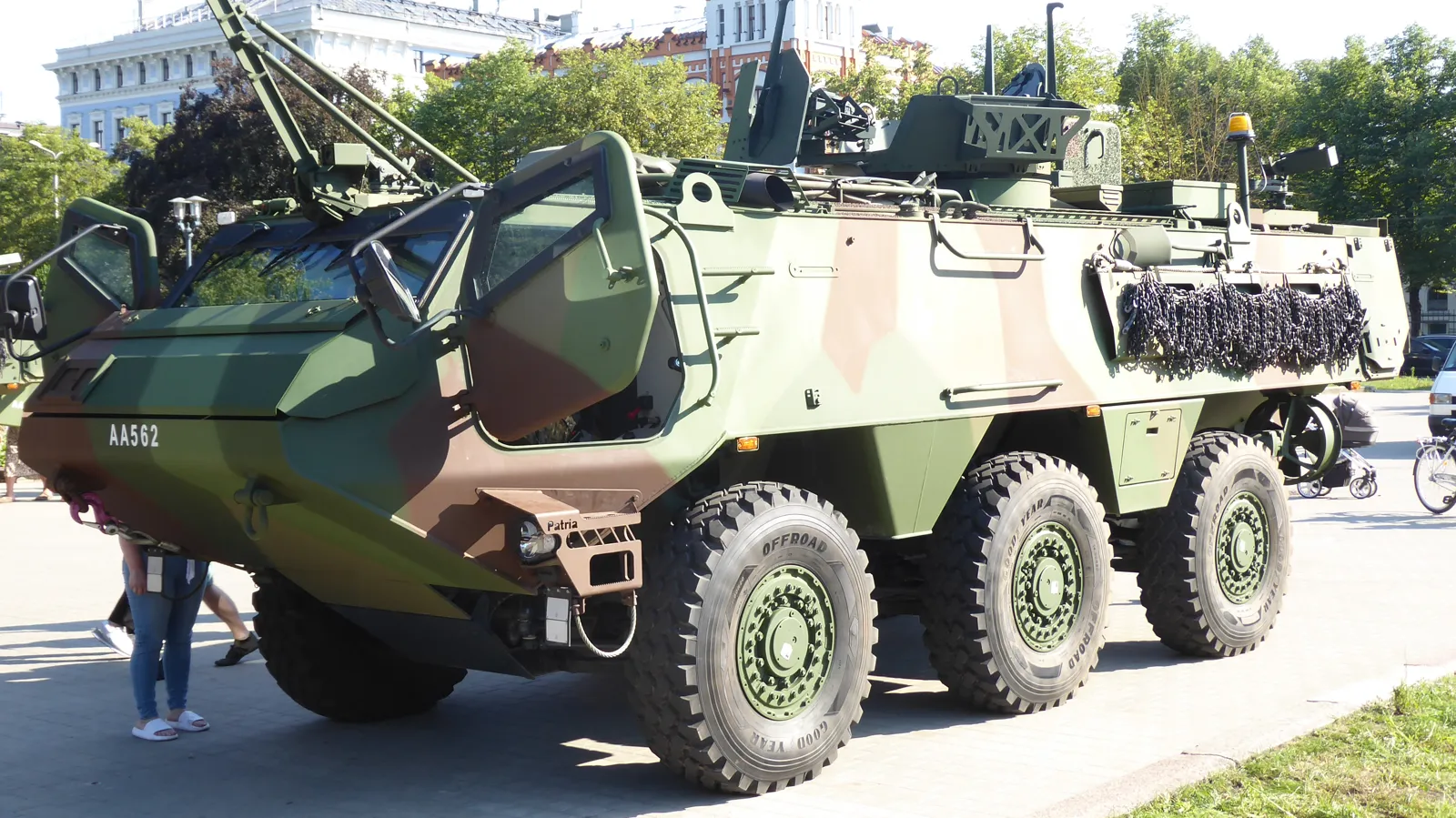
- Main battle tanks: 0. Latvia operates no tanks; the armoured backbone is about 180 CVR(T) tracked reconnaissance vehicles and the Patria 6×6, of which about 100 are in service. 84 ASCOD 2 infantry fighting vehicles are on order
- Military aircraft: 3 (Global Firepower): all three are UH-60M Black Hawk helicopters. There are no combat jets; the airspace is protected by allied aircraft under NATO’s Baltic mission. On 21 August 2026 two Turkish F-16s landed at Lielvarde
- Artillery: Global Firepower counts 47 self-propelled guns: M109A5Os bought from Austria. On 17 September 2026 the government decided to buy 18 Czech Morana howitzers; six HIMARS are due to enter service in 2027
- Naval platforms: 18 (Global Firepower): 11 patrol and 6 mine warfare. The backbone is five Tripartite-class minehunters bought from the Netherlands and five Skrunda-class patrol boats; the Naval Strike Missile is due to enter coastal-defence service in 2027
- Defence budget: The 2026 defence budget is about 2.16 billion euros, 4.91 percent of GDP. Latvia ranks 102nd of 145 countries in Global Firepower with a PwrIndx score of 2.2316
Note: The inventory figures below are approximate values drawn from open sources such as Global Firepower, the IISS Military Balance and SIPRI.
About the Latvia Armed Forces
The Latvian National Armed Forces (Nacionalie brunotie speki) consist of the Land Forces, Naval Forces, Air Force and the volunteer National Guard (Zemessardze), plus Special Operations Command, Military Police, Training Command and Support Command. The combat core is the Mechanised Infantry Brigade at Adazi. Naval headquarters is in Liepaja and the Air Force is based at Lielvarde.
Global Firepower 2026 lists 17,870 active personnel, 38,000 reserves and 12,500 paramilitary, with the National Guard included in the active figure. Latvia reintroduced conscription, abolished in 2007, as the State Defence Service in 2023: men born after 1 January 2004 serve at least 11 months, with military and civilian options, and women are planned to be included by 2028.
The commander-in-chief is President Edgars Rinkevics. Colonel Raivis Melnis has been defence minister since May 2026 and Major General Kaspars Pudans commands the armed forces. After two Ukrainian drones entered Latvian airspace from Russia and hit an oil facility in the east, Defence Minister Andris Spruds resigned on 10 May 2026 and Prime Minister Evika Silina’s government fell on 14 May. Prime Minister Andris Kulbergs’s United List, in office since 28 May, came first in the general election of 3 October 2026 with 35.3 percent of the vote and 41 of 100 seats; with no outright majority, coalition talks are under way.
The budget is growing fast. The 2026 defence budget is about 2.16 billion euros, 4.91 percent of GDP, putting Latvia among the allies closest to NATO’s new 5 percent target. Priorities are air defence, long-range artillery, infantry fighting vehicles, mines and obstacle systems, and the Baltic Defence Line fortifications built jointly with Estonia and Lithuania.
Allied presence on Latvian soil is a key part of deterrence. The Canadian-led NATO forward force at Adazi has been raised to brigade level since 2024 and renamed Multinational Brigade Latvia, while US Army aviation units rotate through Lielvarde. Capabilities Latvia lacks, such as heavy armour, combat aircraft and long-range air defence, are largely provided by these allied forces.
Latvia is among the largest donors of military aid to Ukraine relative to GDP. It sent Mi-17 and Mi-8MTV helicopters, six M109 howitzers, Stinger missiles and CVR(T) vehicles, and co-leads the international Drone Coalition with the UK. The drone crisis of May 2026 made clear that border air defence and counter-drone measures are the country’s most urgent needs.
Land Forces Inventory
| System type | Est. quantity |
|---|---|
| Main battle tanks | 0. Latvia has not operated tanks since regaining independence in 1991. Heavy armour is provided by the Leopard 2 tanks of the Canadian-led NATO Multinational Brigade Latvia at Adazi and by allied reinforcements |
| Infantry fighting vehicles (ASCOD 2) | 0 in service, 84 on order. A 42-vehicle contract was signed with General Dynamics Santa Barbara Sistemas in Spain in January 2025, and 42 more were added in June 2025. Deliveries are planned for 2026-2027; it will be Latvia’s first infantry fighting vehicle |
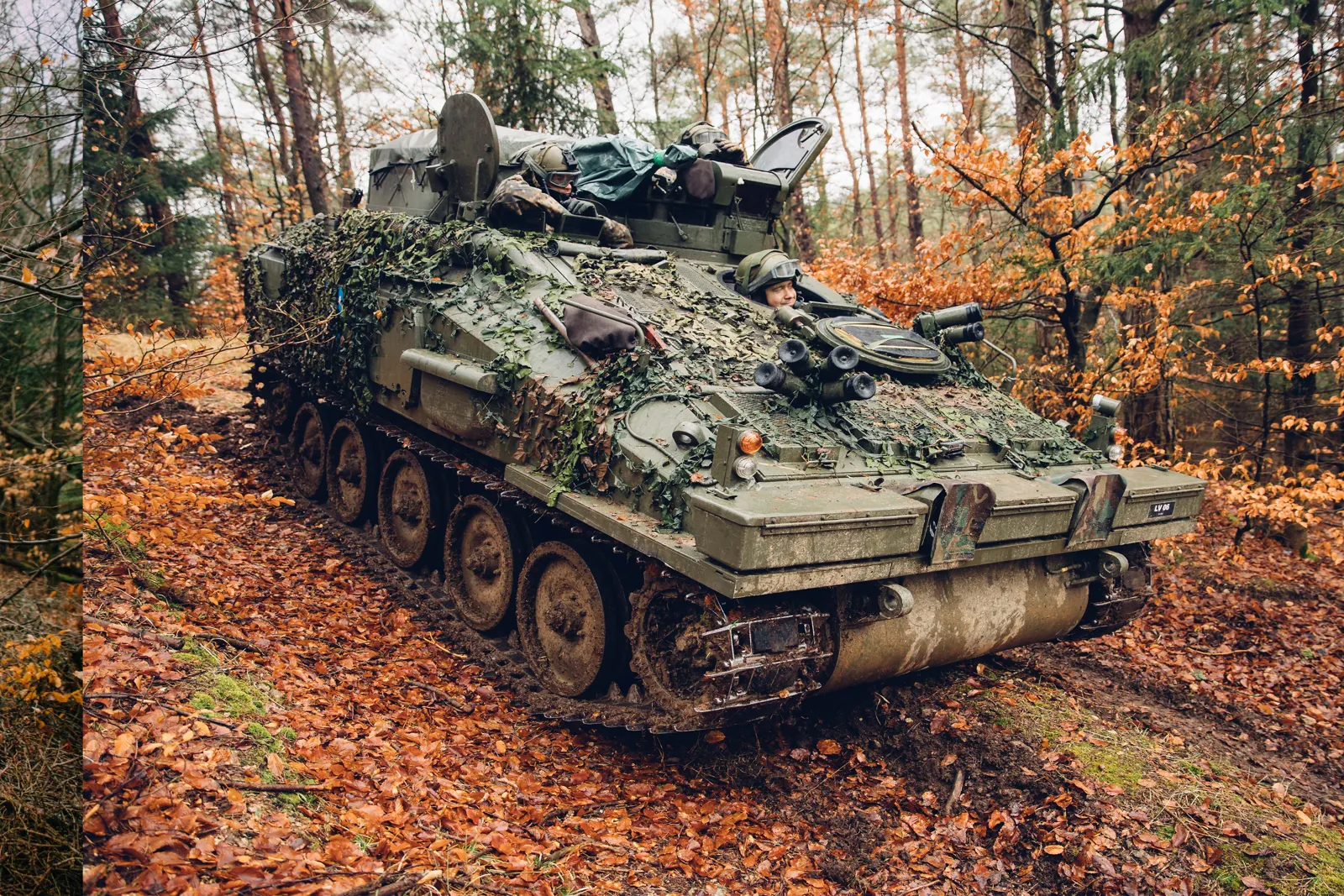
| Tracked reconnaissance vehicles (CVR(T)) | About 180: Scimitar, Sultan, Spartan, Samson and Samaritan variants. Bought from the UK from 2014 and refurbished in Latvia, some were fitted with Spike anti-tank missiles. Twelve were donated to Ukraine in 2025 and transfers continued in 2026 |
| Armoured personnel carriers (Patria 6×6) | About 100 in service out of roughly 256 on order. The first four of the vehicle co-developed with Finland were received in October 2021; 56 command vehicles were added in November 2024. Deliveries run to 2029 and part of the production takes place in Latvia |
| Self-propelled howitzers (M109A5O and Morana) | 47 M109A5Os: 35 howitzers, 10 command and 2 training vehicles were bought from Austria in 2017; six howitzers went to Ukraine in 2022. On 17 September 2026 the government decided to buy 18 Czech 155 mm Morana wheeled howitzers instead of the Swedish Archer, citing faster delivery and lower cost |
| Rocket artillery (HIMARS) | 0 in service, 6 on order. The purchase was announced in October 2022 and the contract signed in December 2023; the package includes GMLRS rockets and M57 ATACMS missiles. The system is expected to enter service in 2027 |
| Anti-tank weapons and mines | Spike SR, LR, LR II and ER II (new order in June 2025), 800 Carl Gustaf M2s donated by Norway plus the M4 variant on order, and AT4. Latvia’s withdrawal from the Ottawa Convention took effect on 27 December 2025; DM22, C-5 and AT2 mines and the Skorpion-2 minelaying system were ordered |
Air Force Inventory
| Platform | Est. quantity |
|---|---|
| Total military aircraft | 3 (Global Firepower): 0 fighters, 0 attack aircraft, 0 transports, 0 trainers, 3 helicopters. The Air Force, with about 250 personnel, runs Lielvarde Air Base, the air-surveillance radars and ground-based air defence |
| Combat jets | 0. Since 2004 Latvia has relied on NATO’s Baltic mission for airspace protection, flown from Siauliai in Lithuania and Amari in Estonia. Two of the Turkish Air Force F-16s flying from Amari from 1 August to 30 November 2026 landed at Lielvarde on 21 August 2026 |
| Helicopters (UH-60M Black Hawk) | 3 in service, 1 on order. A four-helicopter agreement was signed with the US in 2018 and the first two arrived in December 2022. The Soviet-era Mi-17s and Mi-8MTVs were transferred to Ukraine; a purchase of four MD 530F light helicopters was cancelled in March 2026. The first multinational Black Hawk formation flight with the US Army took place on 26 February 2026 |
| Light transport and training aircraft | Four An-2 light transports and two Latvian-built Pelegrin Tarragon training and reconnaissance aircraft. Global Firepower does not include them in its combat inventory count |
| Unmanned aerial vehicles | The Latvian-built Penguin C long-endurance reconnaissance UAV and the US-made RQ-20A Puma (three systems, nine aircraft). Latvia co-leads the international Drone Coalition for Ukraine with the UK and set up a Competence Centre for Autonomous Systems in autumn 2025 |
| Air base and surveillance | Lielvarde Air Base is also used by US Army aviation units and allied aircraft. Three fixed radar stations at Lielvarde, Audrini and Calas are equipped with AN/TPS-77, and the data flow to NATO via the Baltic Air Surveillance Network |
Missile and Air-Defence Systems
| System | Type / Note |
|---|---|
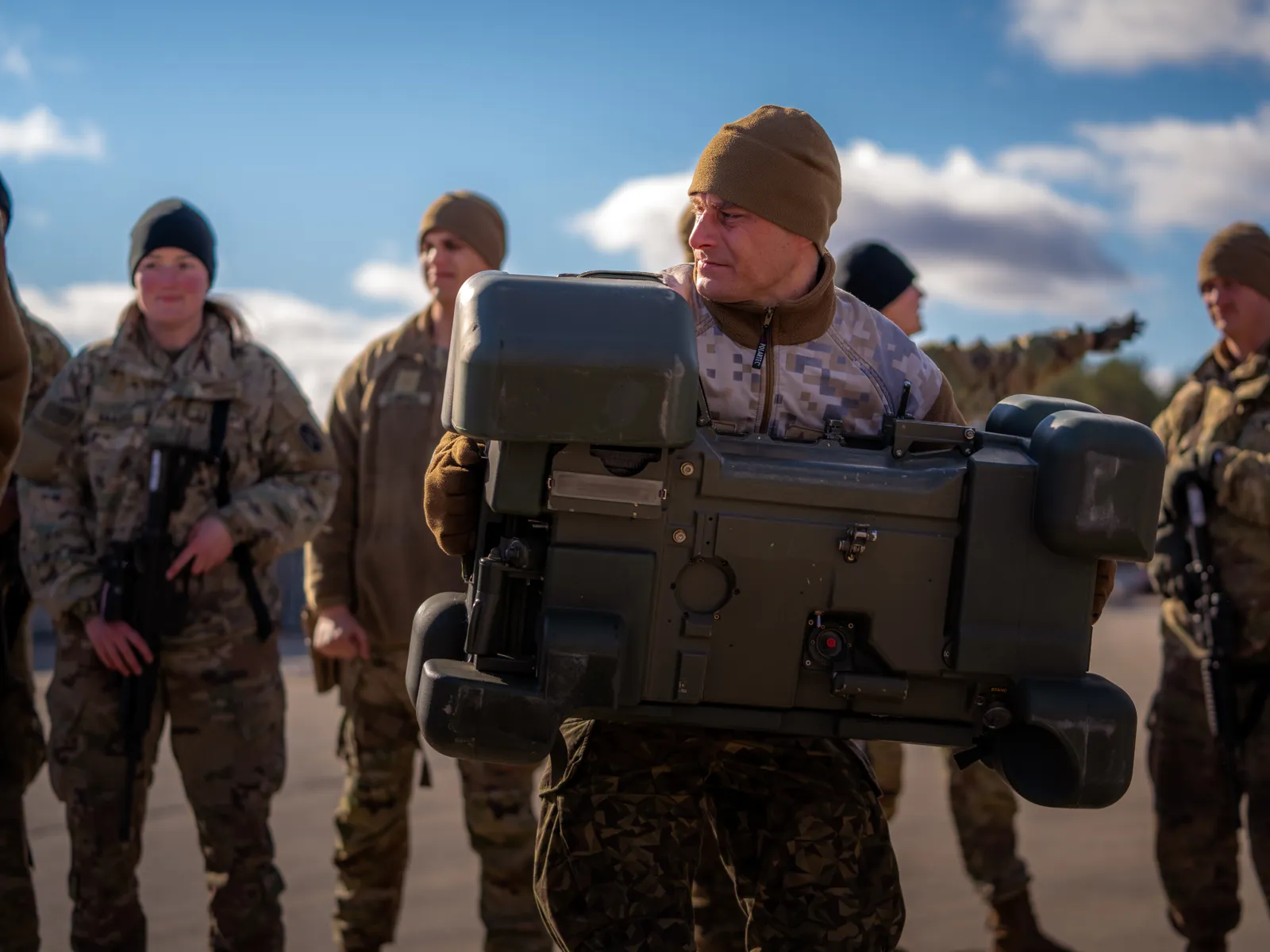
| Medium-range air defence (IRIS-T SLM) | On order. Latvia and Estonia decided in May 2023 to procure the system jointly and Latvia’s contract was signed in November 2023. Deliveries are planned to begin in 2026; it will be Latvia’s first medium-range air-defence capability and will work with the TRML-4D radar |
| Short-range air defence (RBS 70) | RBS 70 Mk 1, Mk 2 and RBS 70 NG, with separate orders in 2015, 2022 and 2025. It is the main weapon of the Air Force’s ground-based air-defence batteries and is used in joint training with allied units at Adazi |
| Man-portable air defence (Piorun) | The Polish-made Piorun was ordered in an undisclosed quantity in 2022, with a follow-on order in 2026. An acoustic drone-detection system was introduced on the border in 2025, and a test batch of the Estonian-made Frankenburg Mark 1 interceptor was acquired |
| Anti-ship missiles (Naval Strike Missile) | Coastal battery; the contract was signed in 2023. The Norwegian missile is scheduled to enter service in 2027, giving Latvia its first land-based sea-denial capability along the Gulf of Riga and the Baltic coast |
| Ballistic and tactical missiles | The HIMARS package includes 12 M30A2 and 12 M31A2 GMLRS pods and 10 M57 ATACMS pods. When the systems arrive in 2027, Latvia will gain precision-strike capability at ranges approaching 300 km for the first time |
| Radar and early warning | Four AN/MPQ-64F1 Sentinel mobile 3D radars, three fixed and three mobile AN/TPS-77s, TRML-4D for IRIS-T and Giraffe 1X short-range radars received in December 2025. The data feed NATO’s integrated air and missile defence system |
Naval Power
| Class / Type | Est. quantity |
|---|---|
| Total naval platforms | 18 (Global Firepower): 11 patrol and 6 mine warfare. Naval Forces headquarters is in Liepaja and the Coast Guard is part of the navy. Because of the heavy mine legacy in the Baltic, the fleet’s main task is mine countermeasures |
| Minehunters (Tripartite class) | 5: Imanta (M-04), Viesturs (M-05), Talivaldis (M-06), Visvaldis (M-07) and Rusins (M-08). Acquired from the Dutch Alkmaar class, they entered service between 2007 and 2011 and regularly serve in NATO’s standing mine countermeasures groups and BALTOPS exercises |
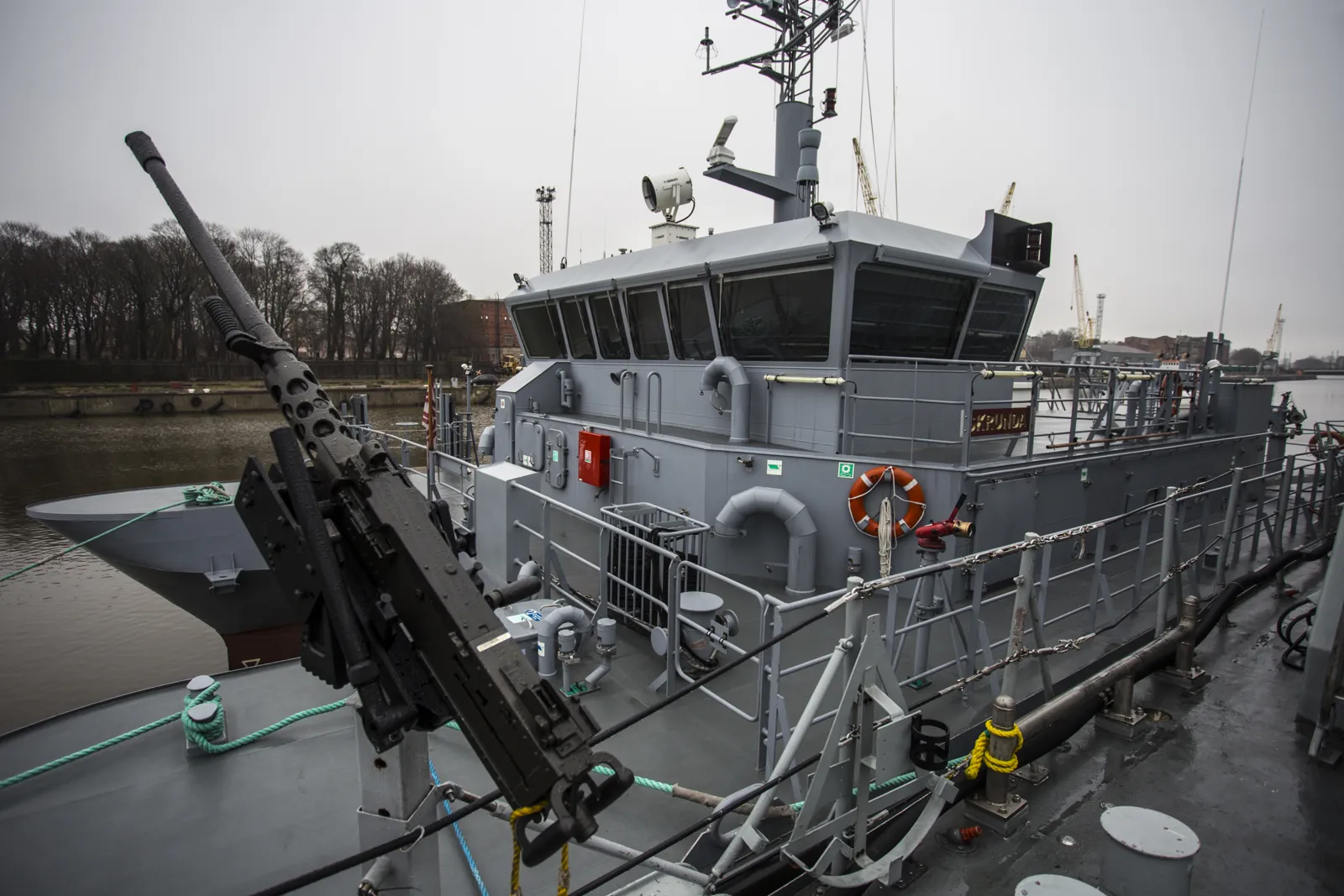
| Patrol boats (Skrunda class) | 5: Skrunda (P-05), Cesis (P-06), Viesite (P-07), Jelgava (P-08) and Rezekne (P-09). The first two of these SWATH-hull boats were built in Germany and the other three in Riga in 2011-2014; the modular mission bay can take mine-countermeasures kit or weapons up to 35 mm |
| Support and minelaying ships | 2: the minelayer and command-support ship Virsaitis (A-53), from Norway’s Vidar class, and the hydrographic survey ship Varonis (A-90), from the Netherlands. Virsaitis has also served as a command ship in NATO mine groups |
| Coast Guard boats | 6: former Swedish KBV-class patrol boats and the Finnish-built Astra (KA-14). They are used for the Gulf of Riga, port security and search and rescue |
| Frigates, corvettes and submarines | None. Latvia’s naval strategy relies on mine warfare, the coastal missiles arriving in 2027 and joint operations with allied navies rather than large warships. After undersea cable incidents the navy contributes to NATO’s Baltic Sentry mission |
The Turkey Angle: Turkish Defence Industry
There is no Turkish-made platform in Latvia’s inventory today and no publicly announced bilateral military framework agreement. The two countries have, however, been NATO allies since 2004, and over the past two years a regular calendar of defence-industry contacts has taken shape. The relationship is currently at the stage of institutional and industrial rapprochement rather than procurement.
The political groundwork was laid in Ankara on 22 October 2024, when Foreign Minister Hakan Fidan said after meeting his Latvian counterpart Baiba Braze that the two countries would strengthen defence-industry cooperation through tangible projects. On 20-21 August 2025 the then defence minister Andris Spruds met Turkish Defence Minister Yasar Guler in Ankara; the agenda covered drone production, research and applications, Turkish participation in Latvia’s Competence Centre for Autonomous Systems and the Drone Coalition that Türkiye joined on 2 July 2025. The visit also included contacts with SSB, ASELSAN, Roketsan, MKE and ASFAT.
The first concrete industrial step came in June 2026. At Eurosatory 2026 in Paris on 15-19 June, ASELSAN signed a letter of intent with VIC TEC, Latvia’s leading maker of unmanned surface vessels and interceptor drones, to enhance Latvia’s counter-drone detection and defeat capabilities. The document is not yet a procurement contract, but it speaks directly to Latvia’s most urgent need after the May 2026 drone crisis.
The Turkish military presence around Latvia has also become visible. In February 2026 the Turkish task group led by TCG Anadolu, in the Baltic for NATO’s Steadfast Dart 2026 exercise, was directed to waters off Latvia under Operation Eastern Sentry; on 14 February 2026 a Bayraktar TB3 launched from the ship struck a maritime target with live ammunition in the Baltic. On 21 August 2026 two of the Turkish F-16s deployed to Amari for NATO’s Baltic mission landed at Lielvarde, with Defence Minister Raivis Melnis and Türkiye’s Ambassador in Riga Ahmet Cemil Miroglu attending.
The NATO Summit held in Ankara in July 2026 added new momentum. President Rinkevics described bilateral relations as excellent and said the summit would give great momentum to bilateral cooperation, especially in the defence industry, noting the interest of Latvia’s defence ministry and industry in drones and electronic warfare systems. Defence-industry cooperation also featured in a phone call between President Erdogan and Rinkevics in the same period. Bilateral trade was about 436 million dollars in 2025.
The areas where the link could grow are clear. Latvia’s most urgent needs, counter-drone defence, electronic warfare, unmanned systems and ammunition, are fields where Turkish industry is strong. Neighbouring Estonia’s on-time receipt of 230 Otokar ARMA and Nurol Makina NMS vehicles and the Turkish-partnered 155 mm ammunition plant planned there set a strong precedent for Turkish products in the Baltic. Latvia’s choice of European solutions such as ASCOD, Morana and IRIS-T for heavy systems suggests Turkish offers will compete first in fast-delivery, cost-effective capabilities suited to the drone age.
Frequently Asked Questions
How many tanks does Latvia have? Latvia has no tanks. Global Firepower 2026 lists 0 and the country has not operated main battle tanks since 1991. The armoured backbone is about 180 CVR(T) tracked reconnaissance vehicles and the Patria 6×6, of which about 100 are in service; 84 ASCOD 2 infantry fighting vehicles are on order. Heavy armour support comes from NATO’s Multinational Brigade Latvia at Adazi.
Does Latvia have fighter jets? No. Latvia operates no combat jets and since 2004 its airspace has been protected by allied aircraft deployed at Siauliai and Amari under NATO’s Baltic mission. The Air Force operates three UH-60M Black Hawks, four An-2s and two Pelegrin Tarragon light aircraft. Two Turkish F-16s landed at Lielvarde on 21 August 2026.
Does Latvia have a navy? Yes, a small navy focused on mine warfare. Global Firepower counts 18 platforms: 11 patrol and 6 mine warfare. The backbone is five Tripartite-class minehunters from the Netherlands and five Skrunda-class patrol boats, alongside the minelayer Virsaitis, the survey ship Varonis and Coast Guard boats. There are no frigates, corvettes or submarines.
What air defence does Latvia have? Today RBS 70 and Piorun missiles are used at short range. Deliveries of the IRIS-T SLM medium-range system, ordered jointly with Estonia, begin in 2026, while Norwegian Naval Strike Missile coastal batteries and HIMARS will enter service in 2027. Air surveillance relies on AN/TPS-77, Sentinel, TRML-4D and Giraffe 1X radars.
Is there defence cooperation between Türkiye and Latvia? Not yet at procurement level: there is no Turkish platform in the inventory and no announced bilateral military framework agreement. But cooperation is developing fast: the Fidan-Braze meeting in October 2024, Spruds’s Ankara visit and the Drone Coalition in August 2025, the ASELSAN-VIC TEC counter-drone letter of intent in June 2026, TCG Anadolu’s deployment off Latvia in February 2026 and the landing of Turkish F-16s at Lielvarde in August 2026 are the main steps.
Bottom Line
Latvia’s inventory shows a late-starting but fast-moving transformation of a small frontline country. At first glance the numbers are modest: no tanks, no combat jets, three helicopters and 18 small naval platforms. But by 2027 the picture will change markedly: its first infantry fighting vehicles with 84 ASCOD 2s, long-range precision strike with six HIMARS, its first medium-range air defence with IRIS-T SLM, its first coastal missile with the Naval Strike Missile and renewed artillery with 18 Morana. The return of conscription, a budget reaching 4.91 percent of GDP and the exit from the Ottawa Convention point in the same direction. The weaknesses are also clear: heavy armour and air power depend entirely on allies, the May 2026 drone crisis exposed the gap in low-altitude defence and a population of 1.8 million limits personnel growth. For Türkiye, Latvia is not yet a customer but a strong candidate. The armoured-vehicle and ammunition examples in Estonia show that Turkish products have earned trust in the Baltic, while ASELSAN’s letter of intent with VIC TEC addresses Latvia’s most urgent need, counter-drone defence, directly. Turkish F-16s and TCG Anadolu operating in the Baltic add a visible military dimension. The drone, electronic-warfare and ammunition purchases of the coalition government formed after the 3 October 2026 election will decide whether this rapprochement turns into a first procurement contract.
Related Reading
Sources
- Global Firepower — Latvia
- IISS — The Military Balance
- SIPRI — Arms Transfers Database
- Wikipedia — Latvian National Armed Forces
- Wikipedia — List of equipment of the Latvian Land Forces
- Wikipedia — Latvian Naval Forces
- Daily Sabah — Türkiye, Latvia to boost defense cooperation
- Trend — Latvia, Türkiye explore stronger defense industry ties
- Unmanned Airspace — ASELSAN signs C-UAS agreement with Latvia’s VIC TEC
- TRT Haber — Rinkevics on defence-industry momentum
- Latvian Ministry of Defence — Turkish F-16s land at Lielvarde
- Army Recognition — TCG Anadolu off Latvia
- The Defense Post — Latvia selects Morana howitzer
- Al Jazeera — Latvia approves new government after drone dispute