Indonesia–Türkiye Defence Industry Relations: Co-Production on Every Layer (2015–2026)

The Indonesia–Türkiye defence industry line does one thing alone in this series: land, unmanned aircraft, missiles, ships and fighters — co-production or local assembly on all five layers. A line that began in 2015 with a jointly designed tank reached, in 2025, the largest export contract in Türkiye’s history, 48 KAAN. In between came 12 ANKA, 45 ATMACA, 60 TB3, 9 AKINCI, 12 KIZILELMA and two frigates. This file reads eleven years in one table.
This is the series’ fifth bilateral file. Why Indonesia co-developed the KAPLAN MT was examined in the tenth file as a single programme; that data is not repeated. What is added is the rest: ANKA, ATMACA, the Baykar joint venture, KAAN, Istif, KIZILELMA, the armoured personnel carrier, the framework meetings and Qatari financing. The pattern set in the Pakistan, Poland, Saudi Arabia and Qatar files applies: contract, agreement, report and plan are written apart. The Turkish original is here.
Short answer: co-production on every layer
In twenty-one files the Turkish line mostly deepened on a single layer: armed drones in the Gulf, armoured vehicles in Africa, ships on the naval line. Saudi Arabia took localisation in drones and land systems, Pakistan joint design at sea and in the air. Indonesia is a partner on all five layers: it designed and built a tank with Pindad, assembles six of its ANKAs at PTDI, will co-produce ATMACA with Republik Defence, is setting up a plant with Republikorp for TB3 and AKINCI, plans production and maintenance infrastructure for KAAN with PTDI and Republik Aero, and has its Istif frigates built in Türkiye. On top come three “first exports”: Indonesia is the first foreign customer of ATMACA, KAAN and Istif. The component this file adds to the Turkish package is full-layer partnership; the second is the first-customer pattern.
| Area | Item | Turkish company | Indonesian partner | Date · value | Status |
|---|---|---|---|---|---|
| Land | 18 KAPLAN MT / Harimau | FNSS | PT Pindad | Co-development 2015; contract 2019 | Deliveries complete 2024; in service |
| Land | KAPLAN / Harimau APC | FNSS | PT Pindad | Revealed 11 Jun 2025 | In production; delivery planned end-2026 |
| UAV | 12 ANKA-S + 3 GCS (6 air, 3 army, 3 navy) | Turkish Aerospace | PTDI (6 assembled) | Feb 2023 · ~$300m press | Delivering; first aircraft Oct 2025 |
| UAV | 60 Bayraktar TB3 + 9 AKINCI; joint venture | Baykar | Republikorp | 12 Feb 2025 | Agreement; plant start not announced |
| UAV | 12 KIZILELMA | Baykar | Republikorp | 6 May 2026 (SAHA) | Agreement; delivery planned 2028 |
| Missile | 45 ATMACA + fire control | Roketsan, Aselsan | PT Republik Defensindo | 25 Jan 2024 | Contract; first export |
| Missile | ATMACA co-production; integration on 2 platforms | Roketsan; Sefine Shipyard | PT RDI; Ministry of Defence | 11 Jun 2025 | Agreement and contract |
| Missile | Weapon systems for Merah Putih frigates | Roketsan | PT PAL | Jul 2025 | Report |
| Fighter | 48 KAAN, ten years | Turkish Aerospace | PTDI, PT Republik Aero Dirgantara | G2G 11 Jun 2025; contract 26 Jul 2025 · ~$10bn press | Contract; first export |
| Naval | 2 Istif-class frigates | TAIS | Ministry of Defence; financing Barzan (Qatar) | IDEF Jul 2025; financing 20 Jan 2026 · $1bn | Contract; first export |
| Naval | 2 fast attack craft (70 m), Sefine | TAIS | Ministry of Defence | 2025 | Report |
| Framework | First High-Level Strategic Cooperation Council; 13 agreements | — | — | 12 Feb 2025 | Signed |
| Framework | 2+2 foreign and defence ministers’ meeting | MoND, MFA | Defence and Foreign Ministries | 9 Jan 2026, Ankara | Held |
Three things the table says. Nine of thirteen items have an Indonesian production partner: Pindad, PTDI, PT PAL, Republikorp, Republik Defence, Republik Aero. On the Turkish side five primes: FNSS, Turkish Aerospace, Baykar, Roketsan, TAIS. And unlike Qatar this is not capital, unlike Saudi Arabia not a percentage share: what Indonesia takes is the right to build on every layer in its own plants.
What did Indonesia need?
Indonesia holds one of Asia’s large defence budgets and a defence geography spread over more than seventeen thousand islands; its inventory is a mix of Western, Russian and Korean origin. The tenth file told the need through a tank: a vehicle in the 30–35 tonne band, suited to inter-island movement, with no ready example on the market. The need this file adds is broader: Indonesia’s procurement doctrine requires a local partner and technology transfer in every major programme — Scorpène submarines at PT PAL, Rafale with offsets, KF-21 by co-development. The Turkish line met that condition more widely than anywhere else in the series: from design to assembly, from missiles to fighters. The Turkish items Defence Minister Sjafrie Sjamsoeddin signed or discussed in 2025–2026 are the densest application of that doctrine.
Land: from KAPLAN MT to the armoured personnel carrier
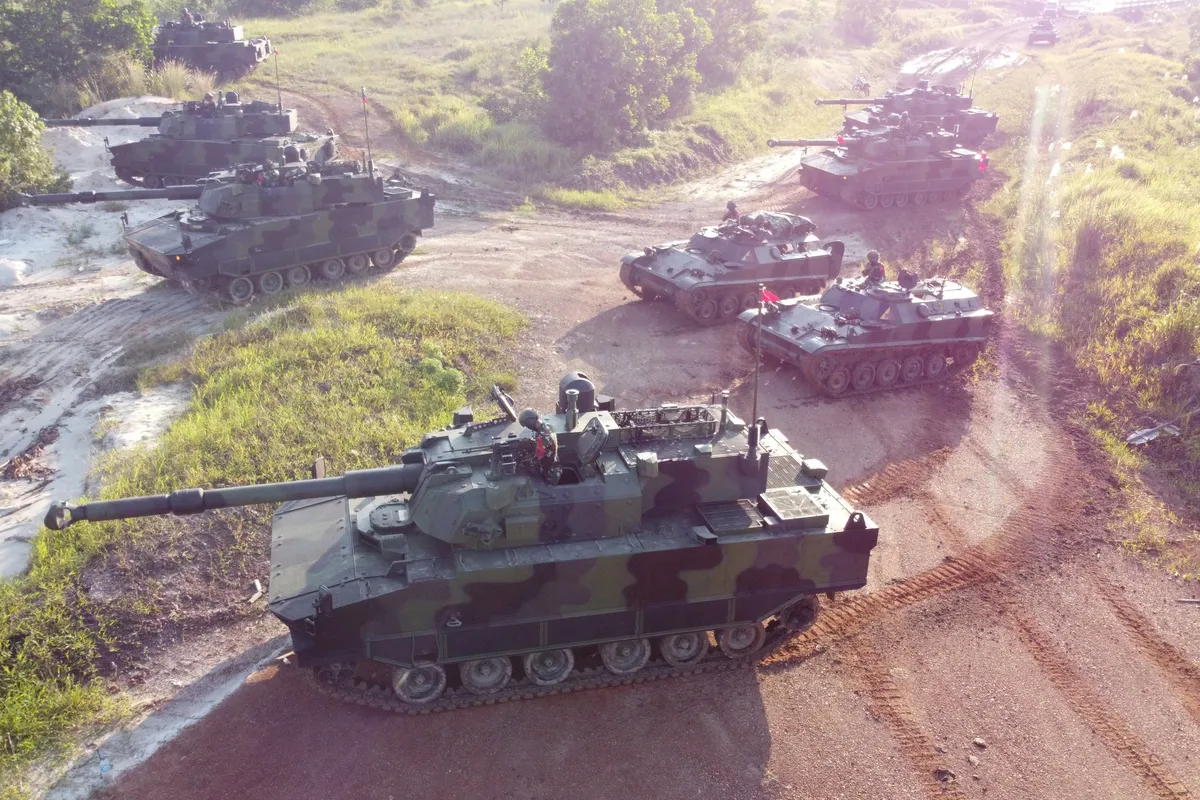
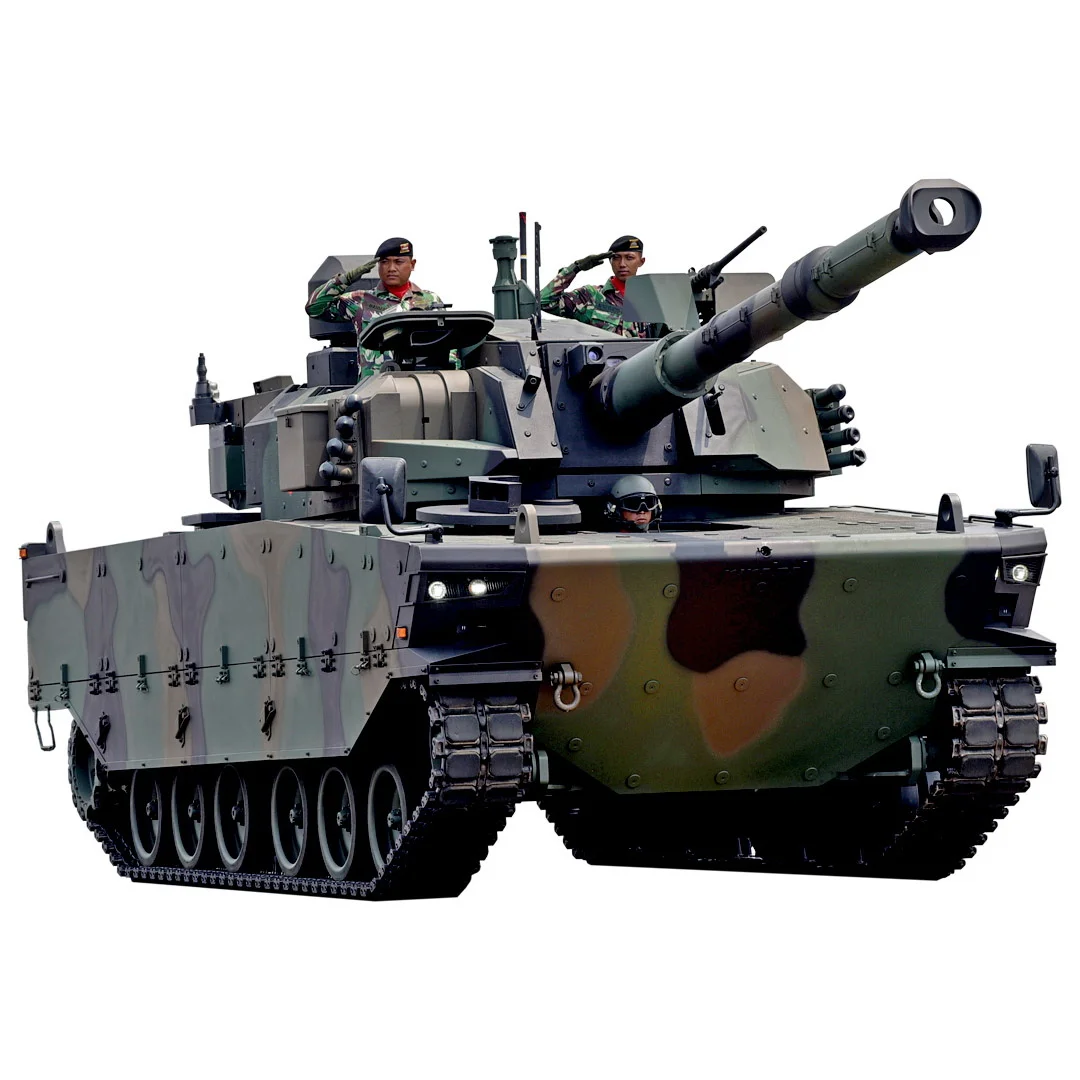
The line’s first item is the KAPLAN MT that FNSS and PT Pindad began designing together in 2015: prototype in 2017, an 18-vehicle production contract in 2019, serial production in Indonesia under technology transfer, deliveries complete in 2024. In June 2025 at Indo Defence the KAPLAN/Harimau armoured personnel carrier derived from the same hull was revealed: the first vehicle built at FNSS, the second at Pindad, delivery planned for the end of 2026. In the series Turkish armour appeared as finished product in Estonia and Africa and as a joint venture in Romania; in Indonesia it is joint design and the birth of a Turkish-signed class among tank makers.
UAVs: ANKA, TB3, AKINCI, KIZILELMA
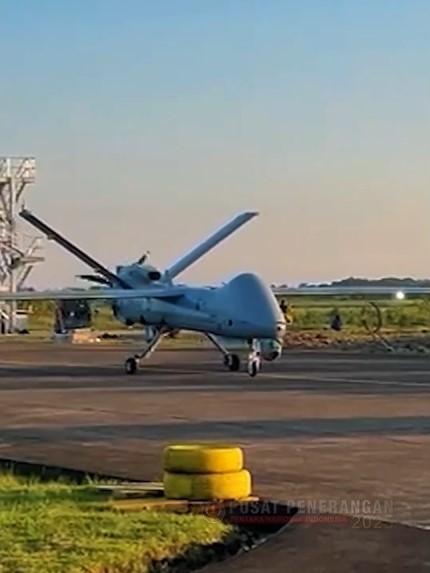
The contract signed in February 2023 covers 12 ANKA-S and three ground control stations — six for the Air Force, three Army, three Navy — with six assembled at PTDI and an offset programme reaching universities; press reports put the value at about $300 million and the first ANKA-S was seen at Supadio Air Base in October 2025. On 12 February 2025, during President Erdoğan’s visit to Jakarta, Baykar and Republikorp signed a joint-venture agreement for UAV manufacturing, assembly and maintenance in Indonesia; the package includes 60 Bayraktar TB3 and 9 AKINCI — Indonesia is the TB3’s first foreign customer. On 6 May 2026 at SAHA an agreement for 12 KIZILELMA was added, delivery planned for 2028. There is no announcement that the plant is in production; the file writes it so. Four armed-drone types in one country: nowhere else in the series. The munition-integration model that turned the TB2 into an export product is carried here into local manufacture.
Missiles: ATMACA’s first export
On 25 January 2024 a contract for 45 ATMACA anti-ship missiles, fire control units and user terminals for the Indonesian Navy was signed through PT Republik Defensindo; Indonesia is ATMACA’s first export customer. On 11 June 2025 at Indo Defence Roketsan signed a co-production and delivery agreement with PT Republik Defence Indonesia and a contract with Sefine Shipyard to integrate ATMACA on two naval platforms for the Indonesian Ministry of Defence. In July 2025 PT PAL was reported to have selected Roketsan for the Merah Putih-class frigates; the file keeps that as a report. Among Roketsan’s export markets Indonesia is the first reference in the anti-ship class.
Naval: Istif and Qatari financing
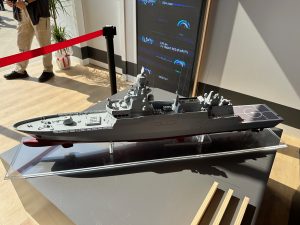
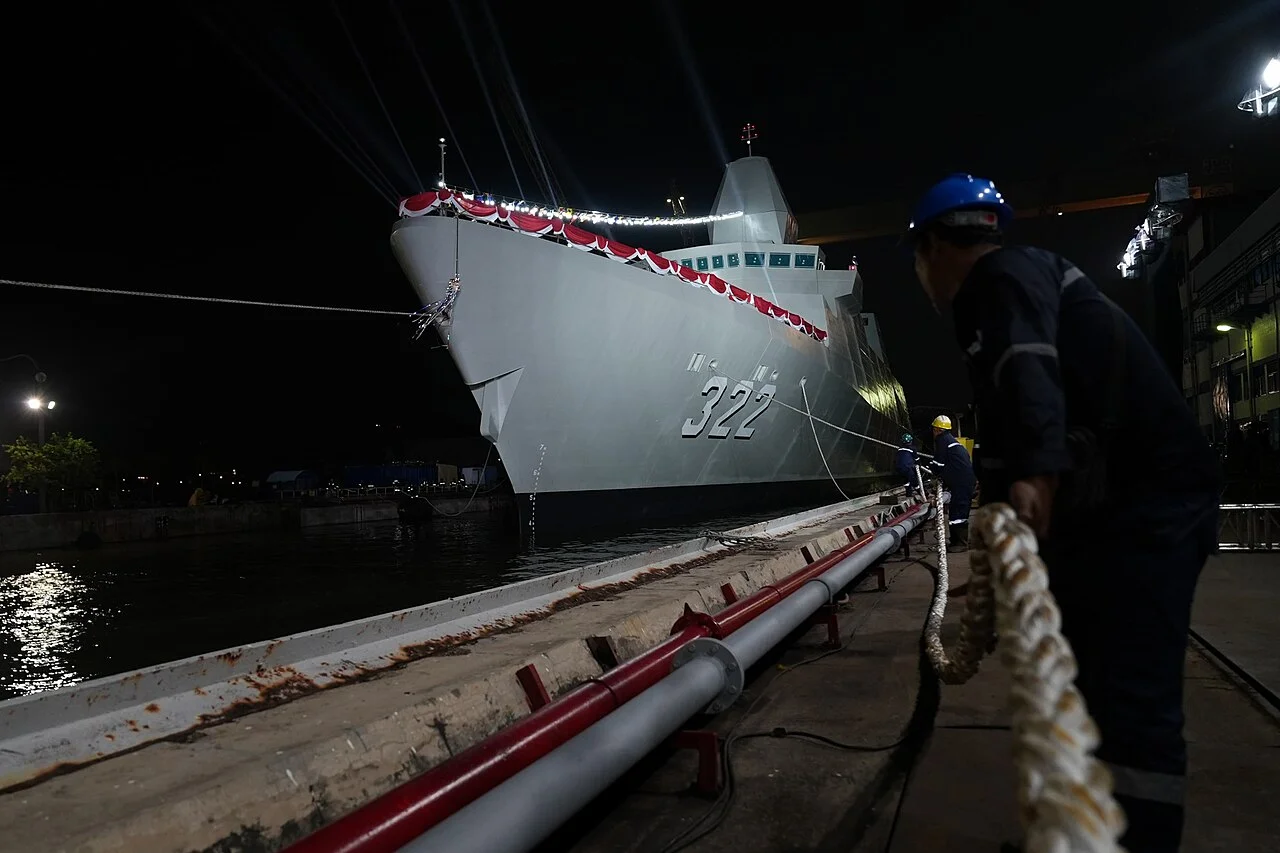
At IDEF in July 2025 TAIS and Indonesia’s Ministry of Defence signed for two Istif-class frigates — the class’s first export and the largest single naval item known in the series. On 20 January 2026 Qatar’s Barzan Holdings signed a $1 billion financing contract with TAIS at DIMDEX: buyer Indonesia, producer Türkiye, financier Qatar. It was also reported that the TAIS consortium would build two 70-metre fast attack craft at Sefine Shipyard; no contract has been announced. A Turkish yard sells Indonesia frigates while Indonesia builds French submarines and Italian frigates in its own yard; three lines in one navy.
Fighters: 48 KAAN
A government-to-government framework agreement was signed at Indo Defence in Jakarta on 11 June 2025 and the commercial contract defining the technical annexes on 26 July 2025 at IDEF in Istanbul: 48 KAAN, phased delivery over ten years, technology transfer and production and maintenance infrastructure in Indonesia; Indonesian partners PT Dirgantara Indonesia and PT Republik Aero Dirgantara. The value was not officially disclosed; the press reported about $10 billion. It is the largest defence export contract in Türkiye’s history and KAAN’s first foreign customer. KAAN’s place in the fifth-generation class will be read for the first time through a buyer’s air force in Southeast Asia.
Why most prices are not written
The only officially disclosed figure in this file is Barzan’s Istif financing: $1 billion. About $10 billion for KAAN and about $300 million for ANKA are press figures; KAPLAN, ATMACA, TB3/AKINCI and KIZILELMA values are undisclosed. Co-production is one reason: part of the value goes not to the Turkish company but to the Indonesian plant. The file makes no unit comparison; the cost score reflects press figures in a reasonable band and uncertainty on the rest.
Training and munitions
Training is the co-production itself: Pindad’s KAPLAN line, PTDI’s ANKA assembly and Republikorp’s planned plant came with technology-transfer and personnel-training clauses. Munitions are an upgraded version of the Turkish package’s “munitions in the same package” component: ATMACA is not only sold but will be co-produced with Republik Defence; the KAAN contract covers weapons integration. The third-country licence problem does not exist on the Turkish line; on Indonesia’s Western line the F-15EX talks did not proceed in 2026 and KF-21 co-production ended — the file records these as context, not as the Turkish line’s reason.
Alternatives and complements
| Item | Turkish offer | Other line | Outcome |
|---|---|---|---|
| Medium tank | KAPLAN MT (co-development) | No ready product on the market | KAPLAN MT; 18 in service |
| MALE UAV | ANKA (PTDI assembly) | CH-4 (China) in inventory | ANKA delivering; reported to replace CH-4 |
| UCAV | TB3, AKINCI, KIZILELMA (Republikorp JV) | No alternative disclosed | Agreement; plant being set up |
| Anti-ship missile | ATMACA (co-production) | Exocet, Yakhont in inventory | ATMACA; first export |
| Frigate | 2 Istif (TAIS) | 6 FREMM + 2 Maestrale (Fincantieri, 2021) | Both lines together |
| Submarine | — | 2 Scorpène Evolved (Naval Group–PT PAL, 2024) | French line; no Turkish offer |
| Fighter | 48 KAAN (ten years) | 42 Rafale (2022); F-15EX not proceeding; KF-21 co-production ended | KAAN + Rafale together |
| Main battle tank | — | Leopard 2RI (Germany) | German line; KAPLAN a different class |
The row to read is the second from last: Indonesia added KAAN beside the Rafale, not in its place. The 42-Rafale contract was signed in February 2022 and the first three arrived on 23 January 2026; the KAAN contract came in 2025 and runs ten years. That the F-15EX memorandum did not proceed in 2026 and that KF-21 co-production ended in June 2026 are decisions on Indonesia’s Western and Korean lines; the file does not write them as the Turkish line’s reason and makes no superiority claim. In submarines and main battle tanks there is no Turkish offer; here too the Turkish line grew not beside the main-platform layer but in layers it defined itself — medium tank, MALE, anti-ship, light frigate and now fighter.
KAAN: a contract, but a ten-year one
The KAAN item is at contract status; where the file is careful is the calendar. Forty-eight aircraft are to be delivered over ten years and KAAN’s own serial production in Türkiye is planned for 2028. Indonesia is therefore the first foreign customer of an aircraft not yet in the Turkish Air Force. This differs from the KAAN talks in the Pakistan file and the “final stage” statements in Saudi Arabia: here there is a signature. The file writes the delivery calendar as a plan and makes no forecast about the programme’s schedule.
The Indonesian version of the Turkish package
In the Gulf we counted four components: record, munitions, permission and production share. The Balkans added donation and in-alliance reference, Central Asia the full catalogue, Pakistan the buyer’s shipyard and reverse flow, Poland subsystem integration and alliance logistics, Saudi Arabia the localisation ladder, Qatar buyer capital and a base in country. Indonesia adds two components: full-layer partnership and the first-customer pattern.
Full-layer partnership
In the series co-production stayed on one layer: armoured vehicles in Romania, drones and engines in Ukraine, a mixed portfolio but limited production in Central Asia. In Indonesia there is an Indonesian production partner on all five layers and four are state companies: Pindad (land), PTDI (UAVs and fighters), PT PAL (naval integration) and the Republik group (UAVs, missiles, aircraft). This differs from the capital partnership in the UAE and the shareholding in Qatar: Indonesia does not become a partner in the Turkish company, it builds the Turkish product in its own plant.
The first-customer pattern
Indonesia is the first export customer of ATMACA, KAAN and the Istif class, and the first foreign buyer of the TB3. In the series Poland was the TB2’s first NATO customer and Qatar its first Gulf customer; Indonesia is first on four separate products. Being first is a risk for the buyer — the product has no export record — and each time Indonesia received co-production in return. That is the pattern: take the risk, get the production right.
What changed in eleven years?
The timeline shows three phases: 2015–2019 co-development, 2023–2024 layer expansion with ANKA and ATMACA, 2025–2026 the UAV plant, KAAN, Istif and KIZILELMA. The turning point is 2025: Baykar in February, the KAAN framework and Roketsan in June, the KAAN contract and Istif in July.
What is official and what is at report stage
| Item | Source | Status | Note |
|---|---|---|---|
| KAPLAN MT 18 vehicles | FNSS, PT Pindad | Official; delivered | Complete in 2024 |
| KAPLAN APC | FNSS, Indo Defence 2025 | Official; in production | Delivery planned end-2026 |
| ANKA 12 | Indonesian MoD, Turkish Aerospace | Official contract | Value press; first delivery Oct 2025 press |
| ATMACA 45 + co-production | Roketsan, PT RDI, Sefine | Official contract and agreement | First export; Merah Putih integration a report |
| TB3 60 + AKINCI 9 + JV | Baykar, Republikorp, 12 Feb 2025 | Official agreement | Plant start not announced |
| KIZILELMA 12 | Baykar, 6 May 2026 | Official agreement | Delivery planned 2028 |
| KAAN 48 | Turkish Aerospace, Indonesian MoD | Official contract | Value press; ten years |
| Istif 2 + Barzan financing | TAIS, Barzan | Official contract | $1bn financing official |
| 2 fast attack craft | Press (Defense News) | Report | No contract announced |
| First HLSCC and 2+2 | Turkish MFA | Official | 12 Feb 2025; 9 Jan 2026 |
The table shows where the next rung lies: the Baykar–Republikorp plant entering production, completion of ANKA deliveries and KAAN’s first delivery. All three are on the calendar; none has happened yet and the file makes no forecast.
EM-PFI assessment
The score assesses the whole relationship, not one programme. The KAPLAN MT decision was scored 85 in the tenth file — the series’ top. The whole relationship sits one point higher because KAAN, ATMACA, Istif and the UAV lines all carry co-production: 86, the series’ new top.
| Criterion | Weight | Score | Rationale |
|---|---|---|---|
| Operational need | 20 | 18 | Inter-island mobility, sea control, long-range strike |
| Technical fit | 15 | 13 | Medium tank, MALE, anti-ship, light frigate, fifth-generation fighter |
| Geography and climate | 10 | 9 | Tropical climate and islands; KAPLAN MT in service since 2024 |
| Inventory compatibility | 10 | 8 | Mixed inventory; Turkish line opens new layers |
| Logistics | 10 | 7 | Long distance; local assembly and production shorten the chain |
| Cost-effectiveness | 10 | 8 | Values mostly press; co-production spreads cost |
| Delivery and production | 10 | 8 | KAPLAN complete; ANKA delivering; KAAN ten-year calendar |
| Technology transfer | 5 | 5 | Co-development, co-production, assembly; series high |
| Local production | 5 | 5 | Pindad, PTDI, PT PAL, Republikorp; on every layer |
| Modernisation path | 5 | 5 | KIZILELMA 2028; ten-year KAAN line |
| Total | 100 | 86 | Strong preference |
The breakdown confirms the series’ backbone at its far end: the deeper the transfer, the slower the delivery. Estonia got its vehicles in twelve months with no industrial share; Indonesia designed and built a tank over a decade, will receive KAAN over ten years and is setting up plants on every layer. The exact opposite of Qatar: speed without production there, production without speed here.
Risks and limits
This section exists not to weaken the Turkish product but to make the file usable.
| Item | Status | What it means |
|---|---|---|
| KAAN calendar | Serial production in Türkiye planned for 2028; first export delivery not announced | Ten-year programme; the file forecasts no date |
| Baykar–Republikorp plant | JV agreement exists; production start not announced | Where the 60 TB3 and 9 AKINCI are built depends on the calendar |
| ANKA delivery | First aircraft October 2025; no completion date | Delivery score medium |
| Values | KAAN and ANKA press; others undisclosed | Unit cost cannot be derived |
| Fast attack craft and Merah Putih | Report | May not become contracts; reports in the table |
| Western-line decisions | F-15EX not proceeding; KF-21 co-production ended | Indonesia’s own decisions; not written as the Turkish line’s reason |
| Logistics distance | Türkiye–Indonesia line is long | Local assembly compensates; score 7/10 |
| Reverse flow | None in product | Partners and scale flow back |
Where is this line going?
Back to the opening definition: co-production on every layer. Indonesia took from Turkish industry through co-production what the Western line gives through offsets — tank design, UAV assembly, missile production, a frigate and a fighter line — and in return took the risk of being first customer on four products. No other buyer in the series has this combination; Pakistan is older in joint design and Saudi Arabia higher in local share, but neither spreads across five layers. Thirteen items in eleven years, five Turkish primes, six Indonesian partners and one Qatari financier: that is the line’s measure.
The next rung depends on three calendars: the Baykar–Republikorp plant entering production, completion of ANKA deliveries and KAAN’s first delivery. If all three happen, the Indonesian line remains the series’ deepest and widest relationship; if they slip, the calendar score falls but the structure does not change. Indo Defence 2027 and the start of KAAN serial production in Türkiye are the places to watch. This file wrote only what was signed or delivered.
Reading the line beside Paris, Rome and Seoul
For a reader who follows the French, Italian and Korean lines into Indonesia, the Turkish line is neither a replacement nor a rival. France holds Rafale and the Scorpène built at PT PAL; Italy holds the FREMM package; Korea held the KF-21 co-development that ended in 2026; Germany holds the Leopard 2RI. The Turkish line entered in the layers those lines left open or served with finished products — a medium tank designed together, a MALE assembled locally, an anti-ship missile co-produced, a light frigate financed by a third country and a fighter with a ten-year local-infrastructure clause. Four lines coexist in one inventory, each in its own segment, and this file makes no claim about which is superior. The one sentence to take away: the Indonesian line is the only case in the series where Turkish industry gave a country production partnership on all five layers and that country became first customer on four products.
Frequently asked questions
What has Indonesia bought from Türkiye?
Verified items: 18 KAPLAN MT / Harimau medium tanks (FNSS–PT Pindad co-development from 2015, contract 2019, deliveries complete 2024), 12 ANKA (February 2023; six air force, three army, three navy; six assembled at PTDI), 45 ATMACA anti-ship missiles (25 January 2024, first export), 60 Bayraktar TB3 and 9 AKINCI with a Republikorp joint venture (12 February 2025), 48 KAAN (G2G 11 June 2025, commercial contract 26 July 2025), two Istif-class frigates (TAIS, IDEF July 2025) and 12 KIZILELMA (6 May 2026). Details in the tenth file (Turkish).
What does the KAAN contract include?
A government-to-government framework agreement was signed at Indo Defence in Jakarta on 11 June 2025 and the commercial contract defining technical annexes and implementation on 26 July 2025 at IDEF in Istanbul: 48 fifth-generation fighters, phased delivery over ten years, technology transfer and production and maintenance infrastructure in Indonesia; Indonesian partners PT Dirgantara Indonesia and PT Republik Aero Dirgantara. The value was not officially disclosed; the press reported about $10 billion. Indonesia is KAAN’s first export customer.
What is KAPLAN MT and why does it matter?
A medium tank in the 30–35 tonne band that FNSS and PT Pindad began designing together in 2015; in Indonesian service it is the Harimau. A contract for 18 vehicles followed in 2019, serial production was carried out in Indonesia under technology transfer and deliveries were completed in 2024. It is the only co-development case in the series; the reasoning is in the tenth file. In June 2025 the KAPLAN/Harimau armoured personnel carrier derived from the same hull was revealed; the first vehicle is built at FNSS, the second at Pindad, with delivery planned for the end of 2026.
Where does ATMACA stand in Indonesia?
A contract for 45 ATMACA, fire control units and user terminals for the Indonesian Navy was signed through PT Republik Defensindo on 25 January 2024; Indonesia is ATMACA’s first export customer. On 11 June 2025 Roketsan signed a co-production and delivery agreement with PT Republik Defence Indonesia and a contract with Sefine Shipyard to integrate ATMACA on two naval platforms for the Indonesian Ministry of Defence. In July 2025 PT PAL was reported to have selected Roketsan for the Merah Putih-class frigates; the file records that as a report.
Is Baykar building a plant in Indonesia?
On 12 February 2025, during President Erdoğan’s visit to Jakarta, Baykar and Republikorp signed a joint-venture agreement for UAV manufacturing, assembly and maintenance in Indonesia; the same package includes 60 Bayraktar TB3 and 9 AKINCI. Baykar provides technology transfer and training, Republikorp infrastructure and certification. No announcement says the plant is in production; on 6 May 2026 an agreement for 12 KIZILELMA was added, with delivery planned for 2028.
Where are the ANKA deliveries?
The February 2023 contract covers 12 ANKA-S and three ground control stations: six for the Air Force, three Army, three Navy, with six assembled at PTDI and an offset programme. Press reports put the value at about $300 million and delivery 32 months after entry into force; the first ANKA-S was seen at Supadio Air Base in October 2025. The file writes delivery as ‘ongoing’; no completion date has been announced.
Who is financing the Istif frigates?
The two-ship contract between TAIS and Indonesia’s Ministry of Defence was signed at IDEF in July 2025; on 20 January 2026 Qatar’s Barzan Holdings signed a $1 billion financing contract with TAIS at DIMDEX. It is the only example of the ‘third-party financed package’ pattern defined in the series’ naval file. Indonesia is the Istif class’s first export customer.
What were Indonesia’s alternatives?
In fighters, France (42 Rafale, February 2022; first three delivered 23 January 2026), the US (an F-15EX memorandum that did not proceed in 2026) and South Korea (KF-21 co-development; co-production ended in June 2026, direct purchase under discussion); in submarines, Naval Group (two Scorpène Evolved, 28 March 2024, built at PT PAL); in frigates, Fincantieri (six FREMM plus two Maestrale, June 2021). The Turkish line grew beside those programmes in its own layers; the file makes no superiority claim.
What has Türkiye received from Indonesia?
No verified reverse flow of product. What flows back is scale and partners: Pindad, PTDI, PT PAL and Republikorp are production partners for Turkish products, and Qatari capital finances the Istif line.
Where does this relationship sit in the series?
The fifth bilateral file and the highest score: 86/100. The single-programme score in the tenth file was 85; the whole relationship sits one point higher because KAAN, ATMACA, Istif and the UAV lines all carry co-production. Pakistan was joint design, Saudi Arabia localisation, Qatar capital; Indonesia is partnership on every layer.
What does the EM-PFI score mean?
Indonesia × Turkish defence industry: 86/100, the upper end of the ‘Strong preference’ band. Full marks on technology transfer, local production and modernisation; low on logistics — the distance is long, local assembly compensates; medium on delivery — KAAN is a ten-year programme. It is Envanter Medya’s editorial assessment.
Why the ‘first-customer pattern’?
Indonesia is the first export customer of ATMACA (January 2024), KAAN (2025) and the Istif class (2025), and the first foreign buyer of the Bayraktar TB3. No other country in the series is first customer on so many Turkish systems. It is a pattern in which the buyer takes the risk and receives co-production in return.
Why are most values not written?
The KAAN, TB3/AKINCI, KIZILELMA, ATMACA and KAPLAN contract values were not officially disclosed; press figures exist for ANKA and KAAN and the file marks them as press figures. The Istif financing ($1 billion) is the only official figure, disclosed with the Barzan contract.
Did the KF-21 matter affect the Turkish line?
The file records it as a programme decision between Korea and Indonesia: co-production ended in June 2026 and Indonesia is discussing direct purchase. The KAAN contract was signed a year earlier; no official link between the two programmes has been announced. The file writes no causality.
What comes next?
On the verified calendar: completion of ANKA deliveries, the first KAPLAN APC delivery (planned end-2026), Istif construction, KAAN’s ten-year delivery line and KIZILELMA (planned 2028). The Baykar–Republikorp plant’s start of production and the Merah Putih integration are at report stage. This file writes only what was signed or delivered.
Other files in the series
The “Why They Chose the Turkish Defence Industry” series goes beyond individual export headlines to examine the buyer’s need, the alternatives on the table and the contract structure.
- Why do Gulf states choose Turkish drones?
- Why is the Turkish defence industry growing in the Balkans?
- Why are Central Asian states turning to Turkish drones?
- Pakistan–Türkiye defence industry relations
- Poland–Türkiye defence industry relations
- Saudi Arabia–Türkiye defence industry relations
- Qatar–Türkiye defence industry relations
The full series and regional breakdowns are on the Türkiye defence exports hub (Turkish).
Sources and method
- Turkish Ministry of Foreign Affairs — First High-Level Strategic Cooperation Council (12 February 2025); 2+2 meeting (9 January 2026)
- Turkish Aerospace and Indonesian Ministry of Defence — KAAN framework agreement (Indo Defence, 11 June 2025) and commercial contract (IDEF, 26 July 2025); ANKA contract (February 2023)
- FNSS statements — completion of KAPLAN MT deliveries (2024); KAPLAN/Harimau APC reveal (Indo Defence 2025)
- Roketsan statements — co-production with PT Republik Defence Indonesia and integration with Sefine Shipyard (11 June 2025); Janes — 45 ATMACA contract (25 January 2024)
- Baykar statements — Republikorp joint venture, 60 TB3 and 9 AKINCI (12 February 2025); KIZILELMA (6 May 2026)
- TAIS and Barzan Holdings — Istif contract (IDEF, July 2025); financing contract (DIMDEX, 20 January 2026)
- Dassault, Naval Group, Fincantieri statements — Rafale (2022; deliveries January 2026), Scorpène Evolved (March 2024), FREMM package (June 2021)
- International defence press — value estimates and items at report status marked in the tables
Method note. Every item is written with its status — contract, agreement, report, plan; reports and plans are not presented as contracts. KAAN and ANKA values are marked as press figures; other values are undisclosed and not written. The F-15EX and KF-21 decisions are given as Indonesia’s own decisions in context, not as the Turkish line’s reason; no superiority claim. The KAAN delivery calendar is written as a plan with no forecast. EM-PFI is Envanter Medya’s editorial assessment, not an official index.