KAAN vs Chengdu J-20: Two Fifth-Generation Programmes, Two Different Questions


On paper, the KAAN and the Chengdu J-20 sit in the same category: twin-engine, heavy fifth-generation fighters with internal weapons bays built for low observability. The real comparison, though, is not about performance — it’s about timeline.
The J-20 flew in 2011, entered service in 2017 and now operates at brigade scale. The KAAN flew on 21 February 2024, and its first serial batch was contracted on 8 May 2026 — a programme that exported before completing its own first domestic order.
The comparison is bounded by the sources themselves
The most important sentence in this article comes before the table: the amount of verifiable information on the two aircraft is not symmetrical. TUSAŞ publishes a signed data sheet for the KAAN — length, wingspan, take-off weight, thrust, speed, ceiling and g-limits, straight from the manufacturer. China publishes no equivalent document for the J-20. Nearly every length or range figure circulating online traces back to photo measurements, satellite imagery or analyst estimates.
Rather than filling both columns with numbers regardless of provenance, most J-20 rows below are marked “no verified figure is published in open sources”. That gap is not a shortcoming of this article — it is data in its own right. Not knowing an aircraft’s basic dimensions says something about the transparency choices of the country that flies it.
Two programmes, two different questions
KAAN — air force renewal and export
Türkiye’s Presidency of Defence Industries (SSB) defines the KAAN project as developing a next-generation fighter with high manoeuvrability, low-observable characteristics and modern mission/sensor systems, built on a principle of maximum domestic industry participation. The development contract was signed on 5 August 2016.
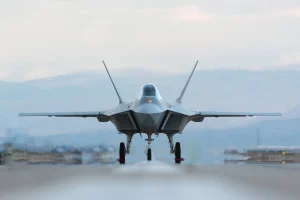
According to TUSAŞ’s official page, the aircraft is 20.3 m long with a 13.4 m wingspan and 5 m height, and a maximum take-off weight of 34,750 kg. Thrust is 2 x 13,150 kgf, top speed is Mach 1.8 at 40,000 ft, service ceiling is 55,000 ft, and g-load limits are +9/-3.5. Internal weapons carriage and sensor fusion are listed as explicit capabilities on the same page.
First flight came on 21 February 2024, followed by a second on 6 May. The programme’s most visible milestone landed on 8 May 2026, when the first serial contract — 20 Block 10 aircraft for the Turkish Air Force — was signed at the SAHA exhibition. The engine remains the programme’s most-discussed line item: early blocks fly on the American F110-GE-129 while TEI and TRMotor develop the domestic TF35000, targeted for integration around 2032.

J-20 — regional reach and long-range air superiority
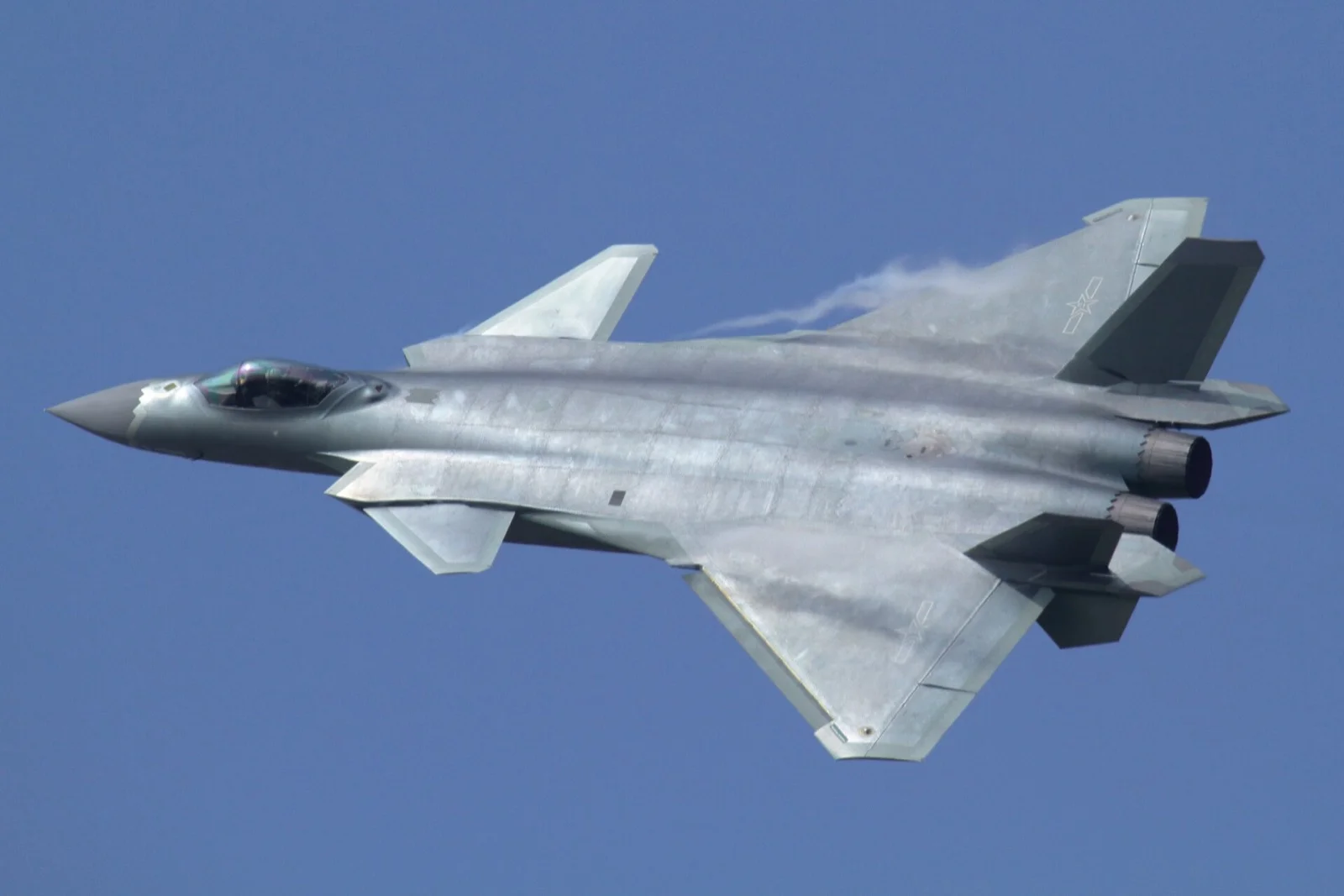
The J-20’s mission concept flows from Western Pacific geography: wide maritime expanses and bases separated by long distances. Its large airframe and internal fuel volume reflect that priority. First flight came on 11 January 2011, and the aircraft entered service in 2017.
Per Janes, more than 70 J-20s were inducted between July 2023 and May 2024, bringing the total to roughly 195 aircraft spread across twelve air brigades, three of them fully equipped with the type. Later independent estimates put the figure around 300 by mid-2025, while some publications place it above 500. The Pentagon’s report to Congress gives no specific J-20 figure of its own.
The aircraft itself keeps evolving. The Department of Defense report lists three planned upgrade lines: more air-to-air missiles carried in low-observable configuration, thrust-vectoring nozzles, and indigenous WS-15 engines to add supercruise. On 3 September 2025 an upgraded single-seat J-20A and a twin-seat J-20S were unveiled, the latter adding a second crew station for drone command and complex mission management.
Technical comparison table
| Criterion | KAAN | Chengdu J-20 |
|---|---|---|
| Manufacturer / programme owner | Turkish Aerospace (TUSAŞ) — SSB project | Chengdu Aircraft Industry Group (AVIC) |
| Class | Twin-engine heavy fifth-generation fighter | Twin-engine heavy fifth-generation fighter |
| Development contract | 5 August 2016 | no verified figure is published in open sources |
| First flight | 21 February 2024 | 11 January 2011 |
| Entry into service | First serial contract signed 8 May 2026 (20 Block 10 aircraft) | 2017 (Chinese Air Force) |
| Length | 20.3 m (TUSAŞ official) | no verified figure is published in open sources |
| Wingspan | 13.4 m (TUSAŞ official) | no verified figure is published in open sources |
| Max take-off weight | 34,750 kg (76,500 lb) | no verified figure is published in open sources |
| Engine | 2 x General Electric F110-GE-129 (interim); domestic TEI/TRMotor TF35000 targeted ~2032 | Early AL-31F, then domestic WS-10C; transition to WS-15 under way |
| Thrust | 2 x 13,150 kgf (29,000 lbf) | no verified figure is published in open sources |
| Top speed | Mach 1.8 (40,000 ft) | no verified figure is published in open sources |
| Service ceiling | 55,000 ft (16,764 m) | no verified figure is published in open sources |
| G-load limits | +9 / -3.5 | no verified figure is published in open sources |
| Supercruise | Stated as a targeted capability by TUSAŞ | Planned via WS-15 engines, per the Pentagon report |
| Thrust vectoring | no verified figure is published in open sources | Listed among planned upgrades in the Pentagon report |
| Variants | Block 10 as the initial serial configuration | Upgraded single-seat J-20A and twin-seat J-20S, unveiled 3 September 2025 |
| Units in service | First batch of 20 aircraft under contract | Janes: ~195 as of May 2024; later estimates range from ~300 to over 500 — no official figure |
| Users | Turkish Air Force; export contract with Indonesia (48 aircraft) | People’s Liberation Army Air Force only |
| Export status | First export contract already signed | No known export contract or offer |
The table rests on manufacturer and official-institution sources. Because no official J-20 data sheet exists, many rows are marked as unverified rather than filled with estimates.
Where the real difference starts
The J-20 is optimised for a single user in a single theatre. With no export agenda, the design faces no pressure to compromise for outside customers — it can prioritise range, internal volume and sensor reach without the trade-offs a diverse buyer list imposes.
The KAAN was built the other way around. Though it begins with the Turkish Air Force’s own requirement, the programme signed its first export contract — 48 aircraft for Indonesia, per the SSB — before its own first domestic serial batch was under contract. That choice raises certification workload and configuration flexibility requirements up front, but frees the production line’s scale from depending on a single buyer’s order volume.
Limitations
For the KAAN, the clearest limitation is the engine: early blocks depend on a foreign powerplant, and the TF35000’s timeline (targeted around 2032) is the single variable that will define the programme’s long-term industrial independence. For the J-20, the limitation is information itself: there is no independently verified data on its actual radar cross-section, engine reliability or readiness rates, and the threefold spread in inventory estimates — from roughly 195 to over 500 — measures exactly that uncertainty.
Verdict
Framing the KAAN against the J-20 as a “which is better” question pushes well past what open sources can support. With no official J-20 data sheet, much of the table has no figure to compare in the first place.
The two programmes serve different mission concepts. The J-20 is a single-user aircraft optimised for one theatre and already deployed at brigade scale. The KAAN combines Turkish Air Force renewal with an export objective built in from the design stage, advancing flight testing and serial-production readiness at the same time.
Given user-country preferences, the two aircraft are not competing in the same market: the J-20 is not exported, while the KAAN has already signed its first export contract. The one thing the two programmes share is the engine line — both countries are chasing a domestic, high-thrust turbofan that, in each case, arrives later than the airframe itself.
Are the KAAN and the J-20 in the same class?
By class, yes: both are twin-engine heavy fifth-generation fighters with internal weapons bays designed for a low radar signature. But their maturity differs sharply. The J-20 first flew in 2011, entered service in 2017 and today equips multiple brigades of the People’s Liberation Army Air Force. The KAAN made its first flight on 21 February 2024, and its first serial production batch was contracted in 2026.
What are the KAAN’s official specifications?
Turkish Aerospace’s (TUSAŞ) official product page lists a length of 20.3 m, a wingspan of 13.4 m, a height of 5 m and a maximum take-off weight of 34,750 kg. Thrust is 2 x 13,150 kgf (2 x 29,000 lbf). Maximum speed is Mach 1.8 at 40,000 ft, service ceiling is 55,000 ft, and the g-load limits are +9/-3.5.
Why are there no official specifications for the J-20?
China does not publish a manufacturer-signed data sheet for the J-20. Nearly every length, weight or range figure circulating online is derived from photo measurements, satellite imagery or analyst estimates. Most of those rows in this article are marked “no verified figure is published in open sources” rather than filled in with a guess.
Is the KAAN’s engine domestically built?
Not yet. Prototypes and the first production batch fly on the General Electric F110-GE-129 turbofan. The domestic engine — the TF35000, developed by TEI and TRMotor — is targeted for integration around 2032, according to statements from TUSAŞ general manager Mehmet Demiroğlu.
Is the J-20 exported?
No. There is no announced export contract or official offer; the aircraft serves only with China’s air force. The KAAN, by contrast, signed its first export contract — 48 aircraft for Indonesia, according to Türkiye’s Presidency of Defence Industries (SSB) — before its own first domestic serial-production batch was even under contract.
How many J-20s are in service?
There is no official figure. Janes assessed that more than 70 J-20s entered service between July 2023 and May 2024, bringing the total to roughly 195 aircraft. Later independent estimates put the figure around 300 by mid-2025, and some publications place it above 500. The Pentagon’s report to Congress does not give a specific J-20 count.
When will the Turkish Air Force receive its first KAANs?
The contract signed on 8 May 2026 covers 20 Block 10 aircraft. TUSAŞ general manager Mehmet Demiroğlu described it to Breaking Defense as “the first order,” expecting the number to grow over time. No official delivery schedule with specific dates has been published.
Related coverage
Sources and verification note
- Turkish Aerospace (TUSAŞ) — official KAAN product page — Length 20.3 m, wingspan 13.4 m, height 5 m, max take-off weight 34,750 kg, thrust 2 x 13,150 kgf, top speed Mach 1.8, service ceiling 55,000 ft, +9/-3.5 g limits; 2016 development contract and 2024 first and second flight details
- Türkiye’s Presidency of Defence Industries (SSB) — National Fighter Aircraft (KAAN) project page — Official programme definition and the principle of maximum domestic industry participation
- SSB — announcement of the export agreement with Indonesia — 48 KAAN aircraft to be manufactured in Türkiye for export to Indonesia, with TUSAŞ as prime contractor
- Breaking Defense — “Turkish air force contracts its first batch of indigenous KAAN jets” (May 2026) — 8 May 2026 contract signed at the SAHA exhibition, 20 Block 10 aircraft, and quotes from TUSAŞ general manager Mehmet Demiroğlu
- Breaking Defense — domestic TF35000 engine development (June 2025) — TEI/TRMotor turbofan timeline, six aircraft in the flight-test campaign flying on the F110, and an integration target around 2032
- Janes — special report on J-20 induction — More than 70 aircraft inducted between July 2023 and May 2024, a total of roughly 195 aircraft, and deployment across twelve air brigades
- US Department of Defense — annual report to Congress on China’s military power, via Air & Space Forces Magazine — Planned J-20 upgrades: more air-to-air missiles in low-observable configuration, thrust-vectoring nozzles, and indigenous WS-15 engines for supercruise
This comparison relies only on manufacturer sources (Turkish Aerospace), official institutions (Türkiye’s SSB and the US Department of Defense) and international defence publications (Janes, Breaking Defense, Air & Space Forces Magazine). Turkish defence news sites were not used as sources. Because no official Chengdu J-20 data sheet exists, no unverified figure has been estimated.
Editor’s note: this article compares mission concepts and programme maturity, not a superiority ranking. The two aircraft’s first flights are roughly thirteen years apart, and no manufacturer-issued data sheet exists for one of them. Technical data reflects official open sources as of publication date; programme status and configuration details may change.