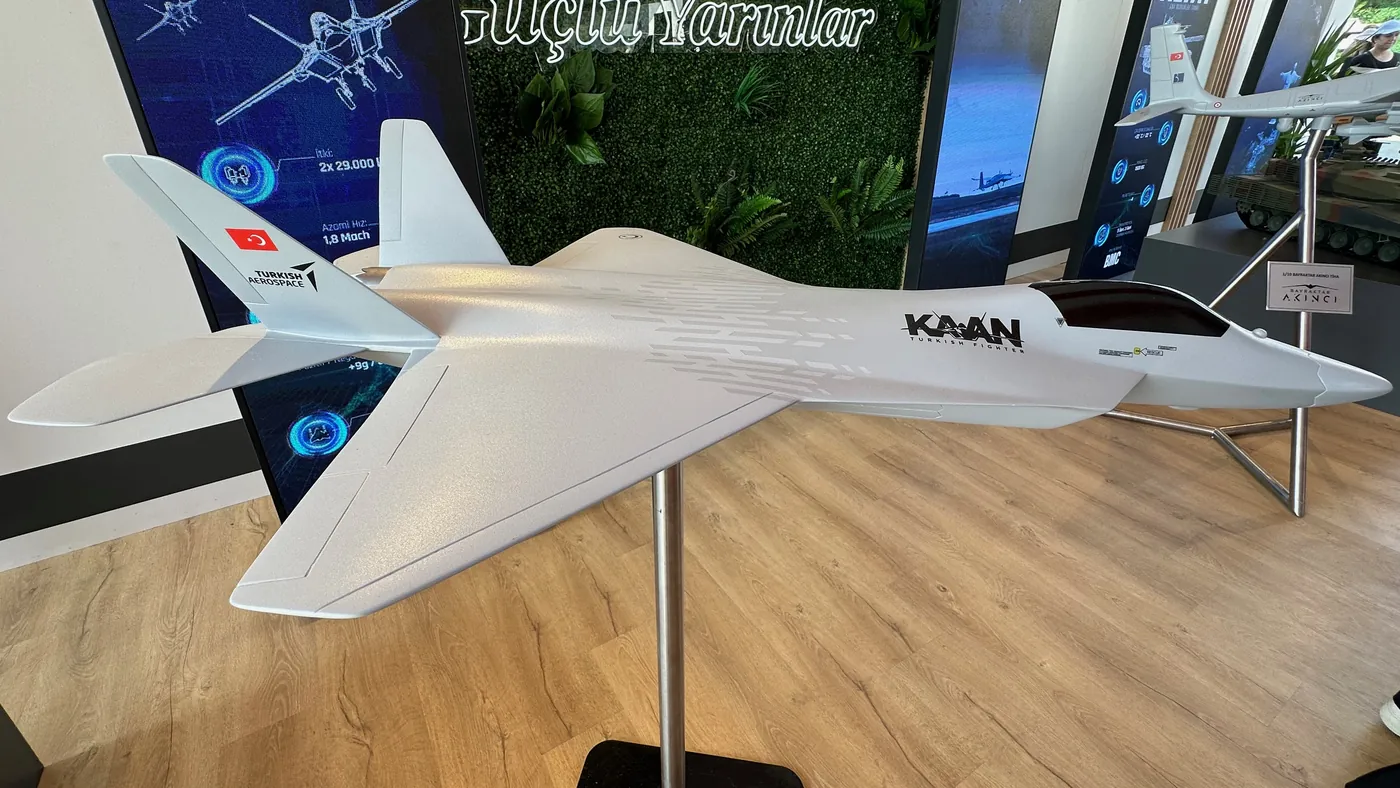
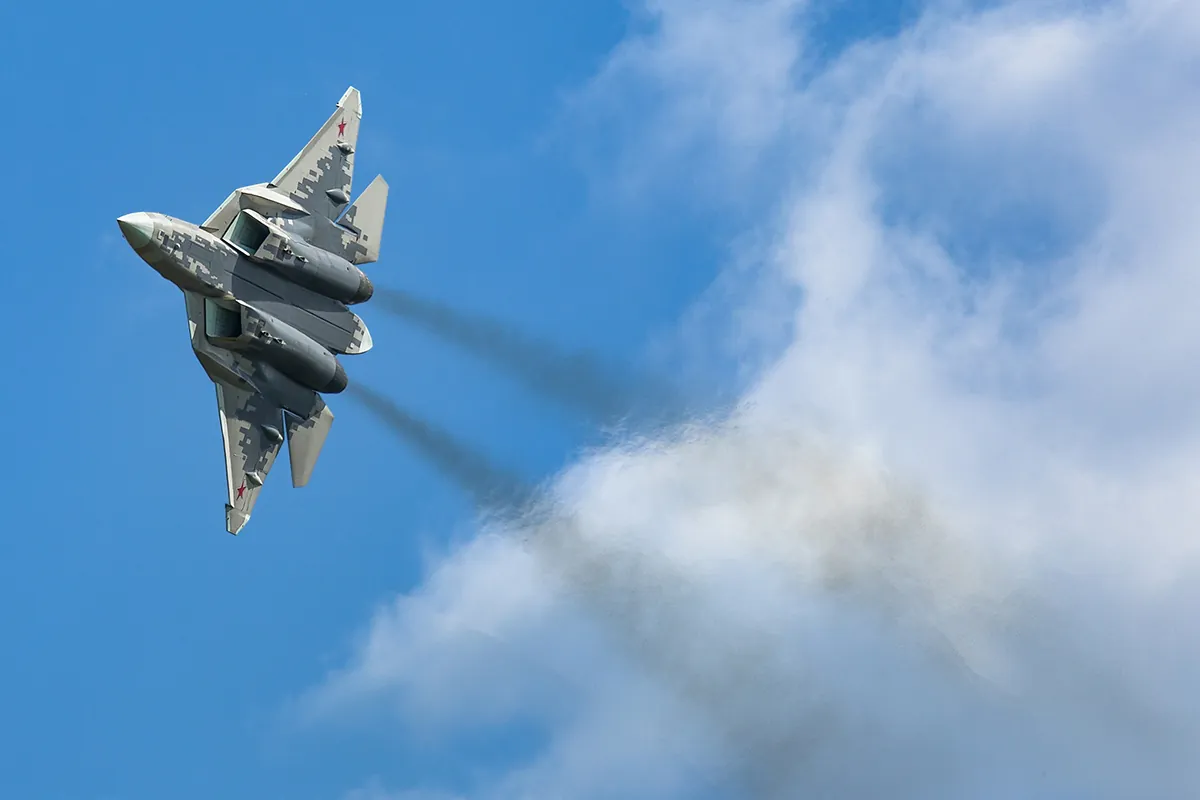
Turkey’s TAI KAAN and Russia’s Sukhoi Su-57 Felon represent two very different paths to fifth-generation airpower outside the U.S. ecosystem. The Su-57 is an in-service, combat-employed Russian stealth fighter now landing its first export customer, while KAAN is a NATO-aligned, newly flying prototype built around Western and indigenous systems. This analysis weighs proven Russian maturity against Turkey’s modern, export-friendly newcomer with honest scoring.
Score Breakdown
| Criterion | KAAN | Su-57 Felon |
|---|
| Operational Success | 3/10 | 7/10 |
| Combat Experience | 2/10 | 6/10 |
| Technology Level | 8/10 | 7/10 |
| Export Success | 2/10 | 3/10 |
| Operator Count | 2/10 | 4/10 |
| Upgrade Potential | 9/10 | 7/10 |
| Production Status | 3/10 | 5/10 |
| Cost-Effectiveness | 7/10 | 6/10 |
| Total | 43.4 | 57.8 |
Technical Comparison Table
| Feature | TAI KAAN | Sukhoi Su-57 Felon |
|---|
| Class | Twin-engine fifth-generation stealth air-superiority fighter | Twin-engine fifth-generation multirole stealth fighter |
| Manufacturer | Turkish Aerospace Industries (TAI) | Sukhoi (United Aircraft Corporation) |
| Engine | 2 × General Electric F110 (interim, Block 10); target 2 × TF35000 (~35,000 lbf) by 2032 | 2 × Saturn AL-41F1 (interim); transitioning to AL-51F1 / izdeliye 30 (~16,000 kgf) |
| Top speed | Mach 1.8+ (target) | Mach 2.0 (≈2,135 km/h) |
| Combat radius / range | 1,100+ km combat radius (target) | ≈1,500 km combat radius; ferry range ≈3,500 km |
| Radar | AESA (indigenous MURAD-family, ASELSAN) | N036 Byelka AESA with side-array antennas |
| Armament | Internal bays; indigenous GOKDOGAN/BOZDOGAN, GOKHAN AAMs; SOM-J | R-77M, R-74M2, Kh-59MK2, Kh-38; 30 mm GSh-30-1 cannon |
| First flight | 21 February 2024 (F110-powered prototype) | 29 January 2010 |
| Status | Prototype / flight test; serial production targeted 2029 | Operational with Russian Aerospace Forces; first export (Algeria) under way |
Design and Stealth
Engines and Performance
KAAN’s central dependency is propulsion. The flying prototypes and the first 20-40 aircraft use the U.S. General Electric F110, which carries export-licence and supply risk for a NATO-but-frictioned customer. Turkey is developing the indigenous TF35000 turbofan (~35,000 lbf), with initial testing in 2026 and airframe integration planned for 2032. Until then KAAN’s performance envelope is bounded by an interim foreign engine.
The Su-57 enjoys mature, domestically produced propulsion and raw kinematic performance: two AL-41F1 engines today, with the second-stage AL-51F1 (izdeliye 30) delivering roughly 16,000 kgf and full thrust-vectoring for supermaneuverability. The Felon’s Mach 2 top speed, supercruise ambitions and post-stall agility are genuine strengths. KAAN’s twin-engine layout promises strong performance once the TF35000 arrives, but in 2026 the proven flight envelope clearly belongs to the Su-57.
Sensors and Avionics
KAAN is built around ASELSAN’s indigenous AESA radar (MURAD family), electro-optical systems, a national mission computer and a modern sensor-fusion architecture, with a roadmap toward manned-unmanned teaming alongside Baykar’s KIZILELMA. For NATO and export customers, a Western-compatible, ITAR-light avionics suite that is fully sovereign to the buyer is a meaningful selling point, even though it is not yet operationally proven.
The Su-57 fields the N036 Byelka AESA with supplementary side-looking arrays and L-band wing-edge antennas intended for improved situational awareness and counter-stealth detection. The sensor concept is ambitious, but integration maturity, data-fusion quality and the reliability of Russia’s electronics supply chain under sanctions remain open questions. KAAN’s avionics are newer and Western-aligned; the Su-57’s are fielded but of uncertain real-world fusion performance.
Weapons and Combat Record
KAAN is designed to carry an indigenous Turkish weapons package internally: the beyond-visual-range GOKDOGAN and within-visual-range BOZDOGAN air-to-air missiles, the developmental long-range GOKHAN, and the SOM-J stand-off cruise missile, all produced by ROKETSAN and TUBITAK SAGE. This sovereign munitions ecosystem lets Turkey offer the platform for export without third-party release restrictions, a structural advantage over both U.S. and Russian options, though the inventory has no combat history yet.
The Su-57 has been employed operationally by Russia, including launching stand-off weapons in the war in Ukraine, giving it limited but real combat exposure that KAAN entirely lacks. Its arsenal includes the R-77M and R-74M2 air-to-air missiles and Kh-59MK2/Kh-38 stand-off weapons. For a buyer, however, Russian munitions now carry severe sanctions, supply and interoperability penalties. KAAN trades combat-proven status for clean, NATO-compatible, export-unrestricted weapons integration.
Production, Cost and Export
Production maturity favours the Su-57 today: it is in low-rate serial production with the Russian Aerospace Forces and, after years of difficulty, has secured its first confirmed export customer, with Su-57E airframes reported in Algeria in early 2026 and plans for a full squadron. KAAN does not reach serial production until a 2029 target, and its first export interest comes from Indonesia, which signalled intent for 48 aircraft.
From a procurement and alliance standpoint, KAAN’s strategic value is its Western alignment and freedom from sanctions exposure. Russia’s defence-industrial base is constrained by international sanctions, component shortages and a Felon production rate that has remained low for a decade, which caps the Su-57’s realistic export reach to a narrow set of buyers. KAAN, by contrast, is positioned as a sovereign, embargo-resilient fifth-generation option for nations seeking an alternative to both the F-35 and the Felon. The Su-57 wins on today’s fielded numbers; KAAN’s edge is its future export accessibility and clean technology base.
Operating Nations
| System | Operators |
|---|
| TAI KAAN | Turkey (developer/launch operator); Indonesia letter of intent (48 aircraft); Azerbaijan and Gulf states cited as prospective customers |
| Su-57 Felon | Russian Aerospace Forces (operator); Algeria (first confirmed export customer, Su-57E); previously offered to India before its 2018 withdrawal |
Verdict
On current evidence the Su-57 Felon leads on fielded reality, in-service operations, mature domestic engines and limited combat exposure (total 45/100), while KAAN, still a flight-test prototype, trails on operational, combat and production axes (total 46/100) yet is the stronger long-term proposition for NATO-aligned and export buyers thanks to its modern design, ASELSAN sensors, sovereign ROKETSAN munitions and freedom from sanctions exposure. The Felon is the more mature aircraft today; KAAN is the more exportable and strategically clean platform once it matures, making this a close contest between proven-but-constrained and promising-but-unproven.
Frequently Asked Questions
Which is better, KAAN or the Su-57?
The Su-57 is the more mature aircraft today: it is operational with the Russian Aerospace Forces, has limited combat exposure in Ukraine and fields domestic engines, but its stealth quality is widely questioned and sanctions cripple its export reach. KAAN is a newly flying NATO-aligned prototype whose advantages, indigenous sensors, sovereign weapons and export accessibility, will only be realised once it reaches serial production around 2029.
Is the Su-57 a true stealth fighter?
Many Western analysts assess the Su-57’s all-aspect radar cross-section as inferior to the F-22 and F-35 because of visible airframe details and early-configuration engine exposure. Russia presents it as a blend of reduced observability and extreme agility rather than a pure low-observable design, which makes its stealth credentials the most contested among fifth-generation fighters.
When will KAAN enter service?
KAAN made its first flight on 21 February 2024, with a full prototype flight expected in mid-2026 and serial production targeted for 2029. The first 20-40 aircraft will use the General Electric F110 engine, while integration of Turkey’s indigenous TF35000 engine is planned for 2032.
Why is KAAN attractive to export customers despite being unproven?
KAAN is NATO-aligned and built around a sovereign weapons and sensor package from ROKETSAN, TUBITAK SAGE and ASELSAN, so it can be offered for export without the third-party release restrictions of U.S. systems or the sanctions exposure of Russian ones. For buyers wary of both Washington and Moscow, it offers an embargo-resilient fifth-generation alternative.
Has the Su-57 been exported?
Yes. After a decade of limited production, the Su-57E export variant secured its first confirmed customer in Algeria, with airframes reported in flight there in early 2026 and plans to build up to a full squadron. India had earlier participated in a derivative programme but withdrew in 2018.
Sources
▶ 5 platformu karşılaştırın →