Peace Eagle (Barış Kartalı): Turkey’s Airborne Command Centre, Explained

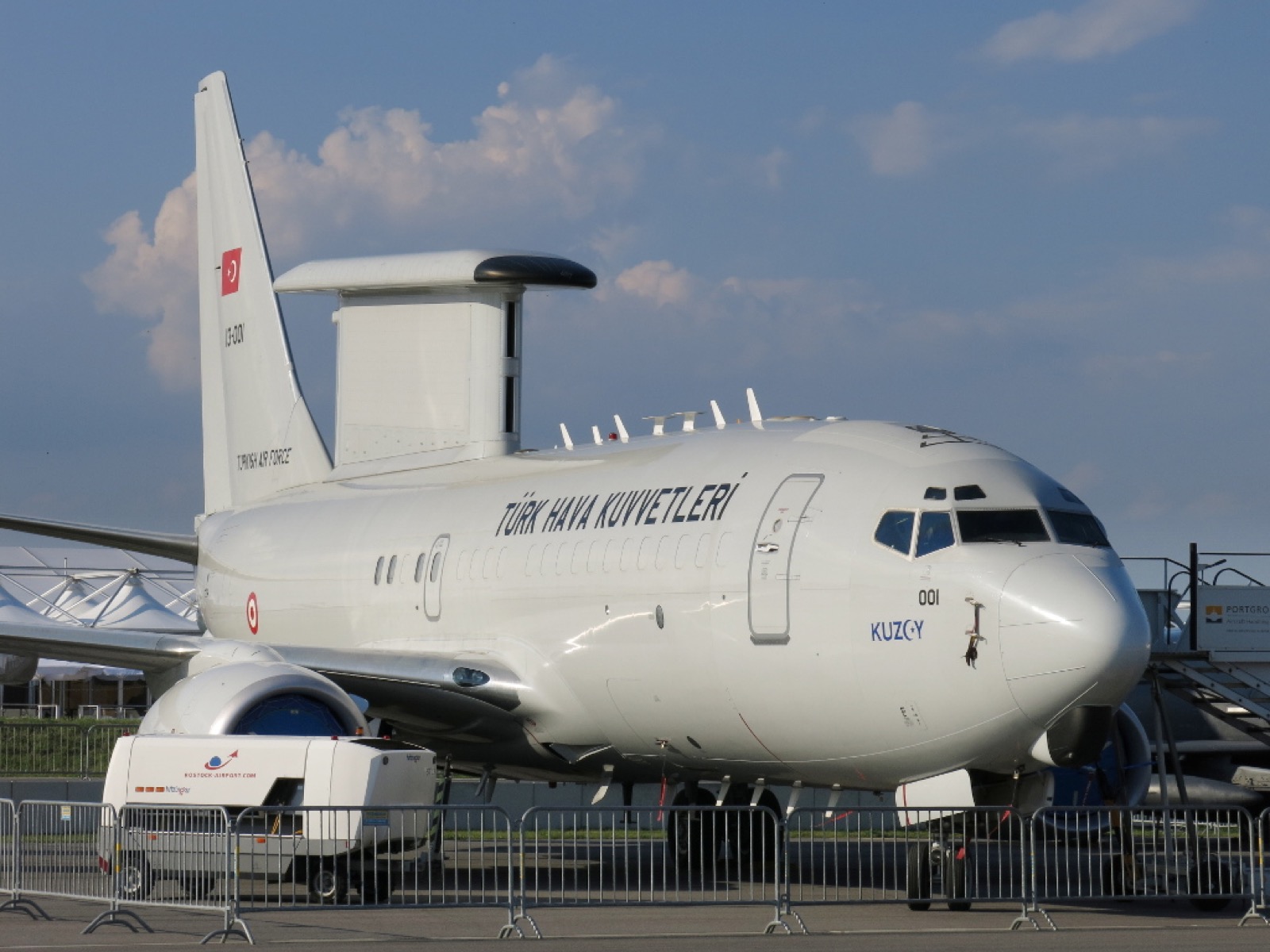
Image: Turkish Air Force Boeing 737-700 AEW&C “Peace Eagle” 13-001 at ILA Berlin Air Show 2014. Photo by Boevaya mashina, Wikimedia Commons, CC BY-SA 4.0.
How far can a fighter pilot actually see from the cockpit? Even with the radar of a modern jet, the answer is at most a few hundred kilometres — and that range shrinks fast in mountainous terrain, at low altitude, or under enemy jamming. But put a plane at ten kilometres altitude with a giant radar antenna on its back, and the picture changes completely: it sees far beyond the horizon, directs dozens of friendly fighters below, and spots an enemy aircraft while it is still rolling down the runway.
That is exactly what the Turkish Air Force’s Barış Kartalı — Peace Eagle — does every day. Its official name is the Airborne Early Warning and Control (AEW&C) System, and despite the singular ring of “Peace Eagle,” it is not a single aircraft. It is a complete system: four Boeing 737-based jets in the air, plus a ground support segment of operations centres and maintenance facilities at Konya Air Base. The platform is part of Boeing’s Wedgetail family, originally built for the Royal Australian Air Force. The Turkish jets entered service from 2014 onwards.
The hardware is Boeing. The brain is, to a significant degree, Turkish — much of the mission-system software was written by HAVELSAN, with ASELSAN and TUSAŞ on the integration side. That is the detail most foreign coverage misses, and it is the detail that explains why Peace Eagle matters strategically for Turkey, not only operationally.
At a Glance
What the Paddle on Its Back Actually Does
The thing that gives Peace Eagle its unmistakable silhouette — that big rectangular blade on top of the fuselage — is its MESA radar (Multi-role Electronically Scanned Array). Older airborne early-warning aircraft like the E-3 Sentry use a rotating dish; Peace Eagle does not. The antenna is fixed. Inside it, the electronics steer the radar beam through a full 360 degrees in fractions of a second.
The practical upshot is that the same radar can simultaneously watch aircraft in the air and ships on the sea surface, and — because the antenna never has to wait for a rotation cycle — every track is updated steadily and quickly. Anything that flies, sails or floats inside a circle roughly 370 km across shows up on the operator’s screen: friendly fighters, hostile jets, civilian airliners, large drones, naval vessels. The IFF (identification friend or foe) system reaches further still, out to around 555 km.
Mission Profiles
Why It Beats a Ground Radar
A ground radar is fixed in place. If a mountain stands between it and the target, the target is invisible. If the enemy flies low, the curvature of the earth swallows the contact behind the horizon. Peace Eagle solves both problems just by being ten kilometres above the ground: there is no horizon problem for any practical purpose. A cruise missile or a helicopter sneaking through a valley is still in plain view from above.
The second advantage is mobility. If a crisis flares up on a different border, Peace Eagle can redeploy to cover it within hours; a fixed radar tower would take weeks. And the third, perhaps the most consequential under modern threat conditions: if a ground control centre is taken out by a missile strike, Peace Eagle keeps running the air battle from the sky.
Specifications
| Specification | Value |
|---|---|
| Type | Airborne Early Warning and Control system (AEW&C) |
| Operator | Turkish Air Force |
| Mission-System Developer | HAVELSAN (Turkey), with Boeing |
| Platform | Boeing 737-700 (Wedgetail family) |
| Fleet Size | 4 aircraft + ground support segment |
| Radar Range | ~370 km (200+ nautical miles) |
| IFF Range | ~555 km (300 NM) |
| Communications | HF, V/UHF, UHF, SATCOM; Link-11 and Link-16/IJMS tactical data links |
| First Delivery | 2014, Konya Air Base |
Why It Matters for Turkey
Peace Eagle did not just add an aircraft to the inventory; it changed Turkish Air Force doctrine. Before its arrival, every air operation depended on the ground radar chain: F-16 pilots could not see past the horizon, and they relied on someone on the ground to tell them what was coming. With four aircraft cycling through patrol slots, Turkey now has 24-hour airborne surveillance covering a belt that stretches from the Aegean across the Eastern Mediterranean and around to the Syrian border and the Black Sea.
The other half of the story is the software stack. Because the bulk of the mission-system code is Turkish, Turkey can add new capabilities, integrate new data links, or change tactics in response to a hostile radar — without asking a foreign vendor for permission. That competence is the foundation HAVELSAN now builds on for its next-generation programmes ADVENT MARTI (maritime patrol) and KARTAL (air command and control).
Summary
| In short | A four-aircraft Boeing-737 fleet that gives Turkey persistent airborne early-warning and air-battle command. |
|---|---|
| Why is it important? | Removes the horizon limit of ground radars and survives strikes that would knock out a fixed control centre. |
| Mission profiles | Early warning, friend-or-foe ID, electronic intelligence, air traffic management, joint air picture. |
| What comes next | HAVELSAN’s ADVENT MARTI and KARTAL programmes inherit the Peace Eagle software lineage. |
Sources: