TCG Anadolu vs Juan Carlos I: One Hull, Two Very Different Air Wings

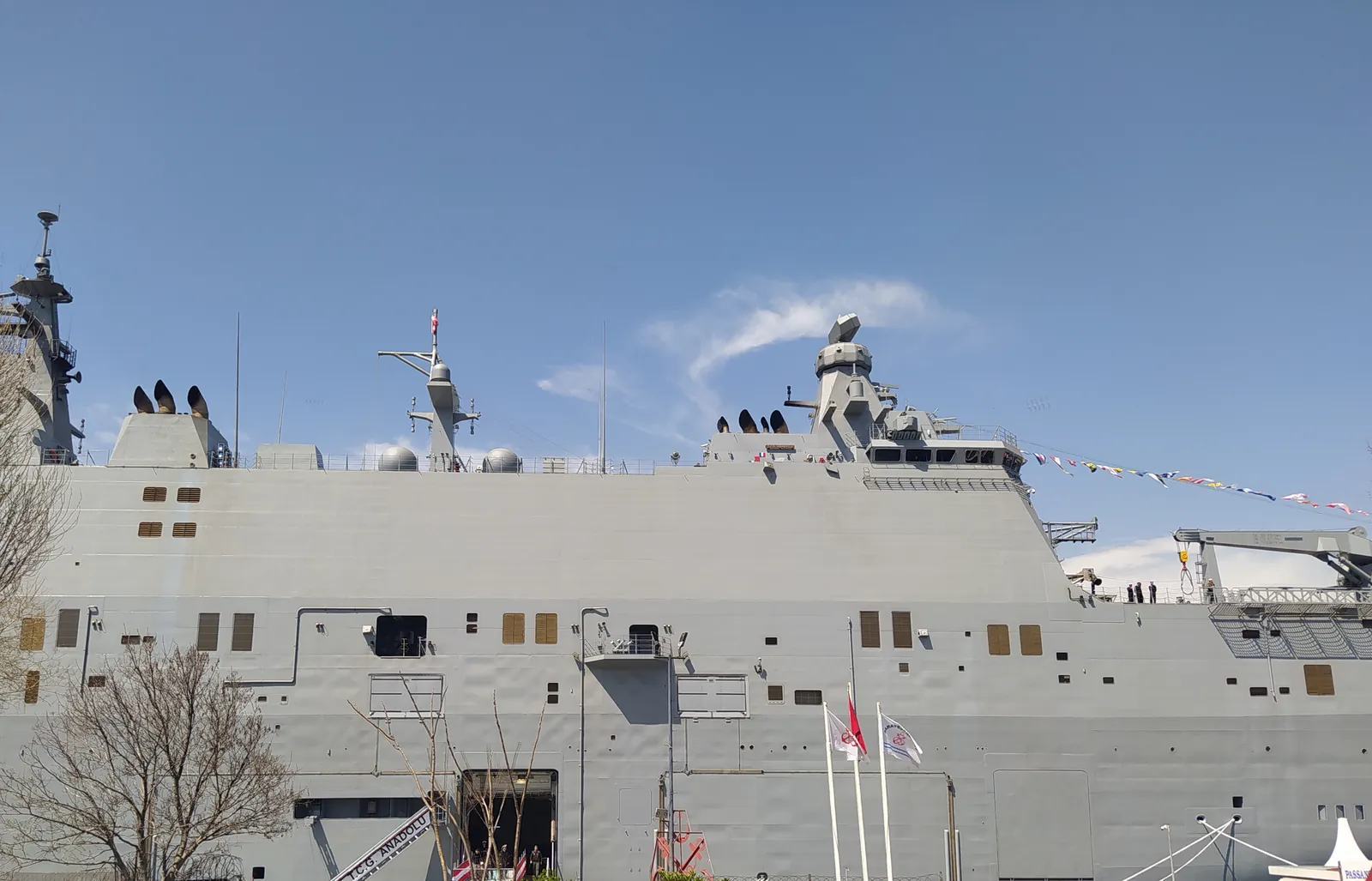
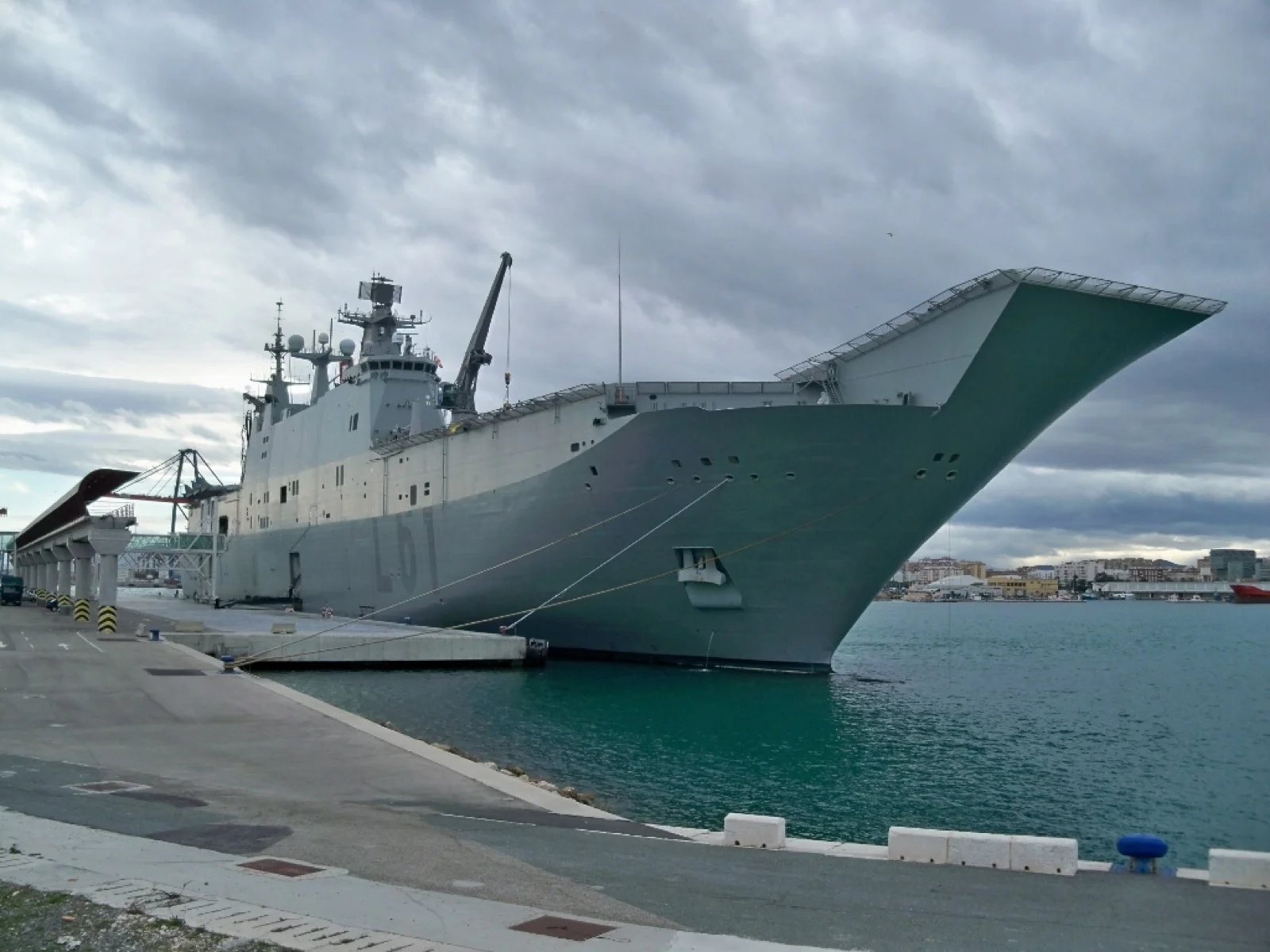
TCG Anadolu and Juan Carlos I share a hull. Both measure 231 metres, both carry a 32-metre beam, and both are credited with a 9,000-nautical-mile range. What separates them is not steel but what flies off the deck: the Turkish ship built its air component around unmanned aircraft, while the Spanish ship still works from a mix of STOVL jets and helicopters.
One design, two navies
Most warship comparisons start by arguing about what is actually comparable. This one does not have that problem. Navantia says plainly on its own product page that Anadolu was designed on the basis of the Spanish Navy’s Juan Carlos I and built at Türkiye’s Sedef Shipyard using Navantia technology, under a 2015 contract covering design, technology transfer, equipment and technical assistance.
The numbers follow from that shared origin. Türkiye’s Presidency of Defence Industries puts TCG Anadolu at 231 metres and 27,436 tonnes full load. The Spanish Navy gives Juan Carlos I 231 metres, a 32-metre beam and 26,000 tonnes. Range is 9,000 nautical miles in both cases. There is no meaningful size argument to be had here.
The interesting question is why two navies took the same hull and turned it into two quite different instruments.
Where the mission concepts diverge
An LHD — landing helicopter dock — is an amphibious assault ship that operates helicopters and carries a floodable well dock from which landing craft are launched. Both ships meet that definition. SSB describes TCG Anadolu as able to move an amphibious battalion with its combat and support vehicles to a crisis area without home-base support. Navantia describes Juan Carlos I as a strategic projection ship combining aircraft carrier, amphibious assault and logistics roles.
So far, the two descriptions are almost interchangeable. The divergence begins on the flight deck.
The distinction in one line
- Juan Carlos I runs a conventional amphibious air group: manned STOVL jets alongside a large rotary-wing element.
- TCG Anadolu runs an air component built around unmanned aircraft, with a deck adapted to UAV operations.
- Both approaches exploit the same hull. They address different mission concepts because they grew out of different procurement realities.
The numbers, side by side
| Criterion | TCG Anadolu (L-400) | Juan Carlos I (L-61) |
|---|---|---|
| Type | Multi-purpose amphibious assault ship (LHD) | Strategic projection ship (LHD) |
| Design origin | Based on the Navantia LHD design; built at Sedef Shipyard under a 2015 technology-transfer contract | Original Navantia design |
| Length overall | 231 m (SSB) | 231 m (Spanish Navy) |
| Beam | 32 m | 32 m (Spanish Navy) |
| Displacement | 27,436 t full load (SSB) | 26,000 t (Spanish Navy) |
| Range | 9,000 nautical miles (Navantia) | 9,000 nm at 15 knots (Spanish Navy) |
| Top speed | Not published in official sources | Not published in official sources |
| Propulsion | Detailed power-plant data not published in official sources | One gas turbine, two diesel generators, two POD units rated 11 MW each |
| Crew | no verified figure available in open sources | 295 (31 officers, 53 NCOs, 66 leading seamen, 145 ratings) |
| Embarked force | An amphibious battalion with its combat and support vehicles (SSB) | Up to 1,500 people on special deployments (Spanish Navy) |
| Well dock | Floodable dock for embarked landing craft | Floodable dock for landing craft and amphibious vehicles |
| Flight deck | Ski-jump; day and night helicopter and UAV operations (SSB) | Ski-jump; STOVL fixed-wing aircraft and helicopters |
| Declared air component | Bayraktar TB2 and TB3 UCAVs, T-129 ATAK, SH-70 Seahawk (Navantia) | Up to 30 medium and heavy helicopters, or 10-12 AV-8B+ class STOVL jets plus a similar number of helicopters |
| Medical facility | At least 30 beds, operating theatre, X-ray, dental unit, intensive care (SSB) | Onboard hospital and logistic support capacity (Navantia) |
| Declared armament | no verified figure available in open sources | 4 × 12.7 mm machine guns, with provision for future anti-missile systems |
| Commissioned | 10 April 2023 | 30 September 2010 |
Every row is sourced to an official publication. Where a figure is not published officially, no estimate has been substituted — the cell says so.
The air component is the real story
Both ships were once discussed in the same breath as the F-35B. A jet that can take off from a short deck and land vertically is the natural match for a ski-jump LHD, and SSB’s project description still notes that TCG Anadolu can accommodate the type. As of 2026, neither navy operates it.
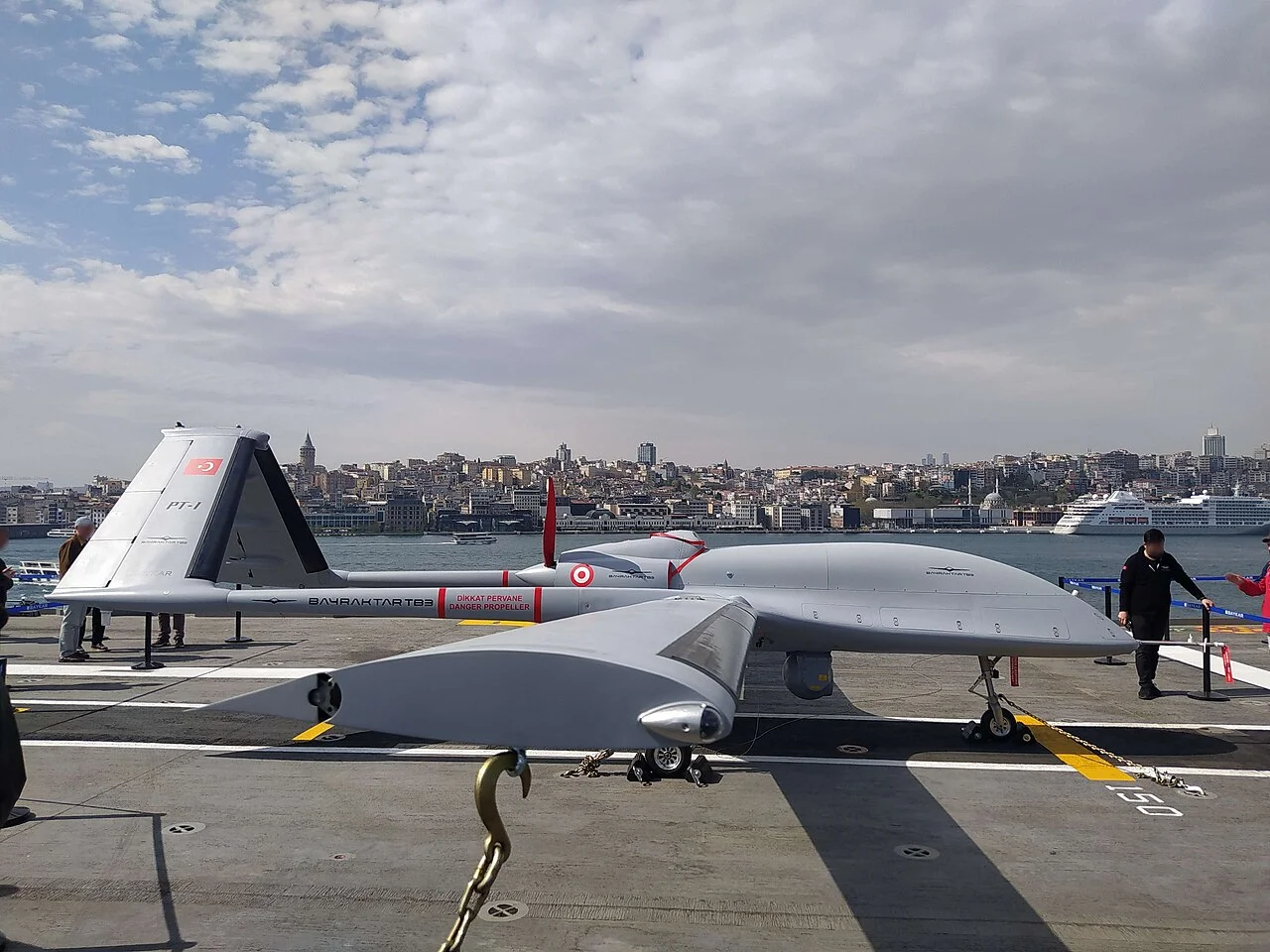
Türkiye was removed from the F-35 programme in 2019, which meant rebuilding the ship’s air component from scratch. Navantia’s L400 page today describes Anadolu in terms of Bayraktar TB2 and TB3 unmanned aircraft alongside T-129 ATAK and SH-70 Seahawk helicopters, and calls it the world’s first naval platform specialised in unmanned combat aerial vehicles.
Baykar’s own releases put dates on that claim. The company says Bayraktar TB3 took off from TCG Anadolu’s short deck on 19 November 2024 and recovered to the same deck after a 46-minute flight without arrestor equipment. By a release dated June 2025, the type had passed 100 sorties aboard the ship, with MAM-L, MAM-T and Roketsan UAV-122 munitions trials in the same period.
Spain’s equation runs the other way. The backbone of the Juan Carlos I air wing is the AV-8B Harrier II family, and those aircraft are ageing. Spanish defence officials told a parliamentary defence committee that the AV-8B fleet is to be sustained until at least 2032, with spare parts procured to that end. Talks on an F-35 purchase have reportedly been suspended, with Madrid prioritising Eurofighter and FCAS. Naval News has framed the resulting gap as the central open question for Spanish naval aviation.
Two navies, one problem: a ski-jump deck and no access to the F-35B. Türkiye built a new concept around unmanned aircraft. Spain chose to extend the life of what it already has and buy time.
Operators and service record
The design’s customer list adds a third dimension. Navantia built two further ships to the same baseline for the Royal Australian Navy, Canberra and Adelaide. The same drawings now serve three navies and three doctrines — a reasonable proxy for how adaptable the design is.
Juan Carlos I has been in service since 2010 and has been used on both military and humanitarian deployments; Navantia gives its Iraq and India deployments a section of their own. TCG Anadolu joined the fleet in 2023. That thirteen-year gap is not a technical advantage so much as an institutional one: crew training pipelines, maintenance cycles and operating procedures settle with time.
Which ship suits which scenario
Where Juan Carlos I has the edge
- Missions calling for manned fixed-wing aircraft, where a pilot’s judgement is in the loop.
- Large-scale vertical assault and evacuation, given the officially stated capacity for up to 30 medium and heavy helicopters.
- A settled support base: fifteen years of operating experience, maintenance infrastructure and trained crews.
- Multinational deployments within NATO and EU frameworks, where the ship has a long record.
Where TCG Anadolu has the edge
- Persistent surveillance: TB3’s stated endurance of over 24 hours is a different kind of sortie cycle from one limited by pilot fatigue.
- Missions where losing the platform does not mean losing aircrew.
- Operating cost per sortie, which for unmanned aircraft is not on the same scale as a STOVL jet fleet’s training and maintenance burden.
- Disaster relief: SSB’s stated minimum 30-bed hospital with operating theatre and intensive care gives the ship a credible hospital-ship role.
- Supply-chain exposure: most of the air component is produced domestically.
Open questions on both sides
For TCG Anadolu: the unmanned air group is a young concept. The sortie counts Baykar publishes come from a test programme; the real test of a concept is how maintenance, spares and tempo hold up under sustained deployment. Unmanned platforms also do not currently match the payload weight or air-to-air capability of manned STOVL jets — these are different mission sets, not equivalent ones. Detailed official data on the ship’s own armament remains limited in open sources.
For Juan Carlos I: the future of the air wing is unresolved. The AV-8B fleet is being life-extended, but what replaces it has not been decided in public. Integrating the F-35B would require deck and infrastructure adaptation, training and armament work; the alternative scenarios discussed in the Spanish press extend as far as a new carrier design. Retaining the carrier role depends on the aircraft, not the ship.
What it means from Ankara’s side
For Türkiye, TCG Anadolu is more than one hull. Building a 231-metre platform domestically under a technology-transfer arrangement moved Turkish shipbuilding into a new size class. Redefining the ship’s air component around what was actually available was a doctrine exercise as much as a procurement one. And being directly comparable with a NATO ally operating the same design puts Türkiye at the same table in this class — while that ally’s thirteen extra years of operating experience is not something that can be bought.
Assessment
Asking which of these ships is better empties the comparison of meaning. The hull is shared: length, beam and range are effectively identical, and the displacement gap is negligible.
They diverge in terms of use case, and specifically in the air component. Spain continues a conventional amphibious concept built on manned STOVL aircraft and heavy rotary-wing capacity, though the post-Harrier chapter is an open question. Türkiye developed a different concept around unmanned platforms — young, but backed by documented trials.
Taking operator choices into account, the same design now serves three navies and three doctrines. That suggests the decisive variable is not the ship but the air component put on it, and the doctrine that employs it.
Are TCG Anadolu and Juan Carlos I the same ship?
Not identical, but they come from the same design family. Navantia’s own product page states that Anadolu was designed on the basis of the Spanish Navy’s Juan Carlos I and built at Sedef Shipyard with Navantia technology. The principal dimensions are effectively the same; the divergence sits in the air component, not the hull.
Why does TCG Anadolu operate drones instead of jets?
The ship was designed with a ski-jump deck capable of supporting short take-off and vertical landing aircraft. After Türkiye was removed from the F-35 programme in 2019, the air component was rebuilt around unmanned platforms. Navantia’s L400 page now describes the ship in terms of Bayraktar TB2 and TB3 operations.
What does Juan Carlos I fly today?
According to the Spanish Navy’s official ship page, Juan Carlos I can embark up to 30 medium and heavy helicopters in the amphibious configuration, or 10-12 AV-8B+ class STOVL jets with a similar number of helicopters in the carrier configuration. The AV-8B fleet is being life-extended; its replacement has not been settled in open sources.
Which ship is larger?
They are effectively the same size. SSB gives TCG Anadolu 231 metres and 27,436 tonnes full load; the Spanish Navy gives Juan Carlos I 231 metres, a 32-metre beam and 26,000 tonnes. The gap is small enough to be explained by equipment fit.
Could either ship operate the F-35B?
Both have ski-jump decks capable of supporting STOVL aircraft. As of 2026 neither navy operates the type. Türkiye was removed from the programme in 2019; Spain has reportedly suspended its F-35 talks and is prioritising Eurofighter and FCAS.
Related coverage
Sources and verification note
- Presidency of Defence Industries (SSB) — Multi-Purpose Amphibious Assault Ship (LHD) Project — dimensions, displacement, well deck, flight deck and hospital capacity of TCG Anadolu
- Navantia — Anadolu L400 product page — design origin, Sedef Shipyard technology transfer and the ship’s declared air component
- Armada Española — LHD Juan Carlos I (L-61) — length, beam, displacement, propulsion, crew, range and air group capacity
- Navantia — Juan Carlos I product page — the ship’s declared role as a strategic projection platform
- Baykar — Bayraktar TB3 press releases — the 19 November 2024 first launch and recovery, sortie counts and munitions trials
- Naval News — Spain’s naval aviation crossroads — the post-Harrier debate and its implications for the Juan Carlos I air wing
Only manufacturer and official government sources plus established international defence publications were used. Where an official figure was unavailable, no estimate was substituted.
Editor’s note: this is a mission-concept comparison, not a ranking. Both ships come from the same design family and serve different doctrines. Figures reflect open official sources as of publication; programme status can change.