Washington clears an $800 million armed helicopter package for Iraq

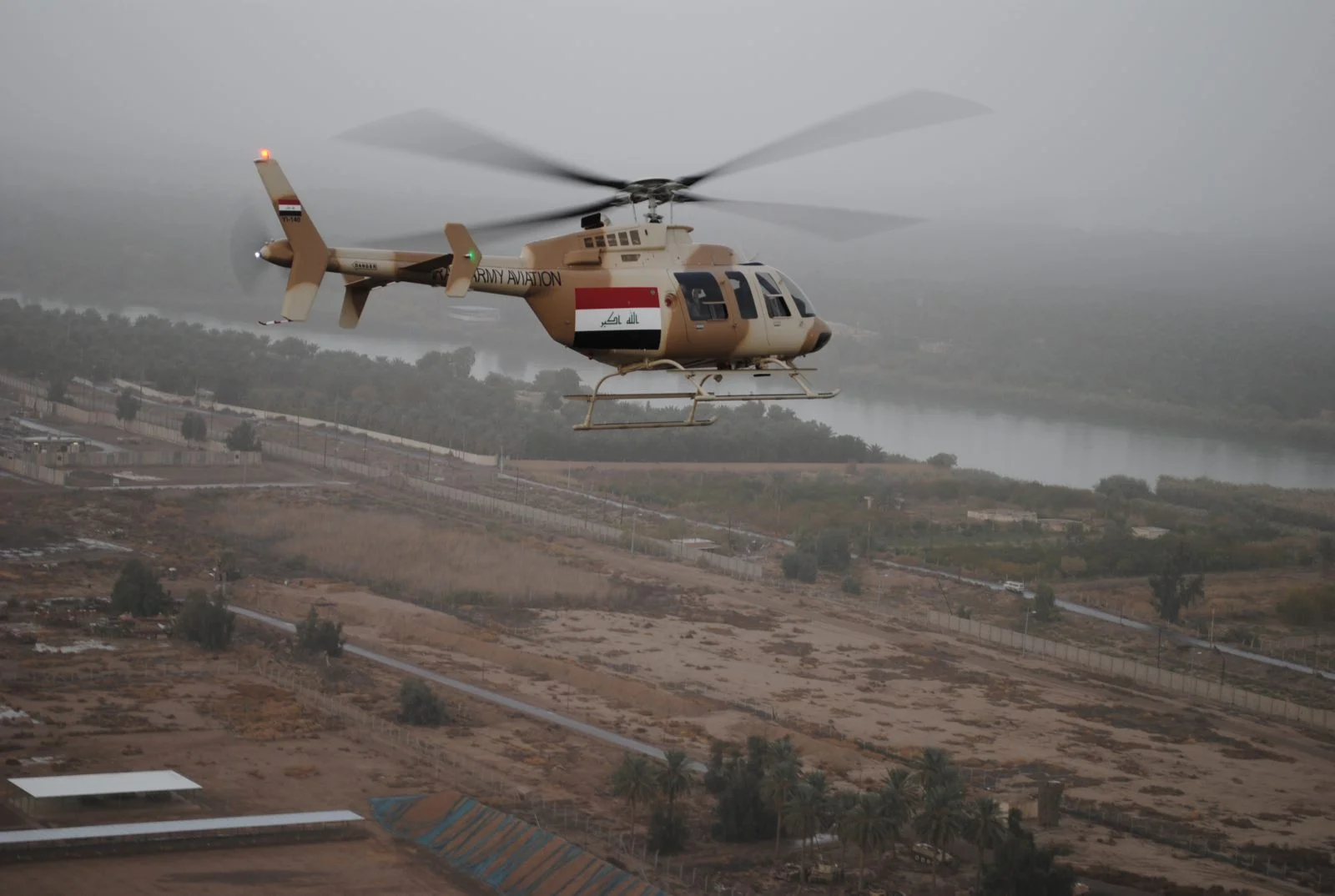
The US State Department approved a possible Foreign Military Sale to Iraq worth $800 million on 31 August 2026, covering helicopters and associated weapon systems. The Defense Security Cooperation Agency notified Congress of the proposed transaction.
Two aircraft types sit at the centre of the package: the Bell 407M for armed reconnaissance, and the Bell 412EPX for utility and transport work.
What the package contains
According to the DSCA notification, the sale covers not only the aircraft but the weapons and sensors that make them combat-capable:
- GAU-19 three-barrel machine gun. A 12.7mm rotary-barrel weapon whose high rate of fire is used against light armour and personnel concentrations.
- M260 seven-tube rocket launcher. Designed for 2.75-inch (70mm) rockets, usable with unguided rounds and laser-guided variants alike.
- Electro-optical/infrared sensors. Imaging systems for target detection, identification and tracking at night and in degraded visibility.
- Missile launch detection systems. Passive protection that warns crews by detecting the motor signature of shoulder-launched air defence missiles.
- Very high frequency radios, spare parts, ground support equipment, technical publications and documentation.
- New-equipment training for Iraqi pilots and maintenance personnel.
The principal contractor is Bell Textron of Fort Worth, Texas.
The stated rationale
The DSCA notification says the sale “will improve Iraq’s capability to meet current and future threats by improving its rotary wing transport, reconnaissance, and air-to-surface targeting capabilities.”
That is standard FMS language, but the package contents indicate the operational need more precisely. The combination of GAU-19, M260 and EO/IR sensors describes a light armed scout profile — sustained patrol and surveillance with the means to engage what it finds — rather than a classic attack helicopter fit.
Two aircraft, two roles
The Bell 407M is a single-engine light platform derived from the civil Bell 407 airframe, with weapon pylons, an EO/IR sensor turret and ballistic protection added. Low operating cost and high availability suit it to long-duration patrol. Its single engine and limited payload constrain use in contested air defence environments.
The Bell 412EPX is a twin-engine medium utility helicopter with a four-blade main rotor, used for troop movement, casualty evacuation, logistics and search and rescue. Twin engines allow continued flight after an engine failure, which is why the type is favoured for overwater and urban tasking.
Procuring both suggests Iraq intends to meet its light reconnaissance and medium transport requirements through a single manufacturer and a largely shared maintenance base.
Iraqi Army Aviation today
Iraq made heavy use of its rotary fleet during operations against the Islamic State and took significant losses. The current inventory mixes Russian-built Mi-17 transports and Mi-28NE and Mi-35M attack helicopters with Bell 407 and Bell 412 types acquired earlier from the United States.
That mix creates a real sustainment problem. Platforms of different origin require separate spare parts chains, separate technician training and separate munitions stocks. Deepening the Bell line can be read as a rationalisation step.
Iraqi procurement policy nonetheless remains deliberately multi-sourced. Baghdad has held talks with South Korea over FA-50 trainer and light combat aircraft, retained its Russian platforms, and maintained cooperation with Washington on sustaining its F-16 fleet. This package does not overturn that balance; it strengthens the American position in the rotary segment.
How the FMS process works
Foreign Military Sales operate differently from commercial arms exports. The buyer contracts with the US government rather than the manufacturer; the government then procures from industry and transfers to the customer.
The process opens with State Department political approval, followed by formal DSCA notification to Congress. If Congress does not object within a set period, negotiations begin, and quantities, configuration and delivery schedule are settled at that stage.
The $800 million figure is therefore a ceiling rather than a signed contract value. In past cases, final contract values have come in appreciably below the notified amount.
Regional context
The approval lands as the Middle East security picture hardens again. Iraq’s requirements in border security, internal security operations and protection of critical energy infrastructure continue to generate demand for aerial surveillance.
For Turkey, the development registers as part of the security equation along its southern border. Baghdad’s capacity to conduct its own aerial surveillance and response is directly tied to how much of the northern security burden it can carry itself.
Sources
- US Defense Security Cooperation Agency congressional notification, 31 August 2026 — scope of the sale, weapons and sensor list, principal contractor and stated rationale. Official primary source.
- Breaking Defense and Defense News, 1 September 2026 — confirmation of total value and approval date.
- Army Recognition, 1 September 2026 — detail on the Bell 407M armed scout configuration.