





ASELPOD vs Sniper ATP: F-16 Targeting Pod Comparison


ASELSAN’s ASELPOD and Lockheed Martin’s AN/AAQ-33 Sniper Advanced Targeting Pod (ATP) are two targeting pods that today fly side by side on the same platform — the F-16 Fighting Falcon. Both promise third-generation mid-wave infrared imaging, multi-mode laser designation, CCD colour camera and wide coverage. Where they diverge is national origin, export regime, platform matrix and unit cost. This comparison relies strictly on verifiable open-source data, without promotional framing.
A targeting pod turns a multirole fighter into a platform that can find, identify and precisely designate ground targets for laser-guided or GPS/INS-aided munitions. Externally mounted on wing pylons of F-16, F-15E, F-4E/2020 and other Western fighters, these pods stream high-resolution multi-spectral imagery to the cockpit and fuse laser designation with target coordinates. For decades the dominant NATO solution has been the Lockheed Martin AN/AAQ-33 Sniper Advanced Targeting Pod (ATP). Turkey answered this dependency with ASELSAN’s ASELPOD, which entered TuAF service in the mid-2010s. This article compares the two head-to-head — hardware, laser, sensor, integration matrix, cost and operational record — using only verifiable open-source data.
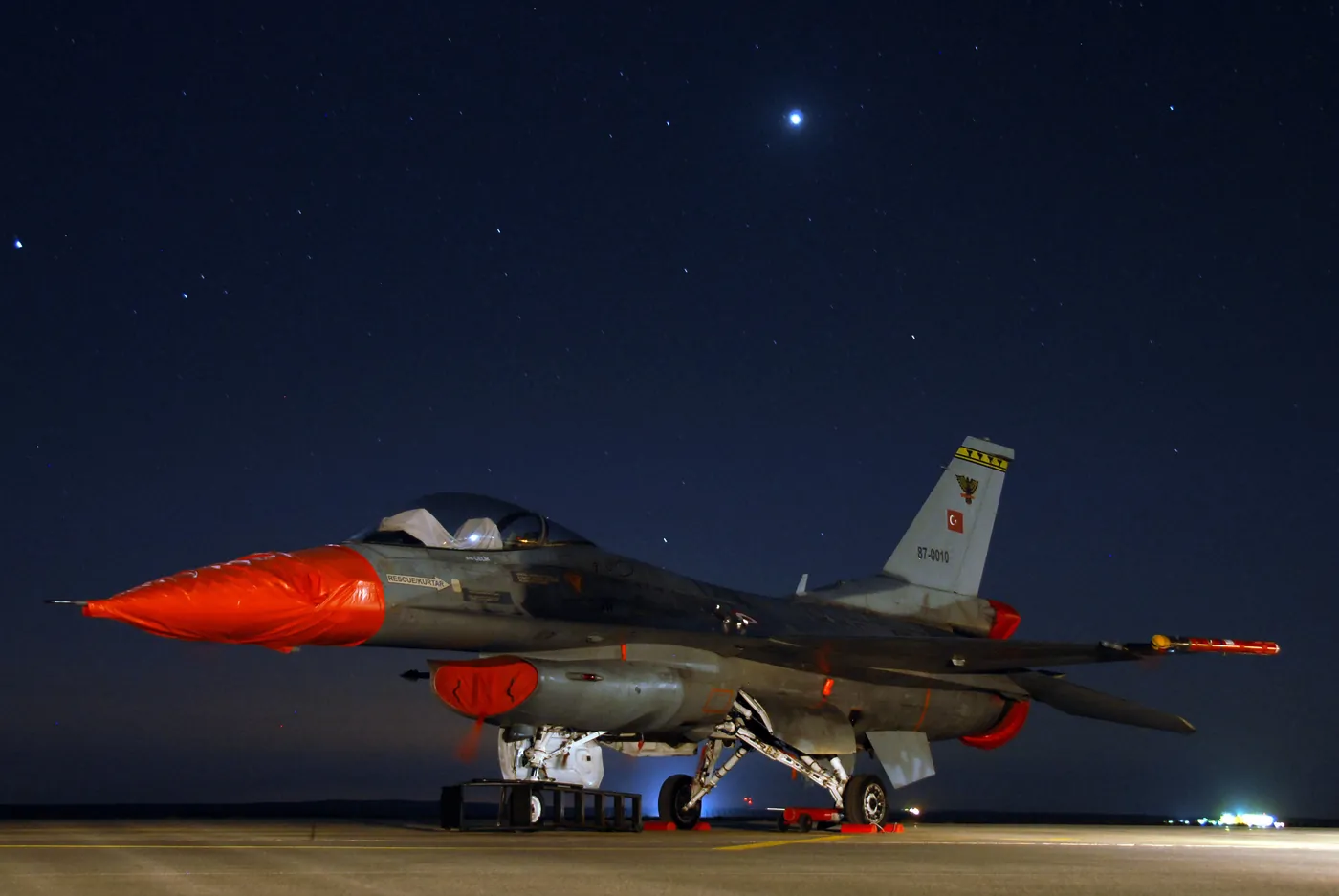
The comparison matters because Turkey operates both. Some Block 50 F-16s carry Sniper ATP acquired through Foreign Military Sales, while ASELPOD has progressively been integrated onto TuAF F-16 and F-4E/2020 fleets. This dual footprint is not accidental; it reflects a deliberate risk-splitting posture between an established American incumbent and a domestic Turkish alternative.
Physical envelope
Sniper ATP has a longer, slimmer airframe; ASELPOD is shorter but wider and heavier. The Sniper is 249 cm long and 30 cm in diameter, while ASELPOD measures 235 cm long and 43 cm in diameter. Mass difference is roughly 33 kg in Sniper’s favour.
Sensor package
Sniper ATP integrates a third-generation mid-wave FLIR and HDTV colour CCD camera; ASELPOD carries a 640×512 IR sensor plus a 768×576 CCD camera. Both pods expose the classic wide/medium/narrow field-of-view scheme. Field of Regard on Sniper is documented at −155° to +5°, giving pilots wide visibility around the airframe.
Laser systems
Both systems use a 1064 nm dual-mode laser designator that is NATO-compatible with STANAG 3733 laser-guided munitions. ASELPOD also lists a 1570 nm eye-safe training mode and a repetition rate up to 20 Hz. Sniper bundles a designator, laser spot tracker and laser marker in the same head.
| Parameter | ASELPOD (ASELSAN) | Sniper ATP (Lockheed Martin) |
|---|---|---|
| Manufacturer | ASELSAN (Türkiye) | Lockheed Martin (USA) |
| Introduction | TuAF service post-2014 | USAF IOC 2005, in production |
| Weight | ≈ 235–240 kg | ≈ 202 kg |
| Length | 2350 mm | 2490 mm |
| Diameter | 430 mm | 300 mm |
| IR sensor | 640×512 3rd-gen MWIR | 3rd-gen MWIR + HDTV CCD |
| TV/CCD | 768×576 | HDTV CCD |
| IR FOV | 0.8° / 4.0° / 28° | Wide / Medium / Narrow |
| Laser designator | 1064 nm combat + 1570 nm eye-safe | Dual-mode 1064 nm + eye-safe |
| Laser designation range | ≈ 25 km | Not published (3–5× LANTIRN) |
| Simultaneous targets | Up to 8 | Multiple (unpublished) |
| Aircraft platforms | F-16, F-4E/2020, JF-17, CN-235 | F-15E, F-16, A-10, B-1B, B-52H, Rafale, Typhoon |
| Operators | Türkiye, Pakistan | 30+ nations including Türkiye |
| Approx. unit cost | ≈ US$1.5M (Pakistan tender average) | Not disclosed; comparable band |
| Export regime | Turkish export licensing | US ITAR + Congressional approval |
Unit cost and total ownership
Pakistan’s ASELPOD tenders are the clearest public data points: US$25 million for 16 pods in 2016 and a second lot of US$24.9 million for another 16 pods in 2017. That averages roughly US$1.55 million per pod. Lockheed Martin does not publish a Sniper ATP unit price, but FMS bulletins and international competitive tenders typically place per-pod cost between US$2 million and US$3 million.
On total cost of ownership (TCO), ASELPOD benefits from a domestic Turkish supply chain, ASELSAN-run training and no supplier-lock. Sniper ATP depot-level maintenance and major overhauls must be performed at Lockheed Martin accredited facilities — a hard constraint for operators exposed to sanction risk.
Export constraints
Sniper ATP is subject to the U.S. ITAR regime; each sale requires Congressional notification and an end-user certificate. ASELPOD is subject to Turkish export licensing. Practical implication: ASELPOD becomes accessible in geographies where U.S. export policy blocks Sniper.
ASELPOD operational footprint
Inside the Turkish Air Force, ASELPOD entered operational service on F-16 Block 40/50 fleets and was also integrated onto modernised F-4E/2020 Terminator jets. Tests aboard CN-235 ISR platforms have been documented. Between 2016 and 2018 ASELSAN delivered 32 ASELPODs to the Pakistan Air Force; integration onto JF-17 Thunder Block II/III was completed, making this Türkiye’s most high-profile airborne EO/IR export.
Sniper ATP operational footprint
Sniper ATP has been in USAF service since 2005 and has spread across 30+ air forces. It integrates on B-52H, B-1B, F-15E, F-16, A-10, Eurofighter Typhoon and Dassault Rafale. It has seen combat use in Afghanistan, Iraq, Syria, Libya, and NATO-aligned operations near Ukraine. Its Rover video downlink for close air support is now the de-facto standard.
Known limits
ASELPOD does not yet have the same every-platform × every-munition certification matrix as Sniper; integration is still expanding. Sniper on the other hand is denied to certain operators by U.S. policy — which is exactly the gap ASELPOD is designed to fill.
Which pod for whom?
- Air forces with unfettered FMS access operating F-15E, A-10 or B-52 gain most from Sniper’s certified integration matrix.
- Operators facing US export blocks (Pakistan being the marquee case) get a near-peer alternative in ASELPOD without geopolitical friction.
- Sovereign supply-chain seekers can move parts of their pod fleet to ASELPOD to reduce ITAR exposure.
- Türkiye itself operates both pods in parallel — a deliberate diversification strategy.
- 1970s — LANTIRN and Pave Tack define the modern targeting pod concept.
- 2001 — Lockheed Martin wins the USAF Advanced Targeting Pod competition; Sniper XR programme begins.
- 2005 — Sniper ATP reaches Initial Operational Capability.
- 2007 — Pakistan becomes the tenth Sniper customer nation.
- Early 2010s — ASELSAN launches the ASELPOD programme.
- 2014 — ASELPOD operational on TuAF F-16 fleet.
- June 2016 — US$25M / 16-pod ASELPOD contract with Pakistan.
- May 2017 — Second contract, US$24.9M / 16 pods.
- 2018 — Deliveries complete; JF-17 integration verified.
- 2020s — ASELSAN publicly signals next-generation targeting pod R&D.
Frequently asked questions
Which air forces operate ASELPOD?
ASELPOD is operational with the Turkish Air Force (F-16 and F-4E/2020) and the Pakistan Air Force (JF-17 Thunder Block II/III).
How many nations use Sniper ATP?
Sniper ATP is in service with more than 30 nations, including Belgium, Canada, Egypt, Japan, Jordan, the Netherlands, Norway, Pakistan, Poland, Saudi Arabia, Singapore, South Korea, Taiwan, Türkiye, the UAE and the USA.
What is the biggest technical difference between the two pods?
Sniper ATP is longer and slimmer; ASELPOD is shorter, wider and slightly heavier. Sensor generation and laser standards are broadly equivalent. The most concrete advantage on the Sniper side is the vast platform-and-munition certification matrix.
Why does Türkiye operate both pods?
The TuAF acquired its first Sniper pods with the Block 50 F-16 package. ASELPOD entered service after 2014 as a sovereign alternative. The parallel fleet spreads life-cycle risk between US and Turkish suppliers.
Is ASELPOD cheaper than Sniper?
Pakistan tender documentation places ASELPOD around US$1.55M per unit. Sniper ATP unit cost is not disclosed but is generally quoted between US$2M and US$3M in international FMS bulletins — suggesting a meaningful ASELPOD price advantage.
What munitions can Sniper ATP guide?
Sniper ATP can designate targets for the Paveway family (GBU-10/12/16), Paveway III GBU-24, JDAM series, Small Diameter Bomb (SDB) and AGM-65 Maverick air-to-ground missiles.
What munitions can ASELPOD guide?
ASELPOD is certified with TÜBİTAK-SAGE HGK precision guidance kits, KGK winged guidance kits, LGK-82/83, NATO-standard Paveway family and TEBER-series bombs under continued integration.
Which pod is better for an F-16 operator?
Both are certified for F-16. The choice depends on the operator’s ITAR posture, existing logistics ecosystem and long-term independence targets. Türkiye demonstrates both can coexist on the same fleet.
What is Rover video downlink?
Rover is a wireless downlink standard that streams the pod’s live video feed to ground troops. It is now default on close air support missions and both Sniper and ASELPOD generations offer compatible downlink options.
Is there a next-generation ASELPOD?
ASELSAN has publicly signalled R&D toward a next-generation targeting pod succeeding ASELPOD, though its operational timeline and serial production date are not officially confirmed at the time of publication.
Sources
- ASELSAN — ASELPOD product page
- Wikipedia — Sniper Advanced Targeting Pod (AN/AAQ-33)
- Defence Turkey — ASELSAN Signs New Export Contract for AselPOD
- Daily Sabah — ASELSAN signs $25M contract with Pakistan
- Lockheed Martin — Sniper Advanced Targeting Pod