ZAHA vs AAV-7A1: The Same Job, Half a Century Apart
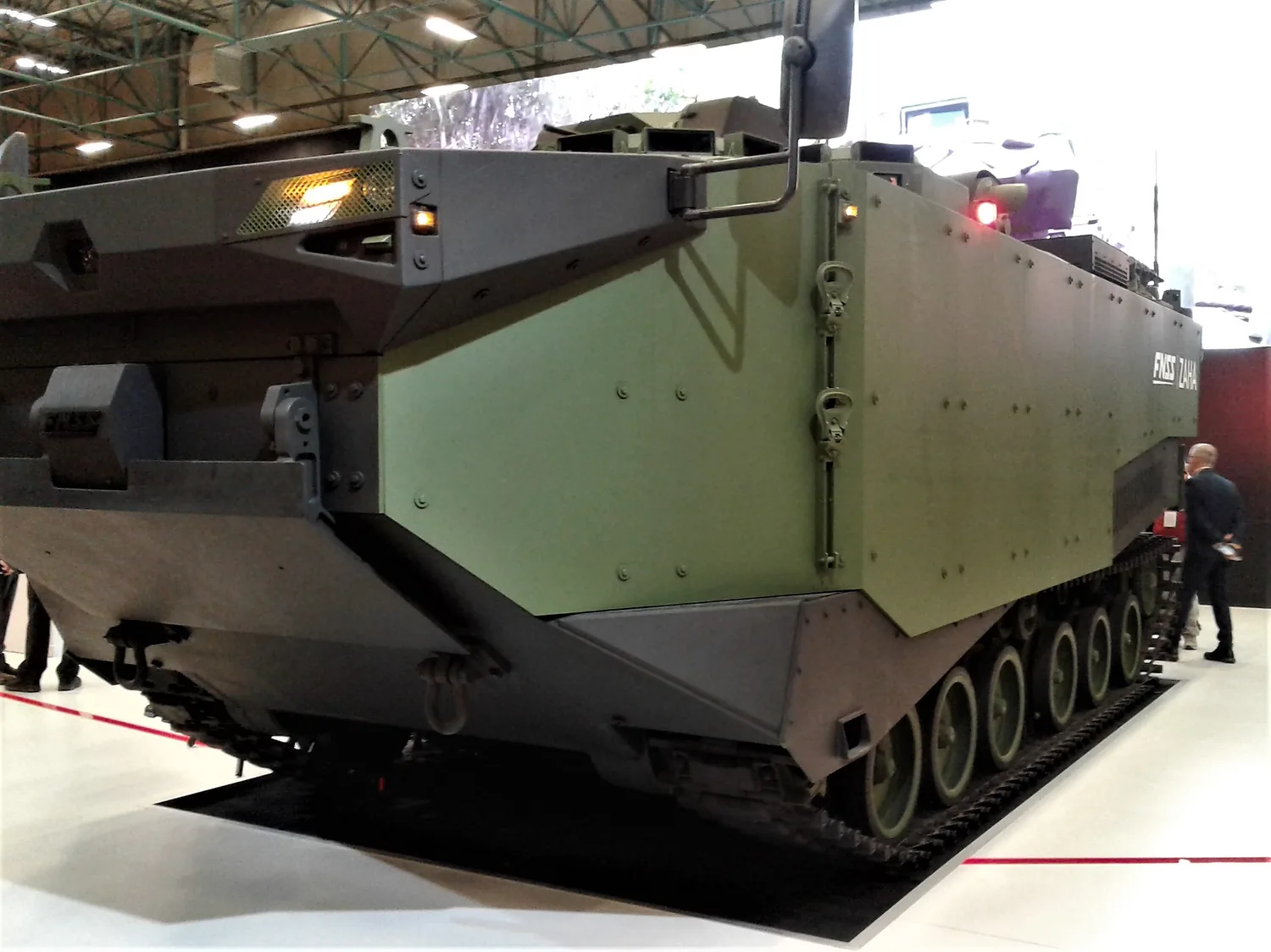
The ZAHA and the AAV-7A1 do the same job: launch from an amphibious ship, swim ashore under their own power and keep fighting as armoured personnel carriers once on land. Their dimensions and their water speed are almost identical — both cruise at 7 knots.
What separates them is not the numbers but the generation. The AAV family dates from the early 1970s; the ZAHA was designed at the end of the 2010s. Self-righting, a remote controlled turret, a battlefield management system and 360-degree situational awareness are the direct consequences of that gap.
The same job, half a century apart
An amphibious landing is one of the least forgiving operations in warfare. The minutes between the moment a vehicle enters the water and the moment its tracks touch sand are the defender’s single greatest advantage. During that window the vehicle cannot manoeuvre meaningfully, cannot take cover and cannot accelerate away. That is why designing an amphibious assault vehicle inverts almost every habit of land vehicle engineering: the hull is calculated as a boat, weight distribution is dictated by buoyancy, and the water resistance of the weapon station matters no less than its ballistic protection.
Very few manufacturers anywhere can build these vehicles. FNSS itself notes that it is one of a small number of NATO suppliers with a hot production line for the type. Putting the ZAHA next to the AAV-7A1 is therefore less a comparison of industrial capacity than a reading of two answers, given fifty years apart, to the same physical problem.
The physical results are strikingly close. The ZAHA is 8.3 m long, the AAV-7A1 7.94 m; the difference in width is three centimetres; both cruise at 7 knots in the water and both top out between 70 and 72 km/h on land. The reason is simple. The dimensions of a swimming tracked vehicle are set less by the engineer than by Archimedes and by the well deck of the ship that has to carry it.
What the two systems actually are
ZAHA — an SSB programme built by FNSS
Türkiye’s Presidency of Defence Industries defines the Armoured Amphibious Assault Vehicle project as enabling amphibious operations from landing platform dock ships and, when required, from other platforms. Its official project page records the delivery of 27 vehicles in personnel carrier, command and recovery configurations. FNSS gave the breakdown in 2021: 23 personnel carriers, two command and control vehicles and two recovery vehicles. Deliveries began on 25 March 2023.
The manufacturer’s technical data sheet is unusually detailed. Capacity is 21 people including gunner, driver and commander. The vehicle is 8.3 m long, 3.3 m wide and 3.8 m high, with a power-to-weight ratio of 20 hp/ton. A diesel engine drives a fully automatic transmission for a maximum road speed of 70 km/h and 7 knots in the water. It climbs a 60 per cent gradient, holds a 40 per cent side slope, crosses a 0.9 m vertical obstacle and a 2 m trench, rides on torsion bar suspension and steers through the transmission.
Armament is a remote controlled turret carrying a 40 mm automatic grenade launcher and a 12.7 mm machine gun, with electrical elevation from -7 to +45 degrees, 360-degree continuous traverse and a day and night sight. FNSS describes its CAKA turret in terms of water resistance, low weight, gunner protection, automatic target tracking, stabilisation and the internal volume it frees up inside the hull.
Protection is partly withheld. Ballistic and mine protection are cited against STANAG 4569 with the level classified. What the brochure does publish is a long list of standard items: self-righting capability, eight smoke grenade dischargers, an integrated smoke generator, automatic fire suppression, a CBRN protection system, air conditioning and a heater. Mission equipment includes 360-degree situational awareness, a driver vision system, a battlefield management system, navigation and VHF/UHF radios.
There is no weight line. Manufacturers often omit it for commercial or operational security reasons, and no estimate has been invented here to fill the gap.
AAV-7A1 — fifty-three years of work
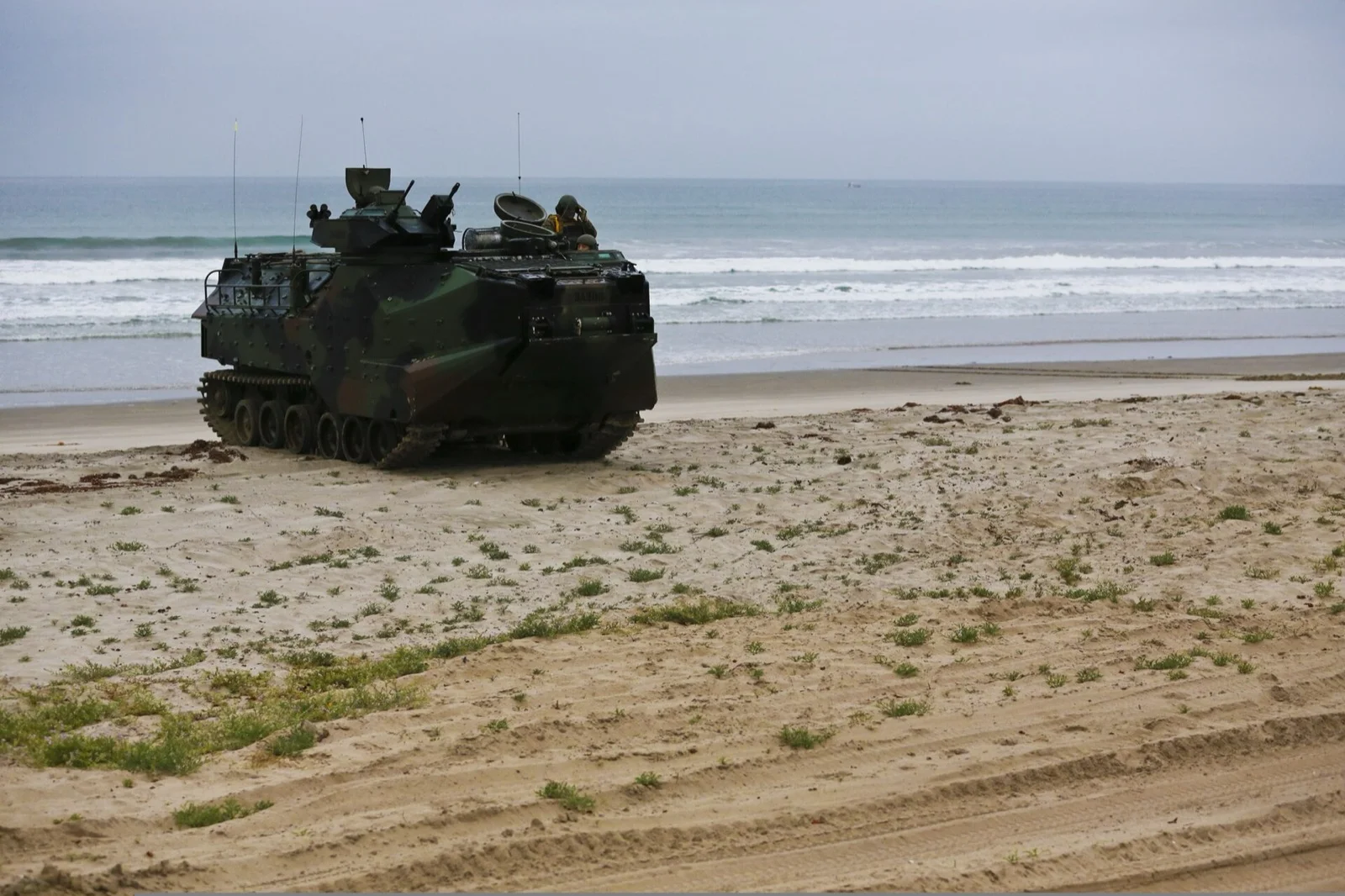
The AAV family entered service in 1972; BAE Systems dates the A1 standard to 1984. The manufacturer describes a 400 hp turbocharged V-8 diesel and two waterjet pumps rated at 14,000 gallons per minute, giving a 7-knot cruise at sea and 45 mph on land. One line BAE highlights is sea keeping: the vehicle can negotiate ten-foot plunging surf heading either seaward or towards the beach.
The family has three core variants: the AAVP7A1 personnel carrier, the AAVC7A1 command vehicle and the AAVR7A1 recovery vehicle. The weapon station pairs a .50 calibre machine gun with a 40 mm Mk 19 grenade launcher, and appliqué armour packages can be added on top. The hull is all-welded aluminium, with EAAK appliqué armour intended to blunt shaped-charge penetration.
The programme that kept the vehicle alive was RAM/RS, which began in 1999 and concluded in 2007, replacing the engine and suspension with components adapted from the M2 Bradley. Weight is where open sources disagree: figures around 23 tonnes per variant sit alongside numbers approaching 29 tonnes for a combat-loaded vehicle. That spread is reproduced here rather than resolved.
The story closed on 26 September 2025. According to DVIDS, the US Department of Defense visual information service, the Assault Amphibian School at Camp Pendleton held a ceremony retiring the vehicle after 53 years. The school’s commanding officer sent it off as “a ship to shore connector, an armored fighting vehicle, a troop carrier, a logistics platform and even sometimes a live boat.” Four years earlier, in 2021, the Marine Corps had already withdrawn AAVs from scheduled deployments and from waterborne training.
Connector or combat vehicle? The doctrinal split
The line that really separates these two vehicles never appears in a table: the concept of operations each was built around. The AAV was born as an assault vehicle but spent most of its life as a ship-to-shore connector. Over five decades it carried Marines and supplies from Grenada to Somalia, from the Persian Gulf to Iraq, and was pressed into service as an armoured fighting vehicle whenever the situation demanded it. That flexibility was both its greatest asset and its heaviest burden.
The ZAHA was specified from the outset to carry both roles at once. FNSS describes it as balancing land and sea requirements so that it holds the characteristics of a military land vehicle and a military marine craft simultaneously, and states that once ashore it can operate alongside main battle tanks and mechanised manoeuvre units. The remote controlled turret, the battlefield management system and the 360-degree awareness package exist to keep the vehicle relevant well beyond the first hour on the beach.
What the United States chose next sharpens the contrast. The ACV that replaced the AAV is not tracked but an 8×8 wheeled platform, and BAE puts its personnel variant at 13 combat-loaded Marines plus three crew. In other words the Marine Corps moved to a vehicle that carries fewer troops but is faster and longer-legged ashore. The ZAHA keeps both the 21-person capacity and the tracked architecture, and sits at a different point on the same trade-off curve.
Specifications side by side
| Criterion | ZAHA (MAV) | AAV-7A1 |
|---|---|---|
| Manufacturer | FNSS Savunma Sistemleri, under an SSB contract | FMC / United Defense lineage; today BAE Systems |
| Class | Tracked armoured amphibious assault vehicle | Tracked armoured amphibious assault vehicle |
| Entered service | Deliveries began 25 March 2023 | 1972 for the family; A1 standard from 1984 |
| Crew and troops | 21 in total, including gunner, driver and commander | 3 crew plus 21 embarked troops; some sources cite 25 |
| Length | 8.3 m | 7.94 m |
| Width | 3.3 m | 3.27 m |
| Height | 3.8 m | 3.26 m |
| Weight | Not published by FNSS; power-to-weight ratio given as 20 hp/ton | Open sources range from about 23 t per variant to roughly 29 t combat loaded |
| Engine | Diesel with fully automatic transmission; output not published | 400 hp turbocharged V-8 diesel; Cummins VTA-903T after RAM/RS |
| Max road speed | 70 km/h | 72.4 km/h (BAE: 45 mph) |
| Water speed | 7 knots | 7-knot cruise; up to 13.2 km/h |
| Water propulsion | Waterjets | Two 14,000 gpm waterjet pumps |
| Land range | no verified figure is published in open sources | About 483 km |
| Sea keeping | Described as able to operate in harsh sea conditions | Able to negotiate 10-foot plunging surf both seaward and shoreward |
| Self-righting | Standard; FNSS calls it a first in the Turkish inventory | no verified figure is published in open sources |
| Turret | CAKA remote controlled turret | UGWS manned weapon station |
| Main armament | 40 mm AGL and 12.7 mm machine gun | Mk 19 40 mm AGL and 12.7 mm M2HB |
| Turret movement | -7° to +45° electrical elevation; 360° continuous traverse | no verified figure is published in open sources |
| Sights | Day and night sight | Day and night sight; engagement range 1,500 m |
| Armour | STANAG 4569 ballistic and mine protection, level classified | All-welded aluminium hull plus EAAK appliqué armour |
| Smoke | Eight smoke grenade dischargers and an integrated smoke generator | no verified figure is published in open sources |
| CBRN | Standard | Addressed in the RAM/RS upgrade |
| Mission equipment | 360° situational awareness, driver vision system, battlefield management system, navigation, VHF/UHF radios, automatic fire suppression, air conditioning | no verified figure is published in open sources |
| Gradient / side slope | 60% / 40% | no verified figure is published in open sources |
| Vertical obstacle / trench | 0.9 m / 2 m | no verified figure is published in open sources |
| Variants | Personnel carrier, command post, beach recovery, combat engineering, battlefield support | AAVP7A1 personnel, AAVC7A1 command, AAVR7A1 recovery |
| Operators | Turkish Naval Forces Amphibious Marine Brigade — 27 vehicles | Retired in the United States on 26 September 2025; still serving with Japan, South Korea, Taiwan, Spain, Italy, Brazil, Romania and others |
| Programme status | Production line active; unmanned U-MAV derivative in development | Replaced in US service by the 8×8 ACV; sustained through upgrades with export operators |
ZAHA figures are drawn from the FNSS product page and technical data sheet; AAV-7A1 figures from the BAE Systems product page and international defence publications. Where official sources publish nothing, nothing has been estimated.
Three things the table makes clear
- The physical dimensions are nearly identical. Thirty-six centimetres in length, three centimetres in width, and the same 7-knot water speed. Physics and the well deck set those numbers.
- The separation is in electronics and protection. A remote controlled turret, battlefield management system, 360-degree situational awareness, an integrated smoke generator and self-righting are all listed as standard on the ZAHA.
- The programme clocks run in opposite directions. The AAV-7A1 has left US service and survives through upgrades with export operators; the ZAHA line is active and an unmanned derivative is in development.
Operators and operational reality
The AAV-7A1’s greatest strength is its spread. Open-source operator lists include Japan, South Korea, Taiwan, Brazil, Spain, Italy, Romania, Indonesia, Argentina, Thailand, the Philippines and Venezuela. South Korea built the vehicle under licence as the KAAV7A1 and made it the backbone of its marine corps. That user base keeps the spare parts and upgrade ecosystem alive even after the originating service walked away.
Türkiye’s picture is different. Open-source operator lists do not include Türkiye, so the ZAHA is not a replacement for an existing vehicle of this class in Turkish service. It is the programme that defines the amphibious brigade’s armoured landing capability in the first place. The initial batch of 27 vehicles was delivered to work with TCG Anadolu and with landing platform dock ships.
User base and operational maturity, from open sources
Where the two actually diverge
Ship-to-shore movement in poor sea states. Both vehicles were built for this and both cruise at 7 knots. The divergence appears in the capsize case: FNSS describes the MAV as able to right itself after turning over and calls it the first such vehicle in the Turkish inventory. No comparable official line exists on the AAV side.
A landing against an active coastal defence. This is where the remote controlled turret earns its place. Letting the gunner engage from inside protected volume, rather than exposing him at the station, is a survivability question in the most fragile minutes of the first wave. The AAV’s UGWS represents the standard of its own generation.
Manoeuvre after the beach. The ZAHA’s specification explicitly includes working alongside main battle tanks, with battlefield management and navigation packages as standard. The AAV performed that role in practice for half a century, but it did so with the sensors and communications of its own era.
Numbers and cost. Here the AAV holds an advantage no new-build platform can match: thousands of vehicles produced, a broad second-hand and spares market, and decades of accumulated training. For a navy trying to establish an amphibious capability on a constrained budget, that is a threshold a fresh production line cannot offer.
Limits of this comparison
The honest part of any comparison is naming what is not known. The ZAHA’s weight, engine output and range are absent from the published brochure, and its protection levels are classified. On the AAV side the manufacturer’s own page gives no weight, dimensions or range, so those lines have to come from international defence publications — which do not fully agree with one another.
The second limit is more fundamental. The two vehicles have never been measured against each other in the same conditions and never will be. The AAV is assessed through half a century of operational record, the ZAHA through test and qualification data. That asymmetry bounds what any specification table can honestly say.
The third is timing. The AAV is now retired in its country of origin, and measuring it against a current production vehicle risks tilting the scale before the comparison begins. The fairer benchmark is the ACV that replaced it — but the ACV is a wheeled 8×8 carrying fewer troops, so the fit is imperfect again. In the amphibious world, finding a true like-for-like counterpart is harder than in almost any other category.
What this means for Türkiye
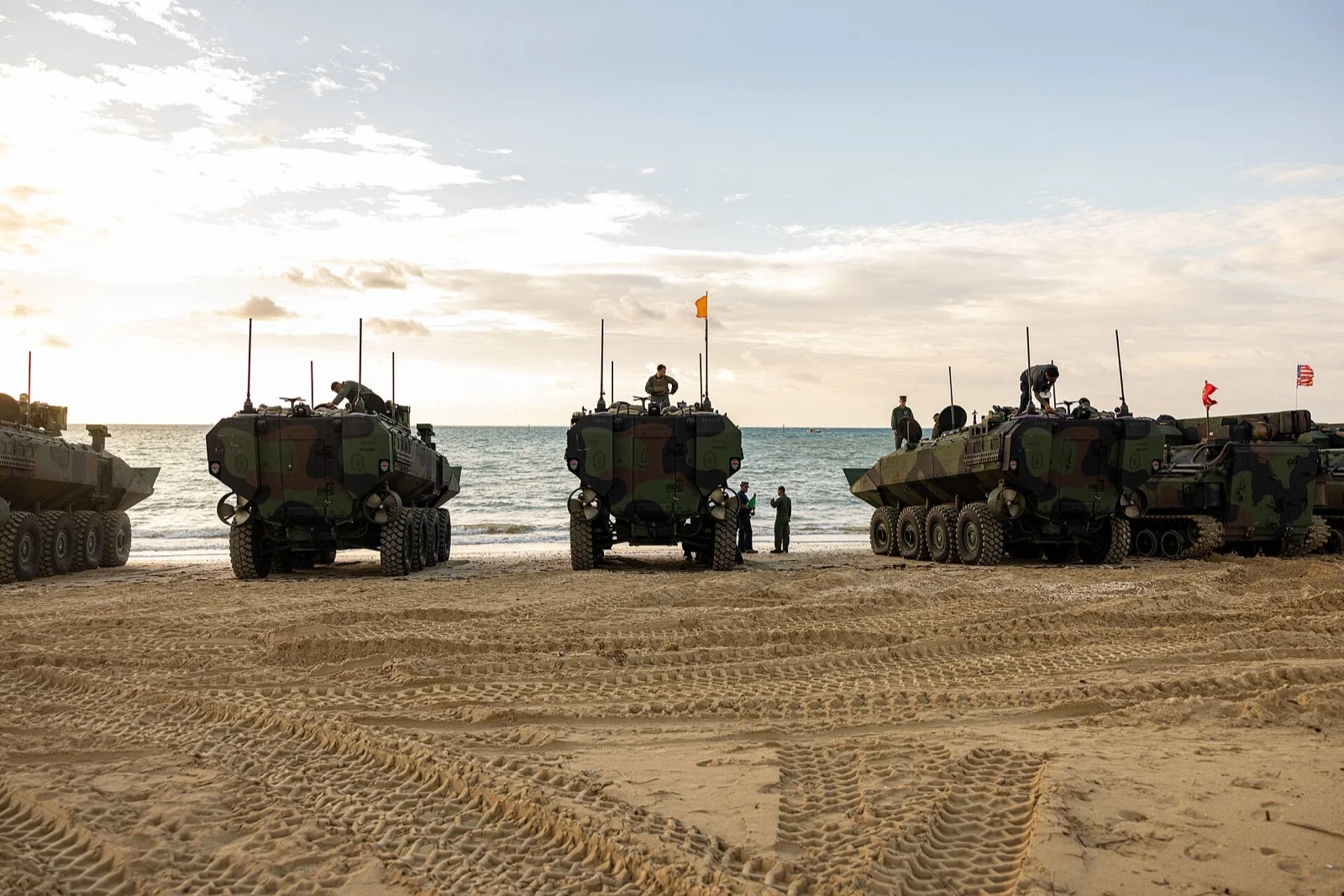
First, the ZAHA is more than a vehicle programme. With TCG Anadolu in service, Türkiye joined the short list of countries able to put armour ashore from a landing helicopter dock — but the ship alone does not deliver that capability. Without a vehicle that can leave the well deck, swim to the beach and keep fighting on land, an amphibious brigade is a transport formation rather than a landing force. The ZAHA closes that link.
Second, there is a supply chain argument. Very few countries can build amphibious assault vehicles, and the type is among the most exposed to embargo: it combines military and marine-specific components and is produced in small series. Establishing that line matters industrially well beyond an order of 27 vehicles.
Third, and looking furthest forward: the U-MAV. FNSS unveiled the vehicle in August 2026 with the aim of making the first landing wave unmanned. In the company’s own description, it is tasked with making first contact with enemy coastal defences ahead of manned MAV/ZAHA elements, clearing mines and obstacles according to its configured payload and preparing the beach for manned vehicles to approach. Handing the highest-casualty minutes of an amphibious landing to an unmanned element is among the more striking conceptual moves in this field.
Fourth, for balance: what became of the AAV-7A1 is also a warning for the ZAHA. A vehicle that served for fifty-three years, and was the most widely used amphibious platform of its generation, was still judged unsustainable in the threat environment of the 2020s — against sensor and missile networks that can see and strike a vehicle approaching the shore from tens of kilometres away. The concept of amphibious landing itself is under debate. The ZAHA’s long-term value will depend less on the vehicle than on the maturity of the reconnaissance, electronic warfare, unmanned systems and fire support network around it.
Assessment
Asking which of the ZAHA and the AAV-7A1 is better would mean going beyond what open sources allow. Their physical dimensions and water performance are very close, and the published data does not support a meaningful ranking on those lines.
The divergence is generational. A remote controlled turret, battlefield management system, 360-degree situational awareness, an integrated smoke generator and self-righting place the ZAHA at the design standard of the late 2010s. The AAV-7A1 carries the solutions of its own era and did the job in earnest, in more than ten marine corps, for fifty-three years.
Taking the choices of user nations into account, the two systems answer different concepts of operations. The AAV made amphibious capability affordable and widespread; the ZAHA is a small fleet with a current protection and sensor package, expected to keep manoeuvring once ashore. And on the beach itself, the outcome is usually decided less by the vehicle than by the fire support, reconnaissance and electronic warfare network that gets it there.
Are the ZAHA and the AAV-7A1 in the same class?
Yes. Both are tracked armoured amphibious assault vehicles: they launch from an amphibious ship, swim ashore under their own power and then work as armoured personnel carriers on land. Their dimensions are close too — 8.3 m for the ZAHA against 7.94 m for the AAV-7A1. The real gap is generational: the AAV family dates from the early 1970s, the ZAHA from the late 2010s.
How much does the ZAHA weigh?
FNSS does not publish a weight line in its official technical data sheet. Instead it gives a power-to-weight ratio of 20 hp/ton. Ballistic and mine protection are described as meeting STANAG 4569, with the level classified. No estimate has been substituted here for the missing figures.
Why did the US Marine Corps retire the AAV?
The vehicle was formally retired on 26 September 2025 at a ceremony held by the Assault Amphibian School at Camp Pendleton, after 53 years in service. Before that, in 2021, the Marine Corps pulled AAVs from scheduled deployments and from waterborne training. The wheeled 8×8 Amphibious Combat Vehicle took its place.
Which ship does the ZAHA operate from?
According to the FNSS product page, the new MAVs are fully qualified and in service aboard the Turkish Navy’s landing helicopter dock TCG Anadolu. Türkiye’s Presidency of Defence Industries (SSB) defines the programme as enabling amphibious operations from landing platform dock ships and, when required, from other platforms.
What does self-righting actually buy you?
Capsizing is one of the deadliest failure modes in amphibious operations: once a vehicle turns over, the crew compartment floods and evacuation is measured in seconds. FNSS describes the MAV as capable of self-righting after a capsize and of operating in harsh sea conditions, and calls it the first vehicle in the Turkish Armed Forces inventory with that capability. The data sheet lists it as standard.
Is the AAV-7A1 still in service anywhere?
It has left the US inventory but continues to serve with export operators. Open sources list Japan, South Korea, Taiwan, Brazil, Spain, Italy, Romania, Indonesia, Argentina, Thailand and the Philippines among them. South Korea built the vehicle under licence as the KAAV7A1.
Related coverage
Sources and verification note
- FNSS — MAV Marine Assault Vehicle product page — Mission description, 7-knot water speed, 70 km/h road speed, self-righting capability, CAKA remote controlled turret, variant list and TCG Anadolu service note
- FNSS — MAV technical specifications brochure (2024 catalogue, PDF) — 20 hp/ton power-to-weight ratio, 21-person capacity, 8.3 x 3.3 x 3.8 m dimensions, 60% gradient, 40% side slope, 0.9 m vertical obstacle, 2 m trench, STANAG 4569 protection and CBRN package
- FNSS — “Turkish Navy’s Marine Assault Vehicle; FNSS MAV” press release (20 August 2021) — Breakdown of the 27-vehicle order: 23 personnel carriers, two command and control vehicles and two recovery vehicles, plus the SSB project framework
- Presidency of Defence Industries (SSB) — Armoured Amphibious Assault Vehicle (ZAHA) Project — Official project definition and delivery of 27 vehicles in personnel carrier, command and recovery configurations
- BAE Systems — Assault Amphibious Vehicle (AAV7A1) product page — In service since 1984, 400 hp turbocharged V-8 diesel, two 14,000 gpm waterjets, 7-knot cruise, 45 mph road speed, .50 cal / Mk 19 weapon station and the three-variant family
- DVIDS (US Department of Defense) — “Marines bid farewell to the Assault Amphibious Vehicle” — The 26 September 2025 retirement ceremony at the Assault Amphibian School, Camp Pendleton, 53 years of service and the transition to the ACV
- BAE Systems — Amphibious Combat Vehicle (ACV) product page — The 8×8 platform replacing the AAV, 13 embarked Marines plus three crew in the ACV-P, and the ACV-C / ACV-30 / ACV-R variants
- Army Technology — AAV7A1 Assault Amphibious Vehicle — Dimensions, variant weights, Cummins engine and HS400-3A1 transmission, 72.4 km/h road speed, 483 km land range, all-welded aluminium hull with EAAK appliqué armour, and RAM/RS content
- Naval News — “FNSS starts ZAHA Marine Assault Vehicle Deliveries to Turkish Navy” (March 2023) — Deliveries beginning 25 March 2023, the 27-vehicle breakdown and the TCG Anadolu service note
- FNSS — U-MAV Multi-Purpose Modular Unmanned Amphibious Vehicle product page — The unmanned first-wave concept, cooperation with manned MAV/ZAHA elements and the mission of making first contact with coastal defences
This comparison uses only manufacturer sources (FNSS, BAE Systems), official institutions (SSB, the US Department of Defense via DVIDS) and international defence publications. Where official sources publish no figure, none has been estimated; those lines are marked as such.
Editor’s note: this article is a comparison of operational concepts, not a ranking. Roughly fifty years separate the two designs, one is still in production and the other has been retired in its country of origin. Technical data reflects official open sources at the time of publication; programme status and configurations can change.
Follow the comparison series
Envanter Medya compares defence systems mission by mission, using manufacturer and institutional sources only.