Altay vs K2 Black Panther: Same Engine, Two Combat Philosophies (2026)
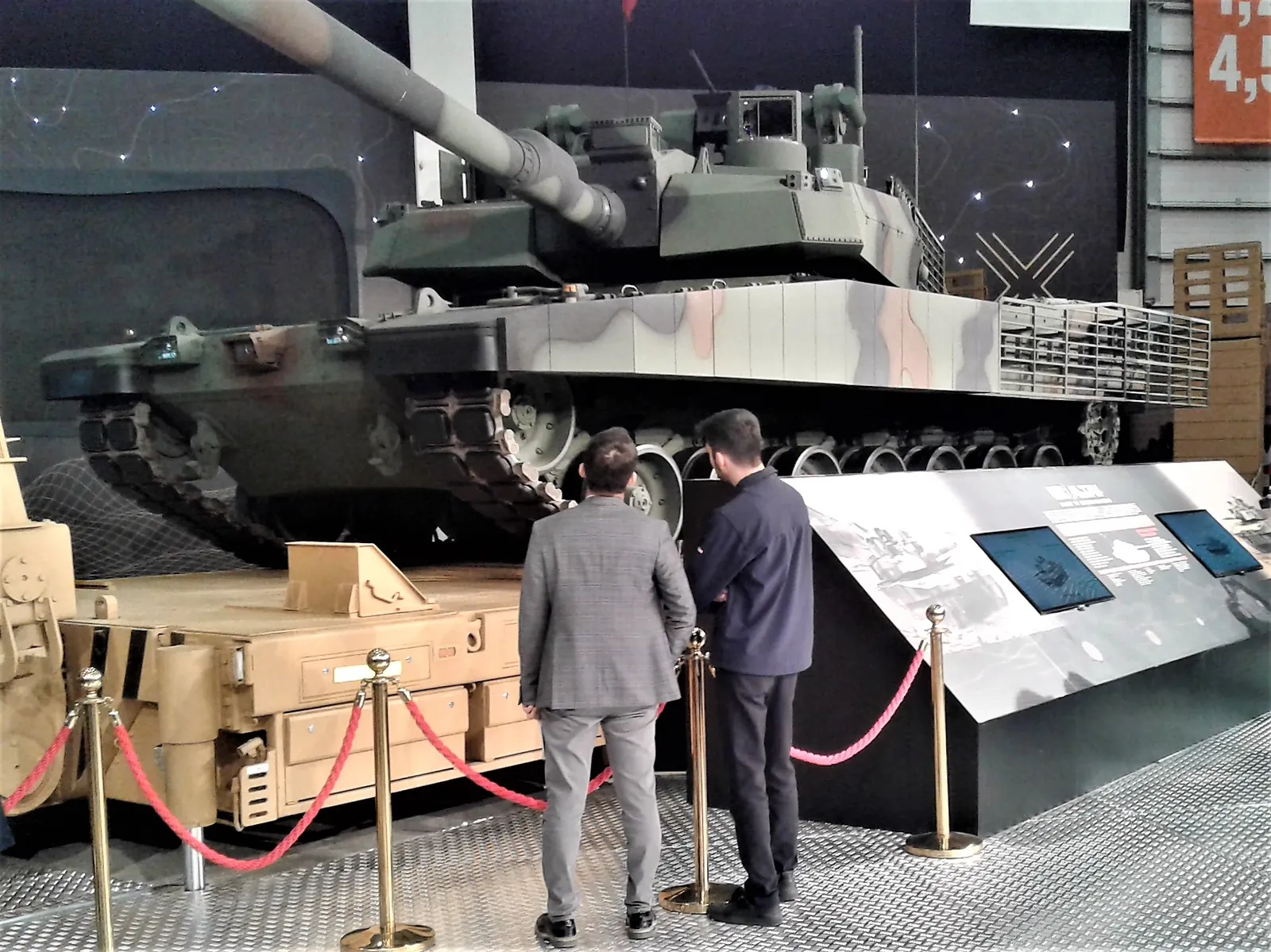
Turkey’s indigenous main battle tank, the Altay, entered serial production in October 2025 with the first two delivered to the Turkish Land Forces. South Korea’s K2 Black Panther has been in service since 2014 with 180 units already delivered to Poland — a proven export success story. These two aren’t just 65 and 56-ton third-generation MBTs; the Altay T1’s engine, transmission, and armor backbone all trace back to Korean partnership. In this analysis we place both systems side by side using neutral data: why does the same engine haul 65 tons on one side and 56 tons on the other? What does the autoloader trade-off actually mean? Who leads on active protection?
Technical Comparison
| Item | Altay T1 | K2 Black Panther |
|---|---|---|
| Weight | 65 t | 55-56 t |
| Length (hull) | 7,3 m | 7,5 m |
| Width | 3,9 m | 3,6 m |
| Height | 2,6 m | 2,0-2,4 m |
| Crew | 4 | 3 (autoloader) |
| Engine | HD Hyundai Infracore DV27K, 1,500 hp | HD Hyundai Infracore DV27K, 1,500 hp |
| Power-to-weight | 23 hp/t | 27.3 hp/t |
| Transmission | SNT Dynamics EST15K | SNT Dynamics EST15K |
| Max speed (road) | 65 km/h | 70 km/h |
| Max speed (offroad) | 45 km/h | 50 km/h |
| Operational range | 450 km | 450 km |
| Main gun | MKE 120mm 55C smoothbore | CN08 120mm L/55 smoothbore |
| Autoloader | None (manual) | Yes (~10 rpm) |
| Active protection | ASELSAN AKKOR (soft+hard) | KAPS (in development) |
| Armor package | Roketsan modular composite (KSAP-based) + AKKOR | Composite + explosive reactive armor |
| Unit cost | ≈USD 13.75M (T1, 2025) | ≈USD 8.5M (2009 base) |
| First delivery | October 2025 | 2014 |
| Built | 5 (T1) + 250 ordered | 440+ |
Dimension-by-Dimension Analysis
Shared DNA: The Same Korean Power Pack
The Altay T1 production line uses the HD Hyundai Infracore DV27K 1,500 hp diesel and SNT Dynamics EST15K automatic transmission. K2 Batch IV moved to the same pack. In other words, the two tanks currently share a heart. What differs is the load this pack has to move: Altay carries 65 tons at 23 hp/ton; K2 carries 56 tons at 27.3 hp/ton. That gives the K2 a mobility edge on paper. BMC Power’s indigenous BATU group is set to arrive on the Altay T2 line, ending the powertrain dependency.
Size and Crew
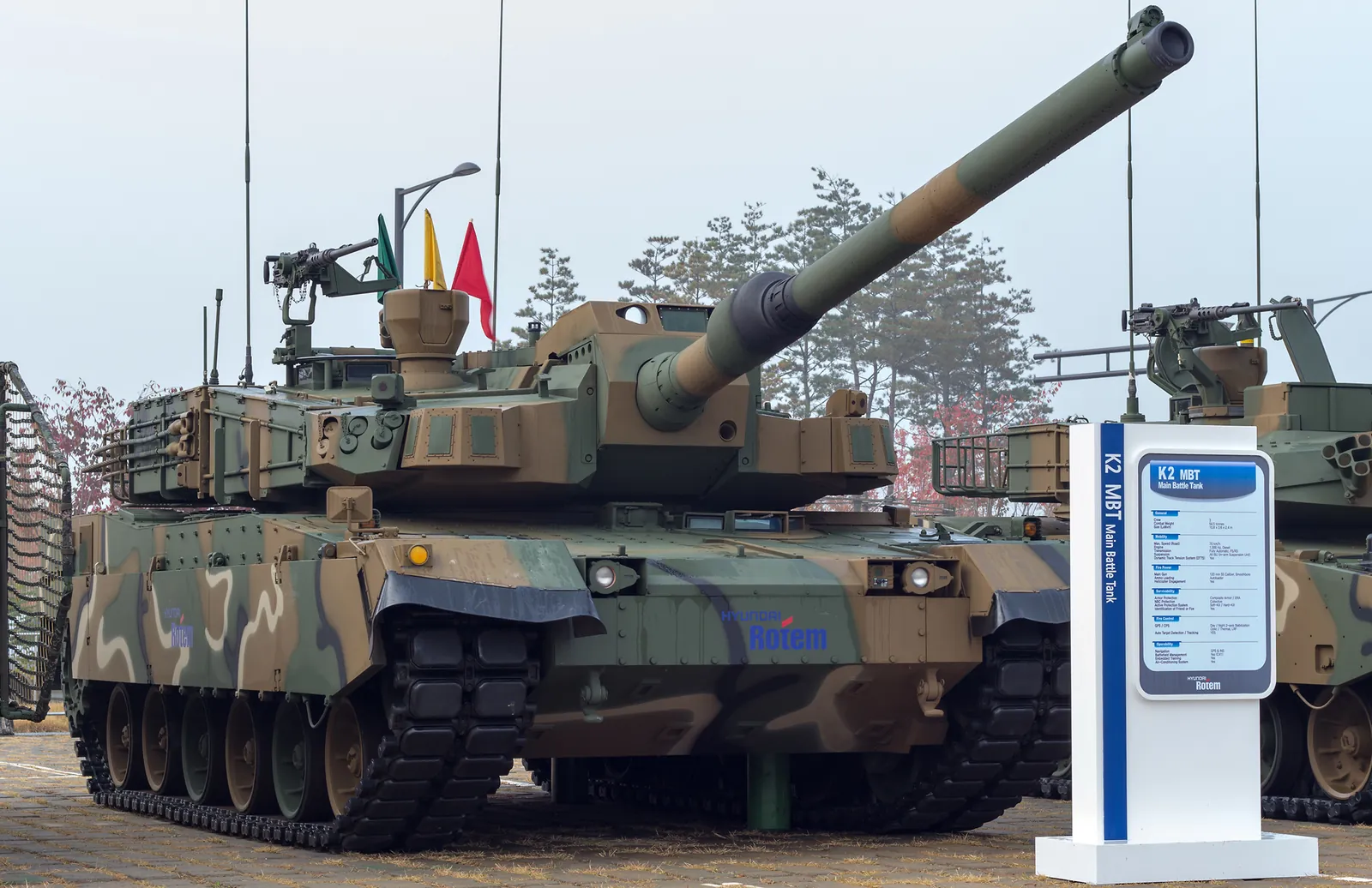
Altay is heavier, wider (3.9 m vs 3.6 m) and taller (2.6 m vs 2.0-2.4 m adjustable). K2’s hydropneumatic suspension can raise or lower the hull, a useful capability in Korean mountain terrain. The crew-size gap (4 vs 3) stems directly from the autoloader choice.
Main Gun and Rate of Fire
Both use a 120mm L/55 smoothbore. Altay’s MKE 120mm 55C is fully produced in Turkey. K2’s CN08 is a Korean-licensed derivative of the Rheinmetall L/55 family. NATO-standard ammunition is shared.
The critical fork is the autoloader. K2 delivers up to 10 rounds per minute and cuts the crew to three; the payoff is sustained rate of fire and one fewer casualty risk. Altay retains four crew and manual loading — a design line that preserves human redundancy and mirrors NATO doctrine.
Fire Control
Altay’s FCS is built by ASELSAN, with claimed high first-round hit probability on the move and in degraded visibility. K2’s FCS features automatic target tracking and a millimeter-wave radar band for enhanced anti-air modes.
Armor Package
Altay’s armor package is Roketsan-developed and derived from the Korean KSAP baseline; it is modular and upgradable against kinetic, chemical and tandem threats. K2 combines composite and explosive reactive armor (ERA); modular upgrade capacity is more limited compared to Altay.
Active Protection System
Altay carries ASELSAN’s AKKOR: soft-kill jammers plus hard-kill interceptors, operationally integrated. K2’s KAPS is still in development phase and not universally fielded across production batches; the K2 platform relies on multispectral screening smoke instead. On the APS row, Altay leads on the data.
Operators
Altay: Turkey has ordered 250 units (85 T1 delivered 2025-2028, remainder T2). Qatar has 100 units on signed order pending delivery. In Turkish Army service since October 2025.
K2 Black Panther: South Korean Army has 260+ (Batches I-III) and 150 more ordered (Batch IV). Poland has received 180 (2022-2025), with 180 more ordered in a Batch II follow-on. Norway trialled K2 in 2023 but selected Leopard 2A8. Talks with Egypt and Romania continue with no firm orders.
Export and Industrial Impact
K2 leads on export track record, though Poland’s K2PL variant pushes local content past 30%. For Altay, the Qatar contract and BMC’s eight-tank-per-month capacity address serial output. Long-term, Altay T2 with fully indigenous BATU promises supply-chain independence.
Timeline
- 1995: South Korea approves K2 development.
- 2007: Turkey awards Altay development contract to Otokar (Hyundai Rotem as technology partner).
- 2014: K2 delivered to the Republic of Korea Army.
- 2018: Altay serial production contract awarded to BMC.
- 2022: Poland-Hyundai Rotem 180-unit K2 first-tranche contract.
- 28 October 2025: First two Altay T1 delivered to Turkish Land Forces; BMC Ankara facility inaugurated.
- 2025-2028: Altay T1 delivery plan: 3+11+41+30 = 85 units.
Frequently Asked Questions
Do the Altay and K2 Black Panther share the same engine?
Yes — the Altay T1 production line and K2 Batch IV both use the HD Hyundai Infracore DV27K 1,500 hp diesel and SNT Dynamics EST15K transmission. Altay T2 will switch to Turkey’s indigenous BMC Power BATU pack.
Which tank is faster?
K2 tops out at 70 km/h on road versus Altay’s 65 km/h; off-road K2 does 50 km/h and Altay 45 km/h. That is roughly 10% in K2’s favor, but both share the same 450 km operational range.
Is the Altay’s armor Korean?
The baseline draws from the Korean KSAP package, but Roketsan developed the modular composite in Turkey. The AKKOR active protection is fully ASELSAN-made and leads the K2’s KAPS on operational integration.
Is the K2 autoloader an advantage or a liability?
Advantage: up to 10 rpm sustained rate and a crew reduced to three (fewer casualties per hit). Liability: if the mechanism jams there is no manual backup. NATO doctrine still tilts toward manual loading — Altay follows that line.
Why did Norway reject the K2 in favor of the Leopard 2A8?
In February 2023 Norway ran K2 and Leopard 2A8 through cold-weather trials. The decision cited NATO integration, survivability and an industrial partnership with Germany. This is a political-industrial choice, not a K2 performance failure.
Which countries operate the Altay?
Turkey since October 2025 — 250 units on order (85 T1 + remainder T2). Qatar has 100 units on signed contract awaiting delivery. BMC’s Ankara facility can produce up to eight tanks per month.
Why is the unit cost gap so wide?
K2’s often-cited ~USD 8.5M is a 2009 baseline; current Polish contracts are higher. Altay T1 is USD 13.75M in 2025 and is expected to drop to USD 11.75M on the T2 line with an indigenous power pack. When normalized by year, the gap narrows.
Does the Turkish Army operate the K2?
No. Turkey and South Korea collaborated at the design and technology transfer level on the Altay programme. Turkey selected the Altay as its indigenous MBT and did not procure the K2 directly.
Sources
- Wikipedia — Altay (tank)
- Wikipedia — K2 Black Panther
- Army Recognition — Altay serial phase
- European Security & Defence — Altay serial production
- Defence Industry Europe — Hyundai Rotem 180 K2 to Poland
- Army Recognition — K2 Black Panther data sheet
- The Defense Post — K2 Black Panther guide 2026