





ATMACA vs Exocet MM40 Block 3: Same Range Class, Two Different Procurement Logics

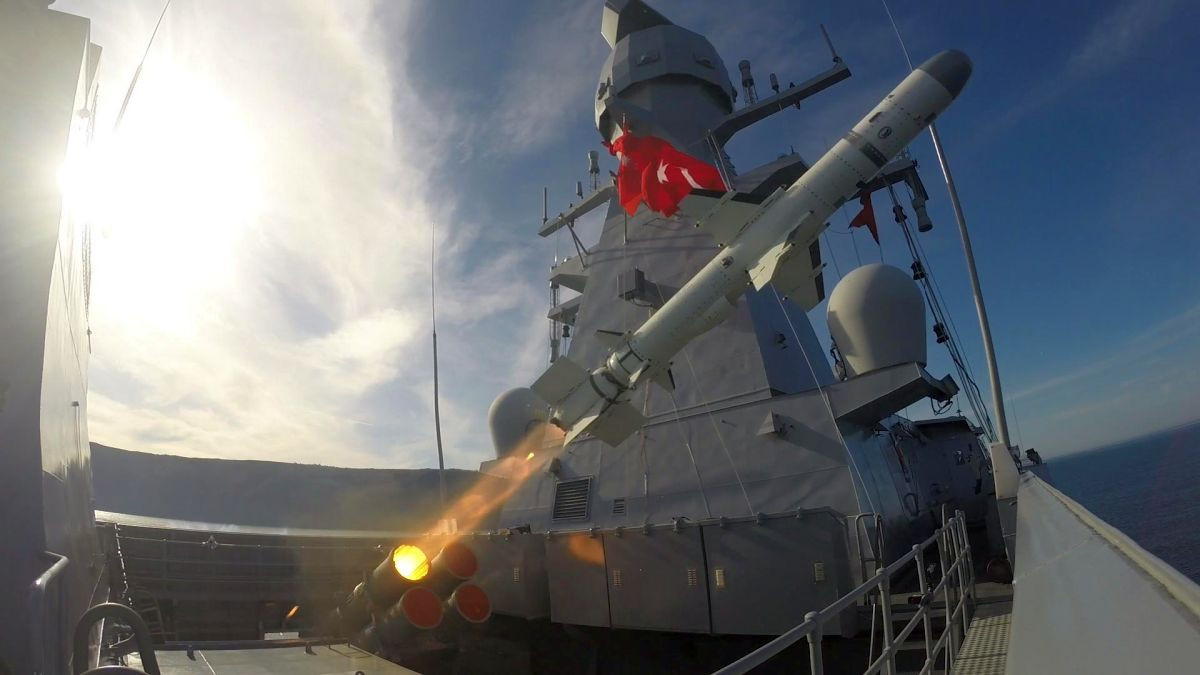
ATMACA and the Exocet MM40 Block 3 occupy the same bracket of the anti-ship missile market. Roketsan publishes 250 km range, a 220 kg warhead and a terminal seeker combining imaging infra-red with radio frequency guidance. MBDA describes the MM40 Block 3c as a 250 km class weapon built around a new-generation J-band active coherent seeker.
The dividing line is not range. Exocet is the latest link in a fifty-year family matured across many navies; ATMACA is a newer system designed from the outset as a multi-platform family with a domestic supply chain behind it.
Two missiles, one bracket
Anti-ship warfare has asked the same expensive question for forty years: how does a frigate hit something it cannot see? The answer has stayed remarkably stable — a low-flying cruise missile with a small radar cross-section that finds the target with its own seeker in the last stretch. The most recognisable expression of that formula is the French Exocet. Türkiye’s answer is ATMACA.
Put the two side by side and the first surprise is how close they read. Roketsan gives 250 km. MBDA advertises a “250 km class operational range.” The DGA fact sheet for the same French missile says “max. range: 200 km +.” That is not an error; it is what happens when a manufacturer publishes the best case and a procurement agency publishes the guaranteed one. Range depends on launch altitude, cruise profile, waypoint count and the terminal manoeuvre — which is precisely why it is the wrong row to judge these weapons on.
What the manufacturers actually publish
ATMACA — Roketsan
Roketsan is unusually forthcoming. The English catalogue lists 5.2 m length, 750 kg weight, 370 mm diameter and a 220 kg high-explosive blast-fragmentation warhead with effective penetration. The product page widens the length to a 4.3–5.2 m band, pointing to different launcher and platform configurations.
Guidance runs in two layers. In cruise, an inertial navigation system works alongside anti-jam satellite navigation, a barometric altimeter and a radar altimeter. That last item matters more than it sounds: it sets how close to the sea surface the missile flies, and therefore how late the target’s radar sees it. In the terminal phase the catalogue names an imaging infra-red seeker together with a radio frequency seeker, while the product page lists the seeker simply as “Active RF.” Both official readings are shown in the table below rather than reconciled.
The most telling line, though, is the platform list: naval platforms, submarine platforms, a fifth generation fighter jet, tactical wheeled land platforms and a fixed launcher. ATMACA is not described as a shipboard missile that might later be adapted. It is described as a family from the start — KARA ATMACA for the land-based role, AKATA for submarine launch, the latter already in Turkish service with a range Roketsan puts beyond 250 km.
Only figures published by the manufacturers and official agencies were used here. Where a row reads “not published in official sources,” that does not mean the capability is absent — only that no verifiable public figure exists. No estimates were substituted.
Exocet MM40 Block 3c — MBDA
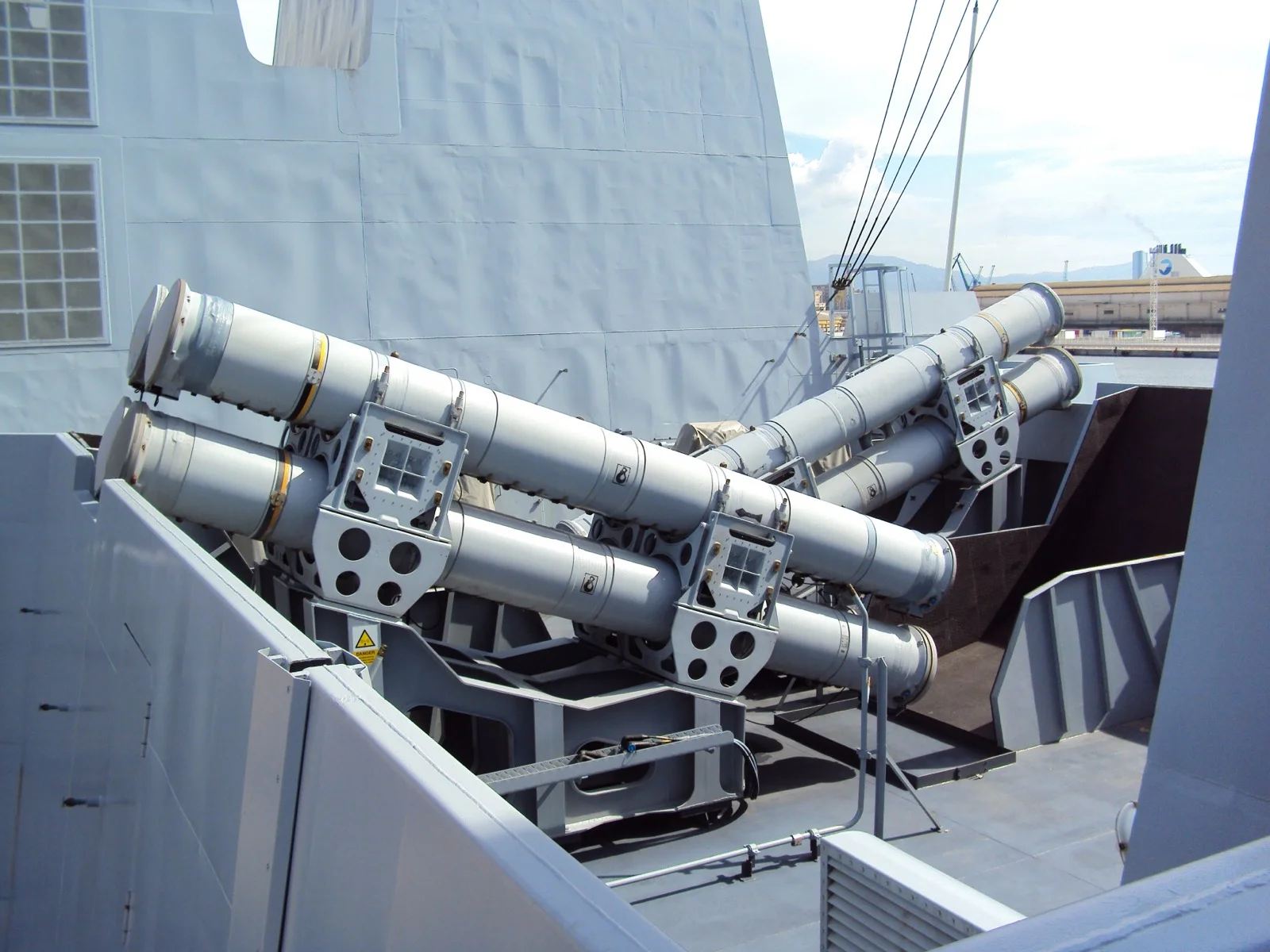
MBDA calls Block 3c “the latest generation ship-borne variant within the EXOCET family” and an all-weather maritime superiority system with land attack capability. The headline technical claim is the seeker: a new-technology J-band active coherent seeker with adaptive search patterns, improving detection, selectivity and ECCM at once.
The word “coherent” carries weight. A coherent seeker exploits the phase of the returned signal, not just its strength, which makes separating a real hull from a jammer or a decoy considerably easier. Naval News reported MBDA describing improved EW resilience and accuracy as the biggest difference from Block 3, with deliveries to the French Navy already under way and the first realistic-scenario firing conducted by the air-defence FREMM Alsace.
The DGA fact sheet supplies the dimensions: 6 m long, 0.5 m in diameter, one-tonne class, high subsonic. The ministry’s own web page lists 780 kg, 350 mm and under 6 m for the same weapon — most likely the difference between a round measured with and without its canister and booster. Both official values appear in the table.
MBDA also stresses something no datasheet number captures: Block 3c’s launcher and mission planning installation remain interoperable with Block 3, and it shares the same logistics support assets. For a navy already operating Exocet, the upgrade does not touch the ship. That is the compound interest of a fifty-year family.
Where the mission concepts diverge
Technically the two weapons speak the same language: low-altitude cruise, active radar terminal guidance, 3D waypoint planning, land attack capability and coordinated multi-missile arrival. That convergence is the modern anti-ship grammar, and both designs sit inside it.
The first real divergence is seeker architecture. Roketsan’s catalogue pairs an imaging infra-red channel with a radio frequency channel; MBDA builds Block 3c around a single but state-of-the-art radar seeker. A dual-mode seeker offers a second way of seeing when the radar channel is contested. A mature single-mode seeker brings decades of threat libraries and software refinement. They manage different risks from different directions — not one being better than the other.
The second is how multi-platform capability is achieved. In the Exocet family each platform is a separate product: AM39 from the air, SM39 and the newly unveiled SM40 from submarines, MM40 from ships, plus a coastal defence system. That is fifty years of layering. ATMACA writes multi-platform use into a single product description instead, trading proven variant diversity for shared infrastructure economics.
The third is maturity, and it is the one Türkiye cannot shortcut. Exocet has been fired in combat, maintained across many fleets, and had its faults found and fixed. MBDA lists “combat proven” first among its operational advantages, and that is more than marketing — knowing how a weapon behaves in real conditions is data no laboratory produces. ATMACA is still accumulating it.
Technical comparison
| Criterion | ATMACA | Exocet MM40 Block 3 / 3c |
|---|---|---|
| Class | Anti-ship cruise missile, also usable against fixed land targets (Roketsan) | Maritime superiority missile system with land attack capability (MBDA) |
| Manufacturer / country | Roketsan (Türkiye) | MBDA (France) |
| Declared range | 250 km (Roketsan) | 250 km class (MBDA) · 200 km + (DGA) |
| Length | 5.2 m (catalogue) · 4.3–5.2 m (product page) | 6 m (DGA fact sheet) · < 6 m (ministry page) |
| Diameter | 370 mm (Roketsan) | 0.5 m (DGA fact sheet) · 350 mm (ministry page) |
| Weight | 750 kg (catalogue) · < 750 kg (product page) | one-tonne class (DGA fact sheet) · 780 kg (ministry page) |
| Warhead | 220 kg high-explosive, blast fragmentation, effective penetration (Roketsan) | Not published in official sources |
| Mid-course guidance | INS + anti-jam GNSS + barometric and radar altimeter (Roketsan) | Inertial navigation; GPS for land targets (DGA) |
| Terminal seeker | Imaging infra-red seeker + radio frequency seeker (catalogue) · “Active RF” on the product page (Roketsan) | New-technology J-band active coherent seeker with adaptive search patterns (MBDA) |
| Speed | Not published in official sources | High subsonic (DGA) |
| Propulsion | Not published in official sources | Not published in official sources |
| Flight profile | Low-altitude cruise; 3D mission planning (Roketsan) | Sea-skimming; 3D waypoints and optimised trajectories (MBDA/DGA) |
| Firing modes | Time on Target, Designated ToT, Simultaneous ToT, ripple/salvo (Roketsan) | Simultaneous terminal attacks of multiple missiles (MBDA) |
| Data link | Target update, re-attack and mission abort (Roketsan) | No separate data link heading in the official sheet; fire-and-forget is emphasised (DGA) |
| Declared platforms | Naval, submarine, fifth generation fighter, tactical wheeled land platform, fixed launcher (Roketsan) | FREMM, FDA/Horizon and FDI first-rank frigates; wide range of naval platforms (MBDA/DGA) |
| Family members | KARA ATMACA (land-based cruise missile), AKATA (submarine-launched, 250+ km) (Roketsan) | AM39 (air), SM39/SM40 (submarine), MM40 (ship), coastal defence system (MBDA) |
| Known operators | Turkish Navy; first launch from TCG Kınalıada (Roketsan) | French Navy; Greece ordered 16 MM40 Block 3c in April 2025 (DGA / Naval News) |
| Service maturity | New-generation system; serial production and fielding under way | Exocet family in service since the 1970s; Block 3c delivered from 2024 |
All figures are taken from documents published by the manufacturers and official agencies. Where two official sources give different values for the same item, both are shown.
Operators and the operational picture
Exocet’s customer base is broad and current. The DGA states that MM40 Block 3c will equip the French Navy’s FREMM, FDA/Horizon and FDI first-rank frigates, and Naval News reported an additional French order in April 2024. In April 2025 Greece signed an intergovernmental agreement with France for 16 MM40 Block 3c rounds — with land attack capability — for the final pair of Roussen-class fast attack craft, HS Karathanasis (P78) and HS Vlachakos (P79), at an estimated €33 million.
ATMACA’s declared operator is the Turkish Navy. Roketsan says the missile integrates with assault boats, corvettes and frigates, and that the first national anti-ship firing came from TCG Kınalıada. Add KARA ATMACA and AKATA and the result is less a single anti-ship missile than a strike family built around a common airframe.
Both systems are therefore present in the Eastern Mediterranean. The framing matters, though: an anti-ship missile does not settle an equation by itself. Something has to find the target, classify it and pass the track to the missile in time — maritime patrol aircraft, unmanned systems, satellites, electronic support measures and a combat management network. Any comparison that stops at the missile stops too early.
Where each system plays to its strengths
- ATMACA — freedom of use: a domestically produced round leaves target selection, rules of engagement and stockpile management outside third-party approval.
- ATMACA — one munition, many launchers: ship, submarine, land vehicle and fixed launcher share training and logistics infrastructure.
- ATMACA — contested EW environments: the catalogue’s IIR plus RF terminal pairing offers a second way of seeing when the radar channel degrades.
- Exocet — upgrade without re-equipping: Block 3c is interoperable with existing Block 3 launchers, mission planning and logistics.
- Exocet — maturity and combat record: a fifty-year family across many navies delivers operational predictability.
- Exocet — allied interoperability: wide NATO adoption creates economies of scale in training and resupply.
Limits of this comparison
The sharpest limit is asymmetry of disclosure. Roketsan publishes warhead weight, diameter and seeker architecture; MBDA and the DGA publish neither a warhead figure nor a propulsion type for Block 3c. Several rows are therefore one-sided, and nothing should be inferred from them.
The second limit is that official sources disagree with each other on the same weapon — Exocet’s mass is one-tonne class on the DGA sheet and 780 kg on the ministry page; ATMACA’s length is 5.2 m in the catalogue and a 4.3–5.2 m band on the product page. Reducing either to a single number would misrepresent the source.
The third is that none of the public material addresses the parameters that actually decide outcomes: probability of hit, performance against specific countermeasures, or effectiveness by target class. Those are classified, so any open comparison necessarily stays at the level of declared capability.
What it means for Türkiye
ATMACA’s significance runs wider than one missile entering service. Building an anti-ship cruise missile means making cruise guidance, a radar altimeter, a terminal seeker, a warhead and mission planning software work as one chain — and few countries close that chain domestically.
It also matters that the family was designed as a family. KARA ATMACA and AKATA extend the same airframe to land-based strike and submarine launch, spreading development cost and concentrating training and resupply on a single line — reaching by design the place Exocet reached variant by variant over five decades.
Finally there is the link to indigenous ships. The striking power of MILGEM corvettes, I-class frigates and fast attack craft depends on what they carry. A nationally built hull does not deliver freedom of action while the weapon rack remains imported. ATMACA closes that side of the equation — and in a theatre where several navies field missiles of the same range class, the decisive variable is increasingly the reconnaissance and electronic warfare network feeding them, not the round itself.
Assessment
Asking which of ATMACA and the Exocet MM40 Block 3 is better would mean going past what open sources support. Both operate in the same range class, with the same flight logic and a similar mission description; the published data does not allow a meaningful ranking.
The divergence is one of use case. Exocet offers predictability: a fifty-year lineage, a wide operator base and an upgrade path that leaves the ship untouched, with Block 3c’s J-band seeker as the family’s newest answer to electronic warfare. ATMACA builds a different equation around a multi-platform airframe, a dual-channel terminal seeker and a domestic supply chain.
Judged by what operators actually buy, the two answer different mission concepts — one the latest increment of a standard shared across an alliance, the other a new line built on freedom of use and family coherence. At sea, what usually decides the engagement is not the missile but the network that points it at the right target.
Do ATMACA and Exocet MM40 Block 3 have the same range?
On paper they sit in the same bracket. Roketsan publishes 250 km for ATMACA. MBDA describes the Exocet MM40 Block 3c as having a “250 km class operational range.” Yet the French defence procurement agency DGA lists “max. range: 200 km +” for the same missile on its official fact sheet. Two official sources, two different figures — a reminder that anti-ship missile range depends on launch geometry, cruise profile and the number of waypoints flown.
Which platforms can launch ATMACA?
Roketsan’s English product catalogue lists naval platforms, submarine platforms, a fifth generation fighter jet, tactical wheeled land platforms and a fixed launcher. The product page adds that the missile integrates with assault boats, frigates and corvettes. Two named family members exist: KARA ATMACA, the land-based surface-to-surface variant, and AKATA, the submarine-launched version that Roketsan says is already in Turkish Armed Forces service with a range exceeding 250 km.
What changed between Exocet Block 3 and Block 3c?
The seeker. MBDA’s datasheet describes a new-technology J-band active coherent seeker with adaptive search patterns, delivering better detection, target selectivity and ECCM. Crucially, the launching system and mission planning installation remain interoperable with the existing MM40 Block 3, so navies can upgrade without re-equipping the ship. The DGA qualified and began delivering the new version in 2024.
Which missile has the heavier warhead?
This row stays one-sided. Roketsan publishes a 220 kg high-explosive, blast-fragmentation warhead with effective penetration for ATMACA. Neither MBDA’s Block 3c datasheet nor the DGA fact sheet publishes a warhead figure for the Exocet. No estimate was substituted for the missing number.
Can both missiles strike land targets?
Yes, and both manufacturers state it openly. Roketsan defines ATMACA’s target set as “moving/fixed maritime systems, fixed ground based targets.” MBDA positions the MM40 Block 3c as a maritime superiority system “with land attack capability,” and the DGA fact sheet attributes that capability to GPS guidance. It reflects a shared shift in the anti-ship missile class over the past two decades.
Who operates these missiles today?
The DGA says the MM40 Block 3c will equip the French Navy’s FREMM, FDA/Horizon and FDI first-rank frigates; France placed an additional order in April 2024. In April 2025 Greece signed an intergovernmental agreement worth roughly €33 million for 16 MM40 Block 3c rounds destined for the last two Roussen-class fast attack craft. ATMACA’s declared operator is the Turkish Navy, with the first national anti-ship missile launch conducted from the corvette TCG Kınalıada.
Related coverage
Compare more systems side by side
Every comparison in this series is built only from manufacturer and official-agency sources, with unpublished figures left blank rather than estimated.
Sources and verification note
- Roketsan — ATMACA Anti-Ship Missile official product page — Range, length, weight, warhead, guidance architecture, firing modes and data link functions
- Roketsan — ATMACA Anti-Ship Missile product catalogue (PDF, 2024) — 250 km range, 5.2 m length, 750 kg weight, 370 mm diameter, 220 kg warhead, IIR + RF terminal seeker and the full platform list
- MBDA — EXOCET MM40 BLOCK 3c datasheet (PDF, 2024) — 250 km class operational range, J-band active coherent seeker, 3D waypoints and simultaneous terminal attacks by multiple missiles
- French Ministry of the Armed Forces / DGA — EXOCET MM40 Block 3c fact sheet — 6 m length, 0.5 m diameter, one-tonne class mass, high subsonic speed, 200 km + maximum range and FREMM/FDI deployment
- Naval News — “Exocet MM40 Block 3c: New anti-ship missile with next generation seeker” (September 2024) — What the J-band seeker changes versus Block 3; start of deliveries to the French Navy and the first firing from the FREMM DA Alsace
- Naval News — “Greece Orders Exocet MM40 Block 3C Anti-Ship Missiles” (April 2025) — 14 April 2025 intergovernmental agreement: 16 missiles for Roussen-class P78 and P79, estimated at €33 million
Only manufacturer (Roketsan, MBDA), official agency (DGA / French Ministry of the Armed Forces) and international defence-press sources were used. No estimates were substituted for unpublished figures; those rows are marked explicitly.
Editor’s note: This article is a mission-concept comparison, not a ranking. The two missiles reflect different procurement logics and different levels of operational maturity. Technical data reflects official open sources as of publication; programme status and variant details may change.