KAAN vs KF-21 Boramae: Full Technical Comparison of Two Indigenous Fighter Programs
Summary Not Found.
Turkey’s TAI KAAN and South Korea’s KAI KF-21 Boramae are the two most ambitious indigenous fighter programs to emerge outside the established superpowers. KAAN aims for a true fifth-generation stealth platform, while the KF-21 is a 4.5-generation aircraft with a clear path to greater stealth. We compare design philosophy, sensors, weapons, and industrial maturity.
2 × General Electric F110-GE-129 (~29,000 lbf each w/ AB)
2 × GE F414-GE-400K (~22,000 lbf each w/ AB)
Max takeoff weight
~34,750 kg
~25,600 kg
Top speed
Mach 1.8
Mach 1.8
Radar
ASELSAN MURAD AESA
Hanwha APY-016K AESA (~1,000 T/R modules)
Air-to-air weapons
GÖKDOĞAN BVR & BOZDOĞAN WVR (internal bay)
Meteor, AIM-120, AIM-9 (external, IWB in Block III)
Stealth
Native low-observable, internal weapons bays
Reduced signature, semi-stealth airframe
First flight
February 2024
July 2022
Status / production
Prototype phase; first Turkish order of 20 (2026)
Serial production rollout March 2026; combat-suitable May 2026
Firepower and Weapons
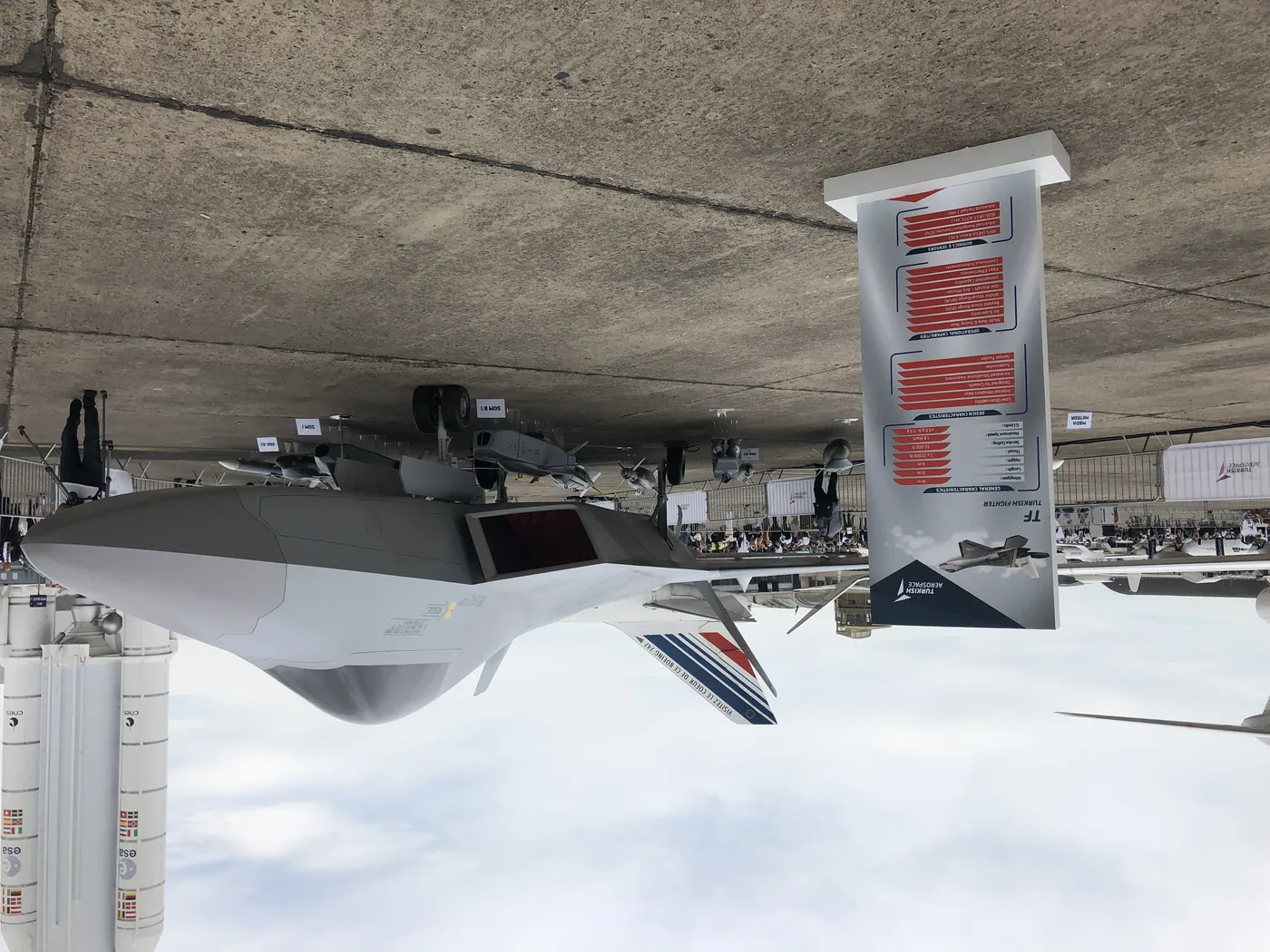
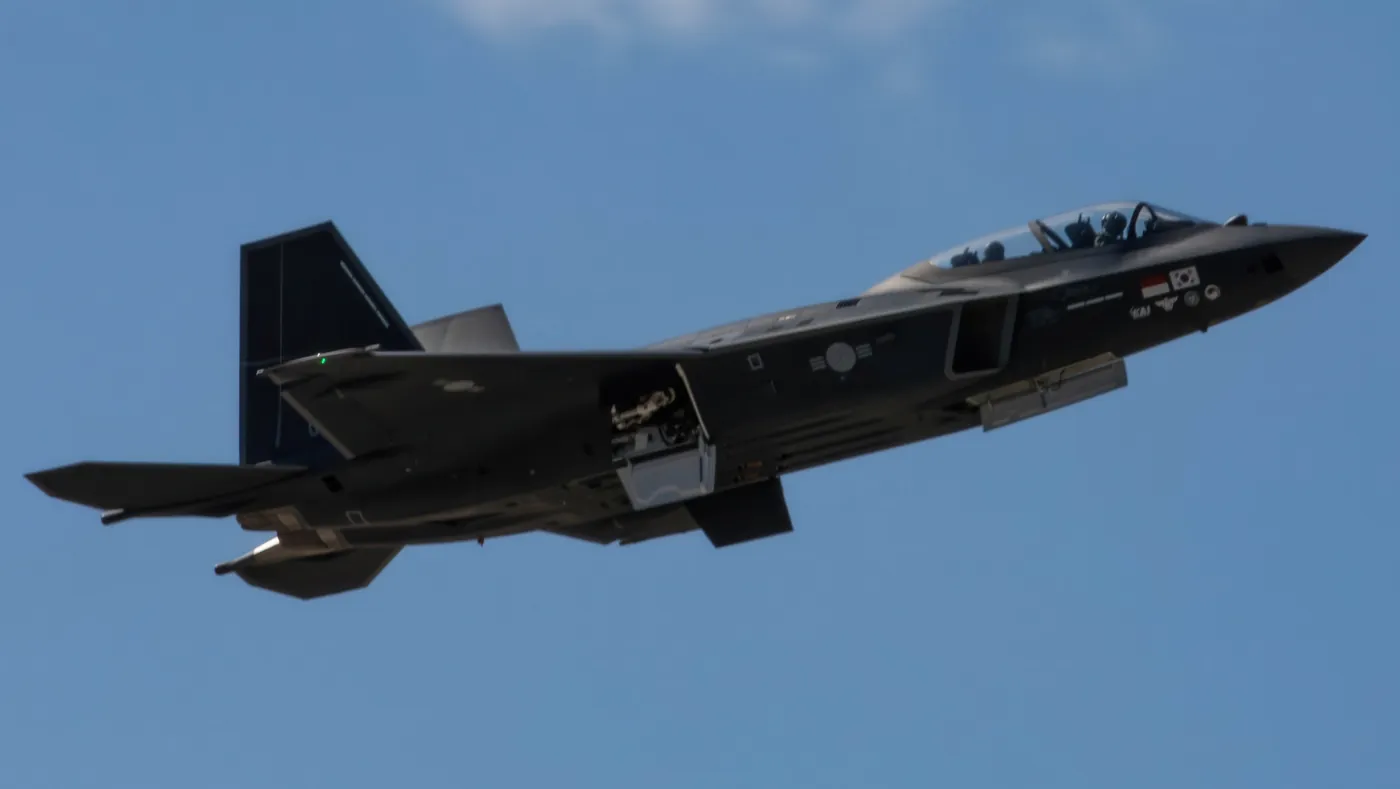
KAAN — CC BY-SA 4.0KF-21 Boramae — Public domain
The KF-21 enjoys a meaningful maturity edge here. Following its first flight in July 2022, the type achieved a serial-production rollout in March 2026 and received Final Combat Suitability approval from South Korea’s DAPA in May 2026. It has live-fired the ramjet-powered Meteor BVR missile and integrates AIM-120 AMRAAM and IRIS-T, with a clear roadmap toward internal weapons carriage in later blocks. Its weapons integration is well advanced toward operational service.
KAAN is designed to carry indigenous ROKETSAN GÖKDOĞAN (BVR) and BOZDOĞAN (WVR) missiles plus the SOM-J cruise missile from internal bays that preserve its radar signature, with combined internal and external payload targeted above 18,000 lb — comparable to Western stealth fighters. The architecture is more ambitious, but it remains in integration and flight test rather than approaching combat clearance.
Sensors and Avionics
Both programs field domestically developed AESA radars, marking a major sovereign-capability milestone for two NATO-aligned nations. The KF-21’s Hanwha APY-016K carries roughly 1,000 transmit/receive modules, detects targets out to 150-200 km, and tracks more than 20 contacts simultaneously; the first mass-produced unit rolled off the line in August 2025, underscoring its production maturity.
KAAN will carry ASELSAN’s MURAD AESA, offering automatic target recognition, multi-target tracking, ground mapping, and electronic-warfare functions, paired with fifth-generation sensor fusion and an open architecture built for manned-unmanned teaming with Baykar’s Kızılelma and the ANKA-3. Conceptually KAAN’s mission-systems target is higher, but the KF-21’s sensor suite is closer to fielded reality today.
Survivability and Stealth
This is where the two diverge most sharply. KAAN is a clean-sheet low-observable design — aligned planforms, internal weapons bays, and radar-absorbent materials — pursuing a genuinely reduced radar cross-section and the first-look, first-shot advantage characteristic of fifth-generation aircraft.
The KF-21 deliberately took a lower-risk path: a semi-stealth airframe with reduced frontal signature and, initially, external weapons carriage. South Korea’s roadmap envisions internal bays and greater low-observability in future blocks, but in its current form the KF-21 is a 4.5-generation aircraft, conceptually a step behind KAAN’s stealth-first philosophy while being considerably more mature.
Cost, Export and Industrial Maturity
From a NATO procurement and export standpoint, both aircraft are positioned as alternatives to US- and European-origin platforms with fewer political constraints. The KF-21 holds the industrial lead: it has crossed into serial production, with an initial 40 Block I aircraft on order for the Republic of Korea Air Force, a maturing supply chain, and Indonesia involved as a development partner — though Jakarta’s cost-share commitment has been a recurring point of friction.
KAAN is earlier on the curve, with Turkey signing its first 20-aircraft contract in May 2026 and Indonesia expressing interest in up to 48. Its at-scale unit cost and supply chain are not yet settled, and it depends near-term on the US F110 engine until the indigenous TRMotor/TEI powerplant matures around 2029-2030. Both carry program risk, but KAAN’s is higher given its more advanced — and therefore less proven — stealth design.
Alliance and Strategic Context
For NATO planners and export customers, both jets answer the same strategic problem: securing modern airpower without full dependence on Washington or major European primes. South Korea has explicitly framed the KF-21 as an exportable multirole fighter for air forces seeking capability outside traditional supplier constraints, leveraging a robust domestic defense-industrial base.
KAAN sits at the heart of Turkey’s drive for air-superiority sovereignty after its removal from the F-35 program, integrating an indigenous radar, missiles, and engine effort under TAI. For nations weighing fifth-generation capability with technology transfer, KAAN offers a compelling — if longer-horizon — proposition, while the KF-21 offers a nearer-term, lower-risk indigenous-class option.
Operating Nations
System
Operators
KAAN
Türkiye (ordered); Indonesia (interest)
KF-21 Boramae
South Korea (ordered); Indonesia (development partner)
Verdict
The KF-21 Boramae leads today on maturity, having reached serial production and combat-suitability approval, scoring 46/100 against KAAN’s 39/100. KAAN holds a clear edge in fifth-generation stealth and mission-systems ambition, but its advantage will only translate to the field once development is complete and the aircraft enters volume production.
Frequently Asked Questions
Which is better, the KAAN or the KF-21 Boramae?
Right now the KF-21 is the more capable option because it has reached serial production and received combat-suitability approval, while KAAN remains in prototype testing. KAAN is more ambitious in stealth and fifth-generation systems, but that advantage is not yet operationally proven.
Is the KAAN a true stealth fighter?
Yes. KAAN is a clean-sheet fifth-generation low-observable design with internal weapons bays, aligned planforms, and radar-absorbent materials. The KF-21 is a 4.5-generation aircraft with a semi-stealth airframe and a roadmap toward greater stealth in later blocks.
Are both fighters export-oriented?
Yes. Both South Korea and Turkey position their jets as indigenous alternatives to US and European fighters with fewer political constraints. Indonesia is involved with both programs — as a KF-21 development partner and a potential KAAN customer.
What radar does each fighter use?
KAAN carries the ASELSAN MURAD AESA, while the KF-21 uses the Hanwha APY-016K AESA with roughly 1,000 transmit/receive modules and a detection range of 150-200 km. Both are domestically developed, a major milestone for each nation.
When did each aircraft first fly?
The KF-21 Boramae first flew in July 2022 and reached serial-production rollout in March 2026. KAAN made its maiden flight in February 2024 and remains in the prototype and flight-test phase.