The T129 ATAK and the AH-64 Apache sit at opposite ends of the attack-helicopter spectrum. One is an agile, mountain-bred medium gunship that has quietly racked up export wins; the other is the heavyweight, deep-strike standard that allied armies have flown for four decades. From a NATO and procurement standpoint, we break the matchup down across eight dimensions.
Score Breakdown
| Criterion | T129 ATAK | AH-64 Apache |
|---|
| Operational Success | 8/10 | 10/10 |
| Combat Experience | 7/10 | 10/10 |
| Technology Level | 8/10 | 9/10 |
| Export Success | 6/10 | 10/10 |
| Operator Count | 5/10 | 10/10 |
| Upgrade Potential | 8/10 | 9/10 |
| Production Status | 7/10 | 10/10 |
| Cost-Effectiveness | 8/10 | 4/10 |
| Total | 72.0 | 92.6 |
Technical Comparison Table
| Specification | T129 ATAK | AH-64 Apache |
|---|
| Class | Medium twin-engine attack helicopter | Heavy twin-engine attack helicopter |
| Max takeoff weight | ~5,065 kg | ~10,400 kg (AH-64D/E) |
| Engines | 2 x LHTEC CTS800-4A (~1,373 shp each) | 2 x GE T700-701D (~2,000 shp each) |
| Max / cruise speed | ~281 km/h | ~293 km/h |
| Primary cannon | 20 mm three-barrel Gatling gun | 30 mm M230 chain gun (~1,200 rounds) |
| Anti-tank missile | Up to 8 x UMTAS (160 mm, ~8 km) | Up to 16 x AGM-114 Hellfire (~8 km) |
| Sensor suite | ASELSAN ASELFLIR-300T EO/IR | AN/APG-78 Longbow radar + M-TADS/PNVS |
| First flight / service | First flight 2009; in service 2014 | First flight 1975; in service 1986 |
| Maker | Turkish Aerospace (with Leonardo) | Boeing (USA) |
Firepower and Payload
Sensors and Avionics
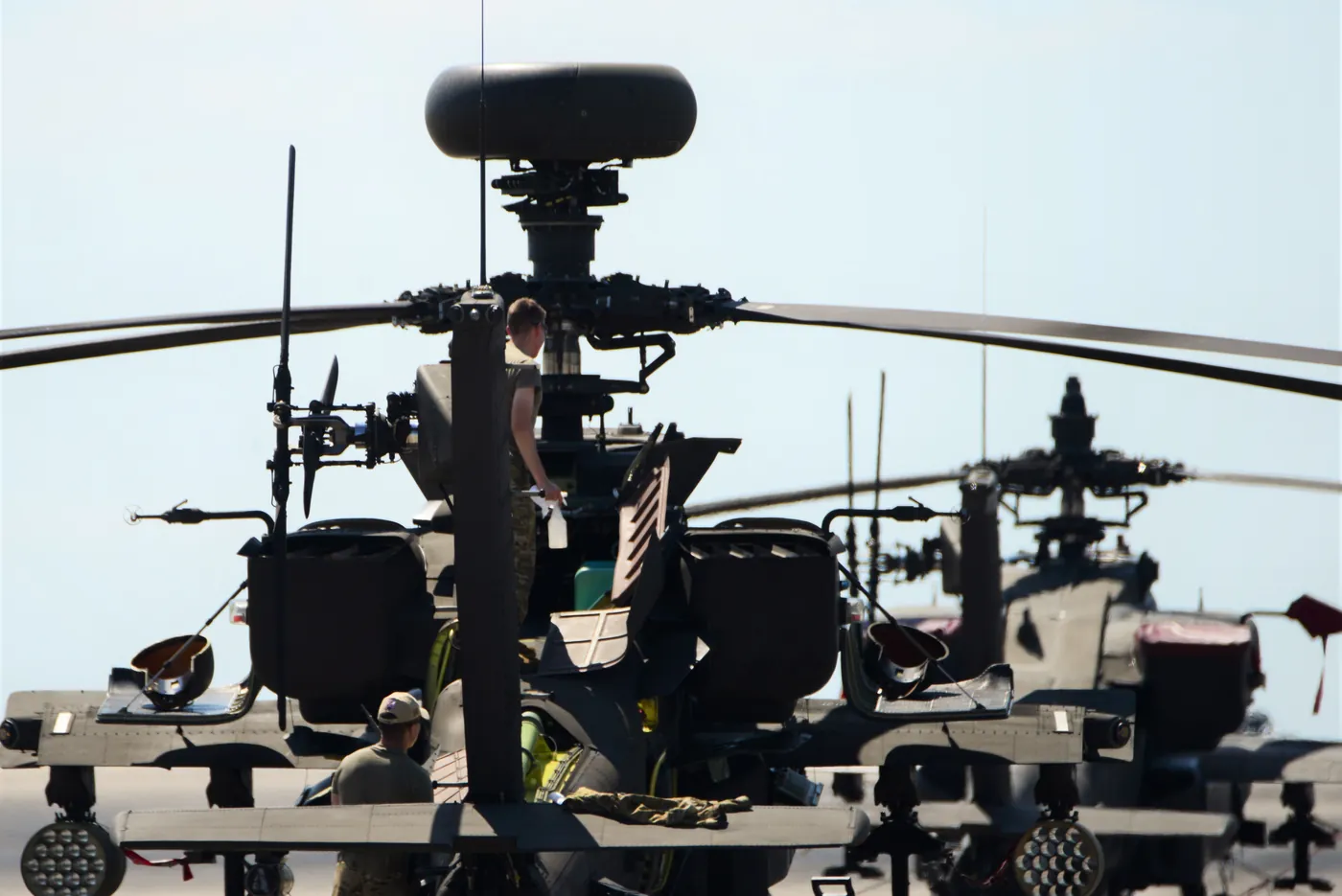
The AH-64E sets the avionics standard with its AN/APG-78 Longbow millimetre-wave fire-control radar, mast-mounted on the D/E, allowing fire-and-forget engagement of multiple targets in obscured conditions, plus advanced datalinks and manned-unmanned teaming with drones. This networked, radar-cued capability is a generational advantage in high-intensity warfare.
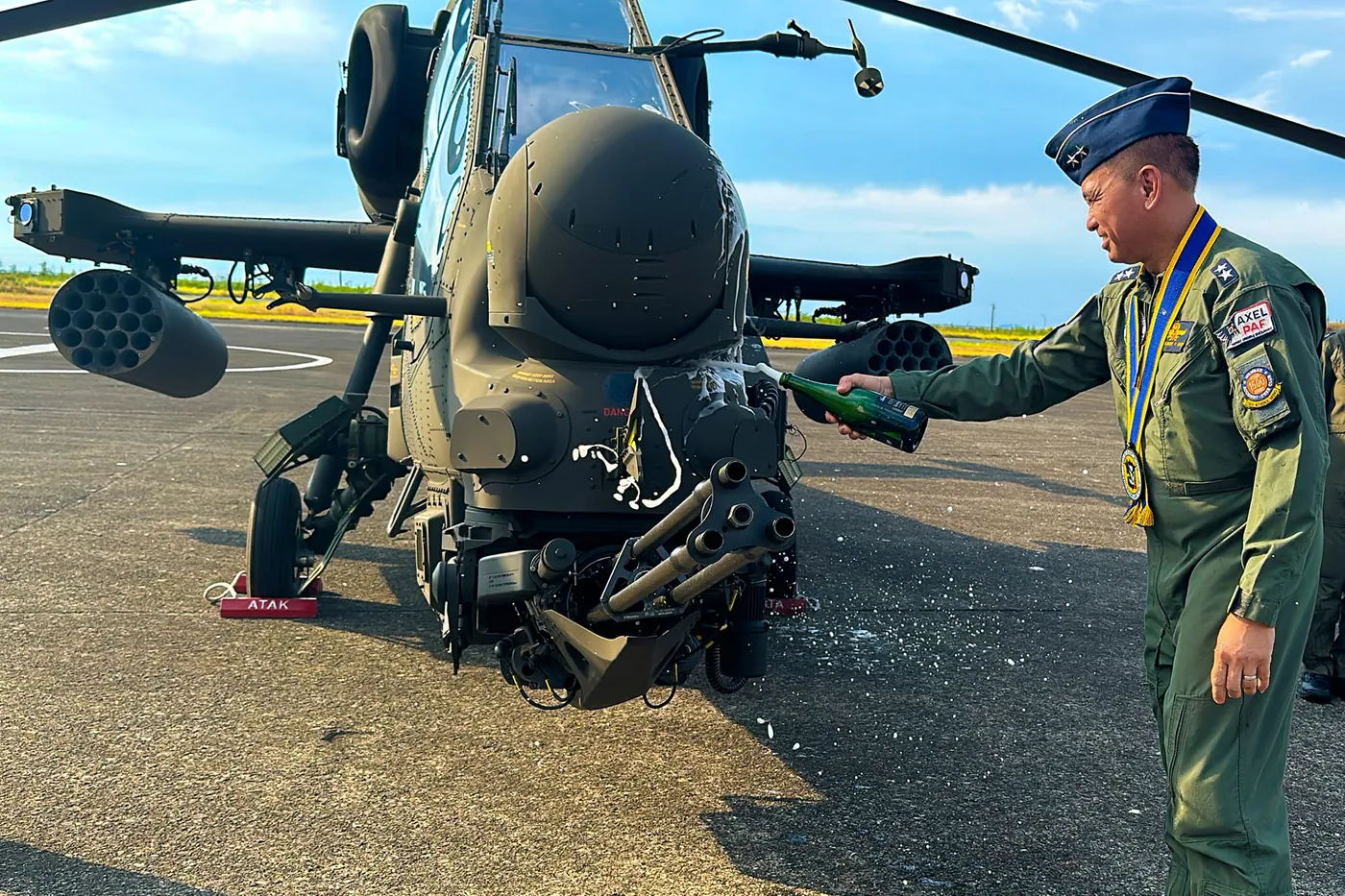
The T129 relies on ASELSAN’s indigenous ASELFLIR-300T electro-optical/infrared targeting system and a modern glass cockpit, which deliver excellent day/night precision against point targets. It is a highly capable EO/IR sensor package, but the standard T129 lacks an integrated fire-control radar of the Longbow’s class, so in degraded-visibility, multi-target engagements the Apache retains the edge.
Survivability and Agility
Here the T129 turns its size into a virtue. Derived from the A129 Mangusta and optimised for Turkiye’s high-altitude, hot-climate eastern theatre, it offers outstanding hot-and-high performance, tight manoeuvrability and a small signature that suits mountain and counter-insurgency operations. Its agility and low operating footprint make it survivable in terrain where a heavier platform is constrained.
The Apache brings brute survivability: redundant systems, armoured crew stations, crashworthy design and decades of combat-proven resilience under fire across multiple theatres. Where the T129 survives by being nimble and hard to hit, the Apache survives by absorbing damage and fighting on — two valid philosophies matched to different mission sets and threat environments.
Cost, Exports and NATO Relevance
From a procurement angle the T129 is the value proposition. Lower acquisition and operating costs, combined with a NATO-interoperable design, have won it real export contracts — six aircraft each to the Philippines and Nigeria, with further interest elsewhere — positioning it as an affordable gunship for nations that do not need, or cannot fund, a heavy platform. Its main historical constraint has been the US-origin LHTEC engine’s export-licence sensitivity, which the indigenous TS1400 programme aims to resolve.
The Apache is the established alliance standard, fielded by the US Army and a long roster of NATO and partner operators including the UK, the Netherlands, Greece, Saudi Arabia, Japan and India, with more than 2,400 built and an unmatched global logistics and upgrade ecosystem. It costs far more to buy and run, but for high-end armoured warfare and coalition interoperability it remains the benchmark. In short: the Apache is the proven heavyweight standard, while the T129 is the agile, export-friendly challenger that delivers most of the capability for a fraction of the cost.
Operating Nations
| System | Operators |
|---|
| T129 ATAK | Turkiye, Philippines, Nigeria (further export campaigns ongoing) |
| AH-64 Apache | United States, United Kingdom, Netherlands, Greece, Saudi Arabia, UAE, Egypt, Japan, India and others |
Verdict
On firepower, sensors, combat record and operator base, the AH-64 Apache is the clear overall leader (roughly 90/100), and for high-intensity armoured warfare it remains the standard. The T129 ATAK (roughly 71/100) cannot match the Apache’s mass or Longbow radar, but its agility, hot-and-high performance, lower cost and growing export success make it the smarter buy for many medium-tier and mountain-warfare operators.
Frequently Asked Questions
Which is better, the T129 ATAK or the AH-64 Apache?
For raw firepower, sensor reach and high-intensity warfare the AH-64 Apache is superior, with more missiles, a 30 mm cannon and the Longbow fire-control radar. The T129 ATAK is lighter and cheaper but excels in agility, hot-and-high performance and affordability, making it the better fit for medium-tier and mountainous-terrain operators.
How do their anti-tank missiles compare?
Both have roughly 8 km reach: the Apache carries up to sixteen AGM-114 Hellfire missiles, while the T129 carries up to eight indigenous UMTAS missiles plus sixteen laser-guided Cirit missiles, trading total quantity for a flexible, cost-efficient mix.
Does the T129 ATAK have a fire-control radar?
The standard T129 relies on ASELSAN’s ASELFLIR-300T electro-optical/infrared targeting system rather than a millimetre-wave fire-control radar, so the radar-equipped AH-64D/E retains an edge in obscured, multi-target engagements.
Which countries operate the T129 ATAK?
Turkiye operates the largest fleet, with export deliveries completed to the Philippines and Nigeria (six aircraft each) and additional export campaigns under way.
Why is the T129 cheaper to operate than the Apache?
It is a lighter, medium-class twin-engine helicopter with a smaller weapons load and logistics footprint, whereas the Apache is a heavyweight platform with higher acquisition, fuel and maintenance costs — the trade-off for its greater payload and combat-proven survivability.
Sources
▶ 5 platformu karşılaştırın →