Spanish F-18 Jets Scramble 36 Times Over Romania in 3 Months

Spain’s fighter detachment in Romania has scrambled on a real threat 36 times in three months on NATO’s Black Sea flank, a rate of roughly one live intercept mission every three days. Spain’s Defence Staff (EMAD) released the figures to mark three months of the current deployment.
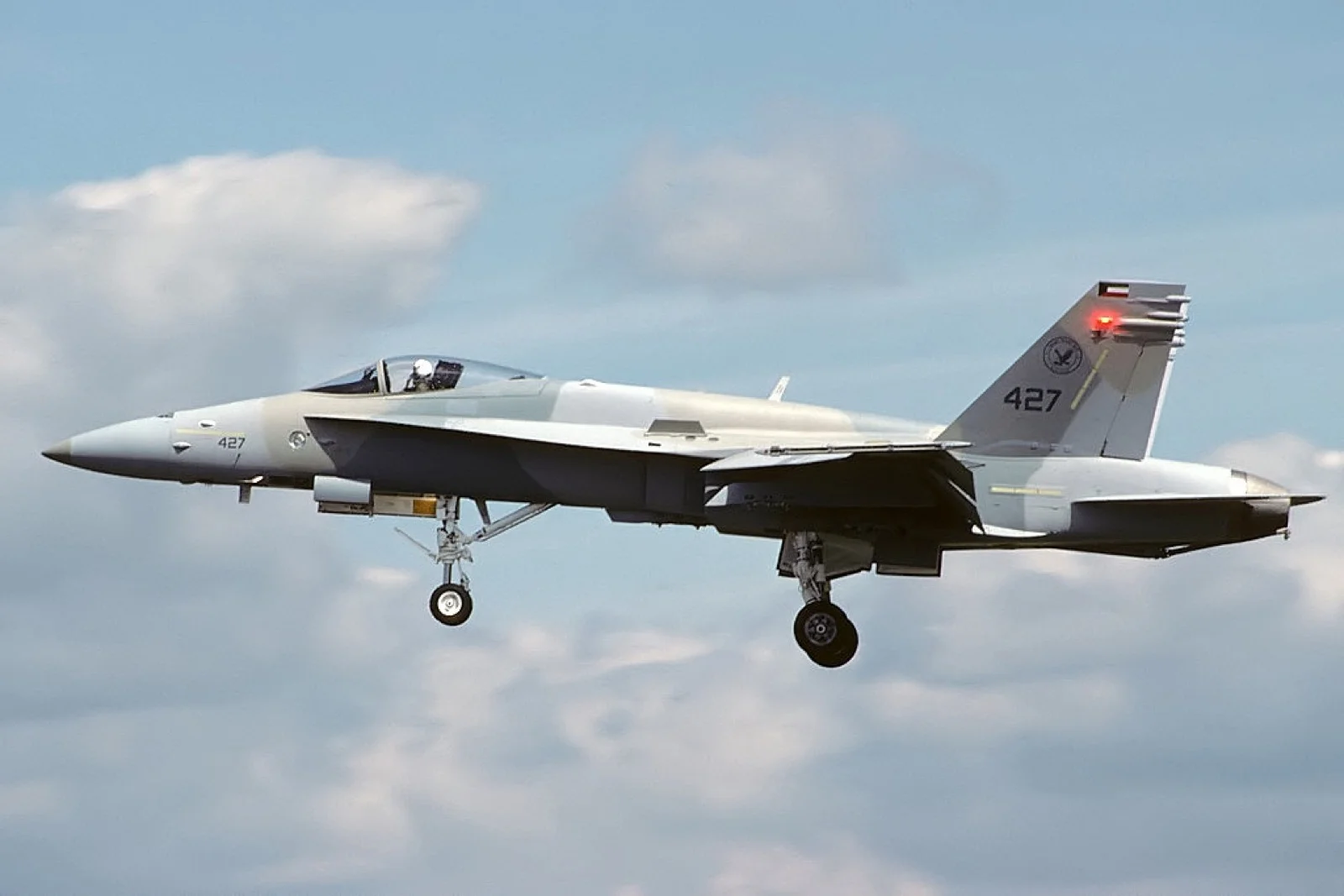
The “Paznic” detachment, run by the Spanish Air and Space Force, has been based at Mihail Kogălniceanu air base on Romania’s Black Sea coast since August 2026. It fields six EF-18M fighters from Wing 12 at Torrejón de Ardoz, three NH90 helicopters and roughly 200 personnel.
Under NATO’s enhanced Air Policing mission, which the detachment has flown since October, all 36 were “A-Scrambles” — real launches ordered after allied radars flagged a possible airspace threat, as opposed to training sorties. EMAD credited the unit, and Spanish combat aircraft generally, with “high operational readiness and effectiveness.”
The most consequential scramble came on 16 August, when one of two F-18s that launched shot down a drone that had entered Romanian airspace. Infodefensa’s report traces the drone to Ukraine; earlier accounts from Romanian and Ukrainian authorities had placed its entry point over Moldova.
Romania’s Ministry of National Defence counted 102 drone incursions near its border, 37 unauthorised airspace violations and six aircraft shot down between 1 January and 4 November 2026. The tally marks Romania as one of the most heavily pressured states on NATO’s eastern flank for drone activity.
That pressure stems largely from Romania’s proximity to Ukraine’s Danube and Black Sea port infrastructure, which Russian drone strikes regularly target — with stray UAVs crossing into Romanian airspace as a side effect. Poland and the Baltic states have raised their own alert postures in recent weeks, and Finland, Estonia, Latvia and Lithuania have each reported drones entering their airspace or crashing on their territory.
NATO has responded by reinforcing eastern-flank surveillance through its Eastern Sentry initiative, shifting in additional aircraft and air-defence systems. Spain’s current rotation is not its first in Romania: its fighters previously deployed there in 2021, 2024 and February 2026, each time as part of the same enhanced Air Policing framework.
The EF-18M is Spain’s designation for its F/A-18 Hornet fleet, progressively upgraded in avionics and weapons since the 1980s and still one of the backbone multirole types in Spanish service. An “A-Scramble,” as distinct from a scheduled training launch, denotes an immediate alert order triggered by a genuine suspected intrusion — meaning the 36 recorded over three months reflect real alerts rather than drills.
Infodefensa’s report gives no date for the rotation’s end or which ally will relieve the Spanish detachment; past rotations at Kogălniceanu have typically been filled by other NATO members fielding similar four-to-six jet contingents. The base itself has seen substantial NATO infrastructure investment in recent years and now hosts one of the alliance’s largest air presences on the Black Sea.
Sources
- Infodefensa.com, “El Ejército del Aire español exprime sus cazas F-18 en Rumanía: 36 activaciones reales en tres meses de misión”, 5 November 2026, https://www.infodefensa.com/texto-diario/mostrar/6079451/ejercito-aire-espanol-exprime-cazas-f-18-rumania-36-activaciones-reales-tres-meses-mision — primary source for the figures, the EMAD statement and the background used in this article.