Spain’s F-100 Frigates Get Tecnobit’s Leda Infrared Camera Upgrade

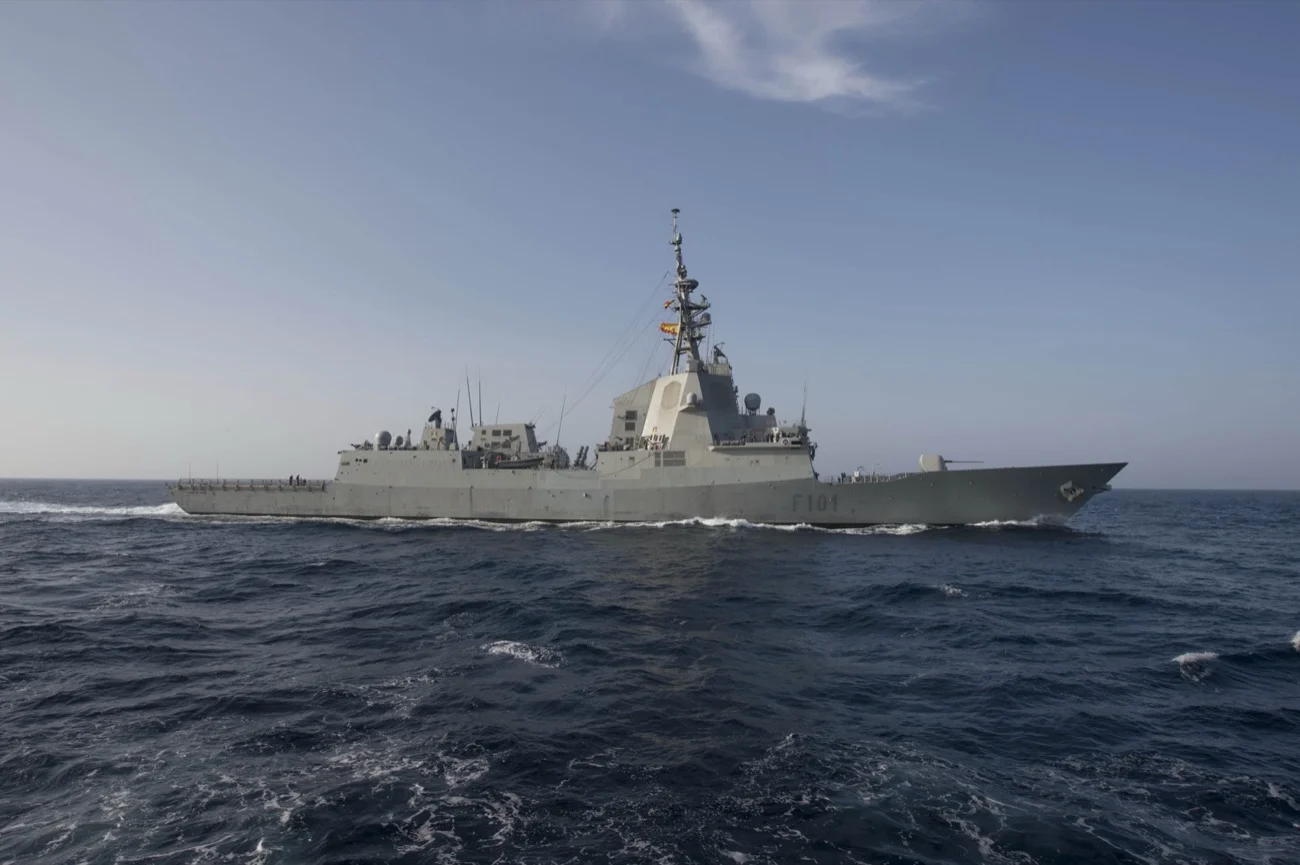
The Spanish Navy has awarded Tecnobit, part of Grupo Oesía, a 1.1 million euro contract to upgrade the Dorna fire-control system aboard its Álvaro de Bazán-class F-100 frigates. The contract covers six Leda C420HR infrared cameras, which will replace the Castor HRS units currently in service.
The deal was awarded directly, without a competitive tender, because Tecnobit is the sole manufacturer and maintenance authority for the Leda family. The Navy considers infrared imaging sensors “essential” for night operations and low-visibility threat detection, making the replacement of the ageing Castor HRS cameras a priority for sustaining the frigates’ operational readiness.
Dorna is the F-100 class’s primary fire-control system, integrated with the ship’s Aegis combat management suite. It handles target detection, tracking and data transfer to weapon systems. Adding the Leda C420HR is meant to extend surveillance range and improve image quality, though the publicly available documentation does not disclose the camera’s exact resolution or detection range specifications.
The budget timeline offers a clue to the programme’s pace. The Dorna modernisation for the F-100 frigates has a total planned budget of 11 million euros, of which 2.75 million euros was allocated for 2026 — but only 1.5 million euros of this year’s allocation has been spent so far. That gap suggests the camera delivery and installation schedule may shift depending on the pace of budget disbursement.
The Álvaro de Bazán class forms the backbone of the Spanish Navy’s air-defence and general combat capability. The five-ship class, commissioned between 2002 and 2012, was among the first European frigate families fitted with the Aegis combat system. More than a decade into service, the ships require periodic updates to their electronic and optronic subsystems, and the Leda contract is being treated as part of that cycle.
Infrared optronic sensors are gaining importance in modern naval warfare precisely because they allow passive detection without emitting a radar signal. In increasingly contested electronic-warfare environments, image-based tracking lets a ship follow threats without revealing its own radar emissions — a rationale behind why most NATO navies have been renewing their optronic sensor fleets on similar grounds.
The timing of the announcement, during Euronaval 2026, is notable in its own right. The Paris show is one of the main venues where European navies lay out procurement priorities publicly, and the fact that a relatively small-budget but operationally significant project like the F-100 upgrade surfaces during this window shows that European fleet-renewal strategy is not confined to headline platform purchases alone.
For Tecnobit, the contract extends an ongoing supply relationship with the Spanish Navy. Operating under the Grupo Oesía umbrella as an optronics and electro-optical systems manufacturer, the company supplies similar sensor packages to other Spanish Navy platforms beyond the F-100 series. No official completion date for the modernisation has been released.
Awarding contracts directly, without opening a competitive tender, is a common practice in European navies’ optronic sensor procurement whenever a single authorised manufacturer exists for a given system family — in this case, Leda. Procurement rules generally waive the competitive-tender requirement in such cases, speeding up the process, though the absence of price competition occasionally draws criticism; the Spanish Navy’s statement gives no indication such an objection was raised here.
A similar optronics-modernisation logic appears, at different scales, across other NATO navies. In Türkiye, electro-optical and infrared systems built by ASELSAN perform a comparable role in the fire-control architecture of MİLGEM-class corvettes and I-class frigates. That parallel underscores how infrared sensors have become not merely an add-on to major platform purchases, but a critical subsystem category requiring regular renewal throughout a ship’s service life.
Sources
- Infodefensa.com, “La Armada dotará a las fragatas F-100 de nuevas cámaras térmicas Leda de la española Tecnobit,” 5 November 2026, infodefensa.com — primary source for contract value, scope and budget timeline.