





HÜRJET vs Leonardo M-346 Master: Advanced Jet Trainer Comparison

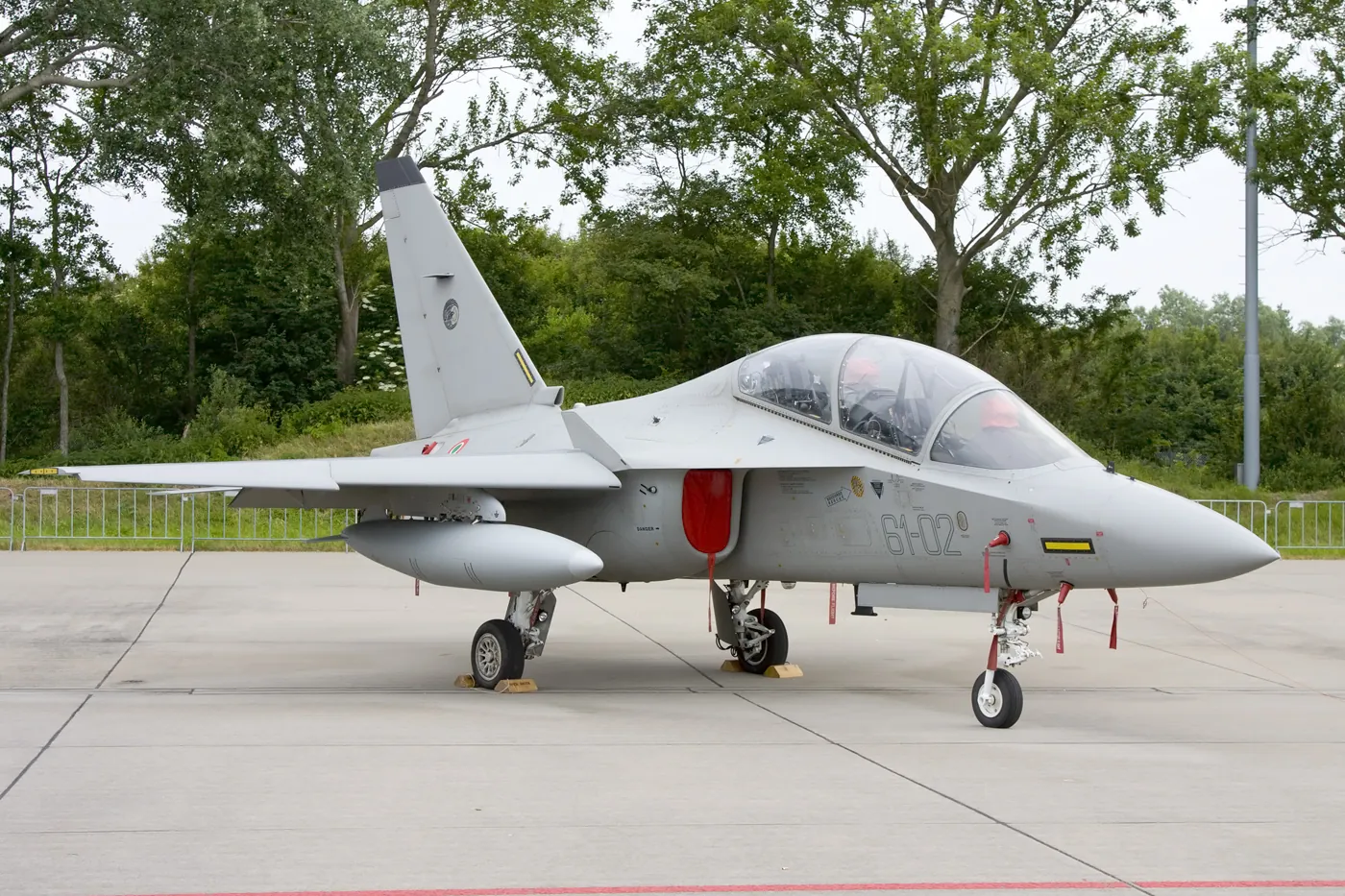
Turkey’s aerospace industry is about to field its first indigenous supersonic jet trainer with the TAI HÜRJET, while Leonardo’s M-346 Master has been a de-facto standard in Western air forces since the mid-2000s. This comparison examines both aircraft strictly on public data — supersonic envelope, thrust, weapons carriage, radar, exports, and operational maturity.
Thrust · HÜRJET
Weapon Load · HÜRJET
5th-gen Envelope Training · HÜRJET
Operational Maturity · M-346
Ferry Range (drop tanks) · M-346
Number of Operators · M-346
Engine Redundancy · M-346
Service Ceiling · Tie
Core Technical Comparison
| Parameter | HÜRJET | M-346 Master |
|---|---|---|
| Country / OEM | Türkiye · Turkish Aerospace (TAI) | Italy · Leonardo |
| Primary role | Advanced jet trainer + light attack | Advanced jet trainer + light attack (M-346FA) |
| First flight | 25 Apr 2023 (prototype); 30 Aug 2026 (first production-representative) | 15 Jul 2004 |
| Engine | 1 × GE F404-GE-104 (afterburning) | 2 × Honeywell/ITEC F124-GA-200 |
| Total thrust | ~53 kN dry · 78.7 kN A/B | ~56 kN combined (no A/B) |
| Top speed | Mach 1.4 (supersonic) | Mach 0.95 (transonic) |
| Service ceiling | 14,000 m (~45,000 ft) | 13,716 m (~45,000 ft) |
| Range | ~1,960 km (internal fuel) | ~2,550 km (3 drop tanks) |
| Hardpoints | 7 (1 fuselage + 4 wing + 2 wingtip) | 7 (M-346FA) |
| Max weapon load | ~3,402 kg | ~3,000 kg (M-346FA) |
| G limits | +8 / -3 | +8 / -3 |
| Radar | AESA block upgrade under development | Grifo-M346 mechanical scan (M-346FA operational) |
| Operator count | 1 (Türkiye) + 1 export deal (Spain) | 7 (Italy, Israel, Poland, Singapore, Greece, Qatar, Turkmenistan) |
| Total deliveries | Series production ramp-up (2027 TR delivery) | 100+ |
| Known orders | TR 12–16 + Spain 30–45 (≈€2.6B) | 103+ cumulative |
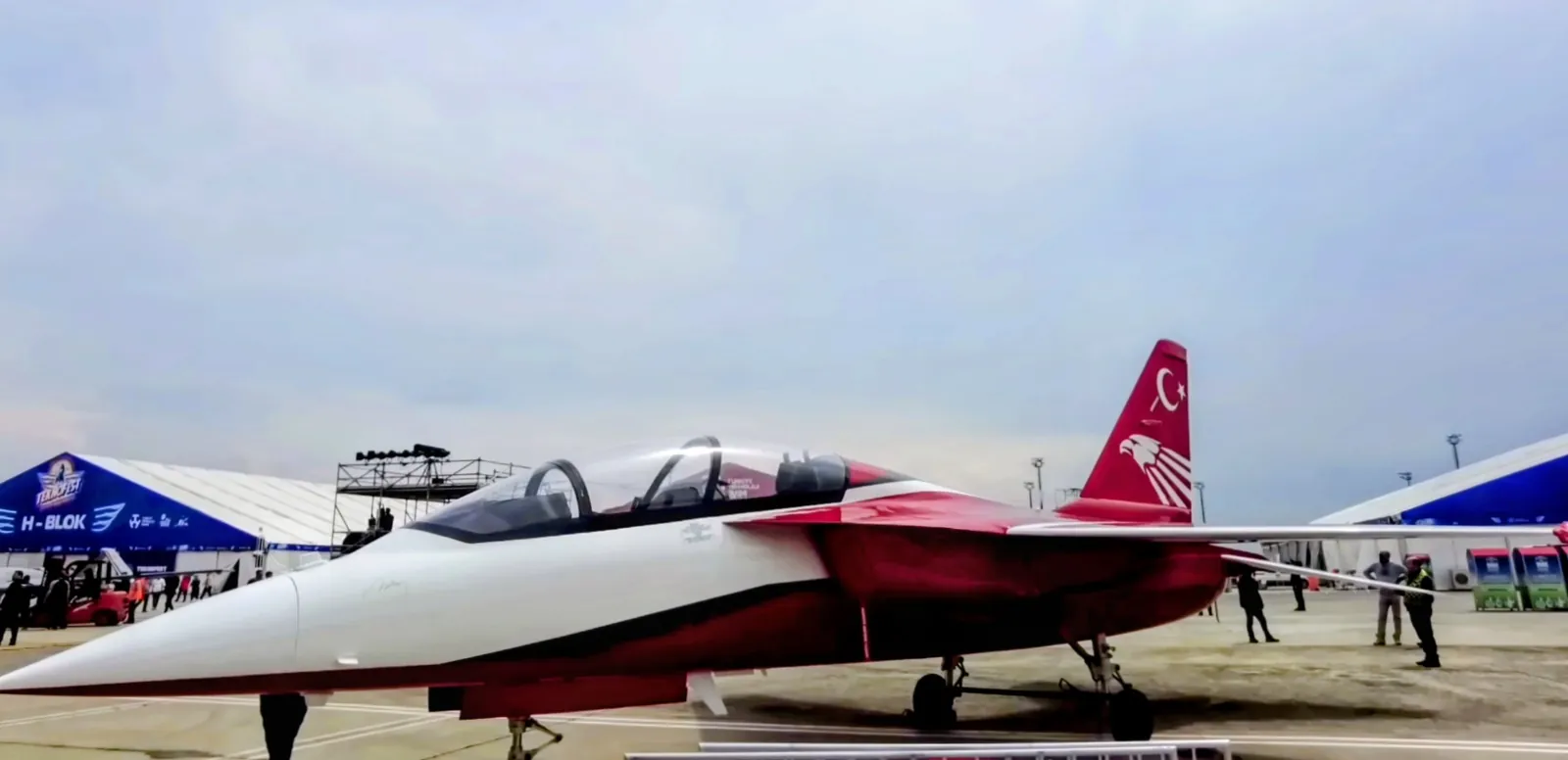
HÜRJET is TAI’s first indigenous supersonic fixed-wing aircraft, both a political and technical milestone. Its tandem single-engine layout is a deliberate choice to bring the training envelope closer to real fifth-generation fighter behaviour, so that pilots destined for KAAN, F-16 or F-35 platforms encounter afterburning acceleration and supersonic handling during training.
M-346 traces its lineage to the late-1990s Italian-Russian Yak/AEM-130 co-operation, redeveloped by Leonardo (Aermacchi). Its twin-engine, low wing-loading airframe, high angle-of-attack (30°+) capability and the industry-leading Live-Virtual-Constructive (LVC) training ecosystem were built to prepare pilots for 4th- and 5th-generation fighters. Frecce Tricolori’s 2024 selection of the M-346 to replace the MB-339 further validates the platform.
HÜRJET’s single GE F404-GE-104 produces 78.7 kN with afterburner — well above the ~56 kN combined output of the M-346’s two non-afterburning F124s. TAI has not disclosed empty weight publicly, but the single-F404 configuration gives HÜRJET what the M-346 fundamentally lacks: afterburning supersonic capability.
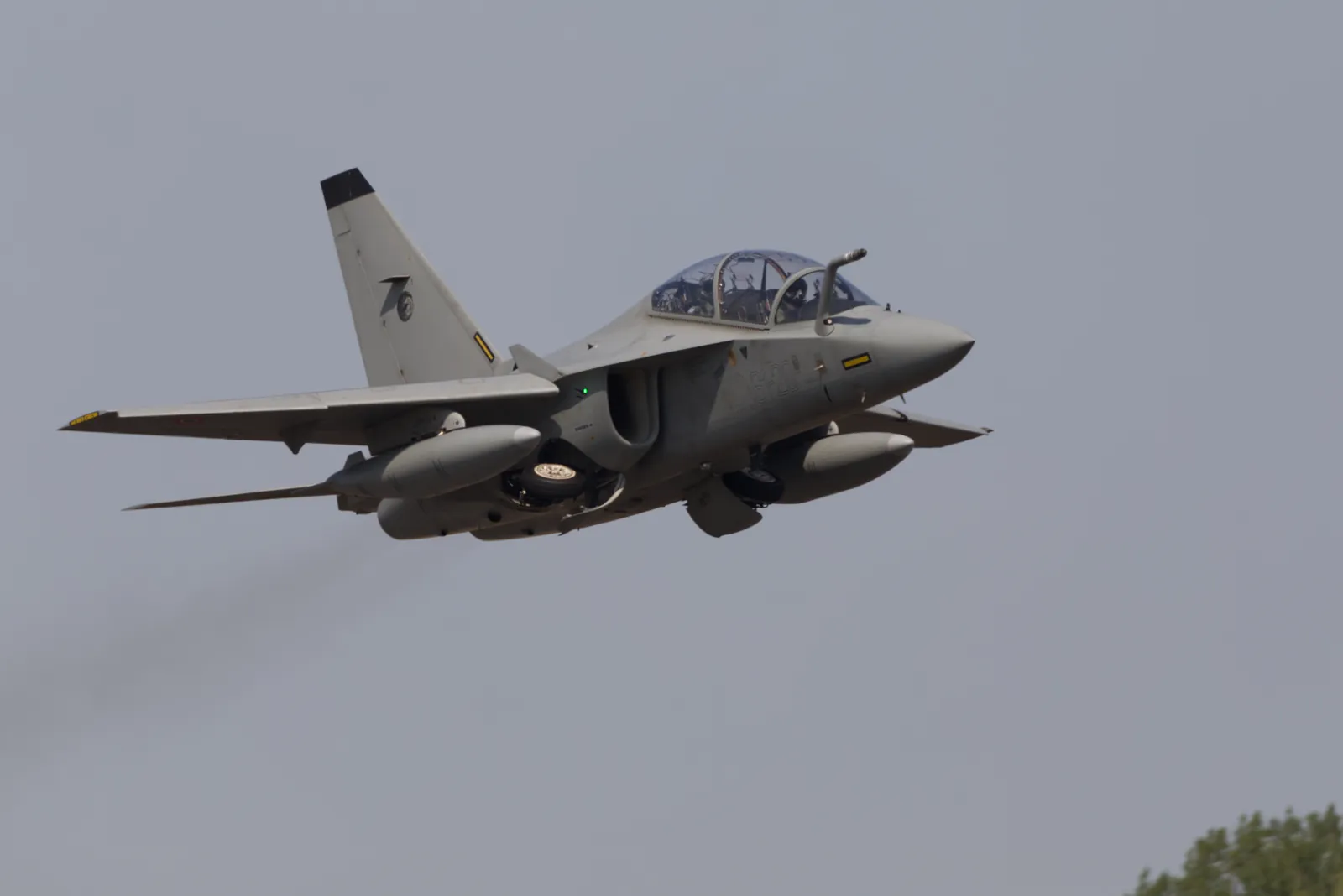
The M-346’s twin non-afterburning F124s are optimised for the transonic envelope, capped at Mach 0.95. In return, two engines add a survivability margin against engine failure and endurance stretches to about 4 hours with three drop tanks — attractive for long training sorties.
Both aircraft carry 7 hardpoints. The M-346FA is already operational, integrating Leonardo’s Grifo-M346 mechanical scan radar, IRIS-T / AIM-9 for air-to-air, AGM-65 Maverick and laser-guided bombs for air-to-ground. Nigeria became the first M-346FA export customer, receiving aircraft from 2026 onwards.
HÜRJET’s combat configuration is centred on Turkey’s growing precision munitions portfolio — Peregrine-class wingtip air-to-air, TEBER/HGK/KGK-family air-to-ground kits, SOM-A / MAM-L integration. The maturity of Türkiye’s indigenous munitions (Roketsan + Tübitak-Sage) is HÜRJET’s strongest medium-term differentiator; ASELSAN’s AESA block upgrade remains on the roadmap.
Unit-price comparison needs care because: (1) M-346 contracts bundle simulators, training and logistics very differently; (2) HÜRJET’s export price is only inferrable from the Spain deal. The Spanish contract — announced at ≈€2.6 billion (~US$3B) for 30+ aircraft — implies a per-aircraft package cost of roughly €60–85 million (with simulators, initial spares, training and support).
Historically the M-346 is reported at US$30–40M unit and US$45M+ per aircraft in fully packaged tenders. Practical takeaway: as airframes, both platforms sit in the same tier; what actually decides tenders is the support package, industrial participation and long-term engine/avionics upgrade path. For Türkiye specifically, HÜRJET’s indigenous IP + local production line is a strategic advantage no import can match.
Operational maturity clearly favours the M-346: 20+ years of development, 100+ deliveries, seven active operator air forces, Frecce Tricolori adoption, and the Italy-Qatar International Flight Training School (IFTS) model that leases M-346 sorties as a service. HÜRJET is only now transitioning to series production, with Turkish Air Force deliveries expected from 2027.
Against that backdrop, HÜRJET has moved faster than most Turkish flagship programmes and completed its first production-representative flight on 30 August 2026. The Turkish Air Force’s need to retire T-38 trainers generates strong domestic demand, and the Spanish contract is historically the first Turkish supersonic aircraft export signed by a Western NATO customer.
Which one, in which scenario?
If a supersonic envelope and 5th-generation transition training matter, HÜRJET pulls ahead at Mach 1.4 with afterburner — closer to what pilots will actually fly on KAAN, F-35 or Eurofighter.
If proven service history, wide operator base and an already-fielded light attack (M-346FA) package are priorities, the M-346 is the safe pick with a rich reference base and mature LVC training.
If indigenous industrial participation, long-term configuration control and cost leverage are strategic, HÜRJET offers depth via local engine roadmaps, ASELSAN AESA and indigenous munitions integration.
Timeline
- 2004 — M-346 first flight
- 2015 — M-346 enters Italian Air Force service
- 2017 — HÜRJET programme launched to Turkish Air Force requirement
- Apr 2023 — HÜRJET P1 first flight
- Oct 2024 — HÜRJET first supersonic flight
- Sep 2024 — Frecce Tricolori selects M-346
- Oct 2025 — Spain signs HÜRJET deal (30+ aircraft)
- Aug 2026 — HÜRJET first production-representative flight
- 2027 — Turkish Air Force HÜRJET deliveries begin
- 2028 — Spain HÜRJET deliveries planned