Altay vs Merkava Mk.4: Same Tonnage, Same Calibre, Two Schools of Tank Design
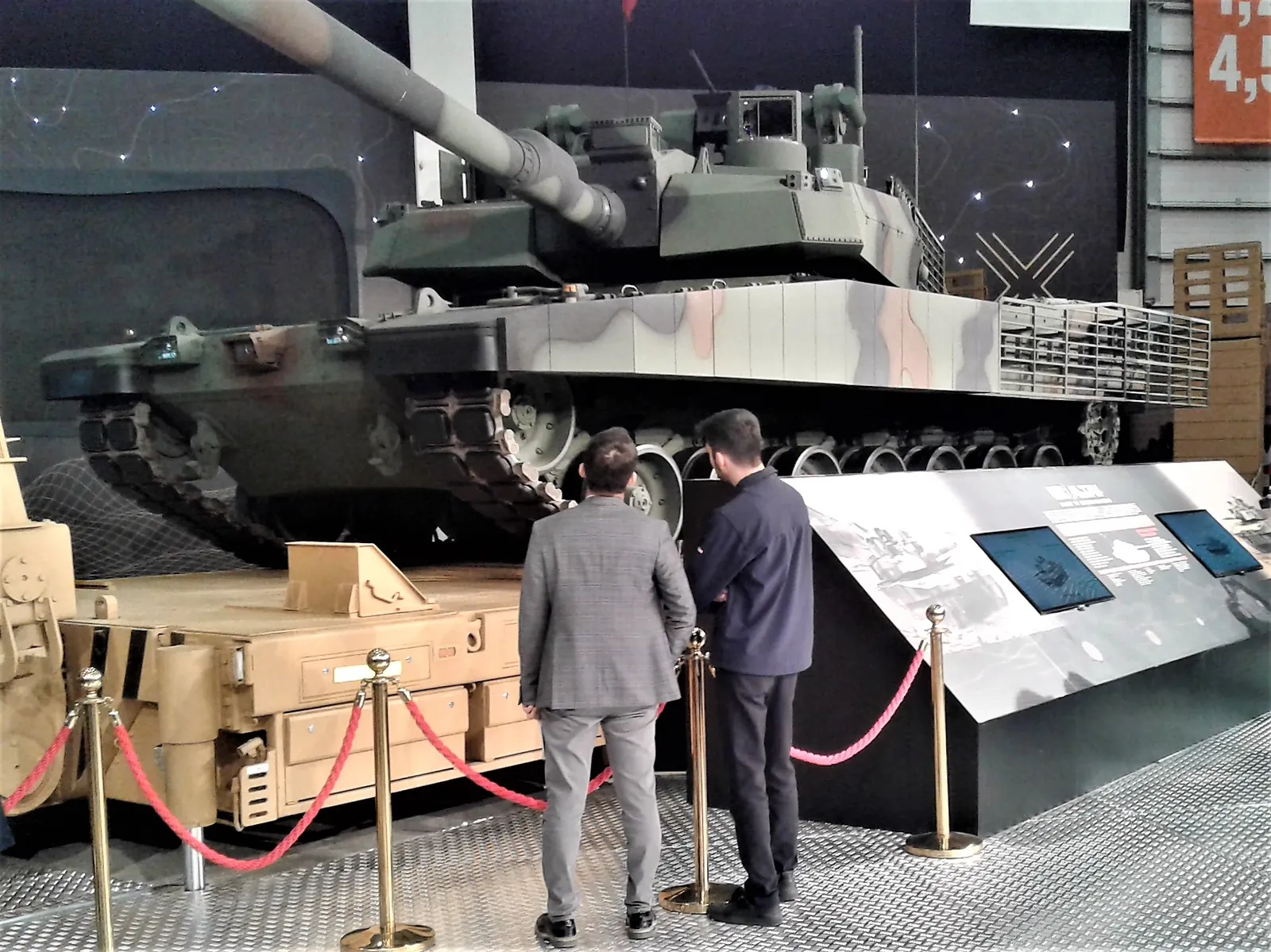
Line up the Altay and the Merkava Mk.4 and the spec sheets almost overlap. Both are 65-tonne main battle tanks with four-man crews, 120 mm smoothbore guns and 1,500 hp powerpacks. On paper there is very little to separate them.
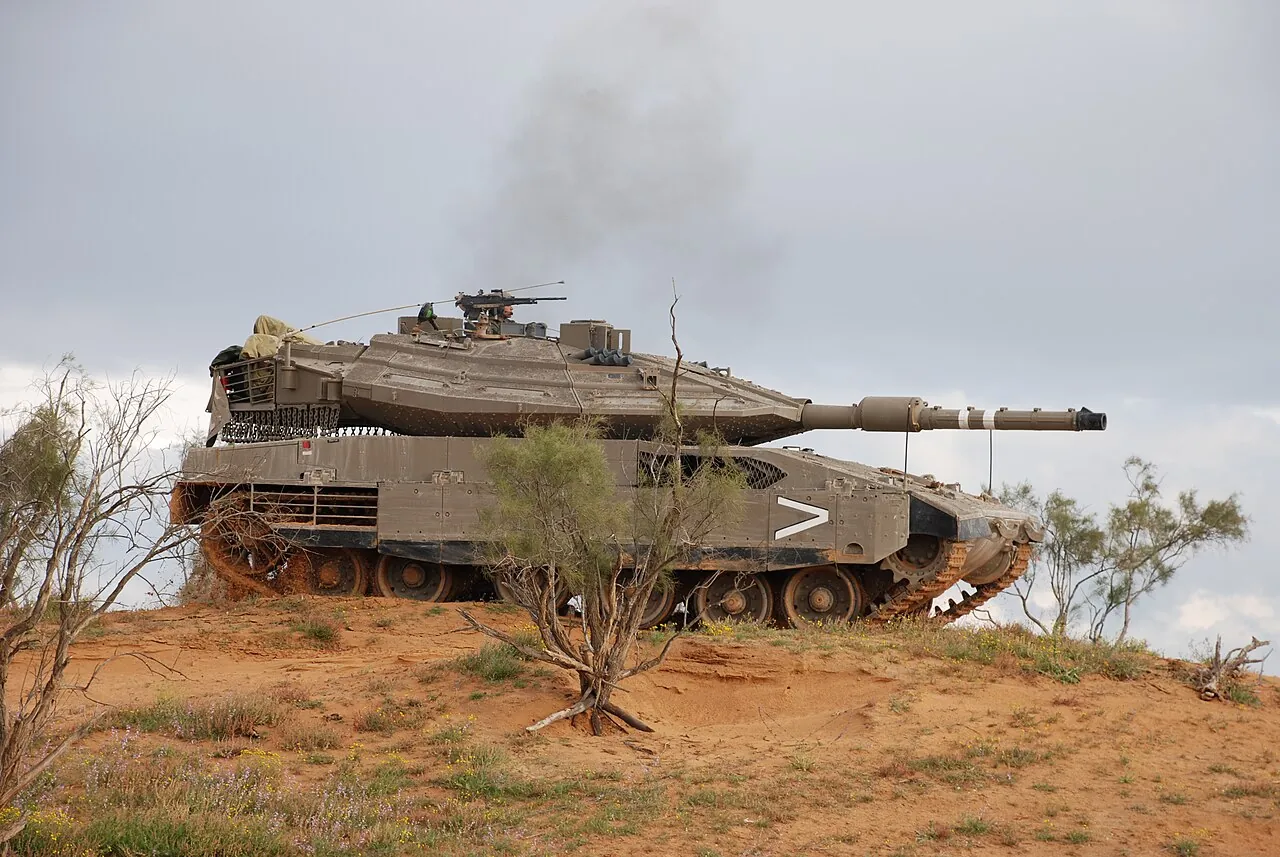
The real divergence is architectural. The Merkava is built around a front-mounted engine and a usable rear compartment — a survivability-first layout answering a specific threat picture. The Altay keeps the conventional arrangement and places its protection bet on layered armour plus a domestically built active protection system. Two mission concepts, not two rankings.
Same tonnage, same calibre, two schools
The main battle tank is the least forgiving product in the defence business. How heavy a tank can be is decided by a country’s bridges and transporters, not by its designer. How fast it moves is decided by how many tonnes each horsepower has to shift. How deep it penetrates depends less on the gun than on the generation of ammunition fed into it. Which is why every 65-tonne, 120 mm, 1,500 hp tank in the world ends up resembling every other one.
The Altay and the Merkava Mk.4 are no exception. Four crew each, loader included. A 120 mm smoothbore each. Fifteen hundred horsepower each. Range between 450 and 500 kilometres. Road speed a shade above 60 km/h. The honest answer to “which is better” is that these rows do not answer it.
The answer is inside the hull. The most expensive decision in tank design is where to put the engine, because that single choice sets weight distribution, silhouette height, maintenance access, crew egress and what the vehicle loses when it is hit from a given aspect. The Merkava answered that question forty years ago and has never revisited it. The Altay inherited the answer shared by the Western and East Asian schools.
What the systems actually say
Altay — BMC, Aselsan and SSB
BMC publishes an unusually complete data set. Crew of four: commander, gunner, loader, driver. A 120 mm L55 smoothbore firing STANAG 4385-compatible ammunition, with stowage for 40 rounds. A 7.62 mm coaxial machine gun, plus a remote weapon station that can carry 12.7 mm and 7.62 mm machine guns or a 40 mm grenade launcher.
Mobility: a 12-cylinder, 1,500 hp electronically controlled engine; six forward and three reverse gears; 65 km/h on road and 45 km/h cross-country; 450 km of range; 60 per cent gradient, one-metre vertical step, three-metre trench. Fording runs from 1.2 m unprepared to 4 m in deep-wading configuration. The declared operating envelope is +52 °C to −32 °C — a specification that says a good deal about where the Turkish Land Forces expect to fight.
Protection is described as hybrid: composite and reactive elements in the same armour system, bar armour solutions, a spall liner, a laser detection and warning system, nuclear and chemical detection, fire suppression and CBRN life support. On top of that sits Aselsan’s AKKOR active protection system. Aselsan states AKKOR carries both hard-kill and soft-kill functions, with AKKOR KAMA detecting an incoming missile or rocket by radar, classifying it with an electro-optic sensor and defeating it at a safe standoff distance. Aselsan also says the system is already fitted to the first two serial Altay tanks.
The programme itself is young. SSB’s 2025 activity report records the first two tanks delivered to the Turkish Armed Forces against a planned run of 250. Initial deliveries use a Korean powerpack; the domestic 1,500 hp BATU unit takes over once qualification is complete — after the 85th tank, according to Defense News, which also reports the new BMC plant is laid out for eight tanks a month.
Merkava Mk.4 — four decades of one idea
Israel’s Ministry of Defense tells the origin story on its own directorate page: an administration set up in 1970 to break dependence on foreign suppliers, the first Merkava Mark I delivered roughly nine years later, and Maj. Gen. Israel Tal remembered as the programme’s architect. The ministry describes the Mark IV as fitted with the Trophy active protection system and as “one of the world’s most armored tanks.”
The numbers come from the international defence press. Army Technology gives 9.04 m with the gun forward, 3.72 m wide without skirts, 2.66 m to the turret roof and 65 tonnes. A V-12 diesel of 1,500 hp drives a five-speed automatic; top speed is above 60 km/h, with up to 55 km/h cross-country and 500 km of range.
Two armament details separate it from the Altay. It stows 48 rounds, ten of them ready. And it carries an internally operated 60 mm mortar with a range of 2,700 m — a way of producing close support fire without spending main-gun ammunition, which matters a great deal in built-up terrain. Gun-launched LAHAT guided rounds are also part of the inventory.
The current configuration, Barak, was unveiled in September 2023 and first went to the 52nd Battalion of the 401st Armoured Brigade. Its additions are electronic rather than structural: Elbit Systems’ Iron Vision helmet, which lets the commander see around the vehicle with the hatches closed; the Torch C4i battle management system; and AI-assisted image processing that classifies what the sensors find. Trophy was already in the package.
A note on naming: the IDF’s own site presents this vehicle as the Merkava Mk. 4 Barak, while international coverage of the September 2023 unveiling described a “fifth-generation Merkava” and some outlets used Mk.5 Barak. This article uses Mk.4 for the baseline hull and Barak for the current configuration.
Where the engine sits decides everything else
The Merkava’s powerpack is at the front. The logic is straightforward: a tank is most often hit frontally because that is the aspect it fights with. Put the engine there and you insert a mass of metal, alloy and fluid between the incoming round and the crew — you turn a component never designed as armour into part of the armour.
The second consequence is the space that opens at the rear. Army Technology puts it at eight infantry or three stretcher cases. A tank that can double as a casualty evacuation vehicle is a meaningful flexibility for an army fighting in confined, mined terrain — and the Namer heavy APC, derived from the same hull, is the direct product of that architecture.
It costs something. The layout raises the silhouette, changes the centre of gravity, and means a frontal hit that protects the crew can also end mobility completely. This is not a claim of superiority; it is a specific answer to a specific threat picture — short-range, dense anti-tank fire, close to built-up areas, where the political cost of crew losses is extremely high.
The Altay keeps the conventional layout and buys its protection differently: layered armour plus an active protection system. Its own threat picture is written into the spec sheet — the +52/−32 °C envelope, the four-metre fording capability, the 450 km range. These are the requirements of a force expecting to operate across wide, varied terrain rather than within a compact theatre.
Technical comparison
| Criterion | Altay (T1) | Merkava Mk.4 / Barak |
|---|---|---|
| Programme authority / builder | BMC, under contract to SSB | Israel MoD Merkava and Armored Vehicles Directorate (MANTAK) |
| Crew | 4 (commander, gunner, loader, driver) | 4 (commander, gunner, loader, driver) |
| Weight | Not published by BMC; Defense News reports 65 tonnes | 65 tonnes |
| Layout | Conventional — rear engine | Front engine; accessible rear compartment |
| Rear compartment | None | Eight infantry or three stretcher casualties |
| Main gun | 120 mm L55 smoothbore | 120 mm smoothbore (MG253) |
| Ammunition | 40 rounds | 48 rounds; 10 ready to fire |
| Secondary armament | 7.62 mm coaxial; RCWS with 12.7 / 7.62 mm and 40 mm grenade launcher | 7.62 mm machine gun; internally operated 60 mm mortar (2,700 m) |
| Guided munition | Laser-guided tank gun round capability | LAHAT gun-launched anti-tank missile |
| Engine | 12-cylinder, 1,500 hp, electronically controlled | V-12 diesel, 1,500 hp |
| Transmission | Six forward / three reverse, automatic | Five-speed automatic |
| Top speed | 65 km/h road; 45 km/h cross-country | Over 60 km/h; up to 55 km/h cross-country |
| Range | 450 km | 500 km |
| Active protection | AKKOR (Aselsan) — hard-kill and soft-kill layers | Trophy (Rafael) |
| Armour | Composite, reactive and bar armour with spall liner | Modular special armour; belly mine protection |
| Fire control | 360° panoramic stabilised commander’s periscope, hunter-killer, automatic target tracking | Two-axis line-of-sight stabilisation, thermal imaging, laser rangefinder, panoramic sight |
| Other sensors | Laser detection and warning system, nuclear/chemical detection | NBC overpressure protection |
| Operating temperature | +52 °C / −32 °C | no verified figure published in open sources |
| Fording | 4 m prepared (deep wading); 2.2 m and 1.2 m | no verified figure published in open sources |
| Operator | Turkish Land Forces | Israeli Ground Forces |
| Combat record | None — entering service | Continuous operational use since 1982 |
| Production plan | 250 tanks; Korean powerpack for the first 85, BATU thereafter | Ongoing through MANTAK; production expansion programme approved |
Altay figures are from BMC’s official technical specifications page, with programme data from SSB and Defense News; Merkava figures are from the Israel Ministry of Defense, the IDF and Army Technology. Rows without a published official figure are marked rather than estimated.
Operators and operational record
Here the comparison stops being symmetric. The Merkava family has been in continuous operational use since 1982, and the decision to field Trophy at scale came directly out of the anti-tank missile threat encountered from the 2006 Lebanon campaign onward. Since 2023, in operations in Gaza and southern Lebanon, open sources have recorded the loss of a substantial number of vehicles, including Barak-configuration tanks; a Barak destroyed by a large improvised explosive device in November 2024 became the most widely discussed of those cases.
That record also marks the limits of the survivability narrative built around active protection and layered armour. APS is designed against threats arriving within a given angle and velocity band; it offers far less against a large charge detonating beneath the hull or a munition diving from above. This is not a Merkava-specific weakness — it is the shared problem of every modern tank.
The Altay has no operational record to weigh. What it has is a documented test burden: 1.5 million engineering hours, 35,000 kilometres of mobility testing and 3,700 live-fire trials, according to Defense News. That is not a substitute for combat hours, but it is not nothing either. One design has been proven; the other is at the beginning of proving itself, and any comparison that blurs that distinction is incomplete.
Where the Merkava Mk.4 is the better fit
- Built-up and close terrain: the internal 60 mm mortar delivers close support without consuming main-gun ammunition.
- Dense anti-tank fire: the front-mounted powerpack adds mass between a frontal hit and the crew.
- Casualty evacuation and resupply: the rear compartment gives the tank a second role its peers do not have.
- Short logistic arms: operating close to home bases, 500 km of range is sufficient.
Where the Altay is the better fit
- Wide, varied terrain: a +52/−32 °C envelope and 450 km of range are written for a force spanning several climate zones.
- River crossings: deep-wading to four metres preserves manoeuvre where bridges do not exist.
- Upgrade headroom: the conventional layout and modular armour make later configuration changes cheaper.
- Supply-chain freedom: fire control, active protection and battle management are domestically sourced; the powerpack closes that loop once BATU is qualified.
What is not published
Armour thickness and protection levels are unpublished for both tanks — a universal limit in this genre. The Merkava’s operating temperature envelope and fording capability do not appear in official sources; the Altay’s weight is absent from BMC’s own specification page. Neither Aselsan nor Rafael publishes reaction time, sector coverage or simultaneous engagement capacity for AKKOR and Trophy. And on the Altay side a second unknown remains: whether the performance rows hold once the BATU powerpack replaces the Korean unit.
Assessment
Asking which of these tanks is better means going beyond what open sources allow. Both are 65-tonne vehicles with four-man crews, 120 mm smoothbore guns and 1,500 hp powerpacks; the published data does not support a meaningful ranking.
The divergence is one of use case. The Merkava places crew survivability at the centre of its architecture and is optimised for close, intense fighting — the internal mortar and the rear compartment are direct consequences of that choice. The Altay keeps the conventional layout and builds protection from layered armour plus a domestic APS, written for wide terrain and extreme temperature swings.
Judged by the operational picture each force actually faces, the two answer different mission concepts. One carries a four-decade combat ledger; the other is at the start of proving itself. And in armoured warfare what usually decides the engagement is not the tank but the reconnaissance, electronic warfare and battle management network feeding it.
Are the Altay and the Merkava Mk.4 in the same weight class?
Yes. Both sit in the 65-tonne bracket. Army Technology lists 65 tonnes for the Merkava Mk.4, and Defense News used the same figure for the Altay when it covered the opening of BMC’s new tank plant. BMC’s own technical specifications page does not publish a weight line. Practically this means both tanks live under the same constraints — the same bridges, the same transporters, the same port cranes.
Why does the Merkava carry its engine at the front?
It is the founding design decision of the family. Moving the powerpack forward places roughly a tonne and a half of additional mass between an incoming frontal hit and the crew. In exchange, the rear of the hull opens up: Army Technology states the compartment can take eight infantry or three stretcher casualties. The trade-offs are a taller silhouette, a different weight distribution and the risk that a frontal hit ends mobility outright.
Does the Altay have an autoloader?
No. BMC’s official page lists a crew of four — commander, gunner, loader and driver — so loading is manual. The Merkava Mk.4 also runs a four-man crew with a human loader, fed from a revolving magazine that keeps ten rounds ready. On this line both tanks differ from autoloader platforms such as the K2 Black Panther or the T-90M.
Which active protection system is more mature?
Trophy has the longer service record: Rafael’s system has been fielded on Israeli armour since 2011 and later on US M1A2 tanks. Aselsan describes AKKOR as a package combining hard-kill and soft-kill layers, with the hard-kill element AKKOR KAMA using radar detection cued to an electro-optical sensor; Aselsan says the system is already installed on the first two serial Altay tanks. The gap is therefore one of accumulated operational hours rather than of declared capability.
Where does the Altay’s engine come from?
Türkiye’s defence procurement agency SSB states that initial serial deliveries use a powerpack sourced from South Korea, and that production will continue with the indigenous 1,500 hp BATU powerpack once qualification is complete. Defense News reports the switch is planned after the 85th tank. Israel’s Ministry of Defense does not publish powerpack sourcing for the Merkava on its official pages.
Is it the Merkava Mk.4 Barak or the Mk.5 Barak?
Open sources do not agree, and this is worth flagging. The IDF’s own technology mini-site presents the vehicle under the heading “Merkava Mk. 4 Barak.” International outlets covering the September 2023 unveiling, however, reported it as a “fifth-generation Merkava,” and some used the Mk.5 designation. This article uses Mk.4 for the baseline hull and Barak for the current configuration.
Have the two tanks ever faced each other?
No, and they are unlikely to. The comparison is inherently asymmetric: the Merkava family has been in continuous operational use since 1982, while the Altay has yet to see combat. SSB’s 2025 activity report records the delivery of the first two tanks to the Turkish Armed Forces. One design is judged on a four-decade combat ledger, the other on test data.
Related coverage
- Altay vs K2 Black Panther: same engine, two combat philosophies
- ATMACA vs Exocet MM40 Block 3: one range class, two procurement logics
- Bayraktar AKINCI vs MQ-9B SkyGuardian: HALE UCAV comparison
- Cyprus wants Israel’s Merkava — and what it turned down
- Gulf armour recapitalisation: Altay, Leopard, M1A2 and K2 compared
- The world’s most expensive tanks (2026)
- World’s largest tank manufacturers
- Bright Sight: the see-through-armour system
Compare more systems side by side
Every comparison in this series is built only from manufacturer and official-agency sources, with unpublished figures left blank rather than estimated.
Sources and verification note
- BMC — ALTAY technical specifications (official product page) — Crew, 120 mm L55 smoothbore main gun, 40-round stowage, 12-cylinder 1,500 hp engine, six-forward three-reverse transmission, speed, range, fording depth, armour and active protection
- Presidency of Defence Industries (SSB) — ALTAY MBT Serial Production Project — Official project description, delivery into Turkish Land Forces service and the powerpack transition plan
- Aselsan — AKKOR Active Protection System — Hard-kill and soft-kill layers, AKKOR KAMA radar and electro-optic architecture, status on the first two Altay tanks
- Israel Ministry of Defense — Merkava and Armored Vehicles Directorate — Official programme history, the directorate’s role, and the Mark IV described with the Trophy active protection system
- Israel Defense Forces — Meet the Merkava Mk. 4 Barak — Official presentation of the Barak configuration: Iron Vision helmet, AI-assisted mission computer, Trophy integration
- Army Technology — Merkava 4 main battle tank — Dimensions, 65-tonne weight, V-12 1,500 hp powerpack, 48-round stowage, 60 mm internal mortar, rear compartment capacity and fire-control architecture
- Defense News — Turkey wants eight Altay battle tanks yearly from new BMC factory (31 Oct 2025) — Plant capacity, the 250-tank order, Korean powerpack for the first 85 vehicles, 65-tonne weight and development test figures
- Breaking Defense — Israel unveils new ‘lightning’ version of the Merkava (Sept 2023) — The Barak unveiling, delivery to the 401st Armoured Brigade, Iron Vision, Torch C4i and the 120 mm MG253 gun
Only manufacturer (BMC, Aselsan), official agency (SSB, Israel Ministry of Defense, IDF) and international defence-press sources were used. No estimates were substituted for unpublished figures; those rows are marked explicitly.
Editor’s note: This article is a mission-concept comparison, not a ranking. The two tanks answer different threat pictures, different procurement logics and very different levels of operational maturity. Technical data reflects official open sources as of publication; programme status, variant naming and configuration details may change.