TAYFUN vs Iskander-M: Two Tactical Ballistic Missiles at Different Stages

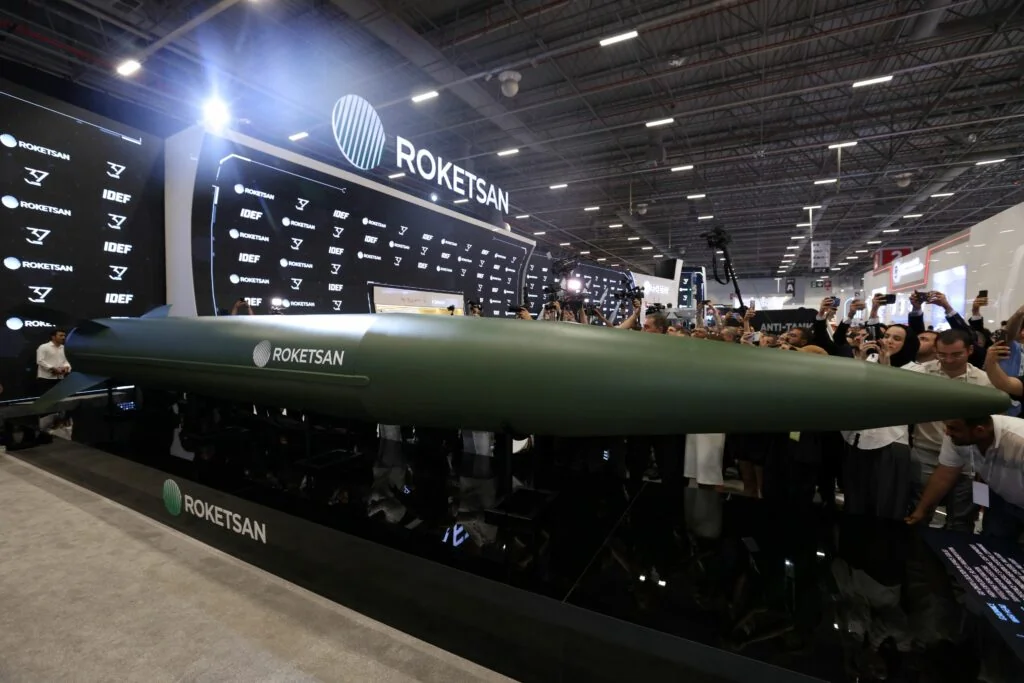
On paper TAYFUN and the 9K720 Iskander-M fall into the same box: road-mobile, solid-fuel ballistic missiles fired from a wheeled launcher. Put the two programmes side by side, though, and what emerges is not a performance race but two very different stories about maturity and mission.
The Iskander-M has been in Russian service for two decades. Its range is given in open sources as 400-500 km, its brigade structure and reaction times are documented, it has export customers, and — decisively — it has been used heavily in combat. Because it is dual-capable, it is also part of Russia’s non-strategic nuclear architecture, which makes it an instrument of escalation management rather than simply a source of firepower.
TAYFUN is newer, physically larger and reaches further. Its verified test record stands at 561 km, and the Block-4 configuration displayed at IDEF 2025 was presented at 10 m and roughly 7,200 kg — well above the Iskander’s airframe. Against that, Roketsan publishes no official maximum range and the system has no verified combat use. The two systems diverge in terms of use case rather than ranking.
Why compare these two at all?
A tactical ballistic missile does something air power cannot: it delivers hundreds of kilograms of payload several hundred kilometres away in minutes, with no pilot, no aircraft and no air tasking order in the chain. Few countries can do it, because the hard part is not flying the missile but putting it where it was aimed. That is why ballistic missile programmes are read as one of the clearest markers of an industrial base’s maturity.
Russia is a founding member of that club; the Iskander-M replaced the Cold War era SS-23 line and has been in service since 2006. Türkiye reached the same rung by a different route: first the 120 km class rocket systems, then the BORA/KHAN family in the 280 km band, and finally TAYFUN beyond 500 km. Roketsan’s own product page for KHAN — 80-280 km, a 470 kg high-explosive warhead, CEP of 10 m or less — describes the step below. TAYFUN is the rung above it.
TAYFUN: a large airframe and an undisclosed range
The first thing to note about TAYFUN is the quality of the available evidence. The missile does not appear on Roketsan’s public product list and the company publishes no manufacturer-signed data sheet for it. The SSB project page carries no technical values at all: it states only that the project was initiated in line with Ministry of National Defence requirements, that it aims to enhance Türkiye’s capability against strategic targets, and that a warhead test firing destroyed its target.
What can be verified therefore comes from test records. The clearest is the third firing, on 3 February 2025: The Defense Post reported that the missile was launched from Rize-Artvin Airport and struck a maritime target 561 km away, with air and sea traffic suspended within a 700 km radius. Defence industries president Haluk Görgün made the announcement. The two earlier tests took place in October 2022 and May 2023.
The second source is the trade show floor. For the TAYFUN Block-4 displayed at IDEF 2025, Army Recognition reported 10 m length, 938 mm diameter, approximately 7,200 kg, solid composite propellant, INS aided by GPS and GLONASS, a CEP of 5-10 m and a pre-fragmented multi-purpose high-explosive warhead. An 800 km class range estimate entered circulation afterwards — but The War Zone was careful to point out that Roketsan disclosed no official maximum.
The word “hypersonic” around Block-4 deserves care. The missile does exceed Mach 5 in its later flight stages, which is ordinary for a large ballistic round. The War Zone notes it does not display the high-manoeuvre characteristics associated with hypersonic glide vehicles or hypersonic cruise missiles. The speed claim is sound; the category label is doing more work than the physics supports.
The third and perhaps most interesting data point arrived in July 2026. Naval News reported that on 4 July a TAYFUN Block-3 scored a direct hit on a moving maritime target roughly 7 m long at the Sinop range. Striking a manoeuvring ship with a ballistic missile is a different problem from hitting a coordinate: the round has to acquire the target itself on the way down. Roketsan disclosed neither the engagement range nor the target’s speed nor the seeker type, but the test points to work on an anti-ship ballistic missile capability.
Iskander-M: a mature system with a crowded record
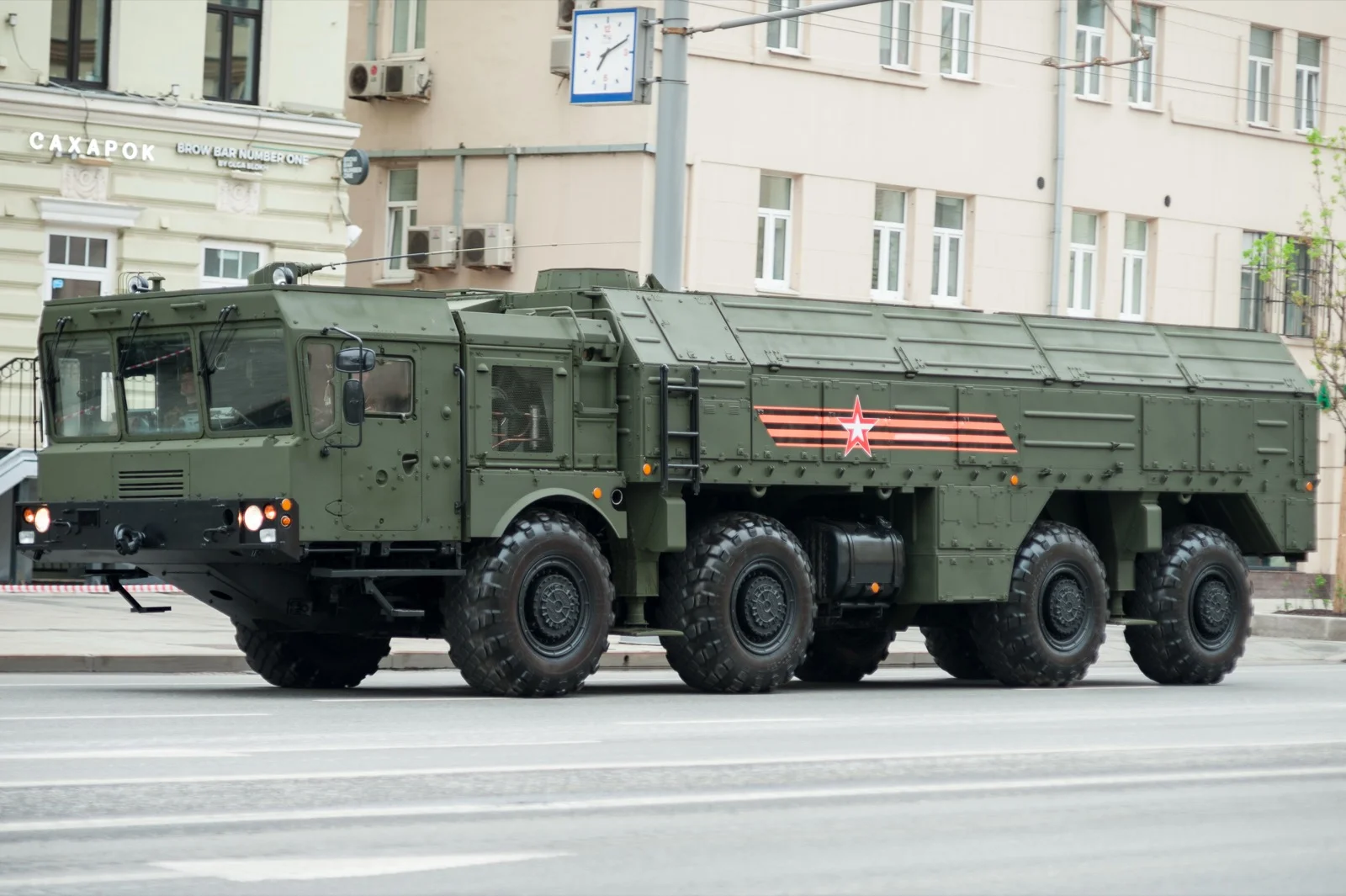
The Iskander picture is almost the inverse of TAYFUN’s: plenty of data, little mystery. CSIS Missile Threat records development from 1993 at KBM Kolomna and Russian service entry in 2006. The 9M723 is 7.3 m long and 0.92 m in diameter, with a launch weight of 3,750-4,020 kg and a payload between 480 and 700 kg. Range is 400-500 km on the domestic variant; the export Iskander-E is capped at 280 km.
Warhead options run wide — high-explosive, submunition, earth-penetrator and thermobaric. Guidance is built on an inertial core with DSMAC terrain matching, GLONASS/GPS support and an optional electro-optical seeker. Accuracy tracks those layers: CSIS gives 200 m on inertial alone at 300 km, 50 m with GLONASS and 10-20 m with the optical seeker, while RUSI’s technical profile puts the electro-optically guided round at 5-10 m, with some examples landing within 7 m.
One of the least discussed but most consequential features is the survivability package. According to RUSI, the 9M723 carries the 9B999 penetration aid system — six canisters of thermal decoys and radar jammers at the base of the warhead. Its quasi-ballistic, depressed trajectory places it above most conventional air defences and below ballistic missile defences, and it can manoeuvre at up to 30g in flight.
The operational picture is equally documented. A brigade comprises three battalions and 12 TELs, each carrying two rounds. A stationary TEL reaches launch readiness in five minutes and can fire both missiles within a minute of each other. Russia operated 11 brigades as of 2019. Armenia bought in 2016 and Algeria in 2017 (four regiments, 48 TELs), and the system has been permanently deployed to Kaliningrad since 2018.
Two different mission concepts
The real divergence is doctrinal rather than dimensional. The Iskander-M was built as an operational-depth weapon: brigade headquarters, supply depots, communications nodes, struck at short notice. RUSI attaches an explicit condition to that — the system only works this way under saturated ISR coverage, which is achievable in compact theatres such as the Donbas or the Baltics but not everywhere.
Layered on top is the nuclear dimension. Because the Iskander supports Russia’s non-strategic nuclear forces, ambiguity about what a given launcher is carrying generates deterrent effect on its own, independent of any round actually fired.
TAYFUN answers a different question. A verified 561 km test and a substantially larger Block-4 airframe push it past the tactical-operational band toward a strategic target set — which is exactly the language the SSB project page uses. The anti-ship test opens a third direction: there is no verified anti-ship employment in the Iskander family on the open record, while a TAYFUN Block-3 has struck a moving vessel. These are not two rungs of one ladder so much as two partly different ladders.
Where each programme concentrates its evidence (qualitative)
These bars are not measured performance. They are a qualitative summary of where each programme has accumulated evidence. No common test protocol or independent performance metric exists in open sources that would let the two be raced against each other directly.
The technical data side by side
| Criterion | TAYFUN (Roketsan) | Iskander-M / 9K720 (KBM Kolomna) |
|---|---|---|
| Class and purpose | Road-mobile ballistic missile system for strategic land targets; a Block-3 round has been fired at a moving sea target | Road-mobile short-range ballistic missile system for tactical-operational targets; dual-capable, conventional and nuclear |
| Manufacturer / origin | Roketsan / Türkiye | KBM Kolomna / Russia |
| Development and service status | Run by SSB against a Ministry of National Defence requirement; first test October 2022, second May 2023, third 3 February 2025. Inventory numbers and delivery schedule not disclosed | Development began 1993; entered Russian service 2006 |
| Range | No official maximum disclosed. Verified test record: 561 km (3 February 2025). An 800 km class figure circulated after the Block-4 display | Iskander-M (9M723): 400-500 km. Export Iskander-E: 280 km |
| Length | Block-4: 10 m (IDEF 2025 display) | 9M723: 7.3 m |
| Diameter | Block-4: 938 mm | 0.92 m |
| Launch weight | Block-4: approximately 7,200 kg | 3,750-4,020 kg |
| Warhead | Pre-fragmented, multi-purpose high explosive. Weight: no verified figure is published in open sources | 480-700 kg; high-explosive, submunition, earth-penetrator and thermobaric options |
| Nuclear role | None; conventional system | Part of the delivery architecture for Russia’s non-strategic nuclear forces (RUSI) |
| Midcourse guidance | INS aided by GPS and GLONASS (Block-4 display data) | INS; DSMAC terrain matching; GLONASS/GPS; Baget 62-04 mission computer |
| Terminal seeker | A new seeker able to track a moving sea target was used on Block-3; type not specified | Optional electro-optical or radar seeker with DSMAC terminal guidance |
| Accuracy (CEP) | 5-10 m (Block-4 display data) | 200 m on inertial alone at 300 km; 50 m with GLONASS; 10-20 m with optical seeker. RUSI records 5-10 m for the electro-optically guided 9M723 |
| Speed and trajectory | Mach 5-plus in the later flight stages on a conventional ballistic trajectory; not a glide or cruise type hypersonic weapon | Quasi-ballistic, depressed trajectory; up to 30g manoeuvre in flight |
| Penetration aids | no verified figure is published in open sources | 9B999 system: six canisters of thermal decoys and radar jammers at the base of the warhead |
| Launcher | TAYFUN Weapon System; canisterised road launcher vehicle. Technical data not disclosed | 9P78 TEL on an MZKT-7930 8×8; 43 tonnes loaded; 70 km/h; 1,100 km range; -50 to +50 degrees Celsius; CBRN-hardened cab; amphibious |
| Rounds per launcher | Not officially disclosed (two canisters visible in archive imagery) | 2 |
| Unit structure and reaction time | no verified figure is published in open sources | Three-battalion brigade with 12 TELs; 11 brigades as of 2019. Five minutes to launch readiness from a stationary TEL; two rounds within a minute of each other |
| Anti-ship capability | Block-3 struck a moving maritime target roughly 7 m long on 4 July 2026 | no verified figure is published in open sources (no verified anti-ship employment on the open record) |
| Operators | Türkiye. No export customer or inventory figure disclosed | Russia; Armenia (2016); Algeria (2017, four regiments / 48 TELs). Permanent Kaliningrad deployment from 2018 |
| Verified combat use | no verified figure is published in open sources | Georgia 2008; Syria 2016; extensive use in Ukraine. 227 of 939 Iskander/Kinzhal rounds intercepted up to 24 October 2025 (about 24 per cent) |
Sources: SSB official TAYFUN Project page; The Defense Post; Army Recognition (IDEF 2025 display data); The War Zone; Naval News; CSIS Missile Threat; RUSI. Values without a manufacturer or official signature were left out rather than estimated.
The blanks in the TAYFUN column are deliberate. Roketsan publishes no data sheet for the system, so there is no official figure for warhead weight, rounds per launcher, unit structure or reaction time. The Iskander values, for their part, come from Western institutional compilations (CSIS, RUSI) rather than from Russian official publications.
Operators and operational status
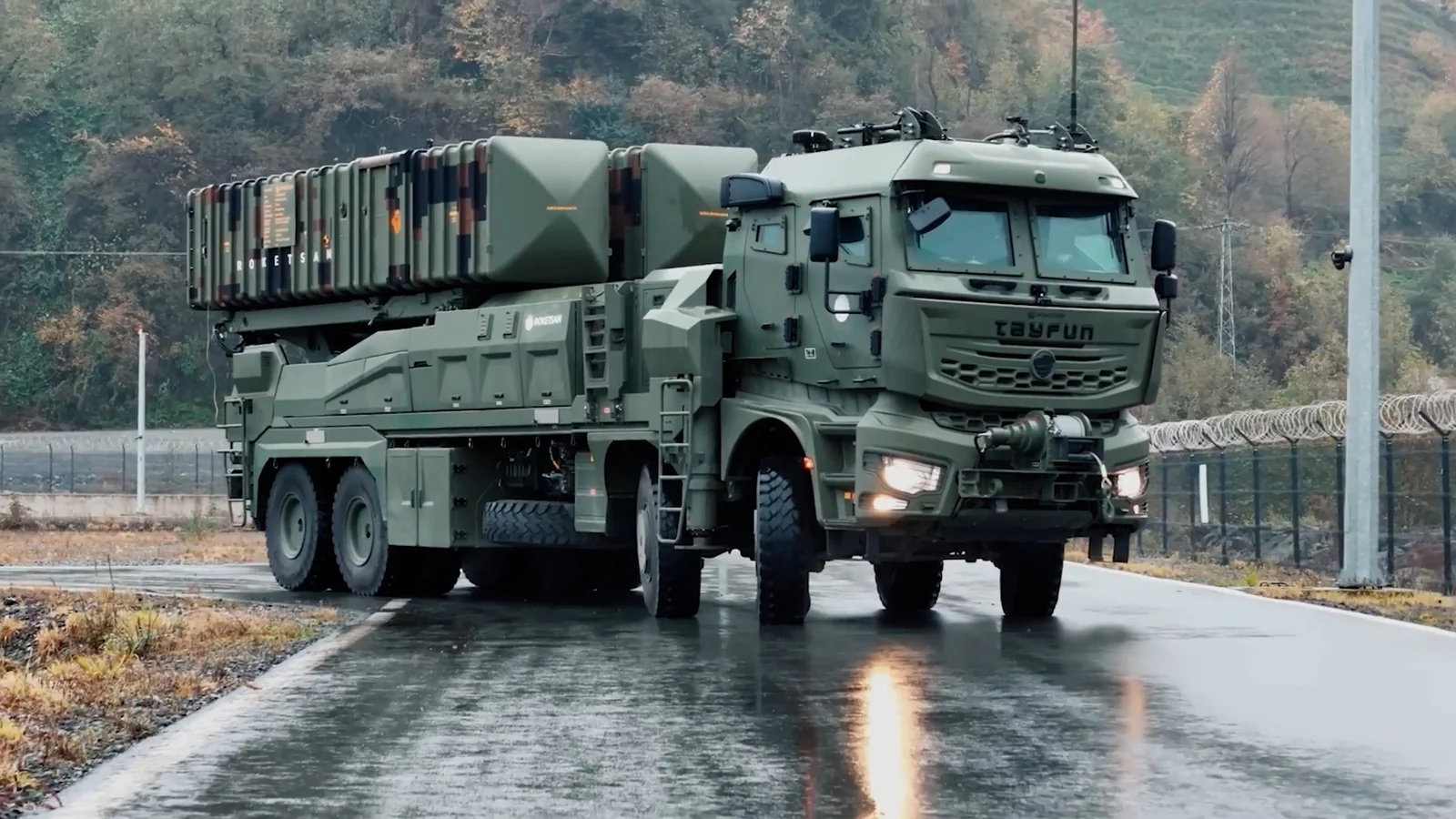
The Iskander side presents a mature deployment and export picture: 11 Russian brigades, users in Armenia and Algeria, a permanent presence in Kaliningrad. Combat use runs back to Georgia in 2008 and a 2016 Syria deployment. Ukraine is a different order of magnitude: compiled figures cited by RUSI and confirmed by CSIS put 939 Iskander and Kinzhal rounds fired up to 24 October 2025, with 227 intercepted — roughly 24 per cent. In only 4 per cent of attacks did the defender stop most of the incoming missiles.
Those numbers cut both ways. They show a system that strains air defences — RUSI reports that software changes to the 9M723 enabled terminal manoeuvres that have made Patriot intercepts harder. They also show that roughly a quarter of rounds were stopped, which means the system is not unstoppable.
The TAYFUN column is far quieter. Inventory numbers, delivery timelines and basing arrangements have not been published, and there is no known export customer. That is normal for a system in this band: missiles above the Missile Technology Control Regime thresholds of 300 km and 500 kg rarely enter an export catalogue at all.
Where each system stands out
Where TAYFUN differs in terms of use case
- Range band: a verified 561 km test sits above the Iskander-M’s 400-500 km band, and the Block-4 target range is higher still.
- Airframe scale: roughly 7,200 kg at launch is close to double the 9M723, which translates into more design margin for range and payload.
- Moving sea targets: the Block-3 firing of 4 July 2026 is a verified step toward striking a manoeuvring vessel with a ballistic round — something with no open-source counterpart in the Iskander family.
- Supply independence: the programme is run domestically, with no documented third-country export licence in the delivery chain.
Where the Iskander-M differs in terms of use case
- Verified operational record: in use since 2008, with hundreds of rounds fired in Ukraine generating data about behaviour outside a test range.
- Survivability package: the 9B999 penetration aid system adds a dedicated layer of thermal decoys and radar jammers aimed at defeating air defences.
- Reaction time and unit structure: five minutes to launch readiness, two rounds a minute apart and a 12-TEL brigade define a documented operational rhythm.
- Mission flexibility: the same TEL also fires the 9M728 and 9M729 cruise missiles, letting one launcher serve two munition types.
- Dual capability: the ability to carry a nuclear warhead turns the system into a deterrent instrument as well as a conventional one.
Limitations
TAYFUN’s principal constraints are transparency and maturity. With no manufacturer-signed data sheet, there is no verifiable figure for warhead weight, launcher capacity, unit structure or reaction time — all operationally decisive. No official maximum range has been declared either; 561 km is a test result, not a design limit. And there is no verified combat use, which is the only record that can speak to how a munition behaves outside a range.
The Iskander’s constraints sit elsewhere. RUSI describes a dependence on Western components in the guidance and processing units and calls it a potential Achilles heel if export controls tighten. The drag penalty of a quasi-ballistic trajectory can pull terminal velocity below claimed figures. Most importantly, the system’s effectiveness is a function of the ISR chain behind it: without adequate targeting and updates, a precise missile lands precisely on the wrong coordinate. Range is also capped at 500 km, and at 280 km on the export variant.
What this means for Türkiye
TAYFUN’s significance for Türkiye is not a single missile but the completion of a capability ladder. For years the inventory topped out in the 120-280 km band; Roketsan’s KHAN page describes that ceiling with 80-280 km, a 470 kg warhead and sub-10 m CEP. TAYFUN fills the rung above, and that rung means access to an entirely different target set in planning.
The second point is directional. The Block-3 firing at a moving sea target pushes the programme beyond land attack. In compact maritime theatres, a shore-launched ballistic round that can engage a ship changes the naval balance through an equation that does not run on hull counts. It does not duplicate anti-ship cruise missiles such as ATMACA so much as complement them: one arrives low and subsonic, the other from above and far faster.
Third, the comparison has limits worth naming. Behind the Iskander-M lie more than thirty years of development, hundreds of operational firings and a nuclear role. Behind TAYFUN lies a four-year public test series. Joining the small group of states that field this band is a genuine threshold in its own right; reading “the two are equivalent” out of it would go beyond what the evidence supports. Taking users’ inventories and preferences into account, the two systems address different requirement profiles.
Assessment
Reducing TAYFUN and the Iskander-M to a ranking would ignore the stage each programme occupies. Technically TAYFUN offers greater range and a larger airframe; the Iskander-M offers a richer spread of guidance options, a defined unit structure, dedicated survivability subsystems and a nuclear role.
The firmest distinction available is evidentiary. Discussion of the Iskander-M rests on field data — 939 rounds, 227 interceptions, an interception rate that has shifted with software updates. Discussion of TAYFUN rests on test announcements and trade show displays. Those are not equivalent weights of evidence, and saying so is a statement about programme timelines rather than a criticism.
For Türkiye the question is not which system is better but which rung TAYFUN reaches. A domestically designed ballistic missile that has flown past 500 km and is now being tested against moving ships creates a planning option that did not exist before. What that option is worth in the field will be shown by time and inventory data, not by a specification table.
Are TAYFUN and the Iskander-M in the same class?
On the category label, yes: both are road-mobile, solid-fuel ballistic missiles fired from a wheeled launcher. The scale is where they part company. The Iskander-M’s 9M723 round is 7.3 m long with a launch weight of 3,750-4,020 kg and a range given as 400-500 km. The TAYFUN Block-4 shown at IDEF 2025 was presented at 10 m and roughly 7,200 kg — a noticeably larger airframe.
What is TAYFUN’s official range?
Roketsan publishes no data sheet for TAYFUN, and the missile does not appear on the company’s public product list. The one verifiable figure comes from a test: Turkish defence industries president Haluk Görgün said the missile struck a maritime target 561 km away on 3 February 2025. An 800 km class range circulated after the Block-4 display at IDEF 2025, but as The War Zone noted, Roketsan has not disclosed an official maximum range.
How accurate is the Iskander-M really?
It depends on the guidance fit. CSIS Missile Threat records a CEP of 200 m on inertial guidance alone at 300 km, 50 m with GLONASS and 10-20 m with the optional optical seeker. RUSI’s technical profile puts the electro-optically guided 9M723 at 5-10 m, with some rounds landing within 7 m. The headline accuracy figures therefore belong to seeker-equipped rounds, not the baseline.
Is TAYFUN an anti-ship missile?
The core design targets fixed strategic objectives on land. But Naval News reported that on 4 July 2026 a TAYFUN Block-3 struck a moving maritime target roughly 7 m long at the Sinop range. Hitting a moving ship with a ballistic missile requires the round to see the target for itself in the terminal phase. Roketsan did not disclose the engagement range, the target’s speed or the seeker type.
Is the Iskander nuclear-capable?
RUSI assesses the Iskander as part of the delivery architecture for Russia’s non-strategic nuclear forces, which makes it a tool of escalation management rather than simply a source of firepower. TAYFUN has no such role: Türkiye has no nuclear warhead programme and the system is described as a conventional weapon.
How has the Iskander-M performed in Ukraine?
Figures compiled by researcher Petro Ivaniuk and confirmed by CSIS, cited by RUSI, put 939 Iskander and Kinzhal rounds fired at Ukraine up to 24 October 2025, of which 227 were intercepted — about 24 per cent. In only 4 per cent of attacks did Ukraine intercept most of the missiles fired. RUSI also reports that software changes to the 9M723 have enabled more effective terminal manoeuvres, degrading interception.
What warhead does TAYFUN carry?
No verified weight is published. The IDEF 2025 display described a pre-fragmented, multi-purpose high-explosive warhead intended for air defence systems, command posts, aircraft shelters and critical infrastructure, but gave no figure in kilograms. CSIS records 480-700 kg for the Iskander-M.
Related reading
Defence comparisons from Envanter Medya
System-by-system comparisons built on manufacturer and official-institution sources, with unverified figures left blank rather than estimated.
Sources and verification note
- Presidency of Defence Industries (SSB) — official TAYFUN Project page — States that the project was initiated in line with Ministry of National Defence requirements and aims to enhance Türkiye’s capability against strategic targets through TAYFUN missiles launched from TAYFUN weapon systems; records a warhead test firing that destroyed its target
- The Defense Post — TAYFUN’s 561 km test — Third test firing on 3 February 2025 from Rize-Artvin Airport against a maritime target 561 km away; announcement by defence industries president Haluk Görgün; air and sea traffic suspended within a 700 km radius; earlier tests in October 2022 and May 2023
- Army Recognition — TAYFUN Block-4 at IDEF 2025 — Display figures: 10 m length, 938 mm diameter, approximately 7,200 kg weight, Mach 5, an estimated 800 km class range, INS aided by GPS and GLONASS, 5-10 m CEP, solid composite propellant and a pre-fragmented multi-purpose high-explosive warhead
- The War Zone — assessment of TAYFUN Block-4 — Close to 10 m long, close to one metre in diameter and nearly eight tonnes; Roketsan has not disclosed an official maximum range; the missile reaches Mach 5-plus in its later flight stages but lacks the manoeuvring characteristics associated with hypersonic glide or cruise weapons
- Naval News — TAYFUN Block-3 against a moving sea target — Direct hit on a moving maritime target roughly 7 m long at the Sinop range on 4 July 2026; announced by Haluk Görgün; engagement range, target speed and terminal guidance type not disclosed; Mach 5-plus terminal speed and a new seeker able to track a moving target
- CSIS Missile Threat — 9K720 Iskander (SS-26 Stone) profile — Development from 1993 at KBM Kolomna, Russian service entry in 2006; 9M723 at 7.3 m, 0.92 m diameter, 3,750-4,020 kg launch weight, 480-700 kg payload; 400-500 km for the Iskander-M and 280 km for the export Iskander-E; CEP of 200 m / 50 m / 10-20 m by guidance fit; high-explosive, submunition, earth-penetrator and thermobaric warheads; up to 30g in flight; 9P78 TEL on an MZKT-7930 8×8; 11 brigades as of 2019; Armenian and Algerian users
- RUSI — the Iskander-M and Iskander-K: a technical profile — 5-10 m CEP for the electro-optically guided 9M723; the 9B999 penetration aid system with six canisters of thermal decoys and radar jammers at the base of the warhead; a three-battalion brigade with 12 TELs; five minutes to launch readiness from a stationary TEL and both rounds fired within a minute of each other; the system’s role in Russia’s non-strategic nuclear forces; dependence on Western components in guidance and processing units
- RUSI — Iskander: an improved Russian missile tests Ukraine’s air defence — 939 Iskander and Kinzhal rounds fired at Ukraine up to 24 October 2025 with 227 intercepted, about 24 per cent; most missiles intercepted in only 4 per cent of attacks; modifications to the 9M723 enabling terminal manoeuvres that degrade interception
- Roketsan — official KHAN missile product page — 80-280 km range, 610 mm diameter, 2,500 kg weight, a 470 kg high-explosive warhead, GPS+GLONASS aided INS and a CEP of 10 m or less, launched from an 8×8 multi-barrel rocket launcher. Used here to define the rung below TAYFUN
This comparison draws on an official government source (the SSB TAYFUN Project page), a manufacturer source (Roketsan’s KHAN product page) and international institutional and trade sources (CSIS Missile Threat, RUSI, Naval News, Army Recognition, The War Zone, The Defense Post). Turkish defence news sites were not used as sources. Range, weight and performance values without a manufacturer or official signature were left out of the table rather than estimated.
Editor’s note: this article compares the mission concepts of two tactical ballistic missile programmes; it is not a superiority ranking. One side (Iskander-M) has been in service for two decades and used heavily in combat; the other (TAYFUN) has a public test series four years long. Some TAYFUN figures come from trade show displays and test announcements rather than a manufacturer-signed data sheet. Technical data reflects open sources as of publication; configurations, range figures and programme status may change.