ANKA-3 vs X-47B: Two Flying Wings, Two Very Different Questions


Put the ANKA-3 and the X-47B side by side and the resemblance is immediate: two tailless flying wings, both turbofan-powered, both shaped to keep a radar return small. The resemblance is where the similarity ends.
The X-47B was a two-aircraft demonstrator built to answer one question for the US Navy — can a tailless autonomous jet work from a carrier deck? It was catapulted and trapped in 2013, refuelled itself autonomously in 2015, and the programme then closed as designed.
The ANKA-3 is a land-based combat programme. It first flew on 28 December 2023, has released a munition from its internal bay, and has air-launched a separate unmanned system. Two aircraft, two questions, two different answers.
One silhouette, two questions
The flying wing has an unhelpful side effect on defence literacy: anything shaped like one gets filed next to everything else shaped like one. In the unmanned combat air vehicle world, though, a shared planform says almost nothing about a shared job. Tailless geometry is simply the most direct route to a smaller radar cross-section, so unrelated programmes keep arriving at the same shape. The difference lies in the question each programme was built to answer.
The ANKA-3 and the Northrop Grumman X-47B are a clean illustration. One serves Türkiye’s requirement for a low-observable, internally armed strike UAV flying from a runway. The other answered a far narrower engineering question for the US Navy more than a decade ago, and retired once it had the answer. What follows sets the two against official sources — and says so plainly wherever the official source does not exist.
ANKA-3: a combat line that works from a runway
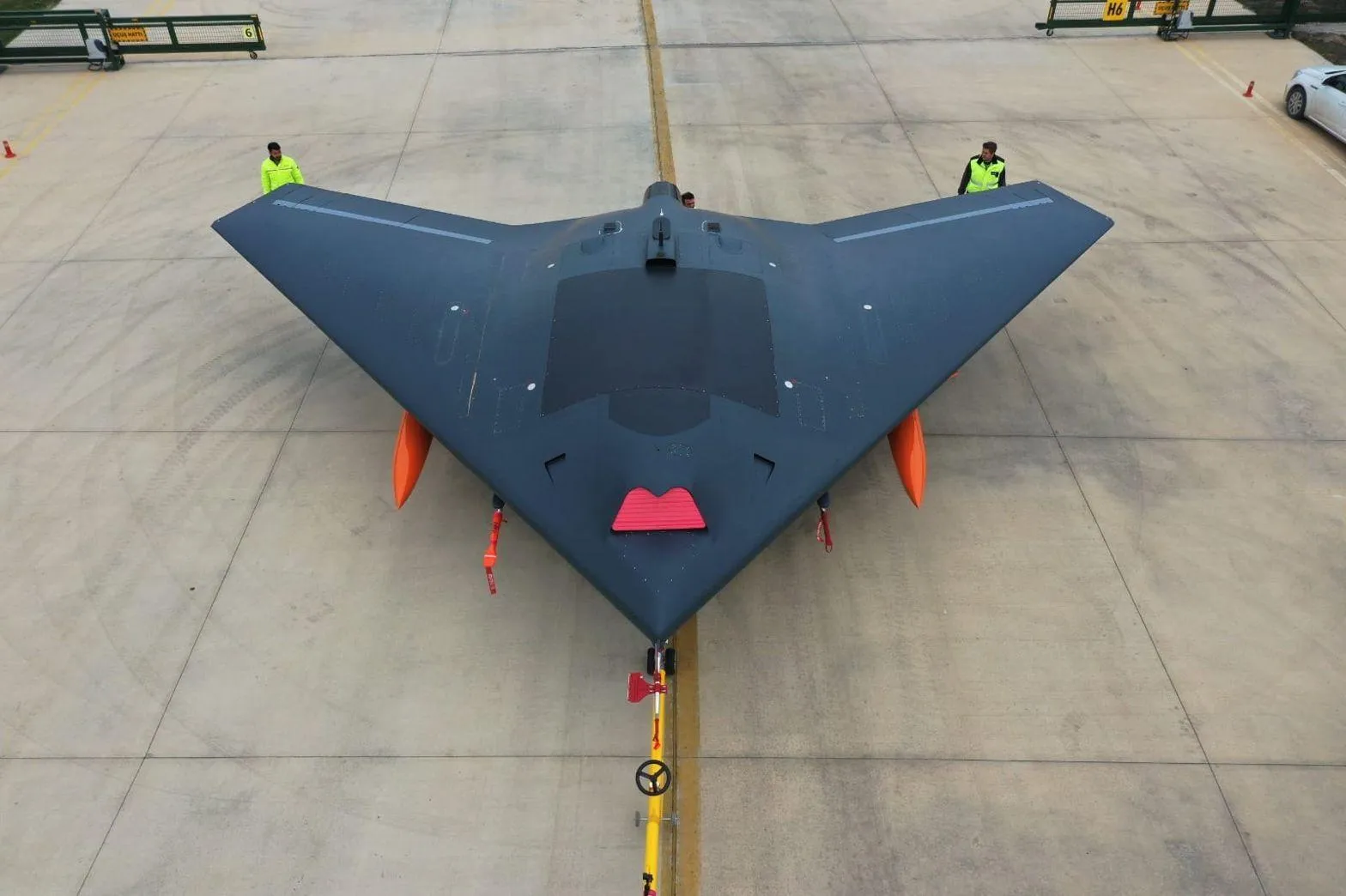
Turkish Aerospace’s official product page gives the ANKA-III a length of 7.9 m, a wingspan of 12.5 m and a height of 2.5 m, with a maximum take-off weight of 6,500 kg and a payload capacity of 1,200 kg. Turbofan propulsion takes it to 425 kt (Mach 0.7) at 30,000 ft; cruising at 250 kt (Mach 0.42) it stays airborne for 10 hours, with a service ceiling of 40,000 ft. The manufacturer lists two internal and five external payload stations, and names low radar observability, manned-unmanned teaming and AI-assisted swarm work among its capability headings.
The maiden flight came at 08:38 on 28 December 2023. Turkish Aerospace reported a flight of 1 hour 10 minutes reaching 8,000 ft and 150 kt, with a HÜRKUŞ trainer and an ANKA flying chase. Türkiye’s Presidency of Defence Industries announced the flight through its own channels.
What came next is where a demonstrator and a combat aircraft part company. The ANKA-3 started dropping things. Turkish Aerospace announced the release of an ASELSAN-built TOLUN munition from the internal weapons station — take-off from Mürted at 12:04, release at 20,000 ft and 180 kt over the Konya Karapınar range. The manufacturer frames it as the first internal-bay munition release by a nationally developed aircraft in Türkiye. A release test with ASELSAN’s LGK-82 guidance kit followed.
An internal weapons bay is not a detail in a low-observable design; it is the whole logic of one. Hang the ordnance outside and you surrender everything the shaping bought you. Demonstrating a release from inside the fuselage is what turns the planform from a styling choice into a capability.
Then there is the part that makes this comparison genuinely interesting. The ANKA-3 does not only carry munitions; it can release another aircraft. Turkish Aerospace announced an air-launch test of the nationally developed Super Şimşek high-subsonic UAV from the ANKA III. After separation, Super Şimşek flew a 50-minute autonomous mission and recovered by parachute. The manufacturer credits the air-launched system with up to 800 km of range and a warhead of up to 50 kg, and describes a mission profile built around autonomous formation flight, triggering air defences early and engaging what is found.
X-47B: two aircraft built to settle one argument
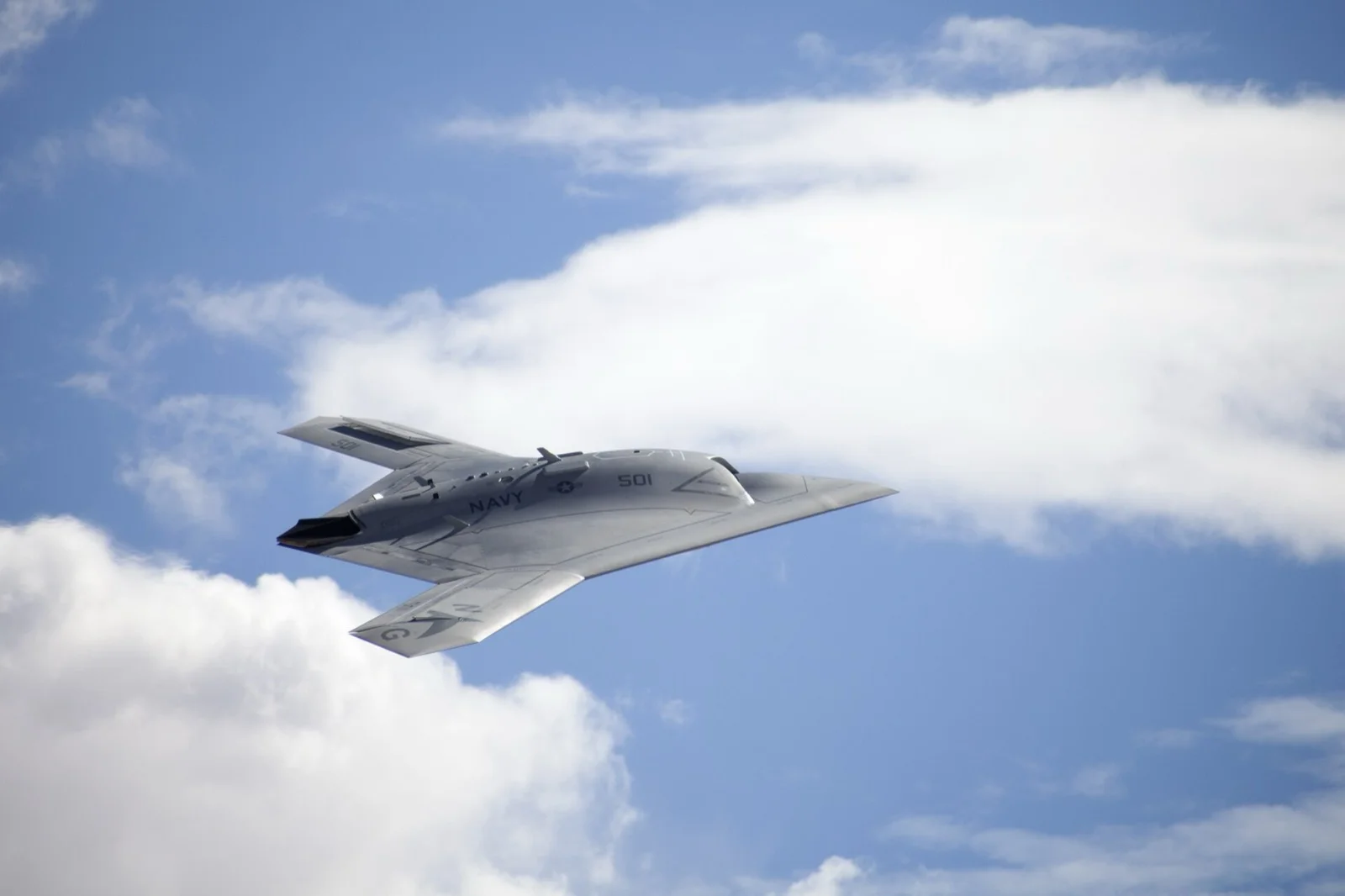
The X-47B is best understood by what it was not: a combat aircraft. The US Navy’s own CHIPS publication traces it to DARPA’s J-UCAS programme, credits Northrop Grumman with its development, and states its purpose as demonstrating carrier suitability for an unmanned air vehicle. The same article says there were no plans to operationalise the X-47B. Northrop Grumman confirms that just two air vehicles were built.
First flight came in early February 2011 at Edwards Air Force Base in California. By December 2012 the aircraft was at sea aboard USS Harry S. Truman (CVN 75) off Virginia, being towed and taxied across the flight deck with an arm-mounted control display unit and run through electromagnetic testing. The Navy’s account puts the wingspan at 62 feet — roughly 17 feet wider than an F/A-18 Super Hornet, which matters a great deal when the question is whether it fits the deck and the hangar bay.
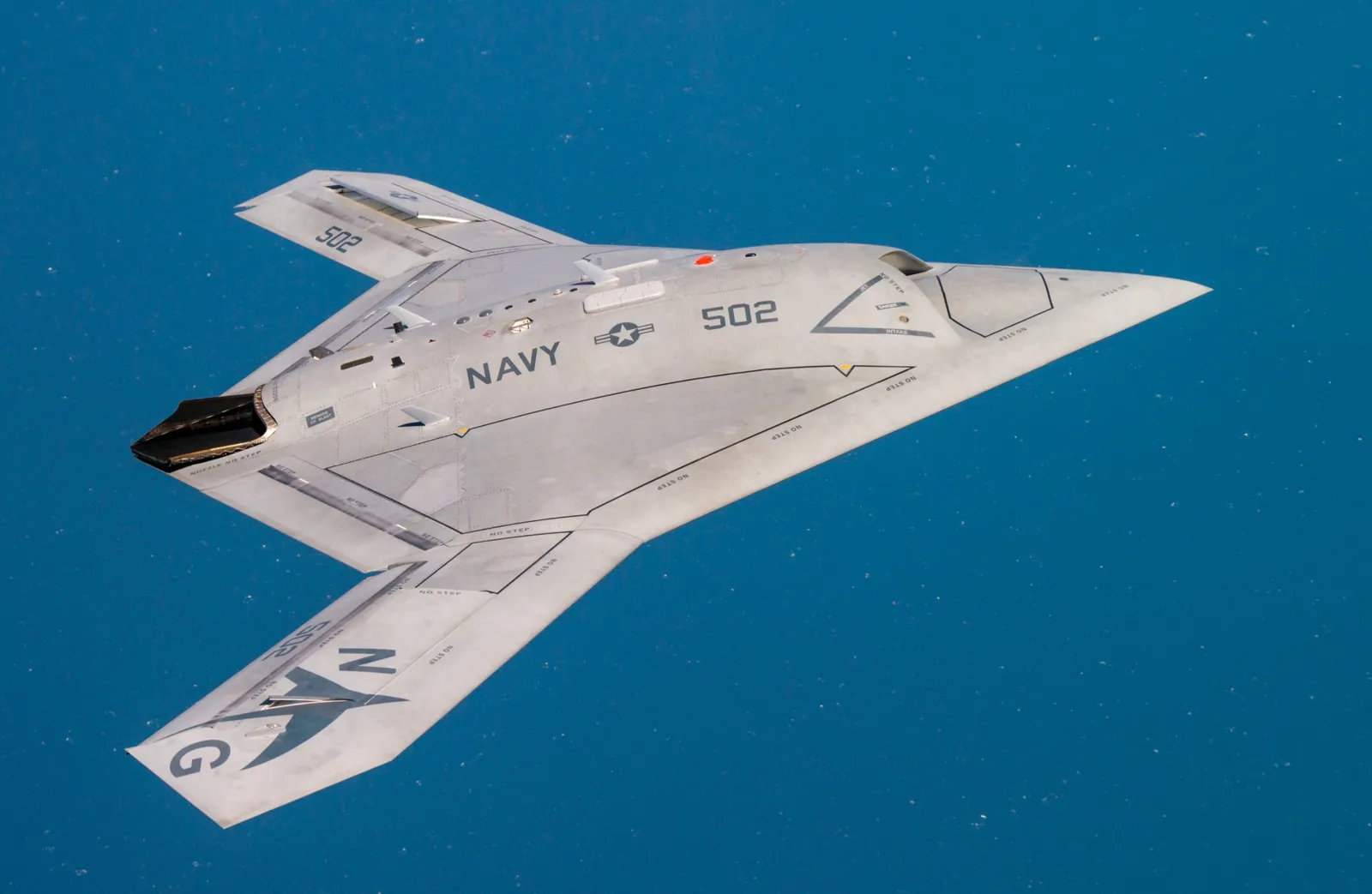
The decisive year was 2013. Northrop Grumman’s release of 10 July 2013 records that the X-47B became the first unmanned aircraft catapult-launched from a Nimitz-class carrier on 14 May, flew the first unmanned precision approaches and touch-and-go landings on a carrier on 17 May, and made the first arrested landing aboard USS George H.W. Bush (CVN 77) at 12:23 Eastern on 10 July. It completed the 35-minute transit from Pax River, caught the three-wire, and came from roughly 145 knots to a stop in less than 350 feet.
The final objective fell on 22 April 2015. According to the US Navy, the X-47B connected to an Omega K-707 tanker off Maryland and Virginia and took on more than 4,000 pounds of fuel by the probe-and-drogue method — the first autonomous aerial refuelling of an unmanned aircraft. It exchanged messages with a government-designed Refueling Interface System aboard the tanker and flew its fixed probe into the basket unaided. Capt. Beau Duarte, the Navy’s unmanned carrier aviation programme manager, called the ability to transfer and receive fuel autonomously a step that would extend the range and flexibility of future unmanned platforms.
The mission-concept divide
This is the fault line. The X-47B’s problem was never delivering ordnance to a target; it was landing precisely on a pitching steel deck, at night and in weather, with no pilot aboard. That demanded folding wings, a tailhook, a catapult interface, a ship-based control architecture and data links that survive one of the harshest electromagnetic environments in existence. Weapons integration was not in scope.
The ANKA-3’s problem runs the other way. The runway is a given; the mission is the hard part. Penetrating with a low signature, releasing from an internal bay, carrying electronic warfare and intelligence payloads, teaming with crewed aircraft. That is why its test calendar is measured in weapon releases and payload integration, while the X-47B’s was measured in deck operations and autonomy.
Where each programme concentrated its declared test objectives (qualitative)
The bars above are not measured performance. They summarise where each programme’s declared test objectives clustered. No common performance metric linking the two aircraft exists in official sources.
The figures, side by side
| Criterion | ANKA-3 (ANKA-III) | Northrop Grumman X-47B |
|---|---|---|
| Class and purpose | Tailless turbofan strike UAV in an operational programme | Carrier-suitability demonstrator (UCAS-D), not a service aircraft |
| Manufacturer / operator | Turkish Aerospace / Türkiye | Northrop Grumman / US Navy (test only) |
| First flight | 28 December 2023, 08:38 — 1 h 10 min, 8,000 ft, 150 kt | February 2011, Edwards AFB, California |
| Length | 7.9 m | no verified figure is published in open sources |
| Wingspan | 12.5 m | 62 ft (approx. 18.9 m) |
| Height | 2.5 m | no verified figure is published in open sources |
| Maximum take-off weight | 6,500 kg | no verified figure is published in open sources |
| Payload | 1,200 kg | no verified figure is published in open sources |
| Service ceiling | 40,000 ft | 40,000 ft (design); flight testing limited to 15,000 ft |
| Maximum speed | 425 kt / Mach 0.7 at 30,000 ft | “High subsonic”, more than 600 mph; testing limited to 220 kt |
| Cruise speed | 250 kt / Mach 0.42 at 30,000 ft | no verified figure is published in open sources |
| Endurance | 10 hours at 30,000 ft | no verified figure is published in open sources |
| Engine | Turbofan (type not given on the official page) | no verified figure is published in open sources (the manufacturer names Pratt & Whitney on its industry team) |
| Payload stations | 2 internal + 5 external | no verified figure is published in open sources |
| Basing | Land base | Aircraft carrier (catapult launch, arrested landing) and shore base |
| Demonstrated weapon release | TOLUN (from the internal bay), LGK-82 | None; weapons integration was outside the programme’s scope |
| Aerial refuelling | no verified figure is published in open sources | 22 April 2015 — autonomous, probe-and-drogue, 4,000+ lb of fuel |
| Airframes built | no verified figure is published in open sources (testing and capability expansion continuing) | 2 |
| Programme status | Ongoing; munition and payload integration expanding | Complete; there were no plans to operationalise it |
Sources: Turkish Aerospace product page and press releases; Northrop Grumman press release; US Navy CHIPS and NAVAIR announcements. No figure has been estimated where a manufacturer-signed source is absent.
The gaps in that table are a method, not an oversight. Most of the X-47B length, weight and engine figures circulating online do not trace to a manufacturer-signed data sheet. Northrop Grumman’s own release names Pratt & Whitney on the industry team without giving an engine designation.
Operators and programme status
Here the difference is at its most concrete. The X-47B’s operator was the US Navy and its use was testing: never exported, never serially produced, never issued to a squadron. Both airframes left the flight line once the programme closed. The Navy’s own publication said the knowledge would carry into later carrier-based unmanned work — and indeed the unmanned aircraft the US is now maturing for the carrier deck is a tanker, not a strike aircraft.
The ANKA-3 sits inside Türkiye’s own force planning and continues through development and capability expansion. Turkish Aerospace has publicised multiple ANKA IIIs flying together and a formation flight with the HÜRJET, which indicates a programme running on more than a single prototype. Production numbers, delivery schedules and unit cost, however, have no published official figure — in those rows, no verified data exists in open sources.
Where each one stands apart
ANKA-3 — the use cases that set it apart
- Depth missions from a land base: ten hours of endurance and a 40,000 ft ceiling suit a profile built around penetrating a defended area with a low signature and staying there.
- Internal-bay release: for a strike profile that depends on preserving the radar signature, carrying weapons inside the fuselage is decisive — and it has been demonstrated with a live release.
- Mothership role: air-launching Super Şimşek turns the aircraft from a weapon carrier into a node that puts its own loyal wingman into the fight.
- Teaming: the manufacturer lists MUM-T and AI-assisted swarm technologies among its capabilities, and the HÜRJET formation flight points the same way.
X-47B — what it settled in its own era
- Carrier integration: being the first tailless unmanned aircraft to be catapulted and trapped remains a threshold very few programmes have repeated.
- Autonomous refuelling: the 2015 probe-and-drogue transfer was the first proven step towards removing the range ceiling from unmanned platforms.
- Deck handling: directing the aircraft with a handheld control unit showed how an unmanned aircraft slots into existing carrier aviation procedure.
- Electromagnetic resilience: programme managers highlighted that command and control links held up in a Nimitz-class ship’s electromagnetic environment.
Limits on both sides
The ANKA-3 remains in capability expansion. Weapon releases have happened; fleet numbers, delivery timelines and an operational record have not been published. The engine is identified only as a turbofan on the manufacturer’s page. The distance between a capability list and sustained performance in the field is closed by time, not by announcements.
The X-47B’s limit is sharper still: it was never tested as a combat system. Flight clearance for testing was capped at 15,000 ft and 220 knots, which means the 40,000 ft ceiling and the high-subsonic speed class were design targets rather than flown results. It carried no weapons, integrated no mission payloads and flew no operational sortie. Its achievements are engineering thresholds, not combat performance.
What this means from Türkiye’s perspective
The ANKA-3 marks a change of category rather than of scale in Türkiye’s unmanned aviation. The country’s best-known drones so far have been propeller-driven, long-endurance, comparatively slow platforms carrying their weapons under the wing. A turbofan aircraft with an internal bay, designed around a low signature, is built for a different air defence environment altogether.
The X-47B’s relevance to Türkiye is not rivalry but a map of problems. Türkiye’s national aircraft carrier work and its unmanned aviation experience aboard TCG Anadolu will eventually meet the same walls the X-47B met in 2013: autonomous recovery onto a moving deck, catapult or short-deck launch, ship-based control architecture, electromagnetic resilience. The X-47B proved those walls can be cleared — and, just as usefully, showed how narrow and how expensive clearing them is. The US Navy itself did not take the aircraft into service.
Assessment
Asking which of these aircraft is better would take the discussion well past what the available data supports. There is no shared performance metric, no current manufacturer data sheet for the X-47B, and a flight envelope that was deliberately narrowed for testing.
The two programmes plainly address different mission concepts. The X-47B was a demonstrator built to prove that autonomous operation from a carrier deck was possible; it reached that objective and closed. The ANKA-3 is a combat line developed for low-observable strike from a land base, still expanding its weapon set and capable of releasing its own loyal wingman.
The firmest comparison the open record allows is this: the X-47B showed that an unmanned jet could belong on a carrier deck; the ANKA-3 is showing that an unmanned jet can release ordnance from inside its own fuselage and put another unmanned system into the fight. Each is an answer to its own question, not to the other’s.
Are the ANKA-3 and the X-47B the same kind of aircraft?
They share a silhouette, not a purpose. Both are tailless, turbofan-powered flying wings shaped for a reduced radar signature. But the X-47B was never built to enter service: it was a two-aircraft demonstrator the US Navy commissioned to prove carrier suitability. The ANKA-3 is a land-based combat programme that is already releasing munitions and expanding its payload set.
What are the ANKA-3’s official specifications?
Turkish Aerospace lists a length of 7.9 m, a wingspan of 12.5 m and a height of 2.5 m, with a maximum take-off weight of 6,500 kg and a payload capacity of 1,200 kg. Service ceiling is 40,000 ft, maximum speed is 425 kt (Mach 0.7) at 30,000 ft, cruise speed is 250 kt (Mach 0.42) and endurance is 10 hours at 30,000 ft. Propulsion is described simply as turbofan, with two internal and five external payload stations.
Why is the X-47B data incomplete?
Northrop Grumman’s X-47B data sheet is no longer publicly available. The US Navy’s own CHIPS publication gives a 62-foot wingspan, a 40,000 ft design ceiling and a speed class of “high subsonic — that’s more than 600 miles per hour.” Length, weight and engine designation have no manufacturer-signed figure, so those rows are marked “no verified figure is published in open sources” rather than estimated.
Did the X-47B really operate from an aircraft carrier?
Yes, across three distinct milestones. According to Northrop Grumman’s 10 July 2013 release, the aircraft became the first unmanned aircraft catapult-launched from a Nimitz-class carrier on 14 May 2013, flew the first unmanned precision approaches and touch-and-go landings on 17 May, and completed the first arrested landing aboard USS George H.W. Bush (CVN 77) on 10 July. It caught the three-wire and went from roughly 145 knots to a stop in under 350 feet.
Has the ANKA-3 released weapons from an internal bay?
It has. Turkish Aerospace announced that the ANKA III released an ASELSAN-built TOLUN munition from its internal weapons station — described as the first internal-bay munition release by a nationally developed aircraft in Türkiye. The release took place at 20,000 ft and 180 kt over the Konya Karapınar range, after take-off from Mürted at 12:04. A separate test with the ASELSAN LGK-82 guidance kit has also been completed.
Why did the X-47B programme end?
Because ending was the plan. The Navy’s own publication states plainly that there were no plans to operationalise the X-47B; its purpose was to demonstrate carrier suitability. The autonomous aerial refuelling of 22 April 2015 was the programme’s final test objective. What the programme produced was transferable knowledge rather than a fielded aircraft.
Can the ANKA-3 carry another unmanned system?
Yes, and this is one of the clearest points of divergence. Turkish Aerospace announced an air launch of the Super Şimşek high-subsonic UAV from the ANKA III. After separation, Super Şimşek completed a 50-minute autonomous mission and recovered by parachute. The manufacturer credits the air-launched system with up to 800 km of range and a warhead of up to 50 kg, describing a loyal-wingman style mission profile alongside the ANKA III.
Could these two aircraft ever meet in combat?
No such scenario exists. Both X-47B airframes were withdrawn from the flight line after the programme closed. The value of this comparison is not a combat matchup but a look at how the same aerodynamic idea was pursued in two countries to answer two very different questions.
Related reading
Defence comparisons from Envanter Medya
System-by-system comparisons built on manufacturer and official-institution sources, with unverified figures left blank rather than estimated.
Sources and verification note
- Turkish Aerospace — official ANKA-III product page — Length 7.9 m, wingspan 12.5 m, height 2.5 m, MTOW 6,500 kg, payload 1,200 kg, service ceiling 40,000 ft, max speed 425 kt / Mach 0.7, cruise 250 kt / Mach 0.42, endurance 10 hours, turbofan propulsion, two internal and five external payload stations, low radar observability and MUM-T
- Turkish Aerospace — ANKA III first flight release — First flight at 08:38 on 28 December, lasting 1 hour 10 minutes, reaching 8,000 ft and 150 kt, accompanied by a HÜRKUŞ and an ANKA
- Turkish Aerospace — TOLUN internal-bay munition release — Türkiye’s first internal weapons bay munition release by a nationally developed aircraft; take-off from Mürted at 12:04, release at 20,000 ft and 180 kt over the Konya Karapınar range
- Turkish Aerospace — Super Şimşek air launch from ANKA III — Separation followed by a 50-minute autonomous mission and parachute recovery; up to 800 km range and a warhead of up to 50 kg when air-launched
- Turkish Aerospace — ANKA III LGK-82 release — Announcement of the successful release test with ASELSAN’s LGK-82 guidance kit
- Presidency of Defence Industries (SSB) — ANKA-3 first flight — Official announcement and footage of the ANKA-3’s maiden flight
- Northrop Grumman — first arrested landing release, 10 July 2013 — Landing aboard USS George H.W. Bush (CVN 77) at 12:23 Eastern, a 35-minute transit from Pax River, catching the three-wire, roughly 145 knots to a stop in under 350 feet; the 14 May catapult launch and 17 May touch-and-go series; two air vehicles built under UCAS-D
- US Navy / NAVAIR — X-47B first to complete autonomous aerial refuelling — On 22 April 2015 the aircraft took on more than 4,000 pounds of fuel from an Omega K-707 tanker using the probe-and-drogue method, completing the final UCAS-D test objective; quotes from programme manager Capt. Beau Duarte
- US Navy CHIPS — The Unmanned Combat Air System Demonstrator X-47B — DARPA J-UCAS origins, first flight in early February 2011 at Edwards AFB, first at-sea testing aboard USS Harry S. Truman (CVN 75) in December 2012, 62-foot wingspan, 40,000 ft design ceiling, high-subsonic speed class, flight clearance limited to 15,000 ft and 220 knots for testing, and the statement that there were no plans to operationalise the X-47B
This comparison relies only on manufacturer sources (Turkish Aerospace, Northrop Grumman) and official institutions (Türkiye’s Presidency of Defence Industries, the US Navy and NAVAIR, and the Navy’s CHIPS publication). Turkish defence news sites were not used as sources. Because no current manufacturer data sheet for the X-47B is published, unverified dimensions and performance values were left out of the table rather than estimated.
Editor’s note: this article compares the mission concepts of two tailless unmanned combat air vehicle programmes; it is not a superiority ranking. One side of the comparison (the X-47B) is a completed demonstrator that was never operationalised; the other (the ANKA-3) is still expanding its capabilities. Technical data reflects official open sources as of publication; programme status and configuration details may change.