Pakistan Air Force Aircraft Inventory 2026: How Many Fighter Jets?


Short answer: The Pakistan Air Force (PAF) flies roughly 400 combat aircraft: per the IISS Military Balance 2025, about 175 JF-17 Thunder, 75 F-16, 20 J-10CE, 49 Mirage III, 37 Mirage 5 and 53 F-7PG, backed by 9 Saab 2000 Erieye AEW&C aircraft, 4 Il-78MP tankers and a drone fleet that includes 24 Bayraktar TB2 and 7 AKINCI. The much-discussed J-35A stealth fighter is a reported programme, not an in-service type.
Last updated: 17 September 2026
Pakistan Defence Hub: Pakistan Military Power → Army → Air Force → Navy → Defence Industry → Türkiye–Pakistan
How many fighter jets does Pakistan have?
The honest answer is “about 400, depending on how you count”. The six fighter types in the IISS Military Balance 2025 (JF-17 175, F-16 75, J-10CE 20, Mirage III 49, Mirage 5 37, F-7PG 53) add up to roughly 409 airframes. The PAF publishes no official order of battle, so every public figure is an estimate built from IISS, FlightGlobal’s World Air Forces directory and manufacturer statements. Three things move the number: JF-17 Block III deliveries from Pakistan Aeronautical Complex (PAC) Kamra, the unconfirmed J-10CE fleet size (IISS 20; about 36 reported), and how many Mirage and F-7PG airframes are actually flying.
Read the fleet in three layers: a modern core of JF-17 Block III and J-10CE with AESA (active electronically scanned array) radars; a mature backbone of F-16s and JF-17 Block I/II; and a legacy tail of Mirage III/5 and F-7PG. The full Pakistan military inventory covers the Army and Navy.
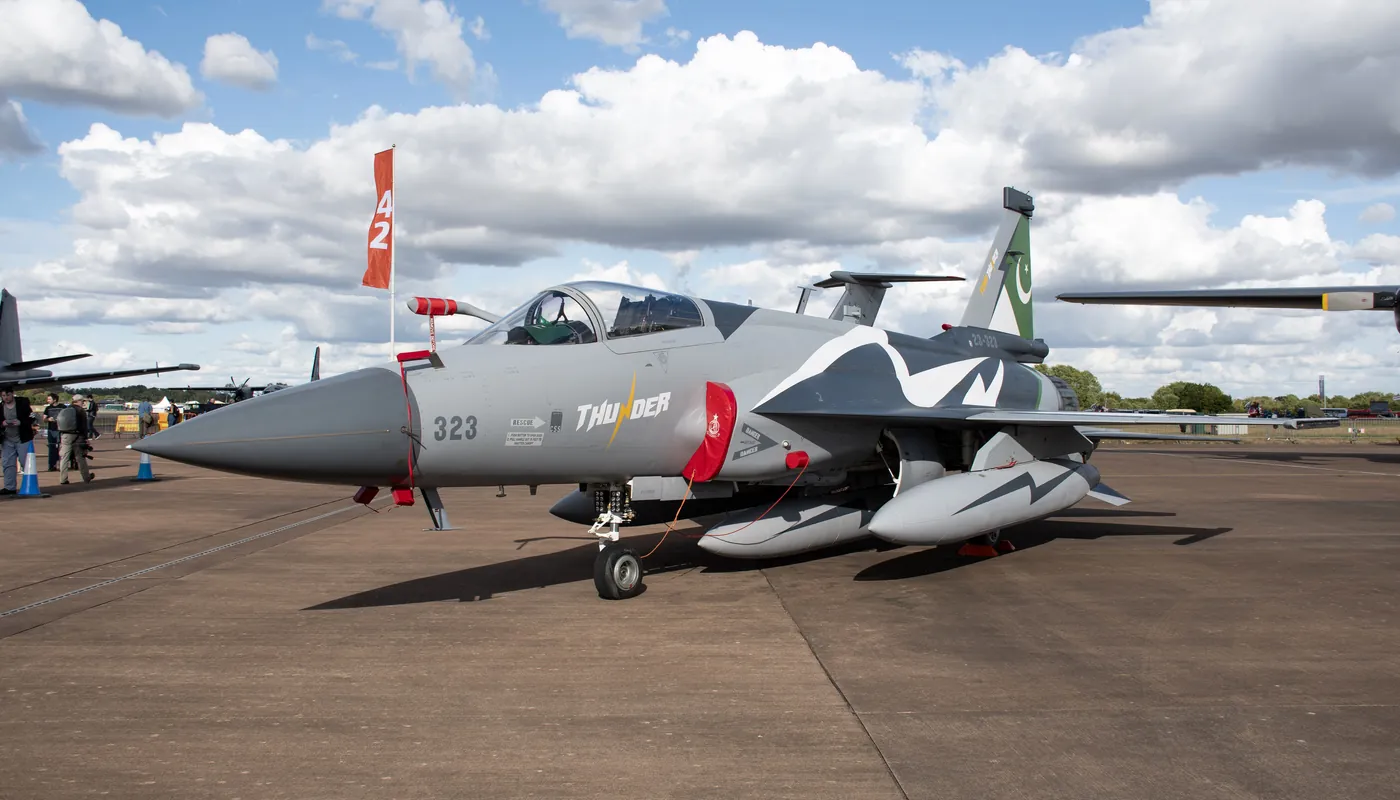
Pakistan Air Force aircraft inventory 2026: fleet by type
The table groups the PAF fleet by role. Numbers are IISS Military Balance 2025 unless stated; “reported” means press reporting not confirmed by ISPR, the PAF or the manufacturer.
| Role | Type | Number | Source / status |
|---|---|---|---|
| Combat aircraft | JF-17 Thunder (all blocks) | ~175 | IISS 2025; PAF said ‘more than 150’ Jan 2026 |
| Combat aircraft | F-16A/B/C/D Fighting Falcon | 75 | IISS 2025 |
| Combat aircraft | J-10CE | 20 | IISS 2025; ~36 reported, unconfirmed |
| Combat aircraft | Mirage III (ROSE upgrade) | 49 | IISS 2025; cruise-missile carrier |
| Combat aircraft | Mirage 5 | 37 | IISS 2025 |
| Combat aircraft | F-7PG | 53 | IISS 2025 |
| AEW&C | Saab 2000 Erieye | 9 | Last delivered 2 Jul 2024 |
| AEW&C | ZDK-03 Karakoram Eagle | 4 (listed) | IISS 2025; reported retired 2023-24 |
| Tanker | Il-78MP | 4 | IISS 2025 |
| Trainer | K-8 Karakorum | 58 | IISS 2025 |
| Trainer | T-37 Tweet | 69 | IISS 2025 |
| Trainer | Super Mushshak (PAC) | No official figure published | PAC-built primary trainer |
| UAV | Bayraktar TB2 | 24 | IISS 2025; inducted 2 Jan 2024 (ISPR) |
| UAV | Bayraktar AKINCI | 7 | IISS 2025; first batch Apr 2023 |
| UAV | Wing Loong II | 3 of 48 | IISS 2025 |
| UAV | CH-4 | 12-24 | IISS 2025 range |
| UAV | Shahpar-II, Burraq (indigenous) | No official figure published | GIDS/NESCOM |
| Helicopter | PAF rotary fleet | No official figure published | Not broken out by IISS |
Global Firepower and similar aggregators publish a single ‘total aircraft’ figure that mixes trainers and helicopters with fighters. Treat it as a rough index, not an inventory.
JF-17 Thunder: block-by-block breakdown
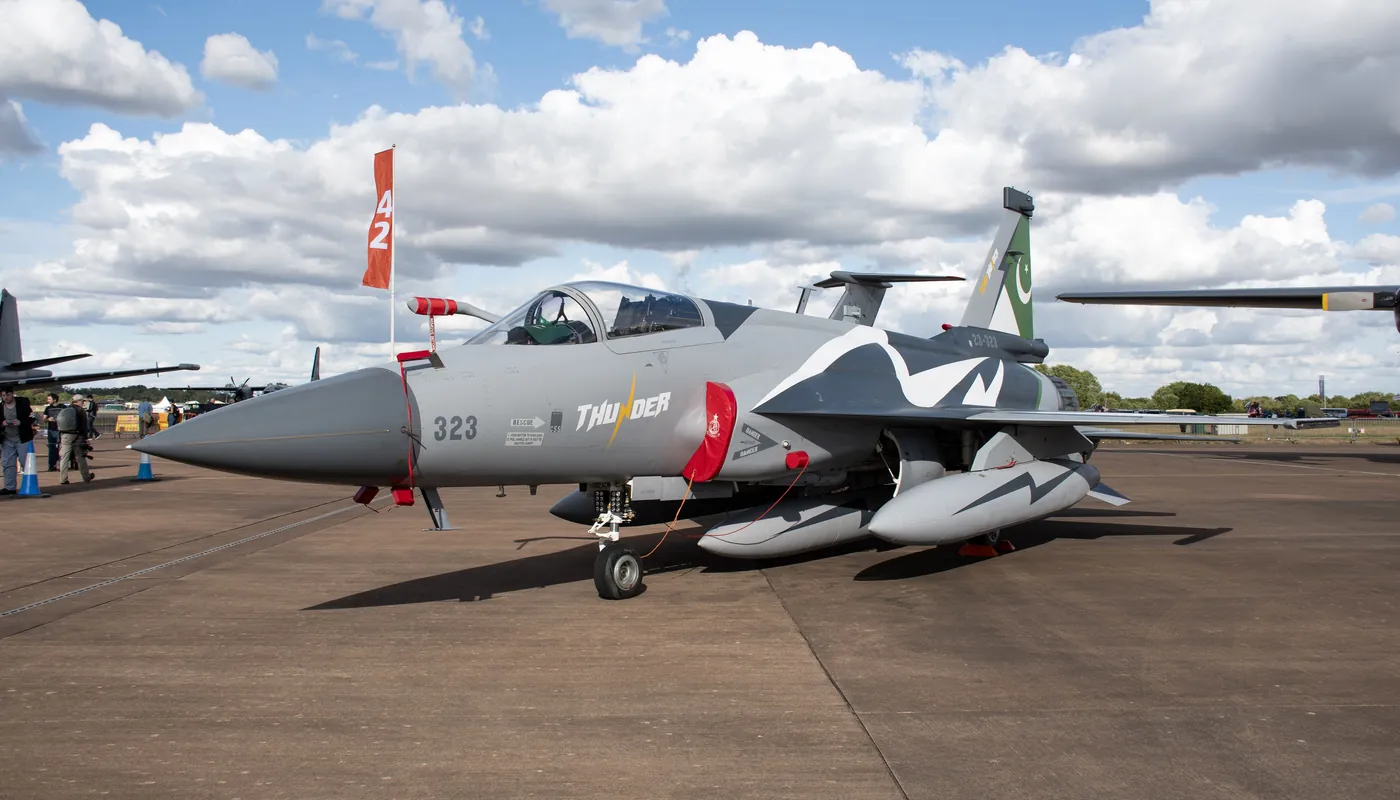
The JF-17 is the PAF’s numerical backbone and the only fighter it builds at home: PAC states a 58 per cent Pakistani work share, with 42 per cent from Chengdu and a Russian RD-93 engine. Serial production began at Kamra on 22 January 2008. Our JF-17 Block III specifications page covers the avionics.
| Block | IISS 2025 | What changed | Status |
|---|---|---|---|
| Block I | 50 | KLJ-7 mechanically scanned radar; first deliveries March 2007 | In service |
| Block II | 62 | Refuelling probe, improved avionics and EW; export standard (Myanmar, Nigeria) | In service |
| JF-17B | 26 | Two-seat variant; first flight 27 April 2017 | In service |
| Block III (JF-17C) | 42 | KLJ-7A AESA radar, helmet-mounted display, PL-15E (145 km export) and PL-10E; first flight 15 December 2019, inducted November 2023 (Janes) | In service, in production |
| PFX | 0 | ‘4.5+ generation’ successor unveiled November 2024, PAC + CAC, local radar; target ‘before the end of the decade’ | In development; no prototype flight |
Two caveats. The 175 total is IISS; the PAF itself said “more than 150” in January 2026, so “150 to 175 depending on source and year” is the defensible phrasing. On engines, UEC-Klimov dispatched RD-93MA units (about 91 kN against 84 kN for the RD-93) in July 2025; no JF-17 with the Chinese WS-13 has been confirmed.
F-16 Fighting Falcon: which variants Pakistan flies
The F-16 remains the PAF’s most versatile multirole fighter. IISS 2025 lists 75 aircraft in three groups. The largest is the 54-strong F-16A/B MLU (mid-life update) force, 31 single-seat and 23 two-seat, upgraded under the “Peace Drive II” contract awarded to TUSAŞ in June 2009 (US$64.5 million reported) for 41 aircraft; the first upgraded jet was handed back on 8 February 2012 and the last four on 2 September 2014. The second group is 13 second-hand F-16A/B ADF (air defence fighter) airframes, 9 and 4. The third is 18 new-build F-16C/D Block 52 (12 and 6), the most capable in the fleet.
The F-16 line has a political ceiling: Washington controls upgrades, spares and weapons, and the US channel has been frozen for years. Hence the PAF’s investment in JF-17 Block III and J-10CE, and the value of the Turkish ASELPOD targeting pod: precision strike without a US licence.
J-10CE: the newest fighter in service
The Chengdu J-10CE is the export version of China’s single-engine J-10C, with an AESA radar and the PL-15E missile. IISS 2025 puts 20 in PAF service; reports of about 36 delivered by early 2026 are unconfirmed by ISPR or the manufacturer. In Pakistan’s account of the 7 May 2025 air battle with India, the J-10CE and PL-15E were credited with most of the six Indian aircraft it claims, including three Rafale. India’s Chief of Defence Staff acknowledged “losses” while rejecting the figure of six; Reuters reported in August 2025 that at least one Rafale was downed by a J-10C/PL-15. Both sides’ claims remain contested.
Mirage III/5 and F-7PG: the ageing tail
Nearly 140 of the PAF’s roughly 400 fighters belong to two families from the 1960s and 1970s. The Mirage III (49) and Mirage 5 (37) fleets, kept flying through ROSE (Retrofit of Strike Element) upgrades, remain the PAF’s cruise-missile carriers: the Ra’ad (350 km; Ra’ad-II 600 km, ISPR February 2020) and the conventional Taimoor (600 km) both fly from Mirage III. The F-7PG (53), a Chinese MiG-21 derivative, is a point-defence fighter with limited beyond-visual-range capability.
No official retirement schedule for either family has been published, but the replacement logic is visible: every Block III that leaves Kamra and every J-10CE that arrives is one fewer Mirage or F-7PG to keep airworthy. Until a newer type carries Ra’ad and Taimoor, the Mirage III is likely to stay.
AEW&C, tankers and trainers
The PAF’s force-multiplier layer is deep for a fleet of this size. Nine Saab 2000 Erieye AEW&C aircraft are in service, the last delivered on 2 July 2024; the four ZDK-03 still listed by IISS were reported retired in 2023-24, and the KJ-500 reported with the J-35A package is unconfirmed. Four Il-78MP tankers extend the reach of the Mirage, F-16 and JF-17 Block II/III fleets.
Training runs on 58 K-8 Karakorum jet trainers, 69 elderly T-37 Tweets and PAC’s own Super Mushshak, an export success in reverse: 52 went to the Turkish Air Force in 2022-25. The PAF has not selected a new advanced jet trainer; HÜRJET is a trainer and light attack aircraft, not a JF-17-class fighter, and no Pakistani order exists.
J-35A stealth fighter: what is reported, what is confirmed
Reported, not confirmed. The Government of Pakistan confirmed in June 2025 that China had offered the J-35A fifth-generation fighter with KJ-500 AEW&C aircraft and HQ-19 air-defence systems. In May 2026 press reports described an initial agreement for about 40 J-35A in phases. As of 17 September 2026 there is no contract, delivery or induction from ISPR, the PAF or the manufacturer, so the J-35A is not counted in the tables on this page.
Turkish systems in the Pakistan Air Force
Türkiye is the PAF’s most important non-Chinese supplier. The full list of Turkish weapons used by Pakistan covers all three services; the air force share is below.
| System | Supplier | Detail | Status |
|---|---|---|---|
| F-16A/B Block 15 MLU | TUSAŞ | 41 aircraft; contract June 2009; first handed over 8 Feb 2012, last four 2 Sep 2014 | In service |
| ASELPOD targeting pod | ASELSAN | 8 pods (June 2016, US$25 m) + 16 pods (May 2017, US$24.9 m); JF-17 live-fire tests June 2017 | In service |
| Bayraktar TB2 | Baykar | Quantity undisclosed; IISS 24; first flown in 8 Mar 2022; inducted 2 Jan 2024 (ISPR PR 6712) | In service |
| Bayraktar AKINCI | Baykar | 6-7 in first batch April 2023, total undisclosed; inducted 2 Jan 2024 (ISPR PR 6712) | In service |
| KORKUT 35 mm and ŞAHİN 40 mm SHORADS | ASELSAN | Revealed by the PAF on 6 Sep 2026 with HQ-17AE and LD-76 for airbase defence | In service (revealed) |
| KaGeM V3 mini cruise missile | Baykar + NASTP | Joint R&D since August 2023; ~70 kg, 150 km | In development |
| KIZILELMA unmanned fighter | Baykar | PAF chief at Baykar 22 May 2026, ‘close to finalising’ | Reported, no contract |
| Baykar K2 loitering munition | Baykar | The Week, 9 Sep 2026 | Reported, unconfirmed |
The AKINCI matters most for PAF strike doctrine as a high-altitude, long-endurance armed drone (see our AKINCI vs MQ-9B comparison and the TB2 vs Wing Loong II guide). Baykar and NASTP signed an R&D agreement on 7 August 2023; reports of a Baykar assembly plant in Pakistan (Bloomberg, December 2025) remain unconfirmed. The Army’s 30-helicopter T129 ATAK order of 2018 was cancelled over the US engine licence.
Modernisation: where the money is going
Pakistan’s FY2026-27 defence allocation is PKR 3.01 trillion (about US$10.8 billion at roughly 279 PKR/USD in June 2026), up 17.65 per cent, with the procurement line up 39.6 per cent to PKR 925.8 billion; military pensions (PKR 822 billion) sit under a separate head (see the defence budget explainer). The air force priorities visible in the fact base:
- JF-17 Block III production at Kamra at a reported 16-18 aircraft a year, plus the Azerbaijan export line (40 aircraft, US$4.6 billion package). Exports fund the line that feeds the PAF.
- J-10CE growth beyond the 20 listed by IISS, with 36 reported.
- Fifth-generation entry via the reported J-35A package, with KJ-500 and HQ-19.
- Layered airbase defence: HQ-17AE, LD-76, KORKUT and ŞAHİN revealed on 6 September 2026, above HQ-9P and HQ-16FE.
- Unmanned expansion: TB2, AKINCI, Wing Loong II, CH-4, Shahpar-II, Burraq, and a Heavy Industries Taxila UAS factory opened on 7 September 2026.
- PFX, the JF-17 successor with a Pakistani-designed radar, targeted before 2030.
The constraints: a US$7 billion IMF programme (September 2024) that caps procurement growth; China at 81 per cent of arms imports in 2020-24 (SIPRI); a frozen US channel; ageing Mirage and F-7PG fleets; and a two-front load since the Afghan border operations of February 2026. For a like-for-like view, see our India-Pakistan military strength comparison 2026.
Frequently Asked Questions
How many fighter jets does Pakistan have in 2026?
About 400 (IISS Military Balance 2025): roughly 175 JF-17, 75 F-16, 20 J-10CE, 49 Mirage III, 37 Mirage 5 and 53 F-7PG.
How many F-16s does Pakistan have?
75 (IISS 2025): 54 F-16A/B MLU, 13 F-16A/B ADF and 18 F-16C/D Block 52; TUSAŞ upgraded 41 in 2012-14.
How many JF-17 does Pakistan have?
150 to 175 depending on source and year: IISS 2025 lists 50 Block I, 62 Block II, 26 JF-17B and 42 Block III.
Does Pakistan have J-35 stealth fighters?
Not in service. A Chinese offer was confirmed in June 2025 and reports in May 2026 spoke of about 40 J-35A, but no contract, delivery or induction is confirmed.
Which Turkish weapons does the Pakistan Air Force use?
Bayraktar TB2 and AKINCI (inducted 2 January 2024), ASELSAN ASELPOD pods on JF-17, the TUSAŞ F-16 mid-life update and ASELSAN KORKUT and ŞAHİN air-defence guns.
Does Pakistan have AWACS aircraft?
Yes: nine Saab 2000 Erieye AEW&C aircraft, the last delivered on 2 July 2024. Four ZDK-03 remain in IISS listings but were reported retired.
Related Envanter Medya guides
- Pakistan Military Inventory 2026: Tanks, Jets and Submarines
- JF-17 Block III Specifications Explained
- Turkish Weapons Used by Pakistan: Full List
- Pakistan Navy Ships and Submarines 2026
- Pakistan Defence Budget 2026-27 Explained
- ASELPOD: The Turkish Targeting Pod on Pakistani Fighters
- India-Pakistan Military Strength Comparison 2026
Sources
- FlightGlobal, World Air Forces 2026 directory
- ISPR PR 6712: induction of Bayraktar TB2 and AKINCI, 2 January 2024
- TUSAŞ: Pakistan Air Force F-16 modernisation project
- Janes: PAF inducts JF-17 Block III aircraft
- Janes: Pakistan unveils JF-17 PFX fighter
- Saab 2000 Erieye handed over to Pakistan (defence-industry.eu)
- Quwa: ASELSAN confirms ASELPOD on Pakistani JF-17
- Al Jazeera, 9 January 2026: JF-17 exports
- The Defense Post, 11 May 2026: J-35A reports
- Ministry of Finance, Budget in Brief 2026-27