US Marines Live-Fire MADIS at Twentynine Palms: Testing a Two-Vehicle Answer to Drone Swarms


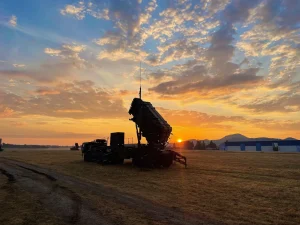
US Marines ran a live-fire counter-drone exercise on October 21 at Range 500, Marine Corps Air Ground Combat Center, Twentynine Palms, California, with crews from the 2nd and 3rd Low Altitude Air Defense Battalions. Footage of the training was recorded October 22; Army Recognition published the details on November 2.
The exercise centered on MADIS, the Marine Air Defense Integrated System, a mobile, JLTV-mounted, short-range air-defense platform built around two cooperating vehicle configurations. MADIS Mk1 pairs an XM914E1 30mm cannon with turret-launched Stinger surface-to-air missiles, electronic-warfare (EW) capability and electro-optical/infrared (EO/IR) sensors; its Stingers can also be fired shoulder-launched by dismounted Marines. MADIS Mk2 adds a 360-degree radar, EO/IR optics, multifunction EW, a direct-fire weapon and command-and-control communications. The training also used an M240B 7.62mm machine gun.
According to Army Recognition, the drill links aerial surveillance, threat identification and weapons employment to prepare crews to protect maneuvering and dispersed forces. The layered mix of cannon, missile, machine gun and EW is meant to answer aerial threats that vary widely in size, speed and flight profile.
The report flags two caveats worth keeping in mind: EW effectiveness depends on a given drone’s design and operating mode, and footage of 30mm fire does not by itself confirm any target was destroyed. Army Recognition also stresses that the training “does not establish a specific accelerated deployment schedule” — this is routine readiness work, not a signal that MADIS is being rushed to a new theater.
MADIS sits at the center of the Marine Corps’ effort to adapt low-altitude air defense to the drone era. It was developed to counter small, slow, massed unmanned aircraft that shoulder-fired MANPADS alone struggle to handle cost-effectively. Splitting detection and firepower across two JLTVs means the system isn’t dependent on a single vehicle: one handles tracking while the other delivers the engagement, so losing or disabling one does not strip the crew of air defense entirely.
The economics matter here. A single MANPADS missile often costs many times more than the cheap commercial-style drone it is meant to shoot down — an asymmetry that has pushed militaries toward lower-cost engagement options. MADIS’s cannon and machine-gun components exist precisely to fill that gap, offering a far cheaper per-shot cost than missile interceptors.
An earlier, lighter version, L-MADIS, has already been deployed operationally in the Middle East, and that combat experience fed back into the full-production Mk1/Mk2 design tested at Twentynine Palms. MADIS has also appeared in joint exercises with allied forces in the Indo-Pacific, including a recent drill with Philippine forces, underlining that interoperability with partners is as much a part of the program as the hardware itself.
The exercise reflects a pattern now visible across NATO and allied land forces: pairing expensive missile systems with low-cost gun- and machine-gun-based engagement tools and electronic warfare on the same platform, to answer a drone threat that is cheap, numerous and still growing. European gun-based air-defense systems are chasing the same tactical gap from a different angle; MADIS is the Marine Corps’ crewed, ship-to-shore version of that same race.
Sources
- Army Recognition, “U.S. Marines Build Combat Readiness With New MADIS Counter-Drone Weapon System,” November 2, 2026, https://www.armyrecognition.com/news/army-news/2026/u-s-marines-build-combat-readiness-with-new-madis-counter-drone-weapon-system — primary source for exercise details and system specifications.