HÜRJET Technical Specifications: Speed, Range, Engine Data

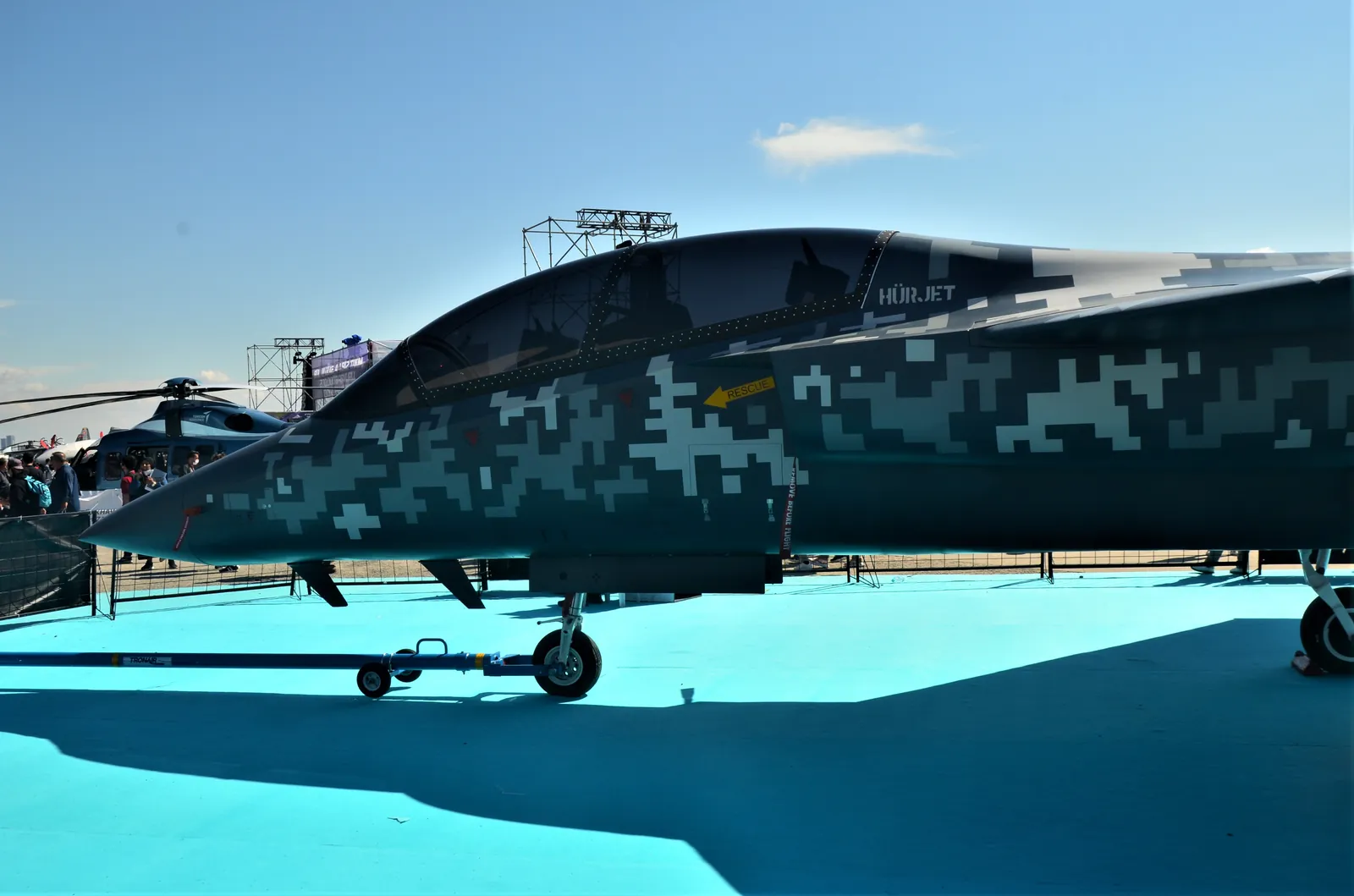
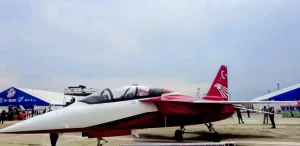
Turkish Aerospace lists HÜRJET at 13.6 m long, with a 9.5 m wingspan, a maximum speed of Mach 1.4, a service ceiling of 45,000 ft and a range of 1,060 nautical miles. It is powered by one imported General Electric F404-104 turbofan rated at 17,700 lbf, carries up to 7,500 lb of stores across seven hardpoints, and seats two crew in tandem. Empty weight and maximum take-off weight have not been officially disclosed.
| HÜRJET — Specification Summary | |
|---|---|
| Aircraft type | Single-engine, tandem two-seat advanced jet trainer (AJT/LIFT) and light attack aircraft |
| Manufacturer | Turkish Aerospace (TUSAŞ/TAI), Kahramankazan, Ankara |
| Dimensions | Length 13.6 m / 44.9 ft; wingspan 9.5 m / 31.2 ft; height 4.1 m / 13.5 ft; wing area 25 m² / 270 ft² |
| Powerplant | 1× General Electric F404-104 afterburning turbofan (imported, United States) |
| Thrust | 17,700 lbf (approximately 78.7 kN) |
| Performance | Maximum speed Mach 1.4; service ceiling 45,000 ft; range 1,060 nm (about 1,963 km); rate of climb 48,500 ft/min |
| Structural limits | +8 g / -3 g; maximum sustained 6.3 g at 15,000 ft |
| Stores | 7,500 lb (about 3,400 kg) payload capacity across seven wing and fuselage hardpoints |
| Weights | Empty weight and maximum take-off weight not officially disclosed by Turkish Aerospace |
What are HÜRJET’s published specifications?
The figures used on this page come from the official HÜRJET product sheet issued by Turkish Aerospace (TUSAŞ/TAI), the platform prime contractor. That sheet gives a maximum speed of Mach 1.4, a service ceiling of 45,000 ft, a range of 1,060 nautical miles (roughly 1,963 km), a rate of climb of 48,500 ft per minute, and structural limits of +8 g / -3 g with a maximum sustained load of 6.3 g at 15,000 ft. Payload capacity is quoted at 7,500 lb (about 3,400 kg), spread across seven hardpoints on the wing and fuselage.
These are the manufacturer’s stated design values, not independently measured flight-test results, and Turkish Aerospace presents them as design limits rather than demonstrated performance in a specific mission profile. Several figures that readers commonly search for are simply absent from the official sheet: internal fuel capacity, radar type, weapon-by-weapon integration status and unit cost have not been officially disclosed. Values for those items that circulate on third-party databases should be treated as unverified. Two prototypes, P1 and P2, flew on 25 April 2023 and 12 November 2024 respectively; prototype data is not automatically the series-production standard.
Dimensions, structure and weights
HÜRJET is a compact airframe by advanced-trainer standards. Turkish Aerospace publishes a length of 13.6 m (44.9 ft), a wingspan of 9.5 m (31.2 ft), a height of 4.1 m (13.5 ft) and a wing area of 25 m² (270 ft²). The crew sit in tandem, one behind the other, which is standard for the lead-in fighter trainer class and allows the instructor’s station to replicate the student’s displays. The airframe makes extensive use of composite structures manufactured in-house by Turkish Aerospace.
The most important gap in the public data set concerns mass. Empty weight and maximum take-off weight (MTOW) do not appear in the official Turkish Aerospace specification sheet. Figures of roughly 6,600 kg empty and around 12,400 kg MTOW circulate on third-party reference sites, but they are not confirmed by the manufacturer and are therefore treated here as unverified estimates rather than specifications. Without an official MTOW, derived calculations such as thrust-to-weight ratio or wing loading cannot be stated as fact. Anyone comparing HÜRJET with rival trainers on a weight basis should be aware that one side of that comparison rests on unofficial numbers.
The table below reproduces the official Turkish Aerospace specification sheet for HÜRJET, with metric and imperial values as published. Items missing from that sheet are marked as not officially disclosed rather than filled in from third-party sources. Note that these are stated design values for the programme; they are not flight-test certificates, and prototype behaviour should not be read as a guaranteed series-production standard.
Specifications only describe the aircraft on paper. The indicators below cover the state of the HÜRJET programme itself — flight-test milestones, production status and delivery planning — which determine how much of the specification sheet is actually available to an operator today.
Engine and thrust: one imported F404-104
HÜRJET is a single-engine aircraft. It is powered by one General Electric F404-104 afterburning turbofan rated at 17,700 lbf (approximately 78.7 kN). This is an important point of accuracy: HÜRJET is not twin-engined, and it should not be confused with KAAN, whose prototype flies on two GE F110 engines. The F404 family also powers the KAI T-50 and is the selected engine for the Boeing/Saab T-7A, which places HÜRJET on comparable propulsion terms with the aircraft it competes against.
The engine is imported from the United States. A domestically produced turbofan is a stated national objective, but no Turkish engine is installed on HÜRJET and none is ready for it; a target is not a product. That thrust figure, combined with a 25 m² wing and the published 48,500 ft/min climb rate, is what supports the Mach 1.4 and 45,000 ft claims. Because maximum take-off weight has not been officially disclosed, thrust-to-weight ratio cannot be stated as a verified specification.
Cockpit, avionics and hardpoints — who supplies what
The crew sit in a tandem two-seat cockpit with a modern avionics suite. Beyond that description, Turkish Aerospace has not published a detailed avionics or sensor breakdown, and the radar type has not been officially disclosed. What is clear is the industrial division of labour, which is frequently reported inaccurately:
- Turkish Aerospace (TUSAŞ/TAI) is the platform prime contractor, responsible for the airframe, composite structures, systems integration and flight test. It is not the supplier of every subsystem on the aircraft.
- ASELSAN is the domestic supplier on the avionics, radar and electronic warfare side.
- ROKETSAN and TÜBİTAK SAGE are the munitions houses; weapons carried on HÜRJET’s hardpoints originate there, not with the airframer.
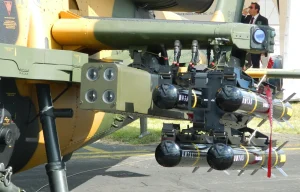
The aircraft has seven hardpoints across the wing and fuselage, with a total stores capacity of 7,500 lb. Which specific munitions are cleared and integrated on which station has not been published. A weapon shown alongside the aircraft at an exhibition is a display, not evidence of operational integration.
Every performance figure on this page is a value published by Turkish Aerospace as a design specification, not an independently verified flight-test result. P1 and P2 are prototypes; prototype data must not be presented as the confirmed series-production standard, even though serial production is under way and first deliveries are planned for 2026. Empty weight and maximum take-off weight have not been officially disclosed — figures of roughly 6,600 kg empty and 12,400 kg MTOW circulating on third-party sites are unverified. Fuel capacity, radar type, weapon integration status and unit cost are likewise undisclosed. HÜRJET is single-engined, and that engine is imported (General Electric F404-104, United States). Reported discussions with Spain are talks only; no signed export contract has been officially announced. An air-show appearance is not proof of operational integration.
Frequently Asked Questions
How long is HÜRJET?
Turkish Aerospace gives HÜRJET a length of 13.6 m, equivalent to 44.9 ft. The wingspan is 9.5 m (31.2 ft), the height is 4.1 m (13.5 ft) and the wing area is 25 m² (270 ft²). These four dimensions come directly from the official product sheet. They make HÜRJET a compact aircraft for the advanced jet trainer class, comparable in size to other lead-in fighter trainers rather than to a frontline fighter.
What is HÜRJET’s top speed?
Turkish Aerospace states a maximum speed of Mach 1.4, which makes HÜRJET supersonic. This is published as a design limit rather than a demonstrated figure from a specific test flight. For context, the KAI T-50 is quoted at Mach 1.5, while the Leonardo M-346 and the BAE Hawk are subsonic. Supersonic capability is one of the features that positions HÜRJET against the T-50 and the T-7A rather than against subsonic trainers.
What is HÜRJET’s service ceiling?
The published service ceiling is 45,000 ft. Turkish Aerospace also lists a rate of climb of 48,500 ft per minute, a maximum sustained load of 6.3 g at 15,000 ft, and airframe structural limits of +8 g and -3 g. As with the speed figure, the ceiling is presented as a design value. The altitude actually achievable on any given sortie depends on stores configuration, fuel state and temperature, none of which the manufacturer specifies.
What is HÜRJET’s range?
Turkish Aerospace publishes a range of 1,060 nautical miles, approximately 1,963 km. That is a range figure, not a combat radius: the distance HÜRJET could reach on a strike mission and return from has not been officially disclosed, and neither has internal fuel capacity or external tank configuration. Range in practice varies substantially with altitude, speed profile and external stores, so the published number should be read as a reference value rather than a mission planning figure.
How much payload can HÜRJET carry?
The official figure is 7,500 lb, about 3,400 kg, carried across seven hardpoints located on the wing and fuselage. That capacity supports the aircraft’s secondary light attack role alongside its primary advanced training mission. Turkish Aerospace has not published which specific munitions are cleared on which station. Weapons for Turkish platforms come from ROKETSAN and TÜBİTAK SAGE rather than from the airframer, and integration status per weapon has not been officially disclosed.
What engine does HÜRJET use and how much thrust does it produce?
HÜRJET uses one General Electric F404-104 afterburning turbofan producing 17,700 lbf, roughly 78.7 kN. The aircraft is single-engined, not twin-engined, and the engine is imported from the United States. A domestic engine remains a stated objective but is not installed and is not ready. The same F404 family powers the KAI T-50 and has been selected for the Boeing/Saab T-7A, so HÜRJET competes on broadly comparable propulsion.
Is HÜRJET in serial production?
Serial production is under way, and deliveries to the Turkish Air Force Command are planned for 2026. An initial batch of 16 aircraft is planned, with a target production capacity of two aircraft per month. The two prototypes, P1 and P2, first flew on 25 April 2023 and 12 November 2024 and have together completed more than 500 test flights. No signed export contract has been officially announced; talks reported with Spain remain discussions only.
Sources
- Turkish Aerospace (TUSAŞ/TAI) — official HÜRJET product page, tusas.com (English and Turkish specification sheet)
- Presidency of Defence Industries (SSB) — HÜRJET programme statements and milestone announcements
- Anadolu Agency — HÜRJET prototype first flight coverage (25 April 2023 and 12 November 2024)
- Turkish Aerospace newsroom — flight test totals, production planning and delivery schedule statements
- Defence Turkey — HÜRJET programme and advanced jet trainer market analysis
- General Electric Aerospace — F404 turbofan manufacturer data (F404-104 variant)