ROKETSAN Ongoing Projects: SIPER Block-2, TAYFUN, AKATA

ROKETSAN’s main ongoing projects include the SIPER Block-2 long-range air defence missile, the TAYFUN Block-4 hypersonic missile programme, CAKIR variants with Akinci drone integration, the submarine-launched AKATA, the LEVENT naval point-defence system, the BURC mobile air defence system, L-OMTAS serial production and a roughly fivefold production capacity expansion at Lalahan and Kirikkale. Most timelines have not been officially disclosed.
| ROKETSAN Ongoing Projects — At a Glance | |
|---|---|
| Company | ROKETSAN Roket Sanayii ve Ticaret A.Ş. |
| CEO/GM | Murat İkinci |
| R&D staff | ~2,000 (of ~5,000 employees) |
| Air defence | SIPER Block-2, LEVENT, BURC |
| Strike systems | TAYFUN Block-4, CAKIR variants, AKATA |
| Anti-tank | L-OMTAS serial production (2026) |
| Infrastructure | Lalahan + Kirikkale plants, $1B+ investment |
| Timeline note | Most schedules not officially disclosed |
Air defence projects: SIPER Block-2, LEVENT, BURC
The most visible cluster of ROKETSAN’s ongoing work is air defence. Within the SIPER family — the upper tier of Türkiye’s layered air defence architecture, known as the Steel Dome — SIPER-1 entered the inventory in January 2026, and the company is now developing SIPER Block-2, expected to extend range beyond 150 km and altitude to around 30 km. Block-2 uses a longer (6.3 m) and wider-diameter (420 mm) airframe; its fielding date has not been officially disclosed. A naval derivative, SIPER-1D, was fired from the MIDLAS vertical launching system in October 2025, and ship integration is continuing.
At sea, LEVENT is a point-defence missile built around an imaging-infrared seeker derived from the SUNGUR MANPADS, intended as the last defensive layer of surface ships. The first test firing took place from a land platform in October 2024; sea trials began aboard the corvette TCG Beykoz in March 2025, and the first seeker-guided live intercept was achieved in November 2025. Which ships will carry LEVENT has not been officially disclosed, though it is widely expected to replace the US-supplied RAM on Turkish Navy vessels.
BURC combines eight SUNGUR missiles with a 20 mm gatling gun on a single stabilised turret, creating a mobile very-short-range air defence system. Unveiled at IDEX in February 2025, it uses four RETINA S-band AESA radars for 360-degree coverage and can engage targets on the move. The system remains in the development and marketing phase; no Turkish Armed Forces order or inventory entry has been officially disclosed.
Strike systems: TAYFUN Block-4, CAKIR, AKATA
On the ballistic missile side, the standout effort is TAYFUN Block-4. Unveiled on 23 July 2025, it is positioned as Türkiye’s first hypersonic missile programme. For the baseline TAYFUN, ROKETSAN officially states a range of 280+ km, while independent sources estimate around 800 km; for Block-4, independent estimates range from 1,000 to 1,500 km, but none of these figures has been officially confirmed. Test and fielding schedules have not been disclosed either.
In the CAKIR compact cruise missile family, serial production began in July 2024, and the project has moved into variant expansion. The missile was designed from the outset for land, naval and air launch in CR/AS/LIR/SW configurations, offering 150+ km range from surface platforms, and integration with the Akinci unmanned combat aircraft is planned. A firm timeline for the air-launched integration has not been officially disclosed.
Under water, AKATA is the encapsulated version of the ATMACA anti-ship missile, launched from a standard 533 mm torpedo tube while submerged, giving a submarine the ability to strike targets at 250+ km without surfacing. The first test was conducted on 12 March 2025 from the submarine TCG Preveze, and the system was unveiled at IDEF in July 2025. The stated target platform is Türkiye’s national submarine MILDEN; integration with the Reis class has not been officially disclosed. AKATA should not be confused with torpedo countermeasures — that product line belongs to ASELSAN’s ZOKA family.
The table below summarises ROKETSAN’s publicly known ongoing projects and their current status. Defence programme schedules are rarely published; the status entries rely on official statements and open-source reporting.
Anti-tank and serial production work
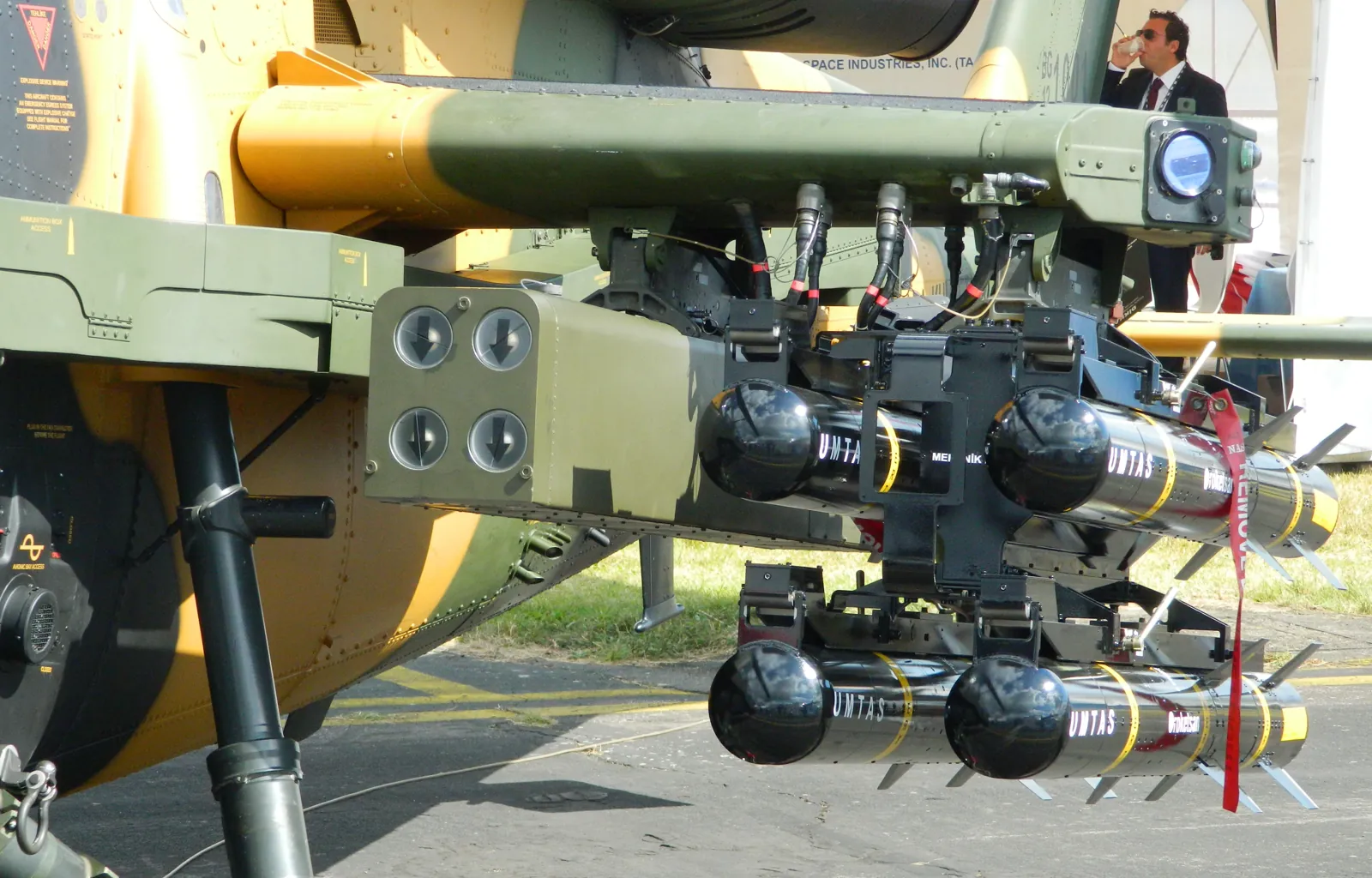
The most prominent current anti-tank project is L-OMTAS, the laser-guided version of the medium-range OMTAS missile. It extends the engagement range to roughly 5.5 km and is scheduled to enter serial production in 2026. Laser guidance allows the missile to home on targets designated by drones or forward observers, complementing OMTAS’s imaging-infrared fire-and-forget mode.
These serial production transitions illustrate a defining feature of ROKETSAN’s portfolio: while the company pushes the technology frontier with programmes such as SIPER Block-2 and TAYFUN Block-4, it simultaneously moves maturing products onto production lines. CAKIR reached serial production in 2024 and L-OMTAS follows in 2026. The AKYA heavyweight torpedo went through a similar maturation: after first deliveries in May 2024, the Turkish Navy conducted the first AKYA firing from the MUREN combat management system in June 2026, sinking a target ship.
The common denominator across these projects is ROKETSAN’s roughly 2,000-strong R&D workforce, close to forty percent of total headcount. Keeping seeker, propulsion and warhead technologies in-house accelerates technology transfer between programmes: the SUNGUR missile becoming the basis of both LEVENT and BURC, or ATMACA evolving into AKATA, are direct results of that approach.
Capacity expansion: Lalahan and Kirikkale
To turn its project pipeline into deliverable hardware, ROKETSAN has made one of the largest infrastructure investments in its history. The Lalahan Missile Integration Facility and the Kirikkale Propellant Production Facility, opened in April 2026, represent a combined investment of more than $1 billion. The stated goal is to raise missile production capacity roughly fivefold.
The expansion answers two pressures at once. The first is the Turkish Armed Forces’ growing procurement programmes for systems such as SIPER, TAYFUN, ATMACA and HISAR. The second is export growth: with new contracts, ROKETSAN’s total order book has reached around $10 billion, and management aims to lift exports above 50 percent of turnover. With 2025 turnover exceeding $2 billion, existing capacity was clearly being stretched.
Concentrating propellant production at a dedicated Kirikkale site reflects how critical composite solid propellant is to the supply chain — it is the common ingredient of nearly every product from TAYFUN to SIPER and the guided rocket family. Scaling up integration at Lalahan, meanwhile, allows several missile types to be assembled in parallel. How the added capacity will be allocated across products has not been officially disclosed.
Project information in this article is based on ROKETSAN’s official statements, trade-show unveilings and open-source defence reporting. For programmes such as SIPER Block-2, TAYFUN Block-4, AKATA and BURC, fielding dates, orders and many key specifications have not been officially disclosed; independent estimates (for example the 1,000-1,500 km range attributed to TAYFUN Block-4) are not presented here as official data. Details should be updated as new official announcements appear.
Frequently Asked Questions
What are ROKETSAN’s ongoing projects?
The main publicly known projects are the SIPER Block-2 long-range air defence missile, the TAYFUN Block-4 hypersonic programme, CAKIR variants with Akinci drone integration, the submarine-launched AKATA, the LEVENT naval point-defence system, the BURC mobile air defence system, L-OMTAS serial production and the Lalahan-Kirikkale capacity expansion.
When will SIPER Block-2 be ready?
SIPER Block-2 is in development, targeting a range beyond 150 km and an altitude of around 30 km. Its inventory entry date has not been officially disclosed. The baseline SIPER-1 entered service in January 2026.
Is TAYFUN Block-4 a hypersonic missile?
Yes. Unveiled on 23 July 2025, TAYFUN Block-4 is presented as Türkiye’s first hypersonic missile effort. Independent sources estimate a 1,000-1,500 km range, but this has not been officially confirmed; for the baseline TAYFUN, the official figure is 280+ km while independent estimates suggest around 800 km.
What is AKATA and which submarines will use it?
AKATA is the encapsulated, submarine-launched version of the ATMACA anti-ship missile, fired from a 533 mm torpedo tube with a range of 250+ km. It was first tested in March 2025 from TCG Preveze; the stated target platform is the national submarine MILDEN, and integration with other classes has not been officially disclosed.
What stage is the LEVENT system at?
LEVENT is in sea trials. The first firing took place from land in October 2024, trials moved to the corvette TCG Beykoz in March 2025, and the first seeker-guided intercept was achieved in November 2025. Which ships will carry it has not been officially disclosed.
Why is ROKETSAN expanding production capacity?
The Lalahan and Kirikkale facilities, opened in April 2026 with an investment exceeding $1 billion, aim to raise missile production capacity about fivefold. The drivers are growing Turkish Armed Forces procurement and export demand: the company’s total order book has reached roughly $10 billion.
Sources
- ROKETSAN official — roketsan.com.tr
- Naval News — SIPER-1D, LEVENT and AKYA test reporting (2024-2026)
- Army Recognition and Janes — AKATA, BURC and LEVENT coverage (2025)
- Anadolu Agency and Daily Sabah — Lalahan/Kirikkale facility opening (April 2026)
- Open-source records verified as of 23 July 2026