TAYFUN Ballistic Missile: Turkey’s Longest-Range SRBM

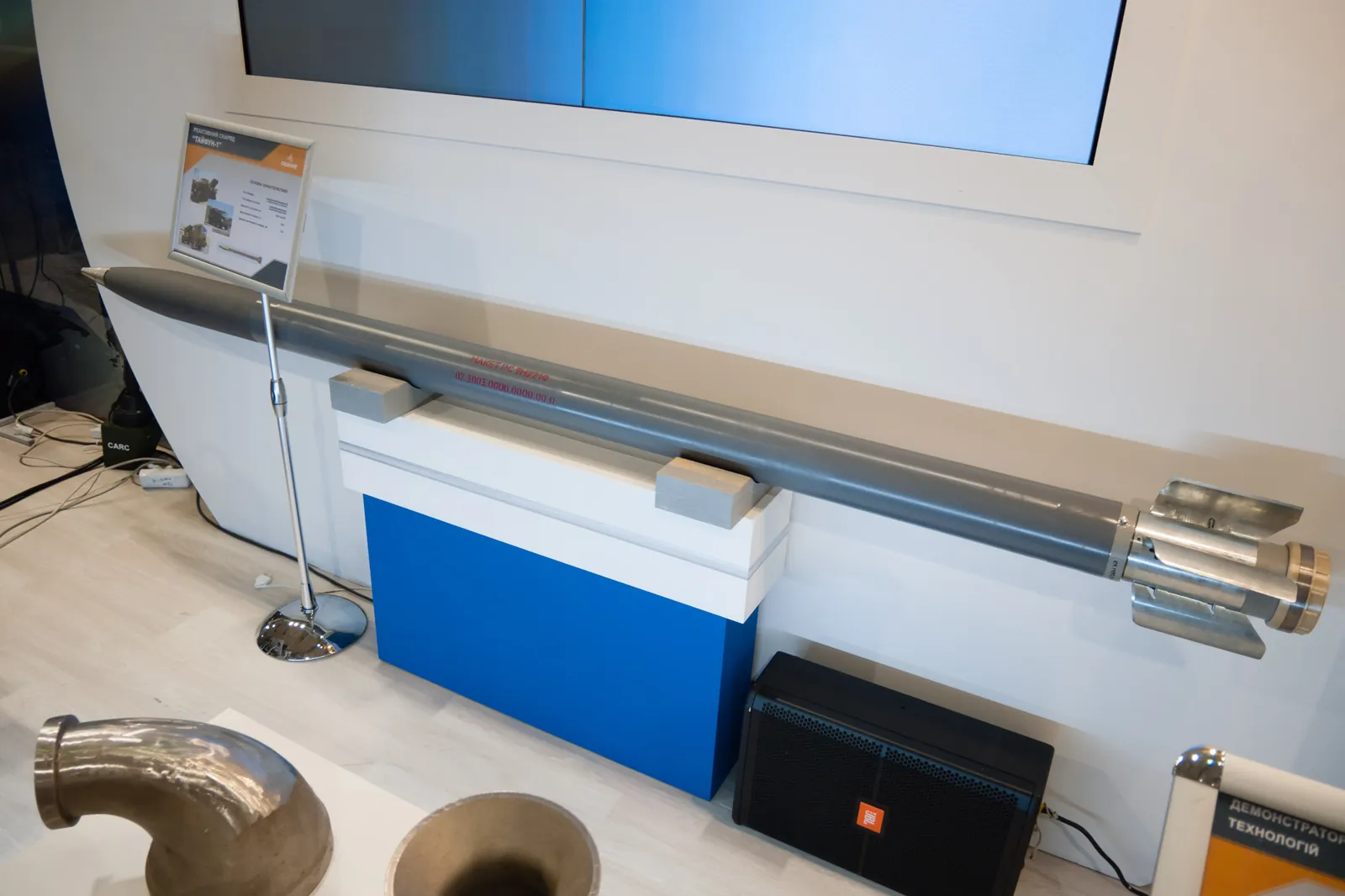
TAYFUN is a short-range ballistic missile (SRBM) developed by ROKETSAN and presented as Turkey’s longest-range indigenous ballistic missile. It made its first flight on 20 October 2022, was tested again on 23 May 2023, and entered serial production from 2023. It is launched from a land-based mobile launcher and reaches speeds of around Mach 5-6.
| TAYFUN — At a Glance | |
|---|---|
| Category | Short-range ballistic missile (SRBM) |
| Developer | ROKETSAN |
| Status | Serial production (2023-) |
| First test | 20 October 2022 |
| Range | Official 280+ km; independent estimate ~800 km |
| Speed | Mach 5-6 |
| Weight | ~2,300 kg |
| Length / diameter | 6.5 m / 610 mm |
| Warhead | High-explosive / fragmentation ~500 kg |
| Guidance | INS + GPS/GLONASS, CEP ≤10 m |
| Propulsion | Composite solid propellant |
| Platform | Land-based mobile TEL (VOLAT) |
| Operator | Turkey only |
What is TAYFUN?
TAYFUN is a land-based short-range ballistic missile (SRBM) developed by ROKETSAN. It has been presented as the longest-range member of Turkey’s family of domestically built ballistic missiles, positioned as a significant leap in capability beyond the earlier BORA system (a derivative of the J-600T Yıldırım).
Unlike a cruise missile, a ballistic missile reaches its target largely by following a ballistic trajectory: after motor burnout it coasts on inertia and gravity. The missile climbs to high altitude, arcs near the upper atmosphere and then descends onto its target at high speed. TAYFUN’s terminal velocity in the Mach 5-6 range narrows the detection and interception window for missile-defence systems.
The first flight test took place on 20 October 2022 over the Black Sea; a second, longer-range test followed on 23 May 2023. The system is developed strictly as a strategic weapon for the Turkish Armed Forces and is not exported.
Technical specifications and how it works
TAYFUN is roughly 6.5 metres long, 610 mm in diameter and weighs about 2,300 kg at launch. These dimensions place it at the upper end of the known tactical ballistic-missile class. Propulsion comes from a composite solid-propellant rocket motor; solid fuel lets the missile be stored fuelled for long periods and launched with minimal preparation.
Guidance combines an inertial navigation system (INS) with satellite navigation (GPS/GLONASS). ROKETSAN cites a circular error probable (CEP) of 10 metres or less, meaning the missile lands very close to its aim point. The warhead is a high-explosive / fragmentation type weighing about 500 kg, designed against fixed high-value targets.
Range is the missile’s most contested figure. ROKETSAN’s official statement gives 280+ km. However, independent defence sources argue that, based on the missile’s physical size and test data, its true range may be on the order of ~800 km. The discrepancy is not accidental: under the Missile Technology Control Regime (MTCR), systems with a range of 300 km or more face export restrictions, so keeping the declared range just below that threshold is a common practice. Rather than offering a single definitive number, this guide reports the official claim and the independent estimate side by side.
TAYFUN is comparable to known tactical and short-range ballistic-missile systems worldwide. The table below summarises its international equivalents and their countries of origin; range and performance figures rest on open sources and should be read with caution.
Platforms, operators and variants
TAYFUN is launched from a land-based mobile transporter-erector-launcher (TEL) built on a VOLAT-type chassis. The mobile platform lets the system reposition rather than remain tied to a fixed base, improving survivability against counter-fire. It is operated solely by the Turkish Armed Forces and, given its strategic character, is not exported.
TAYFUN is a family being developed in stages:
- Block 2: an improved version planned for 2026.
- Block 3: a variant reported to have undergone a sea-launched test.
- Block 4 (hypersonic): unveiled on 23 July 2025. Independent sources estimate its range at 1,000-1,500 km; these figures are not officially confirmed.
This roadmap turns TAYFUN from a single product into an expanding ballistic-missile platform in terms of both range and capability.
Place in Turkey’s defence industry
TAYFUN is one of the flagship projects behind Turkey’s goal of providing its long-range deep-strike capability indigenously. Needs in this category were previously met largely through imports or shorter-range systems. TAYFUN brings together ROKETSAN’s accumulated know-how in solid-propellant propulsion, precision guidance and large-calibre airframe integration.
The system’s main advantage is that it delivers a deterrent-grade range and accuracy from a domestic source. Its main limitation is a lack of transparency: critical values such as range are not fully disclosed officially because of MTCR sensitivity. Open-source performance figures should therefore be treated as ranges and estimates rather than confirmed data. With the Lalahan (missile integration) and Kırıkkale (propellant production) facilities coming online in 2026, production capacity for large-calibre missiles of this kind is expected to rise markedly.
TAYFUN’s range cannot be stated as a single definitive figure: ROKETSAN officially declares 280+ km, while independent defence sources estimate a range on the order of ~800 km. The gap relates to the MTCR export regime, which watches the 300 km threshold. The 1,000-1,500 km range attributed to the Block 4 hypersonic variant is an independent estimate only and is not officially confirmed.
Frequently Asked Questions
What is the range of the TAYFUN missile?
There is no single definitive figure. ROKETSAN’s official statement gives 280+ km, while independent defence sources suggest the true range may be on the order of ~800 km. The difference relates to the MTCR export regime, which restricts systems of 300 km and above.
Who operates TAYFUN?
TAYFUN is used only by the Turkish Armed Forces. Because it is a strategic weapon, it has not been exported to any country.
How is TAYFUN launched?
It is launched from a land-based mobile transporter-erector-launcher (TEL) built on a VOLAT-type chassis, which repositions to improve survivability.
What are TAYFUN’s equivalents?
International equivalents include Russia’s Iskander-M, the US ATACMS, China’s DF-15 and Iran’s Fateh-110/313 — all land-based tactical or short-range ballistic missiles.
When did TAYFUN enter service?
Its first flight test was on 20 October 2022 and a second test on 23 May 2023. Serial production began from 2023.
Is TAYFUN a hypersonic missile?
The baseline TAYFUN is a ballistic missile reaching Mach 5-6. The Block 4 variant unveiled on 23 July 2025 is described as hypersonic; its range is estimated by independent sources at 1,000-1,500 km but not officially confirmed.
Sources
- ROKETSAN official — roketsan.com.tr
- Wikipedia (English) — Tayfun (missile)
- Defence publications and OSINT assessments (range estimates)
- Anadolu Agency and Daily Sabah reporting (2022-2025)