Germany Earmarks €3.4 Billion for Typhon Launchers and Tomahawks

Germany is preparing to spend roughly €3.4 billion on an American ground-launched deep-strike capability it once expected to host for free. The figure appears in a German Defence Ministry planning document feeding into preparations for the 2027 federal budget, and covers Typhon launchers together with Tomahawk cruise missiles.
What the planning document contains
According to reporting on the document, about €1.15 billion is earmarked for up to 400 Tomahawk Block Vb cruise missiles and roughly €220 million for three ground-based Typhon batteries. The balance is understood to cover infrastructure, training, logistics support and munitions sustainment. German industrial participation in Tomahawk production remains an option under discussion.
The number is a ministry estimate, not a contract value. Nothing can be signed before the budget process concludes and the Bundestag’s budget committee approves — a mandatory step for German defence purchases above €25 million.
Berlin’s interest is not new. The Bundeswehr confirmed it publicly on 17 July 2026, when Defence Minister Boris Pistorius said the system would let Germany “increase its own defence capability and significantly improve its deterrence — and Europe’s as well.” Washington approved the sale on 9 July 2026, and the intergovernmental understanding was reached at the NATO summit held in Ankara on 7-8 July 2026.
Typhon in brief
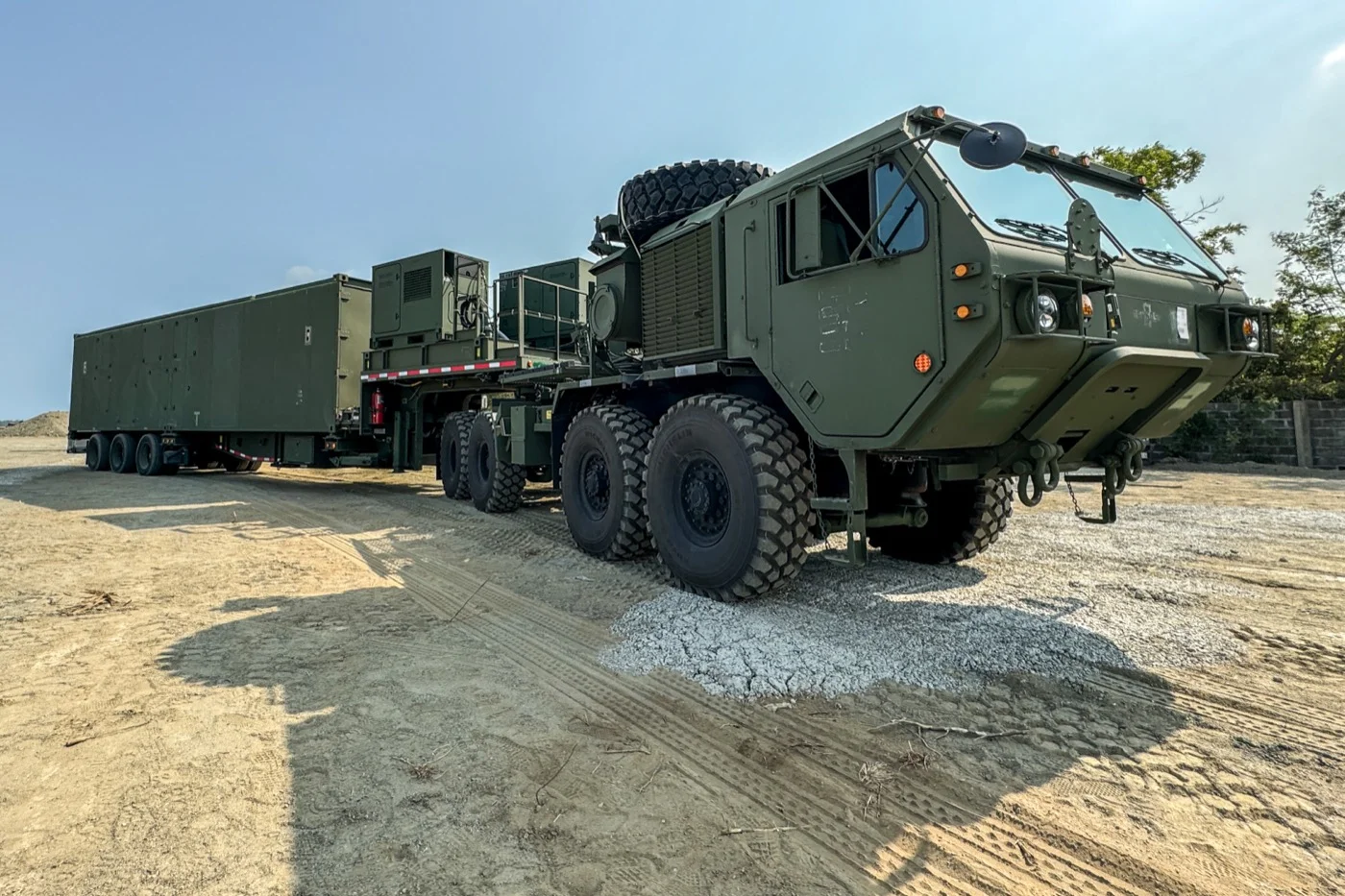
Typhon is the launcher element of the US Army’s Mid-Range Capability programme. Its design logic is straightforward: take the Mk 41 vertical launch cells used aboard warships and mount them on a trailer. The battery can therefore fire two navy munitions from land — the Tomahawk cruise missile, with a range between roughly 1,600 and 2,500 kilometres depending on variant, and the multi-role SM-6.
A typical battery comprises four launchers, a battery operations centre and support vehicles, towed by heavy tactical trucks and air-transportable aboard strategic lift aircraft. The US Army has deployed the system to the Philippines and Australia since 2023, each deployment drawing sharp objections from Beijing.
The gap Berlin is trying to close
The Bundeswehr’s only long-range precision strike weapon today is the air-launched Taurus KEPD 350, with a range in the 500-kilometre class and carried solely by the Tornado — an aircraft scheduled for retirement. Against Tomahawk’s 2,000-kilometre-plus reach, the shortfall Germany labels “Ground Based Deep Precision Strike” becomes self-explanatory.
Berlin frames Typhon as a bridge rather than a destination. European long-range strike programmes — the ELSA initiative involving France, Germany, Italy, Poland and Sweden, and the UK-Germany Trinity House Agreement — are assessed as seven to ten years away from fielded hardware. The ministry’s planning assumption is that Russia could pose a credible military threat to NATO by 2029 at the current rate of escalation.
Why Germany is buying rather than borrowing
The trigger was an American reversal. The previous US administration had committed to rotating a US Army Typhon unit through Germany from 2026. When that deployment was cancelled, Berlin moved from hosting the capability to owning it.
A politically loaded purchase
Four hundred Tomahawks would be a substantial European stockpile. Britain and the Netherlands field the missile from naval platforms; Japan ordered 400 in 2023. Germany would be the first European state to operate it from a ground launcher.
That distinction carries political weight at home. Ground-based intermediate-range missiles on German soil revive memories of the Pershing II debates of the 1980s, and the INF Treaty that once prohibited this class of weapon lapsed in 2019. Moscow has previously described comparable deployments as a direct threat.
The Ankara dimension
That the intergovernmental understanding was reached at the Ankara summit is a reminder of where NATO’s agenda-setting now takes place. Türkiye is pursuing the same capability by a different route: ROKETSAN’s SOM family, the Tayfun ballistic missile and the Gezgin cruise missile programme address domestically what Germany is buying off the shelf. The contrast — procurement versus indigenous development — is one reason Turkish industry’s relative position in European defence continues to strengthen.
Sources
- Bundeswehr official statement, “Bundeswehr will Tomahawk-Marschflugkörper und Typhon-Startgeräte”, 17 July 2026
- German Defence Ministry planning document, reported 14 September 2026
- US Army Mid-Range Capability programme information