Germany Cancels F126 Frigate Program, Turns to TKMS for 8 MEKO A200 Ships

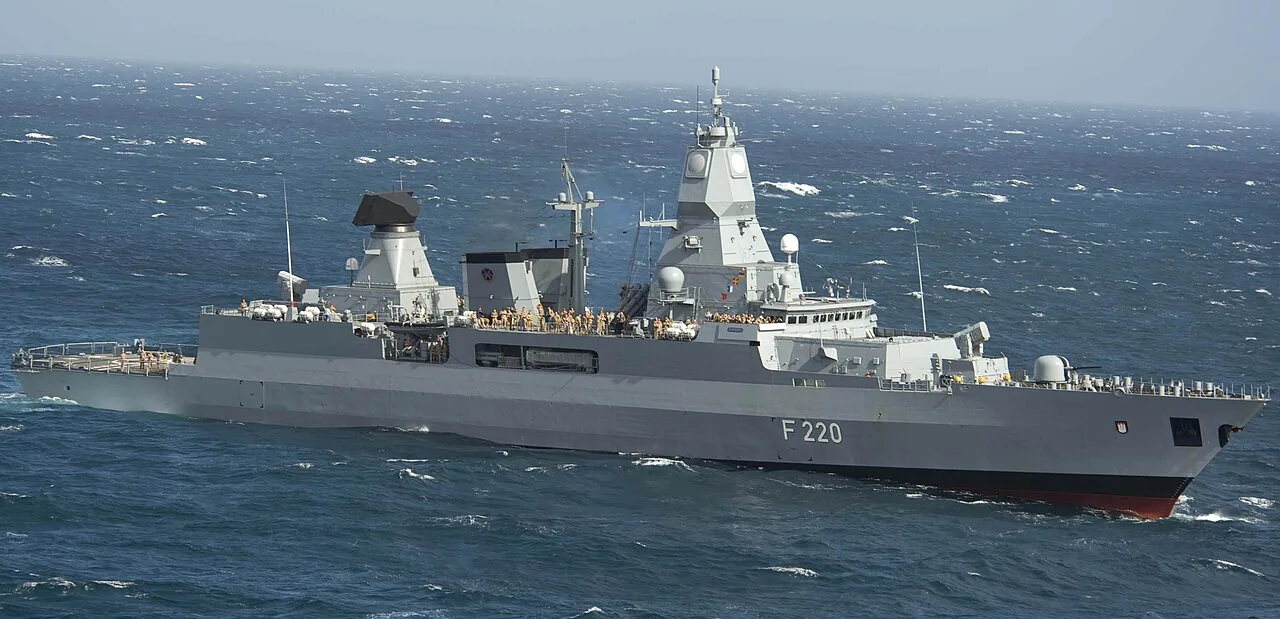
Germany’s Federal Ministry of Defence has formally closed the F126 frigate program that was meant to anchor the navy’s future surface fleet. According to Breaking Defense’s 24 June 2026 report, the decision was driven by mounting construction delays, costs far above projections, and program risk the ministry deemed “unmanageable.”
Rather than the 10,000-tonne multipurpose platform developed by Dutch prime Damen Naval, the German Navy is reverting to the home-grown, export-proven MEKO family. In effect, Europe’s largest economy is abandoning a foreign-prime program mid-course and returning to a domestic, modular design.
Background: Why a €10 Billion Program Collapsed
F126 was Germany’s most ambitious post-Cold-War surface combatant. As reported by Defence Industry Europe, the contract with prime contractor Damen Schelde Naval Shipbuilding (now Damen Naval) was signed on 19 June 2020. The plan covered six frigates — four for €4.6 billion and two more under an exercised option for €2.5 billion — with the total program cost expected to approach €10 billion.
Displacing roughly 10,000 tonnes and measuring 166 metres, the ships were to enter service between 2028 and 2033. But the schedule kept slipping and costs ballooned. When the alternative contractor NVL (formerly Lürssen, now part of Rheinmetall) proposed €15.2 billion for six ships in 2025 — pushing total program cost past €18 billion with prior commitments — the ministry chose to close the project.
The New Plan: 8 MEKO A200 and Klasse F128
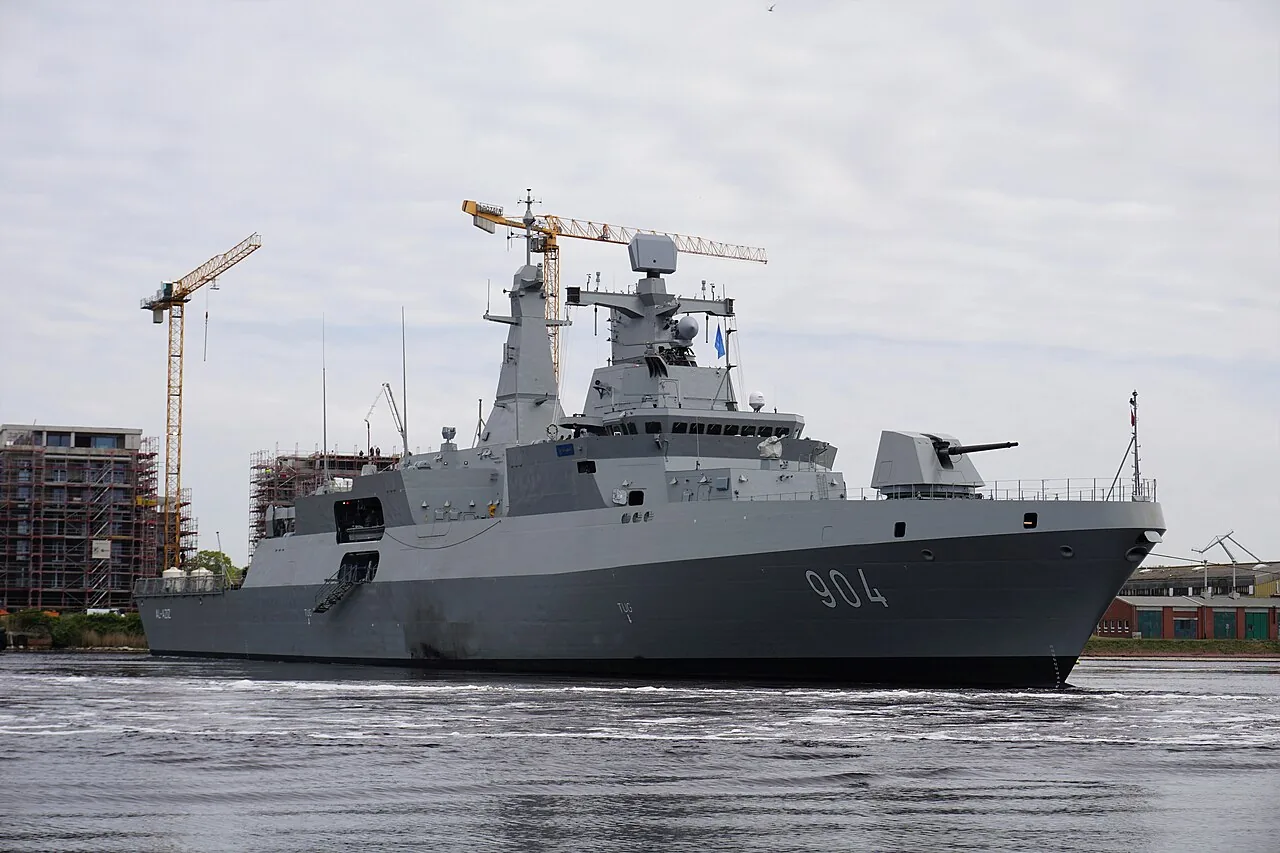
The new direction rests on TKMS’s repeatedly export-proven MEKO A200 design. Instead of the six cancelled F126s, the German Navy plans eight MEKO A200 DEU ships, to be designated Klasse F128. Per Defence Industry Europe, the first four ships are priced at €6.3 billion, with an option for four more — exercisable by end-2026 — set at €5.3 billion. The roughly 5 percent increase reflects the shift from an industry estimate to a binding contractual offer.
Navy Inspector Vice Admiral Jan Christian Kaack stressed that the new ships would deliver anti-submarine warfare capability and meet NATO commitments. One notable point: the baseline MEKO A200 displaces about 3,700 tonnes — substantially smaller than the 10,000-tonne F126 multipurpose hull. Germany appears to have chosen a lighter, ASW-focused ship with a predictable schedule over a larger, riskier platform. The final dimensions of the F128 configuration will be settled during contracting.
| Item | F126 (cancelled) | MEKO A200 DEU / F128 (new) |
|---|---|---|
| Prime contractor | Damen Naval (Netherlands) | thyssenkrupp Marine Systems (Germany) |
| Number of ships | 6 | 8 |
| First-batch cost | €4.6B (4 ships) | €6.3B (4 ships) |
| Estimated full cost | ~€10B | ~€11.6B (8 ships) |
| Displacement | ~10,000 t | ~3,700 t (A200 baseline) |
| Primary role | Multipurpose | ASW-focused |
| Status | CANCELLED | Going to Budget Committee |
The MEKO Family and the Global Picture
MEKO is TKMS’s (formerly Blohm+Voss) modular frigate philosophy: weapons, sensors and systems are mounted in standardized container modules so the ship can be tailored quickly to different customer needs. The A200 variant currently serves with South Africa (4 ships, Valour class, 2006-2007), Algeria (2 ships, 2016-2017) and Egypt (4 ships, 2022-2023).
Germany’s return to a home-grown family makes sense both as industrial policy and within NATO’s division of labour. Berlin keeps the supply chain domestic by backing national shipbuilder TKMS, and lowers program risk with a mature, export-referenced design. The decision also underscores, once again, how costly it can be to develop large, bespoke platforms from scratch.
Why It Matters for Türkiye
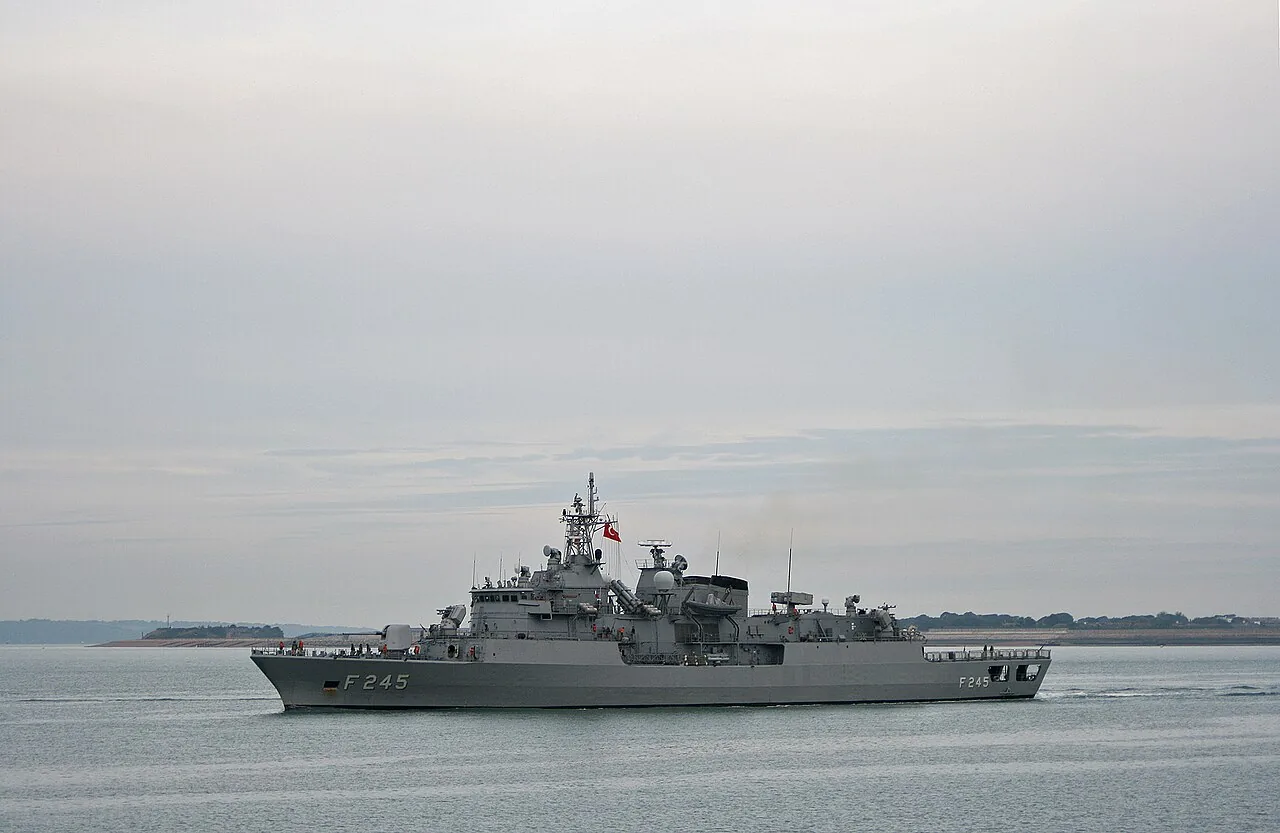
This development matters to Türkiye, because the Turkish Navy has more than thirty years of history with the MEKO design. The Barbaros-class frigates (TCG Barbaros, TCG Oruç Reis, TCG Salih Reis, TCG Kemal Reis) are based on the MEKO 200 Track II, and the last two were built at Gölcük Naval Shipyard. Türkiye is therefore not just an operator of this family but an experienced licensed builder.
The crucial point is what Türkiye did next. The country moved from licensed MEKO production to its own designs with the MILGEM project (Ada-class corvettes and Istif-class frigates), with the SIPER-integrated TF-2000 air-defence destroyer as the next major step. A long-established industrial power like Germany struggling on a foreign-prime program and reverting to a proven modular design validates the path Türkiye chose: national design authority, serial production and budget discipline.
Moreover, Türkiye is now an exporter: led by STM and ASFAT, it sells warship design and construction to Pakistan (Babur/Jinnah-class MILGEM), Ukraine (Hetman Ivan Mazepa) and other markets. Germany’s F126 experience shows precisely why the Turkish naval model — design it yourself, build it in your own yard, on budget, and export it — is so valuable.
Frequently Asked Questions
Why did Germany cancel the F126 program?
What is the MEKO A200 DEU and who will build it?
What is the link to Türkiye?
Is the MEKO A200 smaller than the F126?
Conclusion
Germany’s pivot from F126 to MEKO A200 captures both the risk of developing large bespoke platforms with foreign primes and the appeal of proven modular designs. For Türkiye, the lesson is clear: a naval-industrial model built on indigenous design, serial production and exports is increasingly valuable in global competition.